



Colorado Tenant Protections After Recent Reforms
Colorado's landlord-tenant law has been significantly strengthened in recent legislative sessions. The state now provides a statutory duty to mitigate damages under CRS § 38-12-103.5, meaning landlords must make reasonable efforts to re-rent units when tenants break their lease. This was not always the case — older Colorado case law was mixed on the mitigation question.
CRS § 38-12-104 governs security deposits, limiting them to the equivalent of two months' rent for most units (though this can be modified by local ordinance). The deposit must be returned within 30 days (or up to 60 days if the lease specifies), with an itemized statement of deductions. Denver and Boulder have additional local tenant protections that may provide extra leverage.
Colorado's rapid population growth — the Front Range corridor from Fort Collins through Denver to Colorado Springs has been one of the fastest-growing regions in the country — means the rental market is generally competitive. Landlords can typically re-rent units within 2-4 weeks in metro areas, which limits your financial exposure when breaking a lease.
Statutory Duty to Mitigate (CRS 38-12-103.5)
CRS § 38-12-103.5 explicitly requires landlords to make reasonable efforts to re-rent a unit when a tenant abandons it. The landlord must treat the vacated unit similarly to other available units and cannot unreasonably refuse qualified applicants. If the landlord fails to mitigate, the tenant's liability for future rent is reduced accordingly.
In Denver's competitive rental market, where vacancy rates hover around 5-7%, most units re-rent within a few weeks. However, in mountain resort towns like Aspen, Vail, and Steamboat Springs, the market may be more seasonal — a unit vacated during the off-season (spring or fall) may take longer to fill than one vacated before ski season or summer.
Document the rental market conditions in your area when breaking your lease. Screenshots of comparable listings, vacancy rate data, and evidence of demand can help demonstrate that your landlord should have been able to re-rent quickly, limiting your total financial exposure.
Protected Reasons for Termination in Colorado
Colorado law recognizes several protected grounds for early termination.
Uninhabitable Conditions (CRS § 38-12-505)
Colorado's Warranty of Habitability Act requires landlords to maintain rental units in a condition fit for human habitation. Colorado's altitude and climate create unique concerns — heating systems must function reliably through harsh winters, and water pressure and plumbing must account for altitude effects. Tenants must give written notice and 24 hours for emergencies or a reasonable time for non-emergencies.
DV/Sexual Assault/Stalking (CRS § 38-12-402)
Victims may terminate with written notice plus a copy of a police report, protective order, or statement from a DV advocate. Colorado provides broader protections than many states, including provisions for victims of unlawful sexual behavior and stalking. The termination is effective upon vacating the premises or the end of the rental period, whichever comes first.
Gas Hazards (CRS § 38-12-104(3))
Colorado law provides specific protections for tenants affected by gas-related hazards, reflecting concerns about natural gas and carbon monoxide in the state's high-altitude environment. If gas leaks or carbon monoxide issues render the unit unsafe, this is an immediate habitability violation.
Penalty Structure in Colorado
Colorado law does not cap early termination fees, but the duty to mitigate limits your total exposure. Most Colorado leases include an early termination clause with fees ranging from one to two months' rent. Denver-area leases tend to be on the higher end given the competitive market, while leases in smaller Colorado cities may have lower fees.
Security deposits in Colorado are limited to two months' rent for most units. The landlord must return the deposit within 30 days (or up to 60 days if the lease specifies the longer period) with an itemized statement. If the landlord fails to return the deposit or provide a proper statement, the tenant may recover up to three times the withheld amount plus attorney fees.
Colorado prohibits liquidated damages clauses that are clearly disproportionate to the landlord's actual losses. If your lease includes an early termination fee that significantly exceeds the landlord's actual damages (for example, 6 months rent as a termination fee in a market where units re-rent in 2 weeks), a court may find the clause unenforceable.
DV, Stalking, and Sexual Assault Protections (CRS 38-12-402)
CRS § 38-12-402 provides comprehensive protections for victims of domestic violence, sexual assault, unlawful sexual behavior, and stalking. Colorado's statute is broader than many states because it specifically includes "unlawful sexual behavior" as a qualifying event, providing protection for a wider range of victims.
To invoke these protections, the tenant must provide written notice and one of the following: a police report, a valid protection order, or a written statement from a domestic violence or sexual assault service provider. The tenant may vacate immediately and is liable for rent only through the termination date. No early termination fee may be charged.
Colorado also requires landlords to allow DV victims to change locks on their unit without landlord consent in emergency situations (though the landlord must be provided a copy of the new key). The Colorado Coalition Against Domestic Violence can be reached at 303-831-9632 for referrals to local resources.
Habitability in Colorado's Climate
Colorado's Warranty of Habitability Act (CRS § 38-12-501 through 38-12-511) provides specific protections for tenants living in substandard conditions. Colorado's extreme altitude and climate create unique habitability concerns: heating systems must function reliably through winters where temperatures can drop well below zero in mountain communities, and the state's dry climate creates fire risk and air quality concerns during wildfire season.
The Act defines specific conditions that constitute uninhabitable premises, including failure to provide heat, waterproofing and weather protection, working plumbing, electrical systems, and a clean and sanitary building. Colorado tenants must give the landlord written notice and a reasonable time to repair before terminating.
Wildfire smoke has become an increasingly significant habitability concern in Colorado. During severe fire seasons, outdoor air quality in the Front Range can reach hazardous levels. If your unit lacks adequate ventilation or air filtration and the landlord fails to address smoke infiltration concerns, this may constitute a habitability violation.
Military Protections in Colorado
Colorado hosts several major military installations: Fort Carson (Colorado Springs), Peterson Space Force Base, Schriever Space Force Base, the United States Air Force Academy, Buckley Space Force Base (Aurora), and F.E. Warren AFB (partially in Colorado). The large military presence, particularly around Colorado Springs, means many landlords are experienced with SCRA terminations.
Federal SCRA protections apply fully. Colorado does not have a separate state military tenant protection law, but the Colorado Division of Veterans Affairs provides resources for servicemembers facing housing disputes. The legal assistance offices at Fort Carson and the Air Force Academy provide free SCRA guidance.
The Colorado Springs rental market is heavily influenced by military demand. When multiple units become available during PCS season (typically summer), landlords may be more willing to negotiate flexible termination terms since they know the units will be in demand from incoming servicemembers.
Notice Requirements in Colorado
Colorado requires different notice periods depending on the reason for termination. For habitability issues, CRS § 38-12-507 requires written notice to the landlord with a reasonable time to cure. For month-to-month tenancies, the notice period is determined by the rental payment interval (typically 30 days). For DV terminations, the tenant may vacate upon providing notice and documentation.
Notices should be delivered via certified mail, personal delivery, or as specified in the lease. Colorado courts accept email delivery if the lease authorizes electronic communication. Always retain proof of delivery regardless of the method used.
Sample Colorado Early Termination Letter
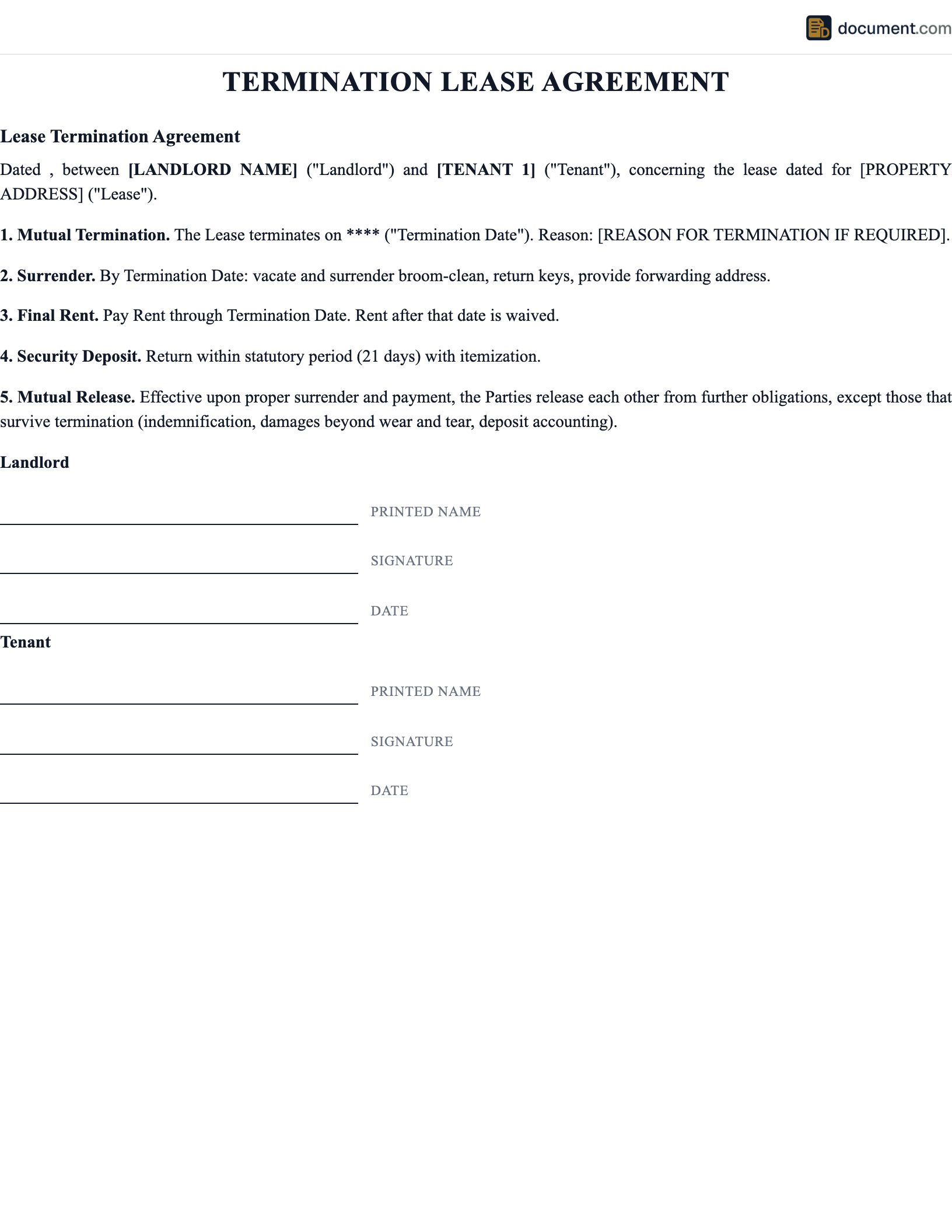
Below is a preview of our Colorado-specific early lease termination letter with proper statutory references for CO law.
EARLY LEASE TERMINATION NOTICE
STATE OF COLORADO
TENANT:
Name: [Full Legal Name]
Address: [Colorado Rental Address]
LANDLORD:
Name: [Landlord Name]
Address: [Mailing Address]
TERMINATION DETAILS:
Vacate Date: [Date]
Reason: [Legal Reason]
Colorado Early Lease Termination FAQ
Answers to common questions about breaking a lease early in Colorado.
Official Colorado Resources
Verified resources for Colorado-specific tenant rights and legal assistance.
Create your Colorado Termination Early Lease Agreement in under 5 minutes.
Answer a few questions and download a Colorado-compliant document, ready for the state agency.