



California Tenant Protection Framework
California's tenant protection framework is among the most comprehensive in the country, governed by California Civil Code § 1940 through 1954.05 and supplemented by extensive case law and local ordinances. The state's approach to early lease termination reflects a strong public policy favoring tenant rights while balancing landlord property interests.
For tenants breaking a lease early, the most important protection is California's well-established common law duty to mitigate damages. Under the landmark case Sommer v. Kridel (applied in California), landlords must make reasonable efforts to re-rent the unit. In California's hot rental market — particularly in the Bay Area, Los Angeles, San Diego, and Sacramento — this means units typically re-rent quickly, limiting your financial exposure.
California Civil Code § 1950.5 requires landlords to return security deposits within 21 days after move-out, with an itemized statement of deductions. The maximum deposit is two months' rent for unfurnished units and three months' rent for furnished units. These strict deposit rules provide tenants with significant leverage when negotiating an early exit.
The Tenant Protection Act of 2019 (AB 1482)
AB 1482 established statewide rent caps (limiting annual increases to 5% plus inflation, or 10%, whichever is lower) and just-cause eviction protections for tenants who have occupied a unit for 12+ months. While AB 1482 does not directly address early termination by tenants, it affects the broader landlord-tenant dynamic in California.
The just-cause provisions mean California landlords cannot simply refuse to negotiate with tenants who want to leave early and then evict them for some pretextual reason. The law creates a framework where landlords and tenants have clearer boundaries, which can facilitate constructive early termination discussions.
AB 1482 applies to most residential properties built more than 15 years ago, but exempts single-family homes (with notice requirements), condos, and properties already covered by stricter local rent control ordinances. Understanding whether your unit is covered helps you assess your overall bargaining position.
Protected Reasons Under California Law
California recognizes an extensive list of protected reasons for early lease termination, more than most other states. These include habitability deficiencies (Civil Code § 1942), domestic violence/sexual assault/stalking (Civil Code § 1946.7), military deployment (SCRA plus California Military and Veterans Code), active military service members entering service (CC § 1942.5), and senior citizens entering residential care facilities (CC § 1946.7 for those 62+).
California's "repair and deduct" remedy under Civil Code § 1942 allows tenants to make necessary repairs and deduct the cost from rent (up to one month's rent) if the landlord fails to maintain habitable conditions after reasonable notice. This is an alternative to termination that can resolve issues without breaking the lease.
California Civil Code § 1946.7 also allows victims of human trafficking to terminate their lease with proper documentation. This protection, not found in most states, reflects California's expansive approach to tenant protections for vulnerable populations.
Duty to Mitigate Damages in California
California case law firmly establishes the landlord's duty to mitigate damages when a tenant breaks a lease. The California Supreme Court has held that landlords must make reasonable efforts to re-rent vacant units, and the tenant's liability is limited to the period the unit remains vacant plus reasonable re-renting costs.
In practice, California's extremely competitive rental market — San Francisco, Los Angeles, San Jose, and San Diego consistently rank among the most expensive in the nation — means landlords can often re-rent units within days or weeks. In the Bay Area, a well-priced unit in a desirable neighborhood may attract multiple applications within 24 hours of listing.
The landlord must treat your vacated unit similarly to other vacancies — they cannot refuse to show it, demand above-market rent, or impose unreasonable application requirements that would deter potential tenants. Keep records of comparable listings in your area to demonstrate market conditions if the landlord claims the unit took an unusually long time to fill.
Domestic Violence Protections (Civil Code 1946.7)
California Civil Code § 1946.7 provides comprehensive protections for victims of domestic violence, sexual assault, stalking, human trafficking, and elder/dependent adult abuse. A qualifying tenant may give written notice and terminate the lease with supporting documentation, which can include a temporary restraining order, emergency protective order, police report, or documentation from a qualified third party.
The notice period is 14 days from the date of notice, and the tenant is responsible for rent only through the termination date. The landlord may not impose early termination fees and must return the security deposit within 21 days. California specifically prohibits landlords from disclosing a tenant's DV status to third parties or using a prior DV termination as grounds to deny a future rental application.
California law also allows DV victims to request that the landlord change the locks on the rental unit (CC § 1941.5 and 1941.6), providing an alternative to termination for victims who wish to remain in their home. The National DV Hotline (1-800-799-7233) and California's CPEDV at 916-444-7163 can provide referrals to local services.
California Habitability Standards
California's implied warranty of habitability, codified at Civil Code § 1941 and reinforced by the landmark case Green v. Superior Court, requires landlords to maintain rental units in a condition substantially suitable for human occupancy. California Health and Safety Code § 17920.3 defines specific substandard conditions including inadequate sanitation, structural hazards, nuisances, and lack of required facilities.
California-specific habitability concerns include earthquake structural integrity (especially in older buildings not retrofitted to current seismic standards), wildfire smoke infiltration (a growing concern in fire-prone areas), drought-related water restrictions affecting water supply, and mold from fog and coastal moisture in San Francisco and other coastal cities.
Under CC § 1942, if a landlord fails to make repairs within 30 days of written notice (or a shorter time for emergencies), the tenant may repair and deduct (up to one month's rent), vacate and terminate the lease, or withhold rent. California's Department of Consumer Affairs provides guidance, and local code enforcement agencies in every city can inspect and document habitability violations.
Local Rent Control Considerations
Many California cities have their own rent control and tenant protection ordinances that exceed state law protections. Cities including San Francisco, Los Angeles, Oakland, Berkeley, San Jose, Santa Monica, and West Hollywood have rent stabilization boards and just-cause eviction ordinances that may provide additional protections when breaking a lease early.
In rent-controlled units, breaking a lease can have implications beyond the immediate penalty. If you hold a rent-controlled unit at a below-market rate, your departure allows the landlord to reset the rent to market rate for the new tenant (vacancy decontrol). This actually works in your favor when negotiating — the landlord may be eager to cooperate because they can charge significantly more rent to the next tenant.
San Francisco's rent board (415-252-4600) and Los Angeles's Housing Department (866-557-7368) can answer questions about local protections. Each city's ordinance is different, so check your specific city's regulations before assuming state law is the only applicable standard.
Military Protections in California
California hosts more military installations than any other state, including Camp Pendleton, Edwards AFB, Fort Irwin, Naval Base San Diego, Travis AFB, Vandenberg SFB, Beale AFB, and dozens more. The California Military and Veterans Code provides additional protections beyond federal SCRA, including protections for state National Guard members called to state active duty.
California Military and Veterans Code § 409.1 provides that a member of the armed forces may terminate a lease upon entering active duty or receiving deployment or PCS orders. The protections are broader than SCRA in some respects, covering certain state activations not covered by federal law.
Given California's high cost of living and the mismatch between military housing allowances and civilian rental rates in many areas, SCRA terminations are extremely common. Base legal assistance offices at all major California installations provide free SCRA counseling and can issue demand letters to non-compliant landlords.
Notice Requirements in California
California notice requirements vary by situation. For habitability issues, CC § 1942 provides for a 30-day notice period for general repairs and a shorter reasonable period for emergencies. For DV terminations under CC § 1946.7, the notice period is 14 days. For month-to-month tenancies, CC § 1946 requires 30 days notice (or 60 days if you have lived in the unit for one year or more).
All notices should be delivered via certified mail to the address specified in the lease. California also permits personal service (hand delivery to the landlord or their agent). Electronic delivery is acceptable only if the lease specifically authorizes it. Keep copies of all correspondence and delivery receipts.
Sample California Early Termination Letter
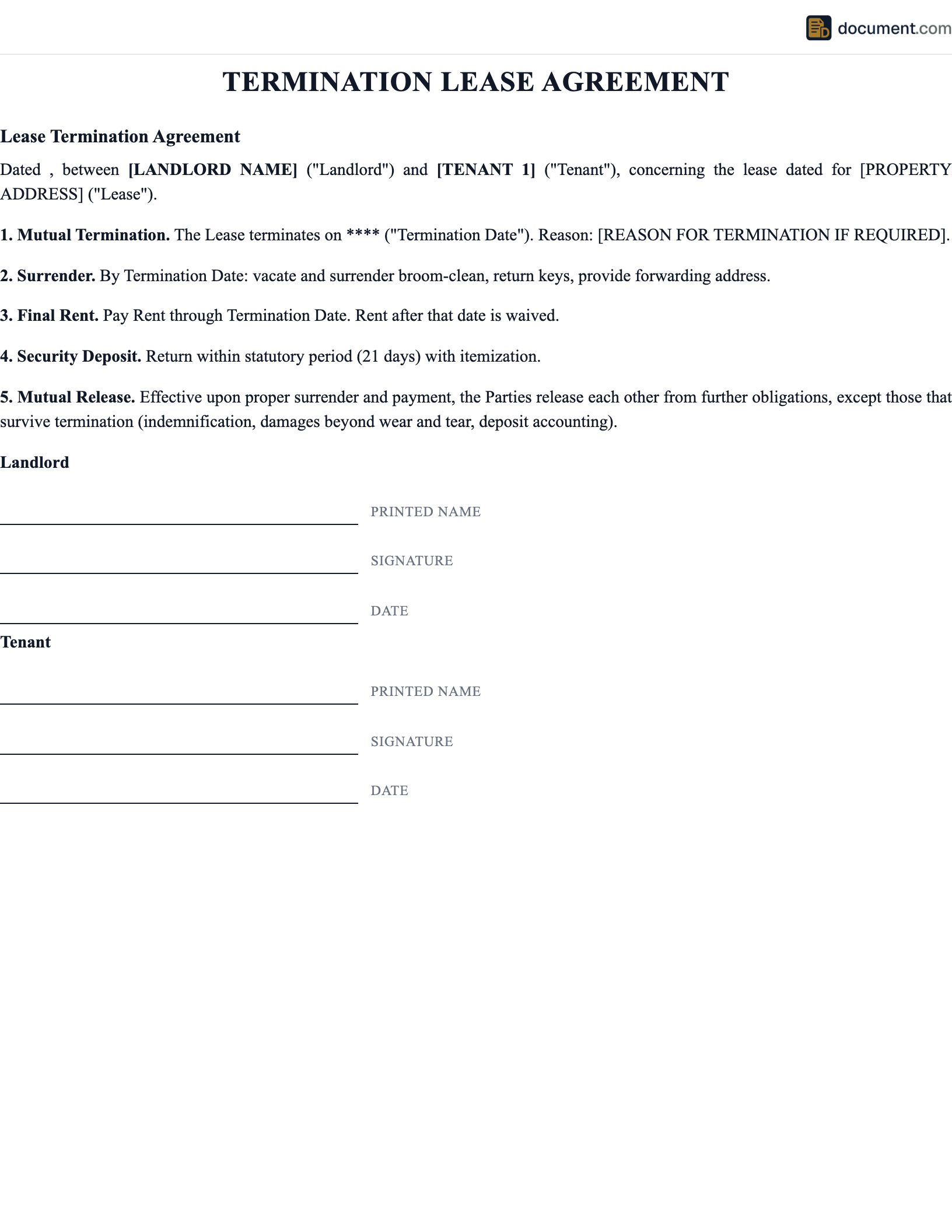
Below is a preview of our California-specific early lease termination letter with proper statutory references for CA law.
EARLY LEASE TERMINATION NOTICE
STATE OF CALIFORNIA
TENANT:
Name: [Full Legal Name]
Address: [California Rental Address]
LANDLORD:
Name: [Landlord Name]
Address: [Mailing Address]
TERMINATION DETAILS:
Vacate Date: [Date]
Reason: [Legal Reason]
California Early Lease Termination FAQ
Answers to common questions about breaking a lease early in California.
Official California Resources
Verified resources for California-specific tenant rights and legal assistance.
Create your California Termination Early Lease Agreement in under 5 minutes.
Answer a few questions and download a California-compliant document, ready for the state agency.