



Georgia's Landlord-Friendly Legal Framework
Unlike many states that have adopted a version of the Uniform Residential Landlord and Tenant Act, Georgia relies on a patchwork of statutory provisions and common law to govern rental relationships. OCGA Title 44, Chapter 7 provides the basic framework, but it is far less comprehensive than the landlord-tenant codes in states like California, New York, or even neighboring Florida.
This limited statutory framework means Georgia landlords generally have more discretion in lease terms, penalty structures, and enforcement. Courts will typically enforce lease provisions as written, giving significant weight to whatever early termination clauses your lease contains. If your lease does not include an early termination option, your negotiating position depends heavily on Georgia's common law duty to mitigate.
Georgia's rental market is dominated by the Atlanta metro area, which accounts for roughly half of the state's renter-occupied units. Other significant markets include Savannah, Augusta, Columbus (near Fort Moore), and Macon. The Atlanta market is generally competitive with units re-renting in 2-4 weeks, while smaller markets may take longer.
Duty to Mitigate in Georgia
Georgia courts have recognized a duty to mitigate damages in landlord-tenant disputes, though this duty is based on common law rather than statute. In Peterson v. P.C. Towers, the Georgia Court of Appeals held that landlords must make reasonable efforts to re-rent a unit when a tenant breaks the lease. The tenant's liability is limited to the actual vacancy period plus reasonable re-renting costs.
In the Atlanta metro area, where rental demand is strong across most neighborhoods, landlords can typically re-rent within 2-4 weeks. This limits your practical exposure even if the lease itself does not include an early termination clause. However, in smaller Georgia markets or during off-peak seasons, re-renting may take longer.
To protect yourself, document the local rental market conditions — screenshot comparable listings, note vacancy rates, and keep records of when you notified the landlord. If the landlord fails to list the unit within a reasonable time after you vacate, this strengthens your argument that they failed to mitigate.
Grounds for Early Termination in Georgia
Georgia recognizes several grounds for early lease termination. OCGA § 44-7-13 establishes the tenant's right to a habitable dwelling, and failure by the landlord to maintain habitability after notice can justify termination. Federal SCRA protections apply to Georgia's large military population. OCGA § 44-7-23 provides domestic violence protections.
Georgia law also permits early termination for active-duty military members stationed more than 50 miles from the rental unit under certain Georgia-specific military provisions, expanding slightly beyond the federal SCRA baseline. Tenants who are victims of stalking may also qualify for early termination protections.
Georgia does not have specific protections for tenants relocating for employment, entering nursing care, or facing other common life circumstances that other states may protect. Without a protected reason, your options are limited to exercising an early termination clause (if your lease has one), negotiating directly with your landlord, or accepting potential liability for remaining rent.
Penalty Structure in Georgia
Georgia does not cap early termination penalties. Security deposits are generally limited to reasonable amounts, and OCGA § 44-7-34 requires landlords to return deposits within 30 days of lease termination. The landlord must provide an itemized list of deductions. Failure to comply may result in the tenant recovering three times the deposit amount plus attorney fees.
Many Georgia leases include early termination clauses with fees ranging from one to three months' rent. In the Atlanta metro area, where average rents have risen significantly in recent years, these fees can be substantial. Always review your lease carefully and calculate the total cost of each option (paying the fee, negotiating a buyout, or leaving and accepting liability with mitigation) before deciding.
Domestic Violence Protections (OCGA 44-7-23)
OCGA § 44-7-23 allows tenants who are victims of family violence to terminate a rental agreement. The tenant must provide the landlord with written notice and a copy of a temporary protective order (TPO) or permanent protective order. The termination is effective 30 days after notice, and the landlord may not impose early termination penalties.
Georgia's DV protections are considered moderate. The statute covers family violence and stalking but has a somewhat narrower definition than states that include dating violence and sexual assault in their DV termination provisions. Georgia Partnership Against Domestic Violence can be reached at 404-873-1766 or 1-800-334-2836.
Georgia Legal Services Program (GLSP) provides free legal assistance to DV victims for housing matters at 1-800-498-9469. Atlanta Legal Aid Society also handles DV-related housing cases in the metro Atlanta area at 404-524-5811.
Georgia Military Installations
Georgia hosts several major military installations including Fort Moore (formerly Fort Benning, Columbus), Fort Stewart and Hunter Army Airfield (Savannah area), Robins AFB (Warner Robins), Moody AFB (Valdosta), Fort Eisenhower (formerly Fort Gordon, Augusta), and Kings Bay Naval Submarine Base. The large military presence means SCRA terminations are common throughout the state.
Each installation's legal assistance office provides free SCRA counseling. Georgia's military installations are spread across the state, creating pockets of military-friendly rental markets where landlords are experienced with SCRA procedures. The Columbus market near Fort Moore is particularly military-oriented.
Georgia law provides some additional protections for state National Guard members beyond federal SCRA. Contact the Georgia Department of Veterans Service at 404-656-2300 for guidance on state-specific military housing protections.
Habitability in Georgia's Climate
Georgia's hot and humid subtropical climate makes functioning air conditioning essential for habitable living conditions throughout most of the year. While Georgia law does not specifically list AC as a required amenity, the state's implied warranty of habitability (OCGA § 44-7-13) requires landlords to maintain the premises in a condition fit for human habitation, which courts have interpreted to include cooling in Georgia's climate.
Mold is a significant concern in Georgia due to the state's persistent humidity. Termite damage is also common (Georgia is in a very high termite risk zone), and landlords are generally responsible for structural pest control. Hurricanes and tropical storms can affect coastal Georgia (Savannah, Brunswick), while severe thunderstorms, tornadoes, and flooding can impact the entire state.
Before terminating for habitability reasons in Georgia, send written notice to the landlord detailing the specific conditions, allow a reasonable time for repairs, and document everything. Contact your local code enforcement office for an official inspection. The Georgia Department of Community Affairs provides resources for tenant habitability complaints.
Notice Requirements in Georgia
Georgia requires written notice for lease termination. For month-to-month tenancies, 30 days notice is standard. For fixed-term leases, the notice period depends on the lease terms and the reason for termination. DV terminations require 30 days notice. Habitability terminations require written notice with a reasonable cure period for the landlord.
Georgia courts accept certified mail, personal delivery, and in some cases email (if the lease permits electronic communication) as valid notice methods. Always retain proof of delivery. Georgia's eviction process is relatively fast, so if you stop paying rent without proper justification, the landlord can file a dispossessory proceeding quickly.
Sample Georgia Early Termination Letter
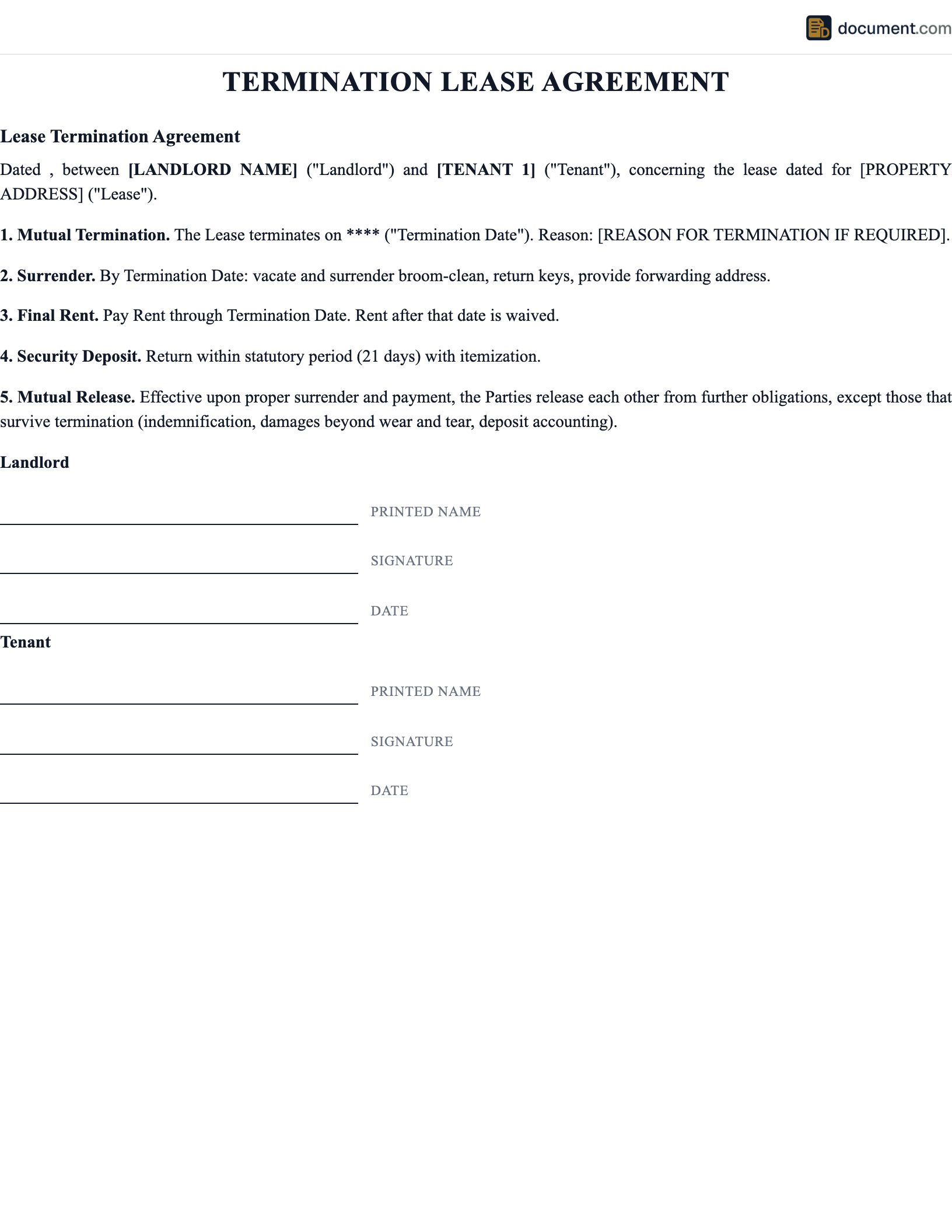
Below is a preview of our Georgia-specific early lease termination letter with proper statutory references for GA law.
EARLY LEASE TERMINATION NOTICE
STATE OF GEORGIA
TENANT:
Name: [Full Legal Name]
Address: [Georgia Rental Address]
LANDLORD:
Name: [Landlord Name]
Address: [Mailing Address]
TERMINATION DETAILS:
Vacate Date: [Date]
Reason: [Legal Reason]
Georgia Early Lease Termination FAQ
Answers to common questions about breaking a lease early in Georgia.
Official Georgia Resources
Verified resources for Georgia-specific tenant rights and legal assistance.
Create your Georgia Termination Early Lease Agreement in under 5 minutes.
Answer a few questions and download a Georgia-compliant document, ready for the state agency.