
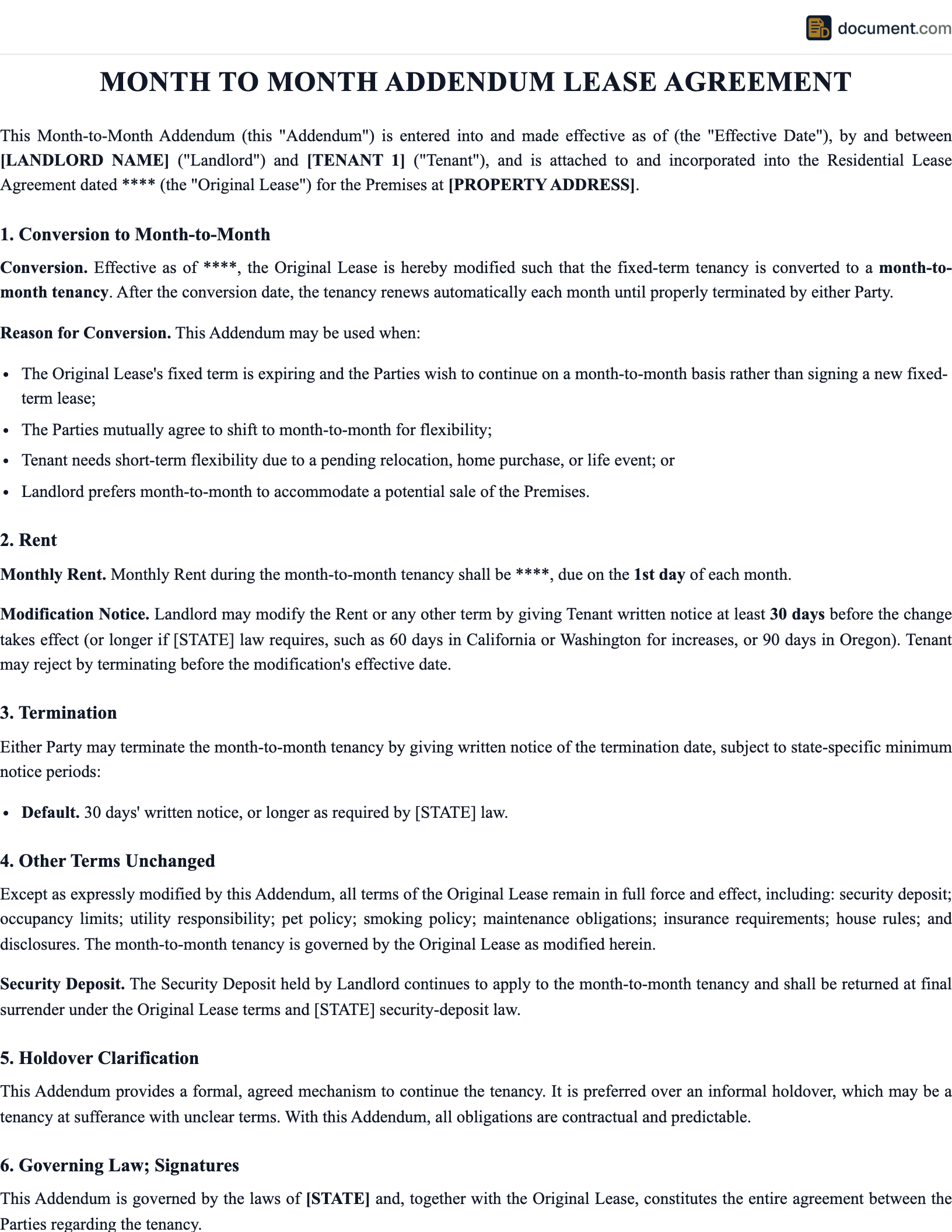



What Is a Month-to-Month Addendum?
A month-to-month addendum converts a fixed-term lease into a periodic tenancy that renews every 30 days under documented terms. It is used at lease expiration when both parties want to continue the relationship without committing to another fixed term, and at any other point during a fixed-term lease when both parties agree to convert. The addendum incorporates by reference all unchanged terms of the original lease (deposit, rules, addendums) and modifies only what the parties want to change: rent amount, notice period, utility allocation, or any other term subject to amendment.
The addendum exists because state holdover statutes create the conversion by default in most states (California Civ. Code § 1945, Texas Property Code § 91.001, Florida § 83.04, Illinois 735 ILCS 5/9-202: a tenant who remains and pays rent after lease expiration becomes a month-to-month tenant on the original terms by operation of law). The default conversion is procedurally inadequate: it does not document any rent change, does not address notice periods that may have shifted (California's 60-day notice for tenancies over a year), does not refresh disclosure obligations triggered by the conversion, and creates a lawyer-bait gap if the parties later disagree about what was modified.
The addendum protects the landlord by establishing the rent amount and any rent-increase procedure in writing with tenant signature, by setting the termination notice at the state-required minimum (or longer if the landlord wants more notice), and by preserving the deposit-deduction rights and lease rules without re-execution overhead. It protects the tenant by stating the new terms expressly so the landlord cannot later claim ambiguity, by setting any rent change with proper notice (California's 30-day or 90-day rule under Civ. Code § 827(b), New York's increase notice under RPL § 226-c), and by documenting any prior-addendum terms (pet, parking, smoking) that continue to apply.
Statutory notice periods to terminate
Termination notice for month-to-month varies by state and tenancy duration. 30 days in most states by default: Texas (Property Code § 91.001), Florida (§ 83.57), Illinois (735 ILCS 5/9-207), Pennsylvania (68 Pa. Stat. § 250.501), Ohio (Rev. Code § 5321.17), Georgia (§ 44-7-7), and 35 others. 60 days in California for tenancies of one year or more by either party (Civ. Code § 1946.1), with 30 days for tenancies under one year; just-cause cities (San Francisco, Oakland, Los Angeles RSO units) require landlord termination only on listed grounds. 60 days in Delaware (25 Del. Code § 5106) and New Hampshire (RSA 540:3). 20 days for tenant termination in Washington (RCW 59.18.200) with 60 days for landlord under most just-cause local ordinances. Just-cause termination ordinances apply in many cities including Seattle (SMC 22.206), Portland (PCC 30.01.087), New York City (RPL § 226-c), and DC (Rental Housing Act). Notice must be in writing in most states; some require service by personal delivery or certified mail.
Rent-increase notice and AB 1482 cap
California Civ. Code § 827(b) requires 30 days notice for rent increases of 10 percent or less and 90 days notice for any increase over 10 percent, calculated from the lowest rent charged within the prior 12 months. AB 1482 (Tenant Protection Act of 2019, codified at Civ. Code § 1947.12 and § 1946.2) caps annual rent increases at 5 percent plus CPI or 10 percent total, whichever is lower, on most properties built before January 1 fifteen years prior, with exceptions for single-family homes owned by individuals (not LLCs or corporations) and owner-occupied duplexes. Oregon SB 608 (codified at ORS 90.323) caps annual increases at 7 percent plus CPI on properties more than 15 years old. New York's Housing Stability and Tenant Protection Act of 2019 caps increases on rent-stabilized units at the rate set annually by the Rent Guidelines Board (typically 1 to 4 percent). Many local rent control ordinances apply (San Francisco, Oakland, Los Angeles RSO, Newark, DC) with their own notice and cap rules.
Termination Notice
30 days in most states; 60 in California for tenancies of one year or more (Civ. Code § 1946.1)
Rent Increase Notice
CA Civ. Code § 827(b): 30 days under 10 percent, 90 days over 10 percent; AB 1482 caps
Holdover Rules
Default conversion to month-to-month under CA Civ. Code § 1945, TX Property Code § 91.001, FL § 83.04
Form Preview
Below is a preview of the Month-to-Month Addendum template. Your customized document will include all provisions for your specific situation.
MONTH-TO-MONTH ADDENDUM
Lease Conversion Agreement
This document is entered into on [Date] between the parties identified below:
LANDLORD:
Name: [Landlord Name]
TENANT:
Name: [Tenant Name]
How to Use This Document
Four steps. Each documents a procedural element required by state landlord-tenant law and avoids the holdover ambiguity that creates most conversion-time disputes.
Reference the Original Lease
Identify the original lease by date, parties, property address, and original term. State that the fixed term has expired (or will expire on a stated date) and the parties agree to continue the tenancy on a month-to-month basis effective the day after expiration. State that all addendums to the original lease (pet, parking, lead paint per 24 C.F.R. § 35.92, smoking, mold) remain in full force and effect except as modified herein. List each addendum by date and title to avoid later dispute about which terms continue.
Set New Terms
State the new monthly rent in dollars and the effective date. If the rent is unchanged from the original lease, state that expressly. State any other modifications: utility account responsibility (some landlords transfer water and trash from rent to direct-to-tenant at conversion), parking allocation, pet policy update (if a tenant has acquired a pet during the original term), or any property condition update. State that all unchanged terms of the original lease remain in effect including security deposit, late fees, maintenance responsibilities, and rules.
Define Notice Requirements
State the notice period for termination by each party at the state-required minimum or longer. California: 60 days for tenancies of one year or more by either party (Civ. Code § 1946.1), 30 days for tenancies under one year. Most other states: 30 days by either party. Just-cause cities (San Francisco, Oakland, Los Angeles RSO, Seattle, Portland, New York City, DC) require landlord termination only on listed grounds: nonpayment, lease breach, nuisance, illegal use, owner move-in, withdrawal under Ellis Act in California, substantial rehabilitation. Specify delivery method: personal delivery, certified mail, or any method allowed by state law.
Address Rent Increases
State the rent-increase notice requirement at the state-required minimum. California Civ. Code § 827(b): 30 days for increases of 10 percent or less, 90 days for increases over 10 percent. AB 1482 (Tenant Protection Act, Civ. Code § 1947.12) caps annual increases at 5 percent plus CPI or 10 percent total, whichever is lower, on covered properties (most pre-2007 multifamily; some exceptions for single-family homes and owner-occupied duplexes). Oregon SB 608 caps at 7 percent plus CPI on properties over 15 years old. New York rent-stabilized units cap at the Rent Guidelines Board annual rate. Reference any applicable local rent control ordinance by chapter (San Francisco RSO Chapter 37, Oakland § 8.22, LA RSO § 151).
Key Components
| Component | Description |
|---|---|
| Original Lease Reference | Date, parties, and property from the expired lease |
| Conversion Date | Effective date of the month-to-month tenancy |
| Updated Rent | New monthly rent amount and due date |
| Notice Period | Days required to terminate, per state law |
| Continuing Terms | Original lease terms that remain in effect |
| Rent Increase Provisions | Process and notice for future rent changes |
Frequently Asked Questions
Find answers to common questions about the Month-to-Month Addendum.
Resources
Create your Month To Month Addendum Lease Agreement in under 10 minutes.
Answer a few questions and download a compliant, attorney-drafted document ready for your state.