



What Is a Family Member Lease Agreement?
A family member lease agreement is a written rental contract between a property owner and a relative occupying the property. Mechanically it is identical to any residential lease: parties, premises, term, rent, deposit, rules, signatures. Legally and tax-wise it sits in a different posture. The IRS scrutinizes related-party rentals under IRC § 280A and IRC § 267, treating documentation, fair market rent, and arms-length payment behavior as the markers that distinguish a true rental from a disguised gift or personal use.
The same document does triple duty. It establishes the landlord-tenant relationship for purposes of Schedule E reporting and the rental-loss deductions of IRC § 469(i) (the up-to-$25,000 active participation allowance for taxpayers under $100,000 modified AGI). It satisfies the Statute of Frauds in the 49 common-law states for any tenancy of more than one year. And it provides the written terms a court will enforce if the tenancy ends badly, which (despite best intentions) it sometimes does even among close family.
The downside risk of skipping the lease is substantial. Without one the IRS can recharacterize the entire arrangement as a personal-use second home, eliminating depreciation deductions and disallowing repairs and operating expenses. State Medicaid agencies in look-back review can treat informal family rentals as uncompensated transfers under 42 U.S.C. § 1396p(c)(1), delaying long-term-care eligibility by months. And the absence of a written term forces the parties into the periodic-tenancy default rules of state law, which rarely match what either side actually wanted.
Why a written lease still matters between relatives
The lease forecloses three predictable failure modes. First, ambiguity about who pays for what. Family arrangements drift; one month the landlord parent covers the water bill, the next month the child tenant assumes that arrangement is permanent, and an argument starts. The lease pins down utilities, lawn care, HVAC filters, and pest control in writing. Second, ambiguity about move-out. A lease specifies the end date and the notice period for non-renewal. A handshake arrangement runs indefinitely until someone gets angry, at which point one party is invariably surprised by the other's exit timeline. Third, evidentiary gaps when the IRS or a state agency asks questions. A signed, dated lease accompanied by canceled checks and bank-deposit records is the documentation auditors expect; an oral understanding is not.
Section 8, Medicaid, and gift-tax implications
Federal regulation 24 C.F.R. § 982.306(d) bars a Section 8 voucher holder from renting from a parent, child, grandparent, grandchild, sibling, or spouse, with a narrow exception when the local public housing authority finds the unit necessary as a reasonable accommodation for a person with a disability. Inadvertent violations have stripped voucher subsidies retroactively. For Medicaid planning, the 60-month look-back of 42 U.S.C. § 1396p(c)(1) treats any below-FMR rent received by an applicant as an uncompensated transfer that delays benefit eligibility by one month for each multiple of the state divisor (about $11,000 in California, $13,000 in Florida). On the gift-tax side, IRC § 102 excludes true gifts from the recipient's gross income, but a parent who rents to a child at $1,500 below FMR for 12 months has made an $18,000 imputed gift that approaches the 2024 annual exclusion ($18,000 per donee, $19,000 for 2025). Track the differential and file Form 709 when it crosses the threshold.
IRS Compliance
Meet fair market rent and documentation requirements for tax deductions
Family Harmony
Clear expectations prevent misunderstandings that damage relationships
Legal Protection
Written terms protect both parties if the arrangement changes
Form Preview
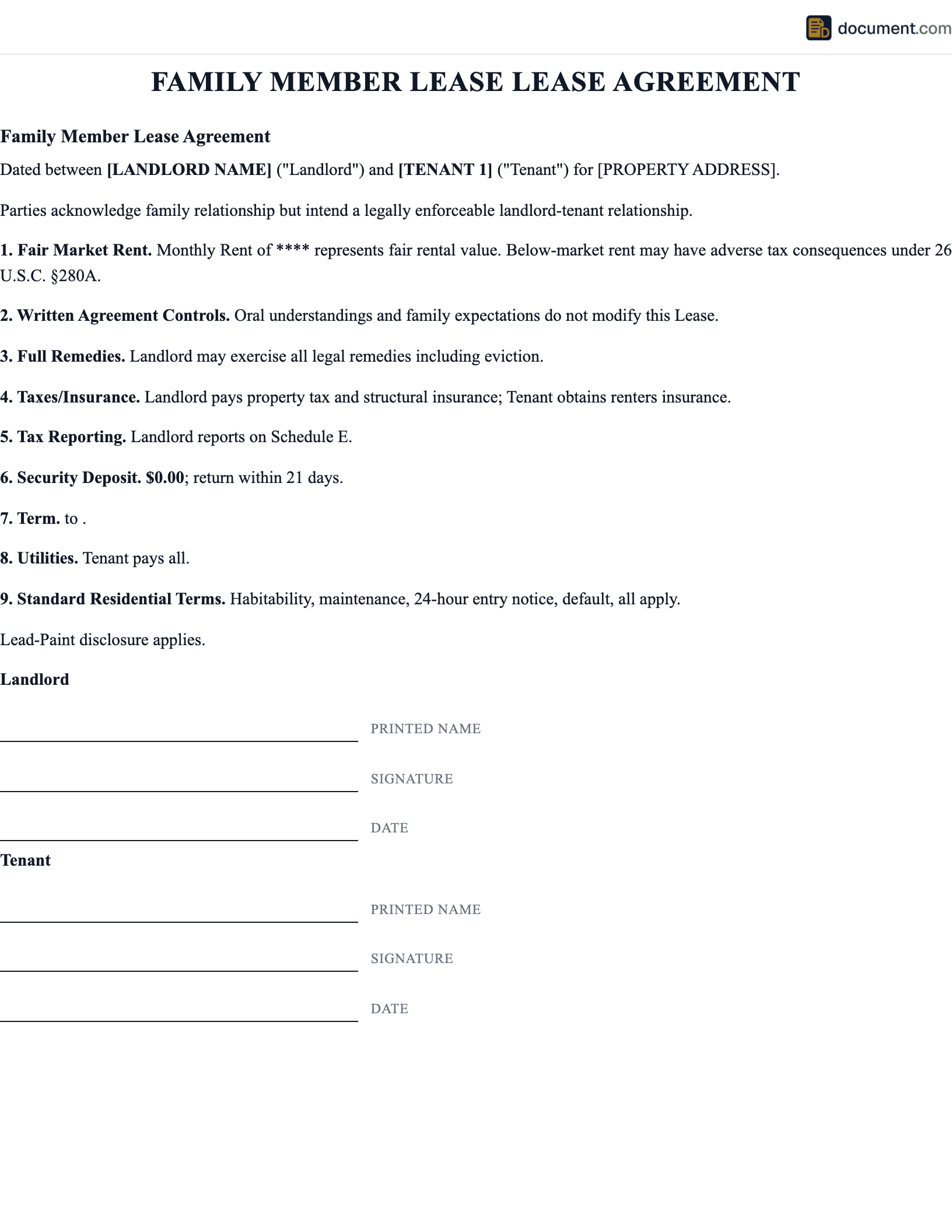
FAMILY MEMBER LEASE AGREEMENT
Residential Rental Agreement
This Lease Agreement is entered into on [Date] between:
LANDLORD:
Name: [Landlord Name]
TENANT (Family Member):
Name: [Tenant Name]
Relationship: [Relationship]
1. PROPERTY & RENT
Address: [Address]
Monthly Rent: $[Amount] (Fair Market Value)
Security Deposit: $[Amount]
How to Rent to Family Members
Treat the rental as if it were arms-length from the first conversation. The four steps below replicate the documentation pattern an unrelated landlord would follow and produce the contemporaneous record an IRS examiner expects to see.
Establish Fair Market Rent with Documentation
Pull HUD's published Fair Market Rents tables for the metropolitan area, retain three to five comparable Zillow or Apartments.com listings within a quarter-mile, and consider a written rental-value opinion from a licensed appraiser. The IRS expects rent within 80 to 100 percent of FMR for a family rental to escape the personal-use trap of IRC § 280A(d)(2). Document the comparable analysis in a one-page memo dated the day of lease signing and retain it for the seven-year audit window. If FMR shifts during the term, an annual rent-increase addendum at the property's CPI rate is the safest renewal mechanism.
Use the Same Lease You Would Use for a Stranger
Include every clause a state-compliant residential lease would carry: parties, premises, term, rent and due date, late fees within state caps (California limits to actual damages under Civil Code § 1671, Texas to 12 percent of one month's rent for properties of four units or fewer under Property Code § 92.019), security deposit, utilities, maintenance allocation, pets, smoking, guests, and the federally required lead-based paint disclosure for any unit built before 1978 (24 C.F.R. § 35.92). State-specific disclosures (California Megan's Law, bed-bug history; Maryland mold; Texas flood hazard) apply regardless of relationship.
Collect Rent on a Traceable Schedule
Require ACH transfer, check, or Zelle/Venmo with the unit address in the memo line. Avoid cash. Issue a written receipt for every payment. The audit pattern that survives IRS scrutiny is twelve consecutive monthly bank deposits in the FMR amount, all dated within the grace period, all matched to a Schedule E entry. Sporadic Venmo transfers labeled "groceries" or "thanks Mom" are the audit pattern that loses the case. If the family member misses a payment, send the same pay-or-quit notice you would send any other tenant; the documentation survives even if you choose not to file unlawful detainer.
Maintain Business-Like Records and File Schedule E
Keep the lease, every signed rent receipt, all expense receipts (mortgage interest from Form 1098, property taxes, insurance premiums, repair invoices, HOA statements), the comparable-rent memo, and the move-in and move-out walkthrough photos in a single property file. Report rental income and expenses on Schedule E of Form 1040. If the property qualifies for active-participation treatment under IRC § 469(i) and modified AGI is under $100,000, claim up to $25,000 of net rental loss against ordinary income; the allowance phases out between $100,000 and $150,000 AGI. Above $150,000 the loss is suspended as a passive activity loss until the property is sold or the taxpayer has offsetting passive income.
Key Components
| Component | Description |
|---|---|
| Fair Market Rent | Rent at or near comparable market rates with documentation |
| Standard Lease Terms | All provisions required of any residential lease in your state |
| Security Deposit | Collected and managed per state law requirements |
| Payment Records | Traceable payment methods for IRS documentation |
| Maintenance Terms | Clear division of landlord and tenant responsibilities |
| Termination Clause | Early exit provisions with proper notice requirements |
Tax Implications & IRS Rules
IRC § 280A is the controlling statute for residential rentals to family members. Section 280A(d)(2) classifies any day a family member uses the property as a personal-use day, with one safe-harbor exception in § 280A(d)(3): rental at fair market rent for use as the family member's principal residence. Failure to satisfy both elements of the safe harbor triggers § 280A(c)(5), which caps Schedule E deductions at gross rental income and disallows any net rental loss. Coordinated with IRC § 469's passive-activity loss rules and the at-risk limits of IRC § 465, the deduction landscape for related-party rentals is unforgiving when documentation is thin. Coordinated planning under § 280A and IRC § 1014 (basis step-up at death) often produces dramatically better outcomes than the intuitive choice of gifting the property during life.
Important IRS Considerations
The IRS treats below-market-rent family rentals as personal use under IRC § 280A. To claim rental deductions, you must charge fair market rent and maintain business-like records. Consult a tax professional for your specific situation.
At Fair Market Rent
Full rental deductions allowed including mortgage interest, taxes, insurance, repairs, depreciation
Below Market Rent
Deductions limited to rental income and no net rental loss allowed
Frequently Asked Questions
Resources
Create your Family Member Lease Lease Agreement in under 10 minutes.
Answer a few questions and download a compliant, attorney-drafted document ready for your state.