



What Is a Rent Receipt?
A rent receipt is a written acknowledgment from a landlord to a tenant confirming that a rent payment has been received. It documents the amount paid, the date of payment, the payment method, the rental period covered, and the property address. Rent receipts serve as official proof of payment and are an essential record for both landlords and tenants, providing documentation for financial records, tax filings, dispute resolution, and future rental applications.
While many modern rent payments are made electronically and create their own digital paper trail, rent receipts remain critically important for several reasons. First, some states legally require landlords to provide written receipts for all or certain types of rent payments. Second, electronic payment records may not include all the details a formal receipt provides, such as the rental period covered, property address, and itemized breakdown. Third, for tenants who pay cash, a rent receipt is often the only proof of payment that exists.
States that require landlords to provide rent receipts include Massachusetts (for all payments), Maryland (upon tenant request), Washington (for cash payments), and others. In New York City, landlords must provide receipts when tenants pay in cash, certified check, cashier's check, or money order. Failure to provide a legally required receipt can expose the landlord to penalties and makes it difficult to prove that rent was not paid if a dispute arises. Even in states without a mandate, receipts are a standard professional practice.
For tax purposes, rent receipts help landlords accurately report rental income on their federal and state tax returns (IRS Schedule E). For tenants, receipts support state renter's tax credits or deductions available in states like Massachusetts, Indiana, and others. The IRS and state tax authorities may request documentation of rental payments during an audit, making receipts an important part of both parties' financial record-keeping.
Proof of Payment
Official documentation that rent was paid, when, and by what method
Tax Documentation
Supports rental income reporting and state renter tax credits
Payment Tracking
Itemized breakdown of rent, utilities, fees, and other charges
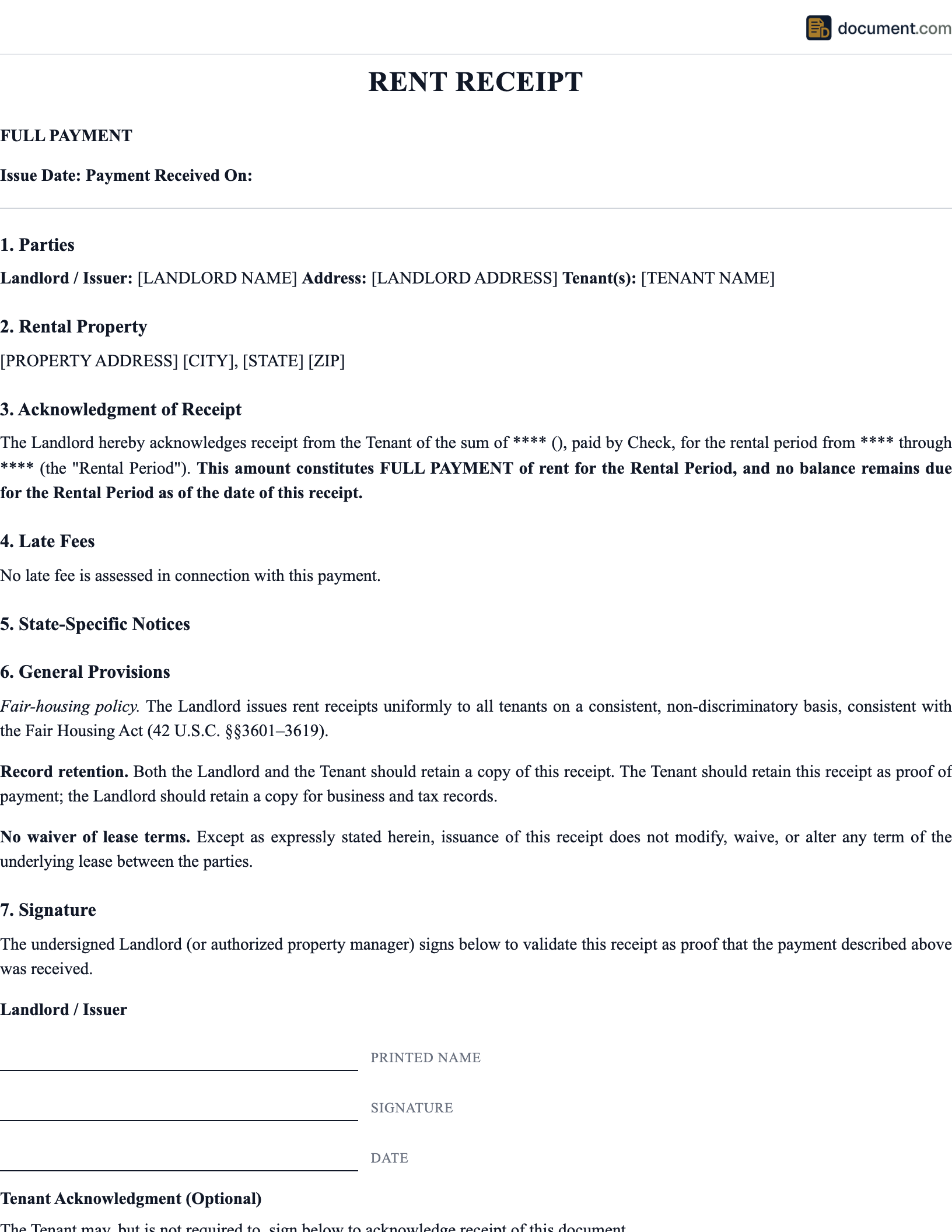
Rent Receipt Form Preview
Our rent receipt template includes all fields required by state laws and IRS record-keeping standards.
RENT RECEIPT
Payment Confirmation
RECEIPT INFORMATION
Receipt #: [Number]
Date Received: [Date]
Rental Period: [Month/Year]
LANDLORD & TENANT
Landlord: [Full Name]
Tenant: [Full Name]
Property: [Address, Unit #]
PAYMENT DETAILS
Base Rent: $[Amount]
Utilities: $[Amount]
Pet Rent: $[Amount]
Late Fee: $[Amount]
Total Received: $[Total]
PAYMENT METHOD
Method: [Cash / Check / Transfer / Other]
Check #: [If applicable]
Balance Due: $[Amount]
LANDLORD SIGNATURE
Signature: [Signature]
Printed Name: [Full Name]
Date: [Date]
How to Write a Rent Receipt
Follow these steps to create a complete, legally compliant rent receipt.
Assign a Receipt Number
Assign a unique sequential receipt number to each rent receipt you issue. This creates an organized system for tracking payments and makes it easy to reference specific transactions. A simple numbering scheme works well — for example, "2026-001, 2026-002" or "RR-001, RR-002." Sequential numbering also demonstrates to auditors or courts that you maintain a systematic record-keeping practice, which adds credibility to your documentation.
Record Payment Date and Rental Period
Include the exact date the payment was received (not just the date the receipt is written, if different) and the rental period the payment covers (e.g., "March 2026" or "March 1 - March 31, 2026"). If the payment covers a partial month, specify the exact dates. If the payment is late, note the date rent was due and the date it was actually received. This distinction is important for tracking late payments and calculating any applicable late fees.
Include Property and Party Information
List the landlord's full name (or property management company name), the tenant's full name, and the complete rental property address including unit number. This information ties the receipt to a specific tenancy and property, which is essential for tax reporting and in case of disputes. If the property is managed by a company, include both the company name and the authorized signer's name.
Itemize the Payment
Break down the total payment into its component parts: base rent, utilities (water, sewer, trash, etc.), parking fees, pet rent, storage fees, late fees, and any other charges. Show each item with its amount, then provide the total. This itemized breakdown prevents disputes about what the payment covered and helps both parties track individual charges for budgeting and tax purposes. Even if the payment is simply base rent with no additional charges, it is good practice to state that explicitly.
Document the Payment Method
Record the specific payment method: cash, personal check (include check number), cashier's check, money order, bank transfer, ACH deposit, credit card, online payment platform, or property management portal. For checks, include the check number and bank name. For electronic payments, include any transaction reference number. This information is particularly important for cash payments where no other record exists, and helps reconcile bank statements with rent receipts for accounting purposes.
Note Any Outstanding Balance
If the payment is partial or if there is an outstanding balance from previous periods, note it on the receipt. State the total amount due, the amount received, and the remaining balance. This creates a clear record of the tenant's account status and prevents disputes about how much is still owed. If the payment brings the account to a zero balance, state "Balance Due: $0.00" to confirm the account is current.
Sign and Provide to Tenant
Sign the receipt with your full legal name and date. If acting as a property manager, include your title and the management company name. Provide the original to the tenant and keep a copy for your records. Receipts should be provided at the time of payment or within a reasonable period (typically 1-3 business days). For electronic payments, the receipt can be sent via email. For cash payments, always provide a receipt at the time of payment — this is when documentation is most critical.
Key Components of a Rent Receipt
A complete rent receipt should include these elements for legal compliance and proper record-keeping.
| Component | Description |
|---|---|
| Receipt Number | Unique sequential identifier for tracking and reference |
| Date Received | Exact date the payment was received by the landlord |
| Rental Period | The month or date range the payment covers |
| Landlord Name | Full name of landlord or property management company |
| Tenant Name | Full name of the tenant making the payment |
| Property Address | Complete rental address including unit number |
| Total Amount | Total payment amount received in dollars and cents |
| Itemized Breakdown | Base rent, utilities, fees, and other charges listed separately |
| Payment Method | Cash, check (with number), electronic transfer, etc. |
| Balance Due | Remaining balance after this payment (if any) |
| Late Fee | Any late fee charged, with amount and reason |
| Landlord Signature | Signed and dated by the landlord or authorized agent |
Legal Requirements for Rent Receipts
Several states require landlords to provide rent receipts, with specific rules about when and how they must be given.
Important: State Requirements Vary
Some states require rent receipts for all payments, others only for cash, and others only upon tenant request. In Massachusetts, failure to provide a receipt can result in penalties. In Washington, receipts are required for all cash payments. Check your state's specific requirements to ensure compliance. Even in states without a mandate, providing receipts is a best practice that protects both parties.
States Requiring Rent Receipts
- Massachusetts: Landlords must provide a written receipt for every rent payment within 30 days; penalties for noncompliance
- Maryland: Landlords must provide a receipt upon the tenant's request; receipt must include specific information
- Washington: Receipts required for all cash rent payments; must include date, amount, and signatures
- New York City: Receipts required for cash, certified check, cashier's check, and money order payments
IRS Requirements for Landlords
The IRS requires landlords to report all rental income on Schedule E of their federal tax return. While the IRS does not specifically mandate rent receipts, they do require landlords to maintain adequate records of all rental income received. Rent receipts, along with bank statements and accounting records, form the foundation of this documentation. In an audit, the IRS may request proof of income amounts and dates, and rent receipts provide this proof. Landlords should retain all receipts and payment records for at least 3 years after filing the relevant tax return.
Sample Rent Receipt
Below is a sample rent receipt with itemized charges. Your customized receipt will include your state's requirements.
RENT RECEIPT
Receipt #2026-003
Date Received: March 1, 2026
Received From: [Tenant Name]
Property: [Address, Unit #]
For Rental Period: March 2026
Payment Breakdown:
Base Rent: $1,500.00
Water/Sewer: $45.00
Trash: $25.00
Pet Rent: $50.00
Total Received: $1,620.00
Balance Due: $0.00
Payment Method: Personal Check #4521
Landlord Signature
Printed Name: _______________
Date: _______________
Frequently Asked Questions
Find answers to common questions about rent receipts, legal requirements, tax implications, and best practices.
Official Resources
Use these resources for information about rent receipt requirements, tax documentation, and record-keeping standards.
IRS Rental Income Guide
IRS guidelines on rental income reporting, deductions, and record-keeping
IRS Schedule E
Federal tax form for reporting rental income and expenses
Nolo Renters' Rights
State-by-state guides on rent receipt requirements
HUD Rental Resources
Federal guidance on rental payments and tenant protections
CFPB Housing Resources
Consumer financial protection guides for renters
USA.gov Housing Help
Government housing resources for landlords and tenants
Related Rental Documents
These documents complement rent receipts and support comprehensive rental record-keeping.
Lease Agreement
Comprehensive residential rental agreement
Security Deposit Return
Itemized deposit accounting statement
Landlord Reference Letter
Tenant rental history verification
Notice to Vacate
Formal tenancy termination notice
Lease Violation Notice
Notice for nonpayment or other lease breaches
Move-In/Move-Out Checklist
Property condition documentation
Create your Rent Receipt in under 10 minutes.
Answer a few questions and download a compliant, attorney-drafted document ready for your state.