
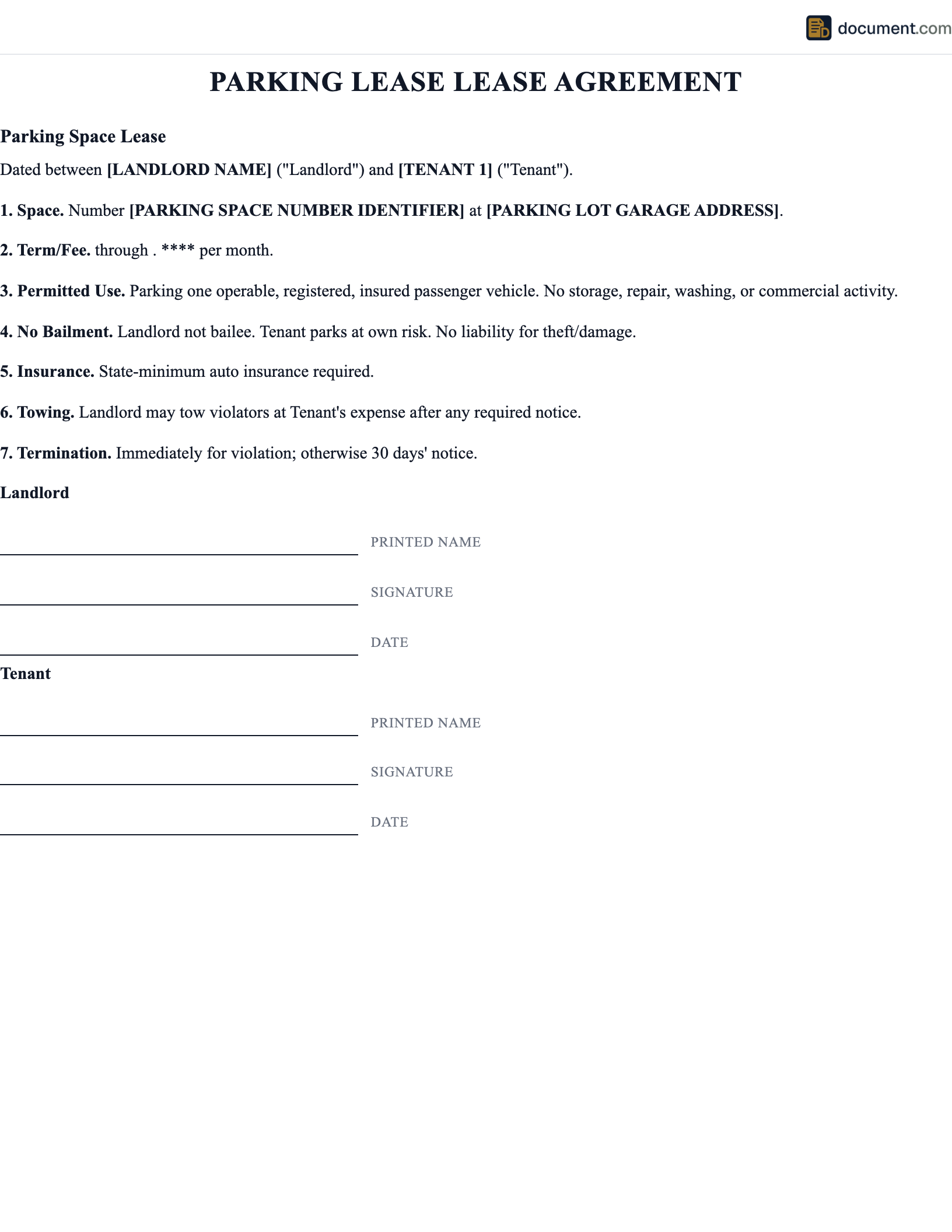



What Is a Parking Space Lease Agreement?
A parking space lease agreement is a legally binding contract between a property owner (or management company) and a tenant that grants the right to use a specific parking space or parking facility for a defined period of time in exchange for regular payment. These agreements establish the terms and conditions of use, including the rental rate, payment schedule, duration, assigned or unassigned status, liability limitations, and rules governing the use of the parking space.
Parking leases are used in both commercial and residential settings. In commercial contexts, businesses lease parking spaces for employees, customers, or fleet vehicles in office buildings, shopping centers, and standalone parking facilities. In residential settings, landlords may offer parking as a separate amenity in apartment complexes, condominiums, and urban rental properties where street parking is limited or unavailable.
The terms of a parking lease can vary significantly depending on the type of space (indoor garage, outdoor lot, covered carport), the location (urban vs. suburban), whether the space is assigned or unassigned, and whether additional features like EV charging stations, security cameras, or climate-controlled storage are included. Monthly rates range from as low as $50 in suburban areas to over $500 in major metropolitan centers like New York, San Francisco, and Boston.
Unlike residential leases, parking space agreements typically do not fall under landlord-tenant protection statutes. They are generally governed by standard contract law, which means the terms agreed upon in the lease are the primary source of each party's rights and obligations. This makes it especially important to have a well-drafted agreement that clearly addresses all potential issues, including liability for damage, towing procedures, snow removal, and termination.
Assigned Spaces
Reserved numbered spots with exclusive access and towing rights for violators
EV Charging
Provisions for electric vehicle charging stations, costs, and usage rules
Liability Protection
Clear terms for damage, theft, and insurance requirements for both parties
Parking Lease Form Preview
Our parking lease agreement includes all essential terms for a complete parking arrangement. Below is a preview of the key sections included in your customized document.
PARKING SPACE LEASE AGREEMENT
Parking Rental Agreement
PROPERTY OWNER / MANAGER
Name: [Owner Name]
Facility Address: [Address]
LESSEE (Parker)
Name: [Full Name]
Vehicle: [Year Make Model] License Plate: [Plate #]
PARKING SPACE DETAILS
Space Type: [Assigned / Unassigned]
Space Number: [# or N/A]
Location: [Level / Section]
LEASE TERMS
Monthly Rent: $[Amount]
Term: [Monthly / Annual]
Start Date: [Date]
LIABILITY & INSURANCE
Owner shall not be responsible for loss, theft, or damage to vehicles or personal property. Lessee shall maintain valid automobile insurance at all times...
How to Write a Parking Space Lease
Follow these steps to create a comprehensive parking space lease that protects both the property owner and the lessee while clearly establishing all terms of the parking arrangement.
Identify the Parties and Property
Include the full legal names and contact information of the property owner (or management company) and the lessee. Describe the parking facility location, including the full address, whether it is an indoor garage, outdoor lot, or covered structure, and any relevant access information such as gate codes, access cards, or key fobs required to enter the facility.
Describe the Parking Space
Specify whether the space is assigned or unassigned. For assigned spaces, include the space number, level, and section. Describe the size (standard, compact, oversized), type (covered, uncovered, garage), and any special features such as EV charging stations, proximity to elevators, or handicap accessibility. Include any vehicle size restrictions that apply to the space.
Set the Lease Term and Payment
Define the lease duration (month-to-month or fixed term), start and end dates, monthly rent amount, payment due date, accepted payment methods, and late payment penalties. Include provisions for automatic renewal, rent increases, and any security deposit or prepaid rent requirements. Specify whether payment is made separately from a residential or commercial lease.
Register the Vehicle Information
Require the lessee to provide vehicle details including year, make, model, color, and license plate number. Specify whether the lessee may park a different vehicle with notice, how many vehicles are permitted on one lease, and the process for updating vehicle information. This is critical for assigned spaces where unauthorized vehicles may need to be identified and towed.
Address Liability and Insurance
Clearly state the owner's liability limitations for theft, vandalism, weather damage, and damage caused by other vehicles. Require the lessee to maintain valid automobile insurance with minimum coverage amounts. Include indemnification provisions protecting the owner from claims arising from the lessee's use of the parking space. Address the owner's responsibility for maintaining the facility in safe condition.
Include Rules and Towing Provisions
Establish rules for facility use, including speed limits, prohibited activities (vehicle repair, storage of hazardous materials, overnight camping), noise restrictions, and guest parking policies. Define towing procedures for unauthorized vehicles, including required signage, towing company information, and notification procedures. Address snow removal responsibilities and seasonal maintenance obligations.
Define Termination Procedures
Specify how either party can terminate the agreement, including required notice periods (typically 30 days for month-to-month), early termination fees for fixed-term leases, and grounds for immediate termination (non-payment, lease violations, safety hazards). Include procedures for returning access cards, gate remotes, and keys upon termination, and address security deposit return timelines.
Key Components of a Parking Lease
A comprehensive parking space lease should include the following essential components to protect both parties and prevent disputes.
| Component | Description |
|---|---|
| Owner / Manager Info | Full name, address, and contact details of the parking facility owner or manager |
| Lessee Information | Full name, address, phone number, and email of the person renting the space |
| Vehicle Details | Year, make, model, color, and license plate number of the vehicle(s) to be parked |
| Space Description | Space number, type (assigned/unassigned), location (level, section), and size |
| Lease Term | Monthly or annual term with start date, end date, and renewal provisions |
| Monthly Rent | Amount, due date, payment method, and late payment fees |
| Security Deposit | Amount held, conditions for deduction, and timeline for return upon termination |
| Access Information | Gate codes, access cards, key fobs, operating hours, and guest access procedures |
| Liability Disclaimer | Owner limitation of liability for theft, vandalism, weather, and third-party damage |
| Insurance Requirements | Minimum auto insurance coverage required and proof of insurance provisions |
| Towing Authorization | Procedures and authorization for towing unauthorized or abandoned vehicles |
| EV Charging Provisions | Availability, electricity costs, usage rules, and installation of personal chargers |
| Snow / Maintenance | Responsibility for snow removal, ice treatment, and general facility maintenance |
Legal Requirements for Parking Leases
Parking leases are primarily governed by contract law rather than landlord-tenant statutes. However, there are several legal considerations that apply to parking arrangements.
Important: Towing Regulations Vary by Jurisdiction
Before including towing provisions in your parking lease, verify your local towing regulations. Many jurisdictions require specific signage (size, placement, content), advance notice to vehicle owners, and reasonable towing fees. Violations of towing regulations can result in fines against the property owner and liability for vehicle damage.
Local Ordinance Compliance
- Towing Signage: Most municipalities require specific warning signs at parking facility entrances before unauthorized vehicles can be towed
- ADA Compliance: Parking facilities must comply with Americans with Disabilities Act requirements for accessible spaces, signage, and access routes
- Fire Code: Parking facilities must maintain clear fire lanes, proper lighting, and emergency access as required by local fire codes
- EV Charging Laws: Many states now require new construction to include EV charging infrastructure or accommodate tenant-installed chargers
Insurance and Liability
Property owners should carry adequate general liability insurance covering the parking facility. While liability disclaimers in parking leases can limit the owner's exposure, they do not protect against claims based on negligence in maintaining the facility. Courts have generally upheld that parking facility owners owe a duty of reasonable care to maintain safe conditions, including proper lighting, structural integrity, and timely snow and ice removal.
Sample Parking Space Lease
Below is a preview of a standard parking space lease agreement. Your customized document will include provisions specific to your parking arrangement and local requirements.
PARKING SPACE LEASE AGREEMENT
Date: _______________
This Parking Space Lease Agreement is entered into between [Owner] and [Lessee] for parking space [#___] located at [Address].
TERMS
Monthly Rent: $_______ | Due Date: _______ | Term: _______ to _______
VEHICLE: _______ (Year/Make/Model) License Plate: _______
LIABILITY: Owner shall not be liable for loss, theft, or damage to any vehicle or personal property parked in the facility...
Owner Signature
Date: ___________
Lessee Signature
Date: ___________
Frequently Asked Questions
Find answers to common questions about parking leases, assigned spaces, liability, EV charging, and towing rights.
Official Resources
Use these trusted resources for information about parking regulations, ADA compliance, and local ordinances related to parking facilities.
ADA.gov — Parking Requirements
Federal accessible parking requirements and guidelines
DOE — EV Charging Laws & Incentives
State and federal EV charging laws and incentive programs
USA.gov — Landlord-Tenant Law
State-by-state property and tenant law resources
CFPB Housing Resources
Consumer financial protection for renters
Related Documents
These related documents may be useful alongside your parking space lease agreement.
Create your Parking Lease Lease Agreement in under 10 minutes.
Answer a few questions and download a compliant, attorney-drafted document ready for your state.