



What Is a Photo Booth Contract?
A photo booth contract is an event-services rental agreement between a photo booth operator and a client for the delivery of equipment, an attendant, and image deliverables at a specified venue and date. It is a hybrid services-and-equipment-rental contract: the vendor brings tangible chattels (DSLR camera, dye-sub printer, backdrop, props, kiosk shell, lighting) and provides labor (setup, on-site attendant, teardown, post-event gallery delivery). The contract sits at the intersection of UCC Article 2A principles for the equipment side and common-law services contract principles for the labor side, with copyright law governing the resulting images under 17 U.S.C. §201.
The economic exposure on both sides is concrete. A wedding photo booth booked at $1,500 for a Saturday in June is replacing other bookings the vendor turned away; a no-show by the client on the day of the event costs the vendor that opportunity in full. On the client side, a vendor who fails to appear at a wedding cannot be fully compensated by a refund, because the photographic record of a once-in-a-lifetime event cannot be reconstructed. The contract allocates these asymmetric risks through liquidated damages, deposit forfeiture, force-majeure language, and a limitation-of-liability cap at the contract price that bars consequential-damage recovery.
Use this template for weddings, corporate galas, bar and bat mitzvahs, birthday parties, brand activations, trade-show booths, holiday parties, and school proms. The same skeleton supports open-air booths, enclosed traditional booths, 360-degree video booths, mirror booths, and roaming-photographer add-ons. State-specific modifications apply for California (Civil Code §1671 governs liquidated damages), Florida (§501.137 regulates event-services advance payments), and New York (General Business Law §394-c governs catering and event vendor contracts above $500).
Event-rental contracts compared to vendor service agreements
A photo booth contract is not an equipment-only rental (which would deliver the booth to the client and let the client operate it) and not a pure service agreement (which would charge for labor without defined deliverables). It carries elements of both. The vendor's exposure to bailment liability under common-law principles of Restatement (Second) of Torts §388 attaches the moment the equipment leaves the vendor's vehicle and remains attached until reloaded; document equipment condition with timestamped photographs at load-in and load-out. The vendor's status as an independent contractor (not an employee or agent of the venue or client) should be stated explicitly to foreclose vicarious-liability claims under respondeat superior if a guest trips on a power cable.
Image-rights ownership under the Copyright Act
Copyright vests in the photographer at the moment of fixation under 17 U.S.C. §201(a), and the photo booth vendor is the photographer of record even when the camera fires automatically (the creative judgment is in the lighting setup, framing, and printer template). The default license to the client should be perpetual, royalty-free, non-exclusive, and limited to personal noncommercial use. The vendor retains marketing and portfolio rights subject to a 30-day blackout window for surprise events. For corporate clients, address logo and trademark display: photographs showing the client's marks should carry a separate license back to the client for marketing use, and the vendor should covenant not to use those branded images in third-party advertising without written consent.
Service Details
Hours, setup, props, prints, and digital delivery
Payment Terms
Deposit, balance, overtime rates, and refund policy
Liability Protection
Equipment damage, cancellation, and force majeure
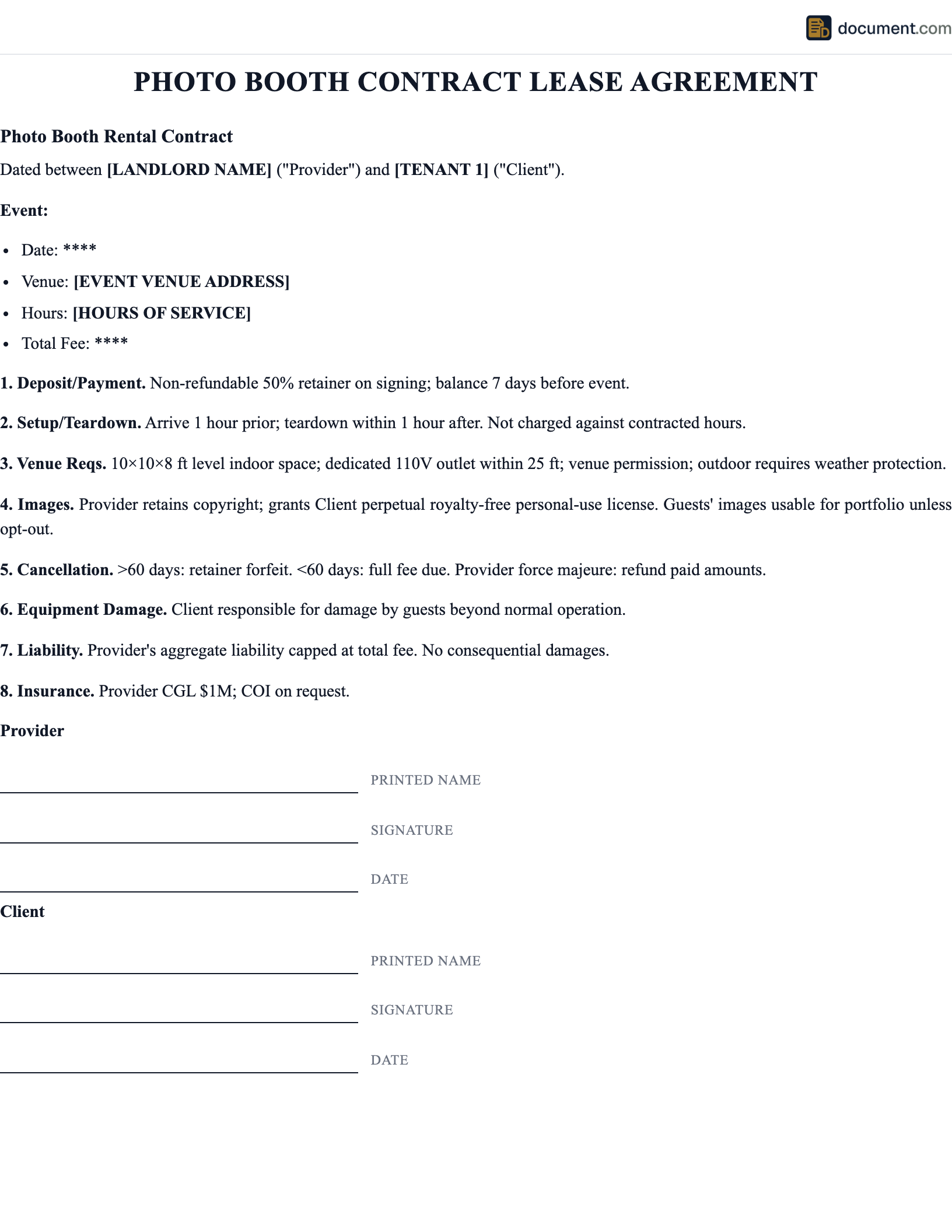
Form Preview
PHOTO BOOTH RENTAL CONTRACT
Event Equipment Rental Agreement
This Agreement is entered into on [Date] between:
VENDOR:
Business: [Company Name]
CLIENT:
Name: [Client Name]
1. EVENT DETAILS
Date: [Event Date]
Venue: [Venue]
Hours: [Start - End]
How to Create a Photo Booth Contract
Four steps produce a contract that survives small-claims review and that an event venue's risk-management office will accept as proof of insurance and liability allocation.
Define the deliverables with photographic specificity
Name the booth model (open-air, enclosed, 360-degree, mirror), the camera body and lens combination (Canon R6 with 24-70mm f/2.8 is industry standard for booths), the printer model (DNP DS620A or DS820A delivers 4x6 prints in 8 seconds), the number of prints per session (typically 2 strips of 4 images), the prop inventory (signs, hats, glasses, themed accessories), the backdrop options (sequin, floral, custom step-and-repeat), the digital gallery delivery method (password-protected URL active for 90 days), and the resolution of digital files (full-resolution JPEG plus social-share-sized derivatives). Specificity defeats the most common dispute at small-claims: the client expected something different from what arrived.
Lock the timeline, footprint, and power requirements
Specify a 90-minute load-in window before guest arrival, the 4-hour or 6-hour active service block, and a 45-minute teardown window after service ends. State expressly that setup and teardown are not counted as billable service hours. Require a 10-by-10-foot footprint for an open-air booth or 10-by-10-by-8-foot for an enclosed booth, level flooring within 2 inches of grade, and a dedicated 15-amp 110-volt outlet within 25 feet. Address venue access through service entrances, freight elevators, and any union load-in restrictions (common at convention centers in Las Vegas, Chicago, and New York where IATSE Local jurisdiction may attach to equipment moves).
Build a tiered cancellation schedule with enforceable liquidated damages
Collect a 30 to 50 percent nonrefundable deposit at booking, with the balance due 14 days before the event. Structure the cancellation tiers as: full refund of payments above the deposit if canceled 60 or more days out, 50 percent refund if canceled 30 to 59 days out, no refund inside 30 days. Liquidated damages are enforceable when the amount is a reasonable forecast of harm and actual damages are difficult to calculate (Restatement (Second) of Contracts §356; California Civil Code §1671(b) for commercial contracts). Offer one free reschedule to a date within 12 months as a goodwill safety valve.
Allocate damage liability, license the images, and cap exposure
Shift guest-caused equipment damage to the client through a refundable damage deposit ($200 to $500) and an itemized replacement-cost schedule attached as an exhibit. Grant the client a perpetual, royalty-free, non-exclusive license for personal noncommercial use under 17 U.S.C. §201, with the vendor retaining marketing and portfolio rights subject to a 30-day surprise-event blackout. Cap the vendor's total liability at the contract price and exclude consequential damages (lost wedding memories, business opportunities, emotional distress). Add a force-majeure clause enumerating pandemics, named storms, government orders, and venue closures, with a notice provision requiring written notification within 72 hours of the triggering event.
Key Components
| Component | Description |
|---|---|
| Event Details | Date, venue, service hours, setup and teardown times |
| Equipment & Services | Booth type, camera, printer, props, backdrop, attendant |
| Deliverables | Prints per session, digital copies, delivery timeline |
| Payment Terms | Total fee, deposit, balance due date, overtime rate |
| Cancellation Policy | Tiered refund schedule based on notice period |
| Damage Liability | Client responsibility for guest-caused equipment damage |
Frequently Asked Questions
Resources
Create your Photo Booth Contract Lease Agreement in under 10 minutes.
Answer a few questions and download a compliant, attorney-drafted document ready for your state.