



What Is a Farm Lease Agreement?
A farm lease agreement is a contract between a landowner and a tenant farmer that grants the tenant the right to use agricultural land for farming purposes in exchange for rent. It is one of the most consequential documents in American agriculture because roughly 40% of all U.S. farmland is operated by someone other than the owner, according to the USDA Agricultural Census. That means hundreds of millions of acres change hands every year through lease agreements, and the terms of those leases directly affect soil health, crop yields, conservation practices, and the financial viability of both the landowner and the tenant.
Farm leases are fundamentally different from residential or commercial leases because the property itself is a productive asset that can be permanently improved or permanently damaged by how the tenant farms it. A tenant who strip-mines the soil with continuous corn, skips conservation practices, and neglects drainage maintenance can reduce the land's productivity and value for decades. A tenant who rotates crops, plants cover crops, maintains waterways, and manages nutrients responsibly can actually increase the land's long-term productivity. That makes the lease more than a rental agreement; it is a stewardship contract that determines what happens to the land over the lease term.
The economic structure of a farm lease depends on how rent is calculated and how risk is allocated. Under a cash rent lease, the tenant pays a fixed amount per acre and assumes all of the production risk. Under a crop share lease, the landowner and tenant divide the crop based on an agreed percentage and share the risk. Under a flex rent or variable cash rent arrangement, the base rent adjusts based on actual yields, commodity prices, or both. Each structure has advantages and disadvantages depending on commodity markets, crop insurance availability, input costs, and the risk tolerance of both parties.
Beyond the economic terms, a farm lease must address a range of operational and legal issues that do not arise in other types of real estate leases. Conservation compliance is a condition of eligibility for most federal farm programs, and a tenant who violates conservation requirements can jeopardize the landowner's eligibility for payments. Water rights in western states are a separate property interest that must be explicitly addressed. Livestock provisions require detailed terms about stocking rates, fencing, manure management, and biosecurity. Hunting and recreational rights must be allocated between the landowner and the tenant. And government program payments (ARC, PLC, CRP, EQIP) need clear rules about who enrolls, who receives the payments, and how they affect the rent calculation.
Our attorney-reviewed farm lease template covers the complete agricultural tenancy relationship: land description, lease term, rent structure, crop and livestock provisions, conservation and stewardship requirements, water rights, improvements and maintenance, hunting and recreational rights, government program participation, insurance, termination, and dispute resolution. It works for row crop farms, livestock operations, specialty crop operations, and mixed-use agricultural properties in every state.
Flexible Rent Options
Cash rent, crop share, or flex rent with built-in adjustment formulas
Conservation Protection
Soil health, cover crops, and USDA compliance requirements built in
Water Rights Covered
Irrigation, livestock water, and state water law compliance provisions
Farm Lease Agreement Form Preview
Below is a visual preview of the sections and fields included in a standard farm lease agreement. Your completed document will be customized for your acreage, rent structure, and state requirements.
Farm Lease Agreement
Agricultural Land Lease
Section 1: Parties & Property
Section 2: Lease Term & Rent
Section 3: Conservation & Water
Section 4: Signatures
Landowner Signature
Tenant Signature
How to Create a Farm Lease
A solid farm lease is built in seven steps. Each one addresses a different aspect of the agricultural tenancy, and getting them right up front prevents the disputes that derail so many landlord-tenant relationships in farming.
Describe the property in detail
Include the legal description, county, total acres, tillable acres, pasture acres, timber, and any excluded areas (homesites, building lots, CRP acres). Attach a plat map or aerial photo as an exhibit. The property description anchors the lease and determines the rent calculation.
Choose the rent structure
Decide on cash rent, crop share, flex rent, or a hybrid. For cash rent, set the per-acre rate and payment schedule (one payment or two installments is typical). For crop share, agree on the split percentage and who pays for inputs. For flex rent, define the base rate and the adjustment formula.
Set the lease term and renewal rules
Specify the start and end dates, whether the lease renews automatically, and how much notice is required to terminate. One-year leases with automatic renewal are the most common, but multi-year terms are increasingly popular for tenants who invest in soil health.
Address conservation and stewardship
Require compliance with the NRCS conservation plan, specify crop rotation requirements, address cover crop and tillage practices, and allocate responsibility for waterway maintenance, erosion control, and nutrient management. These provisions protect the land's long-term productivity.
Allocate water, hunting, and recreational rights
Specify who holds the water rights, how irrigation costs are split, whether the landowner retains hunting and recreational access, and how those activities are scheduled around farming operations.
Define improvement and maintenance responsibilities
Specify who maintains fences, buildings, drainage tile, roads, and waterways. Address who pays for new capital improvements and whether the tenant receives a rent credit or compensation for improvements that outlast the lease term.
Cover insurance, liability, and termination
Require both parties to carry appropriate insurance (liability, crop, property). Include indemnification clauses, specify the termination notice period, and address what happens to growing crops, stored grain, and tenant improvements at the end of the lease.
Key Components
Every farm lease should contain these core building blocks, whether the property is a 40-acre truck farm or a 5,000-acre row crop operation.
Property description
Legal description, total acres, tillable acres, and any excluded areas
Rent structure and payment
Cash rent, crop share, or flex rent with payment schedule and late fees
Crop and rotation provisions
Permitted crops, rotation requirements, and planting restrictions
Conservation requirements
NRCS plan compliance, cover crops, tillage, and erosion control
Water rights and irrigation
Water allocation, irrigation costs, well maintenance, and state compliance
Livestock provisions
Stocking rates, fencing, manure management, and biosecurity
Improvements and maintenance
Maintenance obligations, capital improvements, and tenant compensation
Hunting and recreational rights
Access rights, scheduling, liability, and permitted activities
Insurance requirements
Liability, crop, and property insurance minimums for both parties
Termination and growing crops
Notice periods, automatic renewal, and disposition of unharvested crops
Types of Farm Leases
Farm leases come in several forms depending on the rent structure, the type of agricultural operation, and how risk is allocated between the landowner and the tenant.
Cash Rent Lease
The tenant pays a fixed dollar amount per acre, assumes all production and market risk, and keeps all crop revenue. Cash rent is the most common arrangement in the Corn Belt and is the simplest to administer. The landowner receives predictable income regardless of crop performance.
Crop Share Lease
The landowner and tenant divide the crop based on an agreed percentage, typically two-thirds tenant and one-third landowner. Both parties share the production and market risk. Crop share is more complex to administer because it requires agreement on input costs, marketing decisions, and government program participation.
Flex Rent (Variable Cash Rent)
A hybrid that starts with a base cash rent and adjusts up or down based on actual yields, commodity prices, or gross revenue. Flex rent gives the landowner some participation in good years while protecting the tenant in poor years. The adjustment formula must be clearly defined in the lease to avoid disputes.
Pasture and Livestock Lease
A lease specifically for grazing land, where rent is calculated per animal unit per month (AUM) or as a flat rate per acre. Pasture leases include additional provisions for stocking rates, fencing maintenance, water access, weed control, and the condition in which the pasture must be returned at the end of the term.
Legal Requirements
Farm leases are governed by state landlord-tenant law, real property law, agricultural statutes, federal farm program requirements, and environmental regulations. The requirements below apply to most farm leases, with variations by state.
- Written lease required under the statute of frauds in most states for terms longer than one year
- USDA conservation compliance required if the landowner receives federal farm program payments (ARC, PLC, CRP)
- State termination notice requirements vary (Iowa requires September 1 notice for leases ending the following March 1)
- Water rights must be addressed under state law, especially in prior appropriation states (CO, MT, WY, ID, NM)
- Environmental regulations apply to manure management, chemical storage, and wetland protection on the leased land
- Property tax responsibility should be allocated in the lease (typically the landowner pays, but the arrangement varies)
- Recording may be advisable for leases longer than one to three years to protect the tenant's interest against future buyers
- State right of first refusal laws may apply in certain states, giving the existing tenant priority to match a competing offer
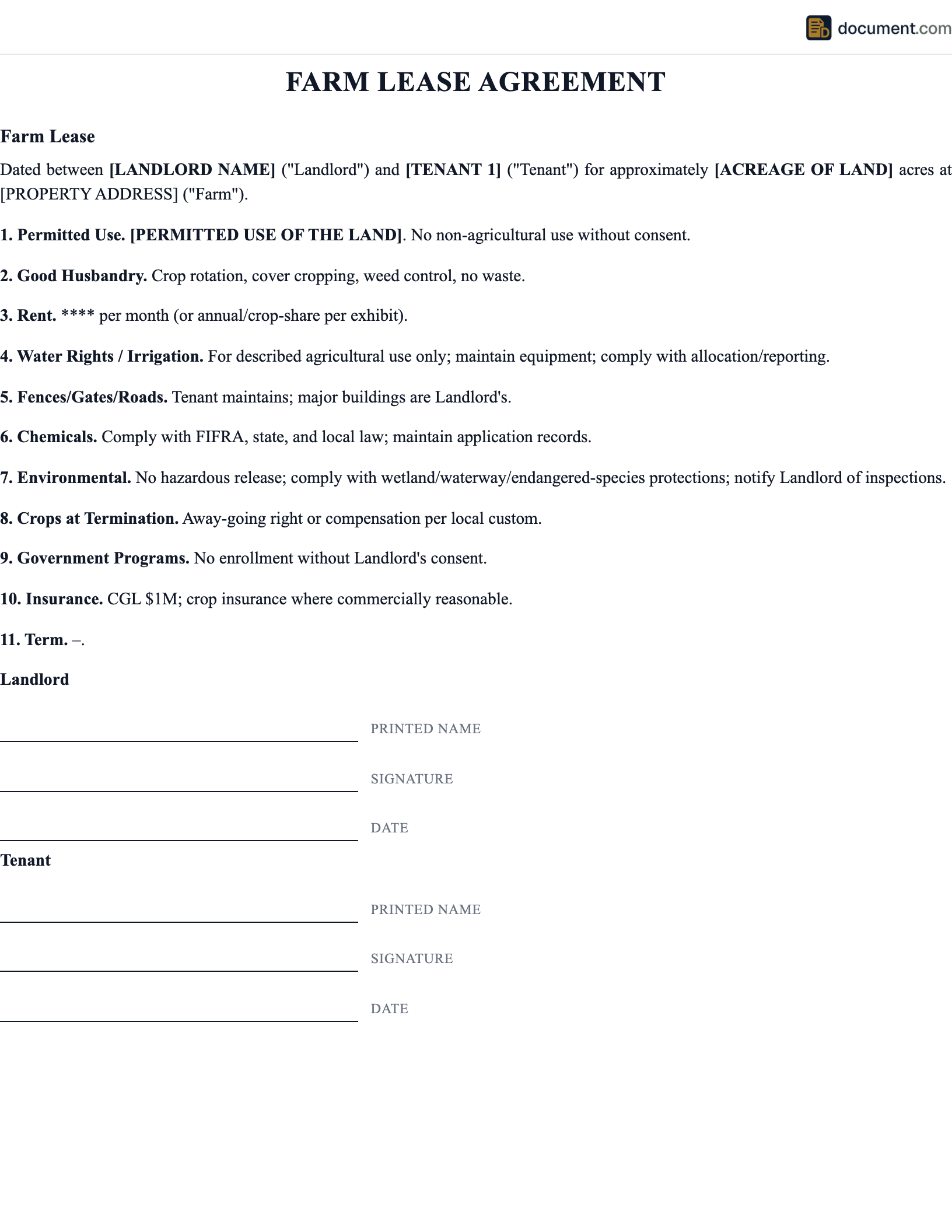
Sample Farm Lease Agreement
Below is a condensed preview of our standard farm lease template. Your final document will be customized for your acreage, rent structure, crop program, and state requirements.
FARM LEASE AGREEMENT
Agricultural Land Lease
This Farm Lease Agreement ("Lease") is entered into as of[Date]between [Landowner]("Landowner") and [Tenant]("Tenant").
1. PROPERTY
Landowner leases to Tenant the following described real property:[Legal Description], consisting of approximately [acres]total acres, of which [acres]are tillable.
2. TERM AND RENT
The lease term begins [Date]and ends [Date]. Tenant shall pay cash rent of $[amount]per tillable acre per year, payable in two equal installments on March 1 and September 1.
3. CONSERVATION
Tenant shall farm in accordance with the NRCS conservation plan for the property and shall comply with all USDA conservation compliance requirements. Tenant shall plant cover crops on all harvested acres by [Date]each year.
4. WATER RIGHTS
Landowner holds all water rights appurtenant to the property and grants Tenant the right to use water for agricultural purposes during the lease term. Tenant shall pay all irrigation costs, including electricity, well maintenance, and water district assessments.
5. IMPROVEMENTS
Tenant shall maintain all existing fences, drainage tile, waterways, and access roads in good repair. Capital improvements require Landowner's prior written consent. Tenant improvements may be removed at the end of the lease provided the land is restored to its prior condition.
6. TERMINATION
Either party may terminate this Lease by giving written notice at least[days] days before the end of the current lease year. If neither party gives notice, the Lease renews automatically for one additional year on the same terms.
Frequently Asked Questions
Answers to common questions about farm lease agreements, rent structures, conservation requirements, water rights, improvements, and crop disposition.
Official Resources
For additional information on agricultural leasing, farm program compliance, and conservation requirements, consult these official resources.
USDA NASS Cash Rent Survey
Annual county-level cash rental rate data for cropland and pasture
USDA Natural Resources Conservation Service
Conservation planning, soil surveys, and stewardship programs
USDA Farm Service Agency
Farm program enrollment, CRP, ARC/PLC, and farm loan information
USDA Risk Management Agency
Federal crop insurance programs and tools for risk management
AgLease101.org
Farm lease education resources from North Central Farm Management Extension
Iowa State Extension - Farm Leasing
Comprehensive farm leasing guides, surveys, and sample lease forms
Create your Farm Lease Agreement in under 10 minutes.
Answer a few questions and download a compliant, attorney-drafted document ready for your state.