



What Is a Notice of Current Rent Balance?
A notice of current rent balance is a written accounting that itemizes a tenant's outstanding obligations under the lease. It identifies base rent owed by month, late fees calculated to the lease and state cap, sub-metered utilities, common-area or NNN charges where the lease assigns them, payments received and how they were allocated, and the running balance as of the notice date. Most landlords issue it within 5 to 10 days after rent becomes delinquent, before escalating to a statutory pay-or-quit. The notice has no statutory effect on its own and does not start an eviction clock, which is precisely its function: it gives the tenant a documented opportunity to cure without invoking unlawful detainer procedure.
Courts treat the notice as evidence on two distinct issues. First, it documents demand and the tenant's actual notice of the balance, which forecloses later challenges that the tenant did not know what was owed. Second, in security-deposit litigation under California Civil Code §1950.5, Texas Property Code §92.103, Florida §83.49, or the equivalent in other states, the contemporaneous ledger admitted with the notice supports the deductions claimed against the deposit. A notice with sloppy math, missing payment credits, or fees above the state cap weakens both the deposit case and any later eviction filing.
The notice also functions as the predicate document for rental assistance. Most state Emergency Rental Assistance Programs and city-level subsidies require the landlord to submit a current balance statement as part of the tenant's application package. Where the program conditions disbursement on partial forgiveness or a 60 to 120 day eviction moratorium, the notice establishes the baseline against which the waiver is calculated.
Pay-or-Quit Predicate in Most States
In the majority of jurisdictions the rent balance notice is the practical predecessor to a statutory pay-or-quit demand. California requires a 3-day notice under CCP §1161(2) stating the precise sum due. Texas requires the lease-specified period or 3 days under Property Code §24.005. New York requires a 14-day rent demand under RPAPL §711(2) before holdover proceedings. Florida requires 3 days excluding weekends and holidays under §83.56(3). Oregon ORS 90.394 sets a 72-hour or 144-hour pay-or-quit depending on cure history. The rent balance notice supplies the figure the formal pay-or-quit must restate, and incorrect amounts in the formal notice are routinely fatal to eviction filings, so accuracy at this stage is the foundation for everything downstream.
FDCPA Implications for Third-Party Servers
When the notice is served by a property manager, collection agency, or attorney rather than the owner directly, the Fair Debt Collection Practices Act (15 USC §1692) applies. Section 1692g requires the initial communication to include the amount of the debt, the creditor's name, a 30-day window for the consumer to dispute, and a statement that the debt will be assumed valid absent timely dispute. Section 1692e prohibits false representations including misstating the amount or implying eviction without legal authority. Section 1692k authorizes statutory damages of up to $1,000 per violation plus attorney fees. Owners self-collecting rent are usually exempt from the FDCPA under §1692a(6) but remain subject to state consumer-protection statutes, several of which mirror the federal framework.
Ledger Itemization
Charges and payments by date with running balance
Late Fee Compliance
Calculated within state caps and lease terms
Pre-Eviction Demand
Documents demand before statutory pay-or-quit
Form Preview
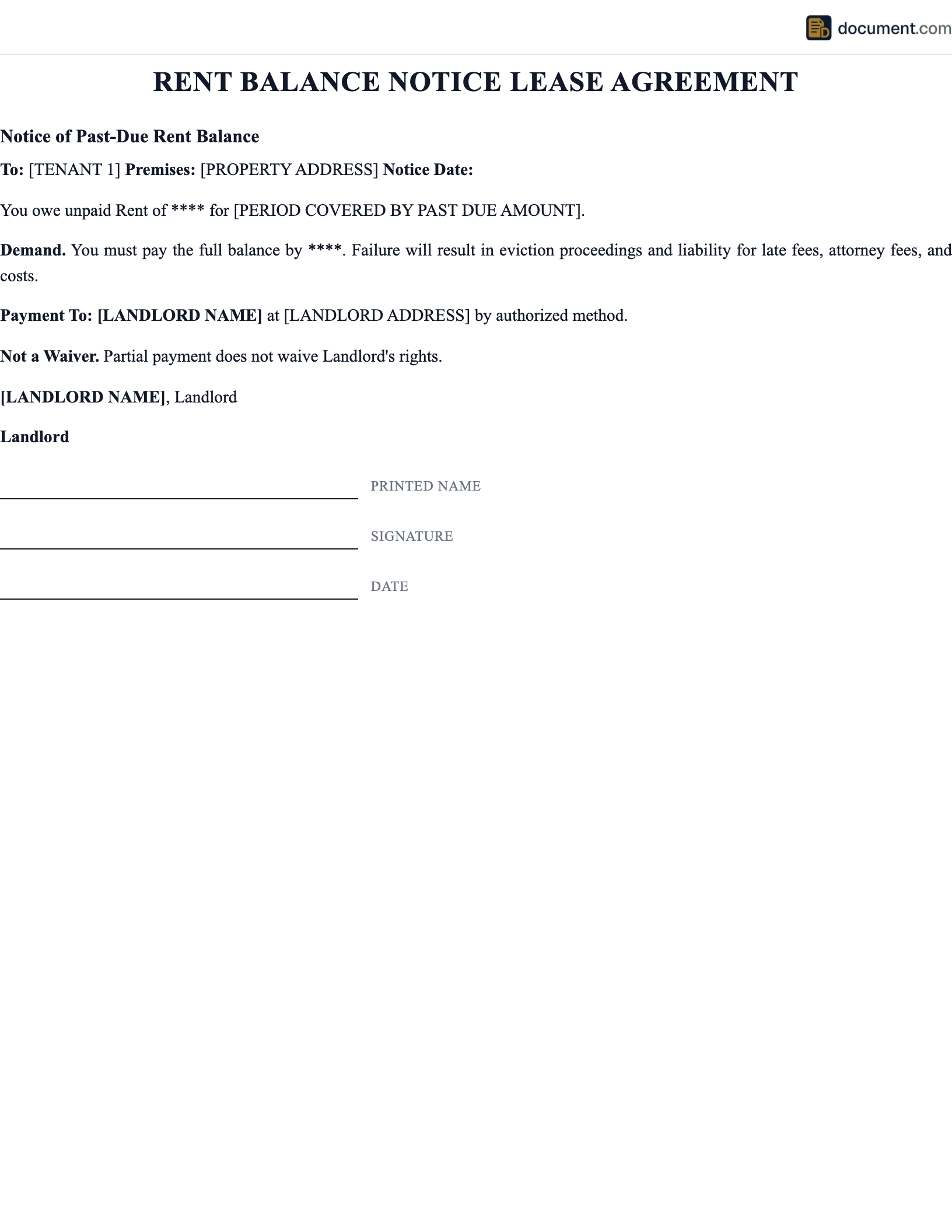
Below is a preview of the Notice of Current Rent Balance template. Your customized document will include all provisions for your specific situation.
NOTICE OF CURRENT RENT BALANCE
Tenant Account Statement
This document is entered into on [Date] between the parties identified below:
LANDLORD:
Name: [Landlord Name]
TENANT:
Name: [Tenant Name]
How to Use This Document
The notice is most useful when assembled directly from the rent ledger and served with documented proof. Sloppy figures invite tenant disputes and weaken any later eviction filing that must restate the same amount.
Building an Accurate Ledger
Pull the tenant ledger from the last zero-balance forward. List each charge by date with description (base rent, prorated rent, parking, sub-metered utility, NNN allocation, late fee). List each payment by date with method (check number, ACH transaction ID, money-order serial). Apply payments per the lease's allocation clause; absent a clause, most states default to allocating to oldest charges first. Note any disputed credits separately so the tenant can see the basis. The running balance column is what the tenant must reconcile.
Calculate the Current Balance
Reconcile the tenant ledger against bank deposits, ACH receipts, and any partial payments. Apply credits per the lease's payment-allocation clause, or default to oldest-charges-first if silent.
Itemize All Charges
List rent, fees, and utilities by date. Show every payment. Calculate the running balance so the tenant can verify each line. Lump-sum demands are routinely challenged and weaken later filings.
Set a Payment Deadline
Allow 5 to 14 days depending on the urgency and prior payment history. State the late fees that will accrue if the deadline lapses, and identify the next step (statutory pay-or-quit) so the tenant understands escalation.
Deliver the Notice Properly
Personal delivery with a witness, plus certified mail with return receipt. Email if the lease authorizes electronic notice. Retain the green card and a proof-of-service affidavit; courts treat the certified-mail return receipt as prima facie evidence of delivery.
Key Components
Each component below addresses a specific evidentiary or compliance function. Omit any one and the notice loses force as a predicate to pay-or-quit or as evidence in deposit litigation.
State-Specific Late Fee Caps
California enforces reasonableness under Civil Code §1671(d), with courts treating fees above 6 percent of monthly rent as presumptively unenforceable. Texas Property Code §92.019 caps late fees at 12 percent of monthly rent for properties with four or fewer units and 10 percent for larger properties, after a 3-day grace period. Massachusetts G.L. c. 186 §15B(1)(c) prohibits late fees before the rent is 30 days late and caps recovery at $5 per day thereafter. Chicago's RLTO §5-12-140 caps late fees at $10 per month for rent under $500 and $10 plus 5 percent of the excess for higher rents. New York's Housing Stability and Tenant Protection Act of 2019 caps late fees statewide at $50 or 5 percent of monthly rent, whichever is less.
| Component | Description |
|---|---|
| Tenant Information | Full name and rental unit address |
| Statement Period | Date range covered by the balance notice |
| Charges Breakdown | Itemized list of rent, fees, and other charges by date |
| Payments Received | Record of all payments and credits applied |
| Current Balance | Total outstanding amount owed as of the notice date |
| Payment Instructions | Deadline, accepted methods, and where to send payment |
Frequently Asked Questions
Find answers to common questions about the Notice of Current Rent Balance.
Resources
Create your Rent Balance Notice Lease Agreement in under 10 minutes.
Answer a few questions and download a compliant, attorney-drafted document ready for your state.