
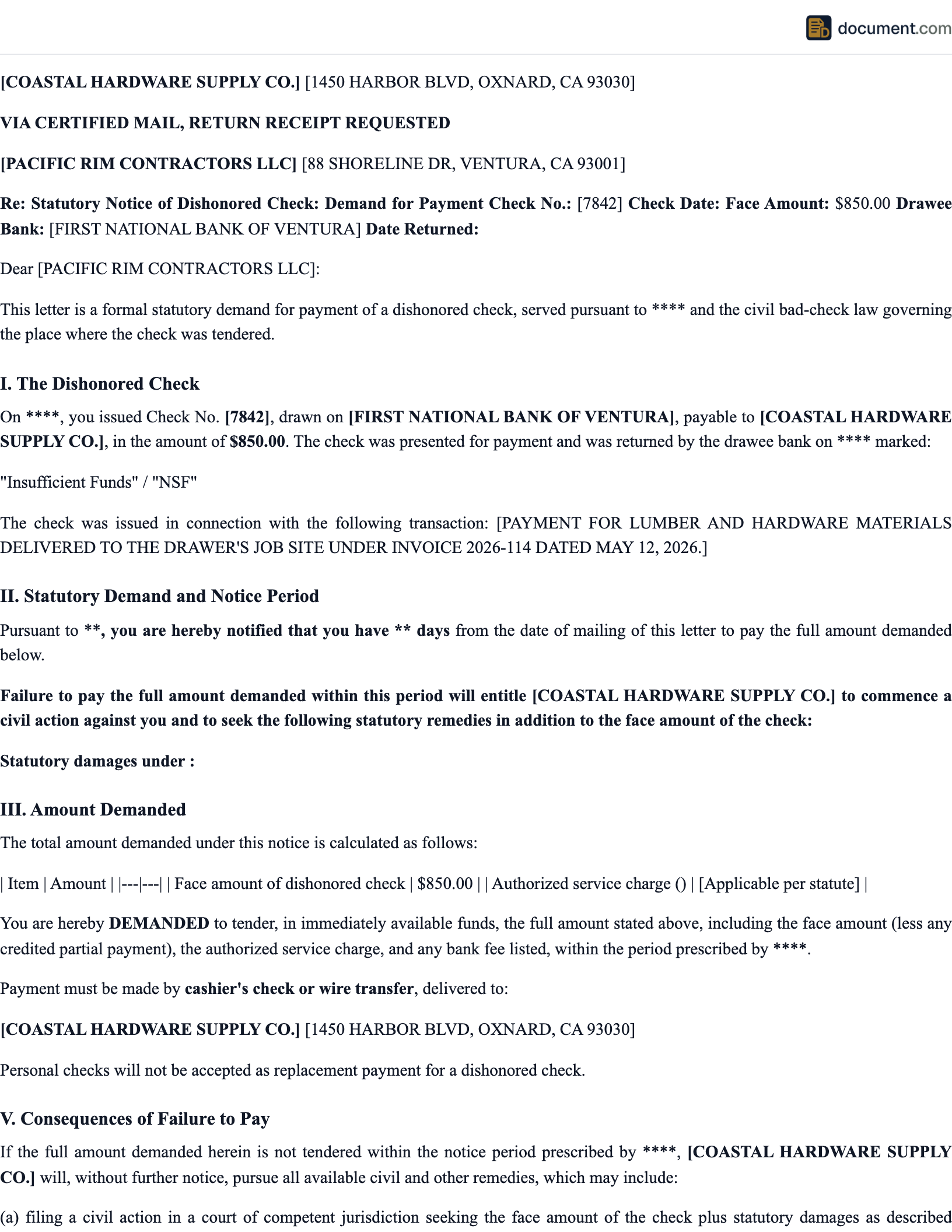



Key Takeaways
- •A notice of dishonored check (also called a bad check notice or bounced check letter) is a written demand the holder of a returned check sends to the drawer, giving that person a fixed number of days to pay before civil penalties apply. This dishonored check demand letter is a legal prerequisite to collecting enhanced damages in nearly every state.
- •Most states allow treble damages (three times the check amount) once the notice period expires without payment. Many cap the enhancement at $500 above the face amount; a few go higher. States that deviate include New York (double damages, capped at $400 or $750 depending on the reason for dishonor) and some smaller states with flat penalty structures.
- •Notice periods under each state bad check law range from 10 days (Georgia, Hawaii, Montana, Pennsylvania, Idaho, New Mexico) to 35 days (New Jersey). Thirty days is the most common floor, applying in California, Florida, Ohio, Oregon, Colorado, and roughly half of all states.
- •Service charges on top of the check amount are authorized separately in most states and range from $10 (West Virginia, North Dakota) to $50 (Virginia, Pennsylvania). In states like Louisiana, the charge is the greater of $25 or 5 percent of the check face amount.
- •Notice method matters. Most statutes require certified or registered mail with return receipt, often paired with a simultaneous first-class mailing. New York requires two separate mailings before the enhanced-damage period opens. Proof of mailing is the first thing a court and the other side will examine.
- •This page provides educational information about civil bad-check statutes and notice requirements. It is not legal advice. The applicable statute in any particular situation depends on where the check was drawn and where the action is filed. Confirm the current statutory text before sending a notice that will be used in litigation.
Reviewed for accuracy by the document.com legal team. Educational information, not legal advice.
Interactive Tool
Bad-Check Civil Damages Estimator
Enter the check amount and select a state to estimate your civil recovery range under that state's bad-check statute. All figures are estimates only -- verify the current statutory text before relying on these numbers.
Estimates only. Statutes are amended periodically. Actual recovery depends on facts, notice compliance, and court interpretation. Not legal advice.
Damages Calculator
A notice of dishonored check is a formal written demand the holder of a returned check sends to the person who wrote it, informing that person the check was not honored and demanding payment within a set number of days. The document triggers a statutory waiting period. Once that period runs without full payment, the holder gains the right to sue not only for the face amount of the check but also for civil penalties, often called treble damages or statutory damages, that can far exceed what the check was worth.
The notice is the gatekeeper to the civil bad-check remedy. A payee who skips it and goes straight to court generally cannot collect the enhanced penalties, and in some states loses the right to attorney fees as well. The requirement is baked into the statute in almost every jurisdiction: the holder must mail the demand, wait the prescribed number of days, and only then file suit if payment has not arrived.
Every state has a bad-check criminal statute, but the civil remedy is a separate track. The civil notice is not a report to the district attorney. It is a direct, private demand between the payee and the check writer. Many payees use the civil route because it is faster, does not require a criminal conviction, and produces a money judgment the payee can enforce directly. Some states explicitly provide that the civil action and the criminal prosecution can proceed on parallel tracks.
The document typically contains the date of the check, the amount, the name of the drawee bank, the reason the check was returned (insufficient funds, closed account, or stop payment), the statutory citation that authorizes civil penalties, the amount the holder demands, the payment deadline, and instructions for how to pay. Several state statutes, including Georgia, prescribe the exact language the notice must use or provide a form the holder can adapt.
Pairs naturally with a demand letter when the underlying transaction also gives rise to a contract or other claim. Where the bounced check was partial payment on a larger debt, a combined demand letter covering the full balance and the statutory bad-check notice for the check itself can be sent together, reducing the total number of mailings and preserving all of the holder's remedies at once.
From Bounced Check to Recovery
Check Bounces
Bank returns the check: NSF, closed account, or stop payment. Get the bank's dishonor notice in writing.
Send Statutory Notice
Mail the demand by certified mail (plus first-class copy in most states) with the required statutory language and your total demand amount.
Wait the Notice Period
Periods range from 10 days (Georgia, Pennsylvania) to 35 days (New Jersey). The most common window is 30 days. Do not file before it closes.
Sue for Multiplied Damages
If the drawer has not paid in full, file suit for the check amount plus civil penalties. Most states allow 2x to 3x the amount owed, often with attorney fees.
What You Can Recover
What the check was written for
Civil penalty once notice period expires without payment
Awarded by statute in California, Florida, Illinois, New Jersey, Louisiana, Oregon, and others
Treble damages (3x) in most states; double damages in New York and a handful of others. Most states cap the penalty enhancement at a fixed dollar amount above the check face. Confirm the current statute for your state.
Notice Timeline at a Glance
Day 0
Check dishonored. Obtain the bank's written dishonor notice.
Day 1 (or soon after)
Mail statutory demand by certified mail plus first-class copy (required in CA, IL, NY, NC, and others).
Day 10 to 35
Notice period runs. 10 days in Georgia and Pennsylvania; 30 days in California, Florida, Ohio; 35 days in New Jersey.
Day 10 to 35 (paid)
Drawer pays face value plus authorized service charge. Enhanced damages do not apply once payment is made in full.
After the period expires
File suit for face value plus civil penalty (2x to 3x in most states) plus authorized fees and attorney fees where the statute allows.
Why This Document Matters
Returned checks remain one of the more reliable sources of small civil claims, and the statutory frameworks have become more payee-friendly over the past decade. Several states have raised damage caps and extended the categories of checks covered. Knowing which version of the statute is in effect matters because courts have dismissed enhanced-damage claims based on superseded notice language.
Electronic payments have not eliminated the problem. Many landlords, contractors, and small retailers still accept paper checks, and ACH returns create parallel issues in states that have extended their bad-check statutes to electronic fund transfers. California, Florida, Illinois, and several others have amended their civil bad-check statutes to cover dishonored electronic debits, so the civil notice procedure now applies to ACH transactions in those jurisdictions the same way it applies to paper checks.
The costs of a bounced check fall disproportionately on small businesses and individuals. A landlord whose tenant's security deposit check is returned, a contractor whose final payment bounces, or a vendor who accepted a bad check for goods already delivered needs a concrete legal tool. The civil bad-check notice is that tool: a single certified-mail letter that, if the drawer ignores it, converts a face-value claim into one worth two or three times as much, often with attorney fees attached.
Payment processors and collection agencies have learned to front-load the notice procedure. A business that receives returned checks repeatedly is better positioned in court if it has a documented, consistent practice of sending statutory notices on a fixed timeline from dishonor. Courts have reduced or denied enhanced damages when the holder's notice practice was sloppy, the timing was off, or the form of notice did not match the statutory requirement.
Criminal referral becomes more credible after the civil notice has been sent and ignored. Many district attorney bad-check programs will not accept a check for prosecution unless the holder has already made a written demand and the check writer has failed to respond. The civil notice letter serves double duty: it opens the enhanced civil remedy and it documents the element of intent that the criminal statute often requires.
The Legal Framework
The notice-before-suit requirement and how it works
Every state's civil bad-check statute conditions enhanced damages on a prior written demand. The structure is essentially the same everywhere: the holder sends notice by a specified method, the drawer gets a window to pay the check plus any authorized fees, and if payment is not tendered before the window closes, the holder may file suit and seek both the check amount and the statutory penalty. The purpose is to give the drawer a final chance to make the check good without litigation, while also creating the paper trail the holder needs to prove the demand element at trial. Courts strictly construe the notice requirement. A notice mailed by regular mail when the statute requires certified mail, or sent to an address other than the one printed on the check, has been found insufficient in multiple jurisdictions. If the notice is defective, the civil penalty is off the table even if the check is worthless.
Treble damages: how they are calculated and capped
The most common civil penalty formula awards the holder three times the amount owed on the check. But 'three times the amount owed' is often not the same as three times the face value of the check, because amounts paid toward the check between dishonor and demand can reduce the base. California Civil Code Section 1719 is explicit about this: treble damages are calculated on the amount still owed at the time the thirty-day demand period runs, not the original check amount. Most states also cap the enhancement. The most common cap structure is that enhanced damages may not exceed the face amount of the check by more than $500, meaning a $100 check can yield up to $600 total in enhanced damages ($100 face + up to $500 in extras), but a $10,000 check still yields only a $500 bonus on top of the $10,000 owed. Florida and a few other states use a different cap structure tied to the amount of the check itself. Some states, including New York, award double rather than treble damages, with tighter absolute caps.
Service charges: the pre-litigation fee
Most states authorize the holder to collect a service charge, separate from the check amount and from any civil penalty, at the time the demand is sent. This charge compensates the payee for the bank's returned-check fee and the administrative cost of the collection effort. The service charge is typically $20 to $35, though some states set it as a percentage: Louisiana uses the greater of $25 or 5 percent of the check face amount, which becomes significant on checks above $500. The service charge can usually be demanded in the notice letter and collected before any litigation begins. The drawer who pays the face amount plus the service charge within the notice period avoids the civil penalty entirely, even if the notice was properly sent.
Notice method: certified mail, first-class mail, and proof of mailing
Most statutes require that the demand be sent by certified mail, return receipt requested, to the address on the check or the drawer's last known address. Several states, including California, Illinois, New York, and North Carolina, additionally require a simultaneous first-class mailing. The reason for the parallel mailing is that certified mail is sometimes refused or unclaimed, and the first-class copy establishes that the drawer had a reasonable opportunity to learn of the demand. New York's statute goes further and requires two separate written demands before the holder may claim enhanced damages. Where a statute expressly allows the holder to proceed if the certified mailing is returned unclaimed, the unclaimed-mail scenario will not defeat the claim so long as the mailing was properly addressed and the first-class copy was sent.
Stop-payment checks: a different civil framework in some states
Most civil bad-check statutes cover checks dishonored because of insufficient funds or a nonexistent account. Stop-payment checks are treated differently in several states. Louisiana has a separate statute, La. R.S. 9:2782.2, specifically for checks on which the drawer stopped payment. Montana's statute expressly covers stop payments made to fraudulently defeat a possessory lien. Oregon's ORS 30.701 applies to stop-payment checks only when the stop was entered without good cause. The payee holding a stop-payment check should confirm whether the jurisdiction's civil bad-check statute covers that scenario before sending the statutory notice, because relying on the wrong provision can leave the payee with only ordinary contract damages.
Bad-Check Civil Statutes: All 50 States + DC
Every state has a civil bad-check statute allowing a payee to recover enhanced damages after sending the required written notice. The table below summarizes the controlling statute, damages formula, mandatory notice waiting period, and authorized service charge for all 51 jurisdictions. Verify the current statutory text before relying on these figures.
| State | Statute | Civil Damages | Notice Period | Service Charge | Create |
|---|---|---|---|---|---|
| Alabama | Ala. Code § 6-5-285 | Punitive and compensatory damages plus reasonable attorney fees | 10 days after certified/registered mail notice | Actual bank charges or $10, whichever is greater | Create |
| Alaska | Alaska Stat. § 09.68.115 | $100 or 3x check amount, whichever is greater; cap: amount of check + $1,000 | 15 days written demand before commencing action | Up to $30 | Create |
| Arizona | A.R.S. § 12-671 | 2x check amount or $50, whichever is greater, plus costs and attorney fees | 12 days (personal notice) or 17 days (mailed notice) | Up to $25 | Create |
| Arkansas | Ark. Code Ann. § 4-60-103 | 2x check amount, not less than $50; plus collection fee | 15 days after written demand before enhanced damages apply | Up to $30, plus any bank fees | Create |
| California | Cal. Civ. Code § 1719 | 3x amount owed; not less than $100 nor more than $1,500 | 30 days after certified mail demand | $25 for first check; $35 for subsequent checks | Create |
| Colorado | Colo. Rev. Stat. § 13-21-109 | 3x face amount; not less than $100 | 15 days after notice before civil action | Up to $20, plus bank fees | Create |
| Connecticut | Conn. Gen. Stat. § 52-565a | No account: lesser of face amount or $750; insufficient funds: lesser of face amount or $400 | 30 days after two statutory written notices | Up to $20 | Create |
| Delaware | Del. Code Ann. tit. 6, § 1301A | 3x check amount, not less than $100 nor more than $500 above check amount | 30 days after written demand | Up to $40 | Create |
| District of Columbia | D.C. Code § 28-3152 | 2x check amount or $100, whichever is greater, plus costs and attorney fees | 30 days after certified and first-class mail demand | No separate cap; damages replace service charge | Create |
| Florida | Fla. Stat. § 68.065 | 3x amount owing; not less than $50 (checks up to $50), not more than $2,500 | 30 days after written demand before treble damages | $25 if check up to $50; $30 if $50.01-$300; $40 if over $300 | Create |
| Georgia | O.C.G.A. § 13-6-15 | 2x amount owed; not more than $500; plus court costs | 10 days after certified mail demand | Up to $30 or 5% of face amount, whichever is greater, plus bank fees | Create |
| Hawaii | Haw. Rev. Stat. § 490:3-506 | 3x check amount; plus incurred costs and attorney fees | 10 days after certified mail demand | $25 for first check; $35 for subsequent checks | Create |
| Idaho | Idaho Code § 28-22-105 | 3x check amount; cap: check amount + $500; plus 12% annual interest | 10 days after written demand (15 days to avoid liability for costs) | Up to $20, or face amount if less | Create |
| Illinois | 720 ILCS 5/17-1(E) | 3x amount owed; not less than $100 nor more than $1,500; plus attorney fees | 30 days after certified and first-class mail demand | Up to $25 | Create |
| Indiana | Ind. Code § 34-24-3-1 | 3x check amount; not to exceed $500 above check amount; plus attorney fees (min. $100) and 18% interest | Notice required; treble damages available after failure to cure | Reasonable fees | Create |
| Iowa | Iowa Code § 554.3513 | 3x face value; cap: check amount + $500 | 30 days written demand before filing | Up to $30 | Create |
| Kansas | Kan. Stat. Ann. § 60-2610 | 3x check amount, not to exceed check amount + $500; or $100, whichever is greater | 30 days after written demand | Up to $30 | Create |
| Kentucky | KRS § 514.040 / KRS § 514.030 | Civil action for actual damages; county attorney program collects $50 merchant fee per check | 10 days after written notice from county attorney's office | Up to $50 through county attorney program | Create |
| Louisiana | La. R.S. § 9:2782 | 2x check amount or $100, whichever is greater; plus court costs and attorney fees | 15 working days after certified/registered mail notice | $25 or 5% of face amount, whichever is greater | Create |
| Maine | Me. Rev. Stat. tit. 14, § 6071 | 2x face amount or $400 (insufficient funds) / $750 (no account), whichever is less; plus civil penalty up to $150 | 10 days after written notice of dishonor; 30 days for enhanced damages | Up to $25 | Create |
| Maryland | Md. Code, Com. Law §§ 15-801 to 15-804 | 2x check amount, not more than $1,000; plus $35 collection fee | 30 days after mailing notice of dishonor | Up to $35 | Create |
| Massachusetts | Mass. Gen. Laws ch. 93, § 40A | Additional liquidated damages not less than $100 nor more than $500 | 30 days after certified and regular mail demand | Actual bank fees recoverable | Create |
| Michigan | Mich. Comp. Laws § 600.2952 | 2x check amount or $100, whichever is greater | 30 days after mailing of notice | Up to $35 processing fee | Create |
| Minnesota | Minn. Stat. § 604.113 | Civil penalty up to $100 or face value of check, whichever is greater | 30 days after certified mail notice of dishonor | Up to $30 (if conspicuously posted at point of sale) | Create |
| Mississippi | Miss. Code Ann. § 11-7-12 / § 97-19-67 | Civil penalty recoverable; restitution of face amount plus service charge | 15 days after written notice before prosecution or civil action | Up to $30 | Create |
| Missouri | Mo. Rev. Stat. § 570.120 | 3x face amount or $100, whichever is greater; not to exceed check + $500 | 30 days after written demand | Up to $25 | Create |
| Montana | Mont. Code Ann. § 27-1-717 | $100 or 3x check amount, whichever is greater; cap: check amount + $500; plus service charge | 10 days written demand before commencing action | Up to $30 | Create |
| Nebraska | Neb. Rev. Stat. § 28-611 | Restitution of check amount plus $10 and reasonable bank fees; criminal restitution available | 10 days after receiving dishonor notice from county attorney | $10 plus reasonable bank handling fees | Create |
| Nevada | Nev. Rev. Stat. § 41.620 | 3x check amount; not less than $100 nor more than $500 above check amount | 30 days after certified mail demand | Up to $25 | Create |
| New Hampshire | N.H. Rev. Stat. Ann. ch. 544-B:1 | $10/day until paid, up to $500 maximum; plus costs and collection fees | 10 days after written notice | Actual court and collection costs | Create |
| New Jersey | N.J. Stat. Ann. § 2A:32A-1 | $100 or 3x check amount, whichever is greater; cap: check + $500 | 35 days after certified mail demand | Reasonable attorney fees and mailing costs | Create |
| New Mexico | N.M. Stat. Ann. § 56-5-2 | $100 or 3x check amount, whichever is greater; not to exceed check + $500 | 10 days after certified mail demand (notice must warn of triple damages) | Up to $25 | Create |
| New York | N.Y. Gen. Oblig. Law § 11-104 | No account: 2x face amount or $750, whichever is less; insufficient funds: 2x amount or $400, whichever is less | 30 days after second certified mail demand | Bank fees recoverable | Create |
| North Carolina | N.C. Gen. Stat. § 6-21.3 | 3x amount owed; not less than $100 nor more than $500 | 30 days after certified mail demand | Actual bank fee plus processing fee under N.C.G.S. 25-3-506 | Create |
| North Dakota | N.D. Cent. Code § 6-08-16 | $100 or 3x check amount, whichever is less; plus collection costs up to $10 | 30 days written demand | Up to $10 | Create |
| Ohio | Ohio Rev. Code § 2307.61 | 3x check value; plus collection fees, bank fees, and reasonable attorney fees | 30 days written demand before filing suit | Actual bank charges | Create |
| Oklahoma | Okla. Stat. tit. 22, § 114 / tit. 68, § 218 | Civil damages available; 5-day cure period after dishonor before criminal/civil exposure | 5 days after dishonor for cure before full liability attaches | Administrative fee authorized under tit. 68, § 218 | Create |
| Oregon | ORS § 30.701 | $100 or 3x check amount, whichever is greater; cap: check + $500; plus attorney fees | 30 days written demand before commencing action | Up to $35 | Create |
| Pennsylvania | 42 Pa. C.S. § 8304 | $100 or 3x check amount, whichever is greater; cap: check + $500 | 10 days written demand before filing | Up to $50 (or actual bank fee if greater than $50) | Create |
| Rhode Island | R.I. Gen. Laws § 6A-3-506 | 3x check amount; not less than $200 nor more than $1,000 | 30 days after written demand | Up to $25 | Create |
| South Carolina | S.C. Code Ann. § 34-11-75 | Lesser of $500 or 3x amount owed; plus court costs | 30 days after certified mail demand | Up to $30 | Create |
| South Dakota | SDCL § 21-57-1 | 3x face amount; not less than $100 nor more than $200 above face amount; plus court costs and legal interest | 30 days after mailing notice of dishonor | Actual collection costs | Create |
| Tennessee | Tenn. Code Ann. § 47-29-101 | 3x face amount; cap: check + $500; plus 10% interest, service charges, attorney fees, court costs | 30 days after certified mail notice warning of treble damages | Reasonable service charges incurred by payee | Create |
| Texas | Tex. Bus. & Com. Code § 3.506 / Tex. Civ. Prac. & Rem. Code § 17.505 | 3x check amount; not less than $100 nor more than $500 above check amount; plus attorney fees | 30 days after written demand (Tex. Bus. & Com. Code § 3.506) | Up to $30 | Create |
| Utah | Utah Code Ann. § 7-15-2 | 3x check amount or $100, whichever is greater; cap: check + $500; plus interest, costs, and attorney fees | 30 days written demand before filing | Up to $20 | Create |
| Vermont | 9 V.S.A. § 2311 | $50 plus face amount, bank fees, interest, attorney fees, and court costs | 30 days after certified and first-class mail notice | Actual bank fees recoverable | Create |
| Virginia | Va. Code Ann. § 8.01-27.2 / § 8.01-27.1 | Lesser of $250 or 3x check amount; plus $50 processing charge, bank fees, interest, and attorney fees | 30 days after written notice by certified, registered, or regular mail | $50 processing charge per § 8.01-27.1 | Create |
| Washington | RCW § 62A.3-515 | 3x face amount or $300, whichever is less; plus reasonable attorney fees; plus 12% interest | 15 days after notice of dishonor | Collection costs up to $40 | Create |
| West Virginia | W. Va. Code § 61-3-39a | Face amount + $500 or face amount doubled, whichever is less; plus filing costs | 30 days written demand | Up to $10 | Create |
| Wisconsin | Wis. Stat. § 943.245 | Face value + actual damages + exemplary damages up to 3x combined; total exemplary damages and attorney fees capped at $500 per violation | 20 days written notice before commencing action | No separate statutory cap in civil section | Create |
| Wyoming | Wyo. Stat. Ann. § 1-1-115 | 3x check amount; not less than $100; plus collection costs and reasonable attorney fees | 30 days after written demand by certificate of mailing | Up to $30 | Create |
Compiled from primary state statutes and verified against official state legislature sources. Statutes are amended periodically; confirm the current enrolled text before sending a notice intended for use in litigation. This table does not constitute legal advice.
What a proper notice of dishonored check contains
Start with the date of the notice, not the date the check was written. The notice period runs from the date of mailing or the date of receipt, and courts measure the window from that date. A notice that is undated or inconsistently dated creates ambiguity about when the clock started.
Identify the check with specificity. Include the check number, the date written on the check, the amount, the name of the bank on which the check was drawn, and if available, the account number (partially redacted if the account has not been closed). Vague references to 'your check' without identifying information leave open a dispute about which instrument is the subject of the demand.
State the reason for dishonor as it appears on the bank's return notice: insufficient funds, closed account, or payment stopped. The reason matters for two reasons. First, some states calculate damages differently depending on whether the check was returned for NSF versus a closed account. Second, the reason for dishonor can affect whether the civil statute applies at all. A check returned for a missing signature or a technical defect in the instrument is not necessarily a civil bad-check situation.
State the total amount demanded. That figure is the face amount of the check, plus the service charge the statute authorizes (if you are claiming it), plus any bank fee the holder incurred and the statute allows the holder to recover. Do the arithmetic and show it. A demand that just says 'pay the check plus fees' without specifying the total has led courts in several states to deny the service charge because it was not adequately demanded.
Cite the controlling statute by section number and reproduce the key language the statute requires to appear in the notice. Georgia's O.C.G.A. 13-6-15 prescribes specific language about the ten-day cure period and the double-damage consequence of failure to pay. California's Civil Code Section 1719 requires that the demand letter state that treble damages may be sought. New Mexico's statute requires the notice to say specifically that triple damages may be incurred. Missing the statutory-language requirement in a notice is the most common procedural defect that defeats the civil penalty claim.
State the payment deadline in plain terms: the number of days from the date of mailing and the resulting calendar date. Do not leave it to the reader to calculate. For a California notice sent on a Monday, the demand reads: 'You have 30 days from the date of mailing of this letter, until [specific date], to pay the full amount demanded.' A deadline that is clear on its face removes any argument that the drawer misunderstood when the window closed.
Provide payment instructions. Name the payee to whom the check should be made out, the address for delivery, and whether a cashier's check or money order is required. Most payees reasonably require that replacement funds be certified, given that the original check was returned. Say so explicitly.
Sign the letter and provide a return contact. The notice should come from the payee or the payee's authorized agent, and it should identify who the drawer can contact with questions about payment. An unsigned demand, or one that comes from a third party without disclosing the authority to collect, can create technical objections about who holds the claim.
When You Need This Notice
You received a check that was returned by the bank for insufficient funds and you want to preserve your right to collect civil penalties above the face amount. Sending the notice starts the clock; failing to send it forecloses the enhanced remedy.
You received a check on a closed account. Most civil bad-check statutes cover closed-account checks, and some states actually provide higher damages for a closed-account dishonor than for NSF, because closing an account before writing the check is stronger evidence of intent.
You received a stop-payment check without apparent justification. Before sending a statutory notice in a stop-payment situation, confirm that the state's civil bad-check statute covers stop payments, because Oregon, Montana, and others condition the civil remedy on the stop payment being made without good cause.
You are a landlord who received a bounced security deposit or rent check and want to pursue the maximum civil remedy allowed by state law before deciding whether to involve the district attorney's program.
You are a contractor or vendor whose customer paid for goods or services with a check that was returned and the customer has not responded to informal outreach. The statutory notice creates a formal record that the claim is in dispute and that you have exhausted the informal cure opportunity.
You are a collection agency or assignee that acquired a dishonored check from the original payee. Most state civil bad-check statutes expressly cover holders and assignees, not just original payees. Confirm the assignment is properly documented before sending the notice in the assignee's name.
You want to preserve the ability to refer the check for criminal prosecution. Most district attorney bad-check programs require proof that a civil demand was sent and ignored before they will accept a check for prosecution. Sending the statutory notice and retaining the certified-mail receipt satisfies that prerequisite.
You are preparing to file in small claims court. Small claims courts in most states hear civil bad-check cases, and judges in those courts are familiar with the statutory notice requirement. A clean certified-mail receipt and a copy of the notice will often resolve the case on the papers without a contested hearing.
How to Fill Out Notice of Dishonored Check (Bad Check Notice)
1. Gather the bank's return document
Before you draft the notice, obtain the bank's notice of dishonor. This document states the reason the check was returned: NSF, closed account, or payment stopped. You need the exact reason, because some states calculate damages differently based on it, and some state statutes only cover certain types of dishonor. The bank's notation also provides the date of dishonor, which starts the limitations clock and should be recited in the notice.
2. Identify the controlling statute
Look up the civil bad-check statute for the state where the action will be filed, which is typically the state where the payee's business is located or where the check was tendered. Note the damages formula, the service charge limit, the required notice period, and any mandatory language the statute says must appear in the demand. Compare the statute's current text to what you find in summaries, because legislatures do amend these provisions. Your state's legislature website will have the current enrolled version.
3. Calculate the demand amount
Add the face amount of the check, the service charge the statute allows (if you are claiming it), and any bank fee you incurred that the statute permits the holder to recover. Write out the calculation in the notice. For example: 'Check amount: $350.00. Service charge authorized by [statute]: $30.00. Bank returned-check fee: $12.00. Total demanded: $392.00.' Showing the math removes ambiguity and prevents a dispute about what 'the full amount' means when payment arrives.
4. Draft the notice with the required statutory language
Use plain language, but do not omit the statutory citations and any mandatory phrases the controlling statute requires. California requires language about the possibility of treble damages. New Mexico requires the notice to state that triple damages may be incurred if payment is not received within ten days. Georgia prescribes a notice form in the statute itself. If the statute prescribes a form or specific language, use it verbatim. Paraphrasing a required statutory phrase can invalidate the enhanced-damage claim.
5. Set the payment deadline as a calendar date
Convert the notice period to a specific date. If the statute requires 30 days and you mail the notice on June 10, write 'on or before July 10' in the letter. Do not just say '30 days from mailing'; specify the date. If the statute measures from the date the drawer receives the notice rather than the date of mailing, allow for mail delivery time and state the assumed receipt date. When the deadline is ambiguous, courts sometimes find the notice deficient.
6. Send by certified mail, return receipt requested, with simultaneous first-class copy
Address the certified mailing to the address printed or written on the check, or to the drawer's last known address if that address is different and you can verify it. In states that require a simultaneous first-class mailing (California, Illinois, New York, North Carolina, and others), send the duplicate the same day. Retain: the original check (or a clear copy), the certified mail receipt, the tracking confirmation showing when and to which address it was sent, and if returned unclaimed, the envelope with the postal notation. These are the exhibits at trial.
7. Wait the full notice period before filing
Do not file suit before the notice period runs. Filing even a day early can cause the court to dismiss the enhanced-damage claim, and some statutes provide that an action filed prematurely forfeits the civil penalty entirely. If the drawer sends partial payment during the notice period, note the receipt, apply it to the balance, and decide whether the reduced balance changes your calculation of enhanced damages under the statute (some states compute treble damages only on the unpaid portion).
8. File in the appropriate court and include your documentation
Civil bad-check cases for amounts within the small claims ceiling can usually be filed in small claims court without an attorney. For larger amounts, file in the appropriate civil court. In your complaint, attach a copy of the original check, the bank's dishonor notice, the demand letter you sent, and the certified mail proof. These exhibits establish each element of the statutory claim: dishonor, written demand, service on the drawer, expiration of the notice period, and failure to pay. Courts grant default judgment in straightforward cases where this documentation is complete.
Key Terms Defined
- Dishonored check
- A check that the drawee bank refuses to pay, whether because the drawer has insufficient funds on deposit, the account is closed, or the drawer stopped payment. The reason for dishonor matters under some state civil statutes, which treat closed-account checks differently from NSF checks or provide a separate framework for stop-payment checks.
- Drawer
- The person or entity that signed and issued the check. In the civil bad-check context, the drawer is the respondent to the demand letter and the defendant in a civil action to collect the penalty.
- Holder
- The person or entity in possession of the check at the time of dishonor, which is typically the payee but can also be an assignee or collection agency that has acquired the check. Most civil bad-check statutes use 'holder' broadly to include any person entitled to enforce the instrument.
- Notice period
- The number of days the drawer has after receiving the written demand to pay the check plus authorized fees before the holder may sue for civil penalties. Notice periods range from 10 days in Georgia and New Mexico to 35 days in New Jersey. The most common period is 30 days.
- Service charge
- A fee the holder may charge the drawer at the time of demand to compensate for the cost of the returned check, separate from the face amount and from any civil penalty. Authorized service charges range from $10 to $50 depending on the state, with a few states setting the charge as a percentage of the face amount.
- Treble damages
- A civil penalty equal to three times the amount of the dishonored check or the unpaid balance at the time the notice period expires. Most states allow treble damages, but many cap the total enhancement at a fixed dollar amount above the check face (commonly $500). The treble calculation is conditioned on the holder having sent the statutory notice and the drawer having failed to pay within the notice period.
- NSF
- Not sufficient funds. A check returned NSF means the drawer's bank account existed but had less money in it than the check required. This is the most common reason for dishonor. Most states treat NSF checks and closed-account checks the same under the civil bad-check statute, though a few states provide higher penalties for the closed-account scenario.
- Stop-payment check
- A check on which the drawer instructed the bank not to honor payment. A stop payment made with the intent to defraud or without legitimate cause falls within the civil bad-check statutes in most states, but several states expressly exclude stop payments made for good cause, such as a dispute about the underlying goods or services.
Related Documents
Notice of dishonored check vs. demand letter
A general demand letter is a request for payment of a debt. A notice of dishonored check is a specific statutory prerequisite to collecting civil penalties under the applicable bad-check statute. A demand letter can cover a bounced check, but only the statutory notice, sent in the required form with the required language and waiting period, unlocks the treble-damage remedy. Where the check is one component of a larger debt, consider sending both: the statutory notice for the check itself and a demand letter covering any remaining balance.
Notice of dishonored check vs. collections lawsuit
The statutory notice is the step before the lawsuit, not the lawsuit itself. Filing suit without sending the notice first forecloses the enhanced damages in virtually every state. Once the notice period runs without payment, the civil action becomes available and in most states can be filed in small claims court if the amount is within the jurisdictional threshold. The notice letter is to the lawsuit what a prerequisite statute is to the cause of action.
Notice of dishonored check vs. criminal bad-check referral
Civil and criminal bad-check procedures serve different purposes and run on different tracks. The civil notice is a private remedy between the payee and the drawer. The criminal prosecution is brought by the state and aims at punishment rather than compensation. Many district attorney bad-check programs use the civil notice process as a filter: they require evidence that a civil demand was sent and ignored before accepting a check for criminal prosecution. The civil notice letter often serves as that proof, making it the natural first step whether your goal is compensation or criminal referral.
Notice of dishonored check vs. ACH return notice
An ACH return is an electronic bank debit that is rejected, and it is the functional equivalent of a bounced check in many commercial contexts. Several states, including California, Florida, and Illinois, have extended their civil bad-check statutes to cover dishonored electronic transfers. In those states, the same notice procedure, the same waiting periods, and the same treble-damage framework apply to an ACH return as to a paper check. Confirm whether the state statute covering your transaction has been amended to include electronic funds transfers before deciding which notice form to use.
Legal Authorities & Sources
This page is grounded in primary law. The statutes and official resources below are the authorities behind the guidance above. Verify the current text of any statute before relying on it.
- California Civil Code Section 1719 (bad check civil remedy, treble damages, 30-day notice)
- Florida Statutes Section 68.065 (worthless check civil action, treble damages, 30-day notice)
- Georgia Code Section 13-6-15 (damages for writing bad checks, 10-day notice, double damages)
- Illinois Compiled Statutes 720 ILCS 5/17-1(E) (civil liability, treble damages, 30-day notice)
- New York General Obligations Law Section 11-104 (civil action for bad checks, double damages, 30-day notice)
- Michigan Compiled Laws Section 600.2952 (dishonored check civil remedy, double damages)
- Oregon Revised Statutes Section 30.701 (actions against maker of dishonored check, treble damages, 30-day notice)
- Alaska Statutes Section 09.68.115 (bad check civil penalties, 15-day notice)
- Maine Revised Statutes Title 14, Section 6071 (civil penalties for bad checks)
- North Carolina General Statutes Section 6-21.3 (remedies for returned checks, 30-day notice, treble damages)
- Colorado Revised Statutes Section 13-21-109 (treble damages for dishonored checks, 15-day notice)
- New Jersey Statutes Section 2A:32A-1 (civil action for bad checks, 35-day notice, treble damages)
- Tennessee Code Section 47-29-101 (liability for dishonored check, treble damages, 30-day notice)
- Montana Code Section 27-1-717 (civil liability for bad checks, 10-day notice)
- Louisiana Revised Statutes Section 9:2782 (NSF check damages and attorney fees, 15-working-day notice)
- Washington Revised Code Section 62A.3-515 (dishonored check liability, 15-day notice)
- Pennsylvania Consolidated Statutes Section 8304 (damages in actions on bad checks, 10-day notice)
- DC Code Section 28-3152 (merchant civil recovery for dishonored checks, 30-day notice)
- Vermont Statutes Title 9, Section 2311 (civil action for dishonored checks, 30-day notice)
- Wisconsin Statutes Section 943.245 (civil action for worthless checks, 20-day notice, treble damages)
- South Carolina Code Section 34-11-75 (civil remedy for fraudulent checks, 30-day notice)
- Virginia Code Section 8.01-27.2 (civil recovery for giving bad check, 30-day notice)
Frequently Asked Questions
Create your Notice of Dishonored Check (Bad Check Notice) in minutes.
Answer a few questions and download a clear, attorney-drafted document that cites the controlling law and is ready to sign.