
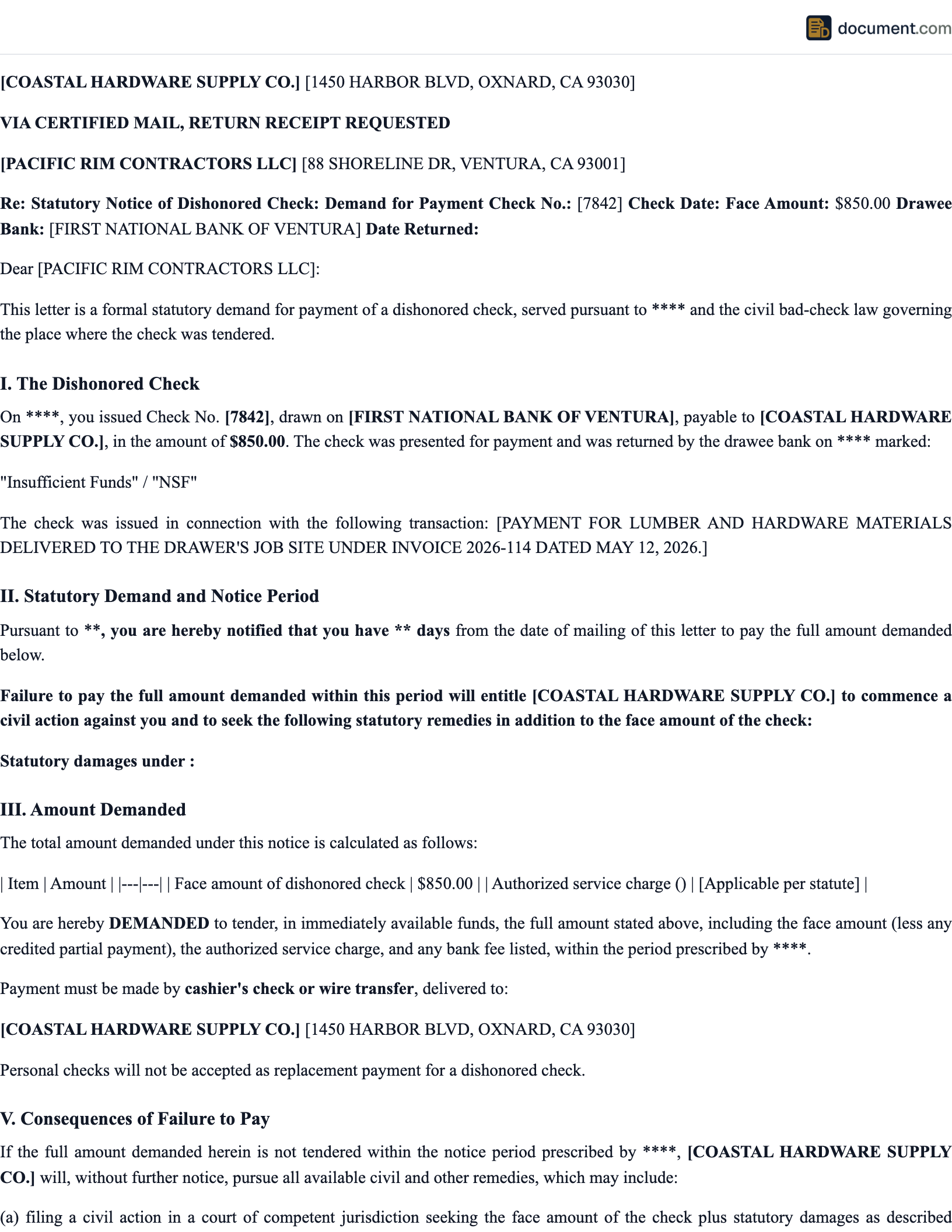



Virginia Notice of Dishonored Check Overview
Virginia gives payees a clean, self-contained civil remedy for dishonored checks. Two code sections do the work: § 8.01-27.1 establishes the $50 processing charge and defines what qualifies as a bad check under the civil framework, while § 8.01-27.2 sets the damages formula and the notice procedure that must be completed before the enhanced civil penalty becomes available. Together, they let a payee recover more than the face amount of the check without needing a criminal conviction or a district attorney's involvement.
The statute is notable for its conservative cap. Unlike California, Florida, or Oregon, Virginia does not award treble damages up to some large ceiling. The civil penalty here is the lesser of $250 or three times the check amount. That means on a check for $50 the penalty is $150 (three times), but on a check for $200 the penalty is $200 (still three times), and once the check exceeds roughly $83 the $250 cap controls. The cap is the binding constraint on most bad-check claims, so the real recovery is built from the combination of the penalty, the $50 processing charge, documented bank fees, interest, and attorney fees.
Virginia's notice rule mirrors the 30-day standard used in California and Florida, but with a mailing-method flexibility that distinguishes it from those states. The statute expressly accepts regular mail alongside certified or registered mail, provided the sender retains an affidavit of service of mailing or other sufficient proof of mailing such as a USPS Certificate of Mailing. That flexibility is useful, but it places the burden squarely on the sender to retain documentation that would hold up in court.
Lesser of $250 or 3x check amount
Civil damages
30 days after written notice by certified, registered, or regular mail
Notice period
$50 processing charge per § 8.01-27.1
Service charge
Va. Code Ann. § 8.01-27.2 / § 8.01-27.1
Controlling statute
The Controlling Statute: Va. Code Ann. § 8.01-27.2 / § 8.01-27.1
Va. Code Ann. § 8.01-27.1 is where the $50 processing charge lives. It authorizes the payee of a dishonored check to demand and recover a service charge of up to $50 in addition to the face amount. This charge is separate from the civil penalty under § 8.01-27.2 and separate from any bank fee the payee incurred. The service charge can be demanded in the same notice letter that opens the 30-day window, and a drawer who pays the face amount plus the $50 within the 30-day period avoids the civil penalty entirely.
Va. Code Ann. § 8.01-27.2 creates the civil cause of action. The statute allows the payee to sue for the face amount of the check plus the lesser of $250 or three times the check amount, but only if the check remains unpaid 30 days after the drawer received written notice that it was returned. The action is brought by filing a warrant in debt, which in Virginia courts means the general district court for most consumer and small-business check amounts.
The statute covers checks, drafts, and orders dishonored because of lack of funds in or credit with the drawee bank. It does not require that the drawer have acted with intent to defraud; the civil remedy is triggered by the dishonor and the failure to pay after proper notice, not by proof of fraudulent purpose. That distinction matters because it makes the civil route more accessible than the criminal one: the payee does not have to prove the drawer knew the account was short.
The statutory scheme also extends to rejected electronic funds transfers in defined circumstances, a recognition that ACH debits have replaced paper checks in many commercial relationships. Payees holding a dishonored electronic transfer should examine whether the specific transaction falls within the statutory definition before sending the § 8.01-27.2 notice, because the extension is not categorical.
Statute Reference
Va. Code Ann. § 8.01-27.2 / § 8.01-27.1
Damages: Lesser of $250 or 3x check amount; plus $50 processing charge, bank fees, interest, and attorney fees
What You Can Recover in Virginia
Virginia's recovery formula stacks several separate items. First is the face amount of the check, which you would be entitled to recover even under an ordinary contract claim. On top of that, the statute authorizes the civil penalty: the lesser of $250 or three times the check amount. For checks below approximately $83.34, three times the amount yields less than $250 and that is the operative figure. For checks at or above $83.34, the $250 cap controls and the penalty is a flat $250 regardless of whether the check was for $100 or $5,000.
Added to those two items are the $50 processing charge authorized by § 8.01-27.1, actual bank fees the payee was charged for the returned item, prejudgment interest, and reasonable attorney fees. The attorney fee provision is significant for larger-face-value checks: when a $1,500 check is involved, the civil penalty caps at $250, but attorney fees and documented bank fees can substantially increase the total judgment. For payees using general district court without counsel, attorney fees are irrelevant, but for those who retain a lawyer the fee-shifting provision makes the case economically viable.
Add it up on a concrete example: a $400 check that bounces. The civil penalty is $250 (the cap, because three times $400 is $1,200, well above $250). The processing charge is $50. The bank's returned-item fee is, say, $35. Prejudgment interest at Virginia's statutory rate accrues on the face amount from dishonor. If attorney fees are awarded, the total judgment can meaningfully exceed $735 plus interest. For a check in the $50 to $80 range, the picture is different: the $250 cap is never reached, the penalty is three times the face, and the $50 processing charge may actually exceed the penalty itself on a very small check.
- Civil damages: Lesser of $250 or 3x check amount; plus $50 processing charge, bank fees, interest, and attorney fees
- Service charge: $50 processing charge per § 8.01-27.1
- Notice period before suit: 30 days after written notice by certified, registered, or regular mail
Notice Procedure and Timeline in Virginia
The 30-day clock under § 8.01-27.2 starts when the drawer receives written notice that the check was returned unpaid. The statute accepts three methods of delivery: registered mail, certified mail, or regular mail. If you use regular mail rather than certified or registered, you must retain an affidavit of service of mailing or other sufficient proof of mailing such as a U.S. Postal Service Certificate of Mailing. The USPS Certificate of Mailing (PS Form 3817) is not the same as certified mail; it proves you handed the piece to the postal service but not that it was delivered. Keep that certificate with the file. If the drawer later disputes receipt, you need something more than your own testimony.
Calculate the deadline from the date of mailing, add 30 days, and state both dates explicitly in the notice letter itself. If you mail the notice on June 10, the letter should say: 'You have 30 days from the date of mailing of this notice, through July 10, to pay the full amount demanded.' Writing the calendar date removes any argument that the drawer miscalculated when the window closed. Do not file in court before July 11 in that scenario. Courts have denied the civil penalty in cases where suit was filed even marginally before the notice period expired.
Address the notice to the address printed on the face of the check or to the drawer's last known address if that address has changed and you can document the current one. The statute does not prescribe the exact language the notice must contain beyond identifying the check and demanding payment, but best practice is to recite the check number, date, amount, reason for dishonor, total amount demanded (face plus the $50 processing charge plus bank fees), the statutory citations, and the specific calendar date by which payment must be received. Retain a copy of the letter. Together with the proof of mailing and the bank's return notice, that copy is the foundation of your case if the drawer does not pay.
Virginia-Specific Notes
Virginia operates a two-tier civil court structure that shapes where bad-check claims get filed. The Small Claims Division of the General District Court handles claims up to $5,000 exclusive of interest, and attorneys are barred from representing parties at trial in that division under Va. Code § 16.1-122.4. Most bad-check claims fall well within the $5,000 ceiling given the $250 civil penalty cap, so small claims is the practical venue for individual and small-business payees. Claims between $5,000 and $50,000 fall on the regular General District Court civil docket, where attorneys are permitted and the jurisdictional cap was raised from $25,000 to $50,000 effective July 1, 2025. Claims above $50,000 require Circuit Court.
Virginia's criminal bad-check statute, Va. Code § 18.2-181, runs parallel to the civil remedy and uses a $1,000 threshold to split misdemeanor from felony treatment. A check under $1,000 is a Class 1 misdemeanor, punishable by up to 12 months in jail and a $2,500 fine. A check of $1,000 or more is a Class 6 felony, carrying up to five years in prison. A separate provision, § 18.2-181.1, covers a pattern of bad checks: two or more checks totaling more than $1,000 within 90 days to the same payee drawn on the same account constitute a felony regardless of the amount of any single check. The civil notice letter, with its certified-mail receipt or affidavit of mailing, is typically the documentation a Commonwealth's Attorney will ask to see before accepting a check for criminal prosecution.
Virginia Specific Note
Virginia's civil statute does not require certified mail in the way some other states do, but choosing regular mail without retaining solid proof of mailing creates real litigation risk. A drawer who testifies they never received the notice, and a sender who has no Certificate of Mailing or affidavit to produce, may find the civil penalty disallowed even if the check is undisputed. Certified mail with return receipt requested is never the wrong choice; it provides a tracking record and delivery confirmation that regular mail cannot match. If the certified piece comes back unclaimed, keep the sealed envelope; an unclaimed-mail return does not defeat the claim when you can show the piece was addressed correctly and tendered to the postal service.
Virginia's civil bad-check framework does not impose a separate deadline by which the notice must be sent after dishonor, but the general statute of limitations for contract actions in Virginia is five years. Because the civil penalty depends on the drawer's failure to pay after receiving proper notice, a payee who waits years after dishonor to send the notice may encounter a defense that the delay was prejudicial or that the account and transaction records no longer exist. Sending the notice promptly after the bank returns the check, typically within 30 to 60 days of dishonor, is both strategically and practically sound.
Virginia Bad Check FAQ
Other State Bad Check Laws
Each state sets its own notice period, damage formula, and service charge. Browse sibling state pages for the specific rules that apply to your situation, or return to the full 50-state guide.
Create your Virginia Notice of Dishonored Check in minutes.
Answer a few questions and download a Virginia-compliant bad check demand letter that cites Va. Code Ann. § 8.01-27.2 / § 8.01-27.1 and is ready to mail certified.