
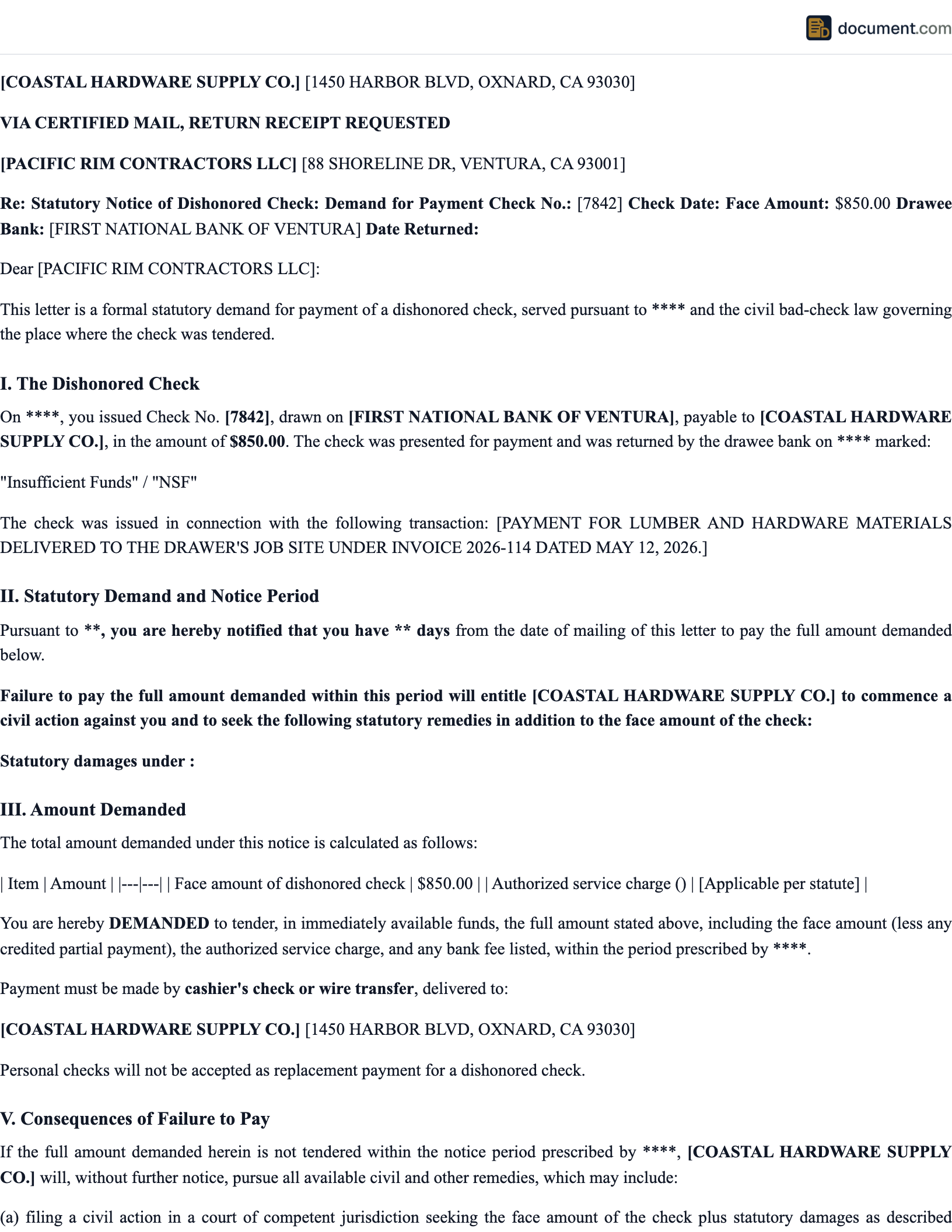



Wyoming Notice of Dishonored Check Overview
Wyoming gives holders of dishonored checks a direct civil remedy that often far exceeds the face value of the instrument. Under Wyo. Stat. Ann. § 1-1-115, a payee who sends a proper written demand and waits the required 30-day cure period may sue the drawer for three times the check amount -- subject to a floor of $100 -- plus a $30 collection fee and court costs. In cases where the drawer contests the claim with dilatory or bad-faith defenses, courts may also award reasonable attorney fees. The statute creates a straightforward collection pathway that does not require a criminal conviction or any involvement from a prosecutor.
Wyoming's approach differs from many neighboring states in one procedurally significant way: the notice must be sent by United States Postal Service certificate of mailing, not certified mail with return receipt requested. Certificate of mailing is a simpler postal product -- it proves you mailed the letter but does not require the drawer to sign for it. That distinction matters when drafting the demand and preserving proof of compliance. Personal service under the Wyoming Rules of Civil Procedure is an alternative if the drawer's address is unreliable, but the certificate-of-mailing route is the standard path for most business and consumer situations.
The civil remedy under § 1-1-115 runs on a separate track from the criminal fraud-by-check statute at Wyo. Stat. Ann. § 6-3-702. A payee who sends the civil demand is not filing a criminal complaint, and the criminal prosecution -- if one ever occurs -- is brought by the state, not the payee. Many holders never involve law enforcement at all. The civil notice is the payee's primary lever: it is self-executing, it produces an enforceable money judgment, and it typically resolves the matter before any court filing is necessary.
3x check amount
Civil damages
30 days after written demand by certificate of mailing
Notice period
Up to $30
Service charge
Wyo. Stat. Ann. § 1-1-115
Controlling statute
The Controlling Statute: Wyo. Stat. Ann. § 1-1-115
Wyo. Stat. Ann. § 1-1-115 is titled 'Civil Liability for Unpaid Checks' and sits in Title 1 (Code of Civil Procedure), Chapter 1 (General Provisions as to Civil Actions). Its structure follows the same notice-then-penalty pattern used in most state civil bad-check statutes, but the specific numbers and procedural requirements are Wyoming's own. The statute covers checks drawn on Wyoming accounts and checks tendered in Wyoming transactions, and it applies to all dishonored checks -- not just those returned for insufficient funds. A check returned because the account was closed, or because the drawer instructed the bank to stop payment without valid justification, falls within the statute's reach in the same way an NSF return does.
The statute's mechanics work in two stages. In the first stage, the holder sends a written demand meeting the statutory requirements. The demand must be mailed by USPS certificate of mailing to the address printed on the check or to the drawer's last known address, or personally served under the Wyoming Rules of Civil Procedure. The demand must state the amount of the check, the collection fee being claimed, and the 30-day cure period. Once the demand is properly dispatched, the drawer has 30 days to pay the full amount demanded -- the check face amount plus the collection fee of up to $30. Payment within that window closes the matter; the holder gets made whole and the civil penalty never attaches.
If the drawer does not pay within 30 days, the second stage opens: the holder becomes entitled to sue for three times the check amount (but not less than $100 regardless of check size), the $30 collection fee, and court costs. Attorney fees may be awarded by the court in cases where the drawer responds with dilatory or bad-faith defenses, though the statute does not make fees mandatory in every successful case. The treble-damage award represents the legislature's judgment that a drawer who ignores a formal written demand over 30 days warrants more than mere restitution.
The statute does not impose a separate cap on the total treble recovery. Unlike California's Civil Code § 1719, which caps the enhancement at $500 over the check amount in some circumstances, Wyoming's § 1-1-115 simply multiplies the full check amount by three. On a $2,000 check, that is a $6,000 treble figure before adding the collection fee and costs. The $100 minimum floor protects holders of small checks -- a $25 NSF check still produces a minimum $100 civil recovery if the demand is properly sent and ignored.
Statute Reference
Wyo. Stat. Ann. § 1-1-115
Damages: 3x check amount; not less than $100; plus collection costs and reasonable attorney fees
What You Can Recover in Wyoming
The primary measure of damages under § 1-1-115 is three times the amount of the dishonored check. Wyoming does not reduce that base by payments made before the suit is filed; the multiplier applies to the face amount of the check. A holder of a $500 dishonored check who properly sends the demand and waits out the 30-day period can pursue $1,500 in treble damages plus the $30 collection fee plus filing fees and other court costs. On larger checks, the numbers scale accordingly: a $3,000 check yields a treble base of $9,000.
The $100 minimum floor operates as an absolute guarantee for small-check holders. If the face amount of the check is $30, ordinary treble math produces only $90 -- but the statute overrides that result and sets the floor at $100. This means § 1-1-115 is economically viable even for very small checks, because the minimum recovery always covers at least the cost of the demand letter and postage. Holders of checks between $1 and $33 will receive the $100 minimum rather than three times face; holders of checks above $33 receive the full treble figure.
Attorney fees require a separate showing. The statute does not automatically award fees to a prevailing holder the way California's and Florida's civil bad-check statutes do. Wyoming courts may award reasonable fees when the drawer's defense is dilatory or brought in bad faith -- conduct such as raising frivolous disputes about the transaction just to delay judgment, or denying receipt of the demand when postal records contradict that denial. For routine bad-check cases where the drawer simply does not respond, the fee award is discretionary and may not be sought. Holders with checks large enough to justify counsel should document any bad-faith litigation conduct from the outset to preserve the fee argument.
- Civil damages: 3x check amount; not less than $100; plus collection costs and reasonable attorney fees
- Service charge: Up to $30
- Notice period before suit: 30 days after written demand by certificate of mailing
Notice Procedure and Timeline in Wyoming
The notice must be a written demand sent by USPS certificate of mailing. Certificate of mailing -- obtained at any post office window -- gives the sender a dated postal receipt proving that a letter was accepted for delivery to a specific address on a specific date. Unlike certified mail, it does not require the recipient to sign anything, and it does not generate a green return-receipt card. The Post Office's record of acceptance is the holder's proof of mailing. Keep the certificate receipt and staple it to a copy of the demand letter; that combination is what you produce at trial or in small claims court.
Address the demand to the address printed or written on the check itself. If you know the drawer has since moved and you have a verified current address, you may use the last known address instead, but using a different address than the one on the check creates a factual issue you will need to explain. Personal service under the Wyoming Rules of Civil Procedure is the other authorized method, suitable when the drawer is evading mail delivery or when the address on the check was never valid. Most holders use certificate of mailing because it is faster, cheaper, and sufficient.
The 30-day cure period runs from the date of mailing shown on the postal certificate. Count calendar days, not business days. A demand mailed on June 1 expires on July 1. Do not file suit before that date arrives; filing prematurely may forfeit the statutory penalty. The demand should state the calendar deadline explicitly -- not just 'you have 30 days' but 'you have 30 days from the date of mailing of this notice, which is [date], making your deadline [specific date].' A deadline stated as a calendar date removes any dispute about when the cure window closed.
Wyoming-Specific Notes
Wyoming's small claims court ceiling is $6,000 under Wyo. Stat. Ann. § 1-21-201. The treble-damage remedy fits comfortably within that limit for checks up to $2,000 -- a $2,000 check produces a $6,000 treble recovery, exactly at the ceiling. Checks above $2,000 will produce treble damages that push the claim above the small claims jurisdictional cap, requiring filing in circuit court. Filing fees and procedural rules differ between the two tracks, but the evidentiary requirements are the same: the original check, the bank dishonor notice, the demand letter, and the certificate of mailing receipt.
Wyoming's criminal fraud-by-check statute at Wyo. Stat. Ann. § 6-3-702 creates parallel exposure for the drawer, independent of any civil action. The criminal thresholds are: checks under $1,000 are a misdemeanor (up to six months, up to a $750 fine, or both); checks of $1,000 or more are a felony (up to ten years, up to a $10,000 fine, or both). Two or more checks within a 60-day period totaling $1,000 or more in the aggregate also constitute a felony even if each individual check is below $1,000. The civil demand under § 1-1-115 and a criminal complaint under § 6-3-702 run on entirely separate tracks; sending the civil notice does not prevent a subsequent criminal referral, and the two proceedings can advance simultaneously.
Wyoming Specific Note
Wyoming's § 1-1-115 conditions the treble-damage remedy on the demand being sent by certificate of mailing or by personal service -- not by certified mail with return receipt. A demand sent only by certified mail, without also obtaining a certificate of mailing, may not satisfy the statutory method even though certified mail is a stricter form of proof. The statute specifies the certificate-of-mailing form, and courts construing similar notice provisions in other states have denied enhanced damages when the mailing method deviated from the statute. Use the correct postal product.
Wyoming does not operate a centralized statewide district attorney bad-check diversion program in the manner of Texas or Florida. Individual county attorneys handle criminal check-fraud matters, and their practices vary. Some county attorney offices will not accept a check for prosecution unless the holder can show that a civil demand was sent and the drawer failed to respond, consistent with the general intent requirement of § 6-3-702. Sending the § 1-1-115 demand and preserving the postal record therefore serves double duty: it opens the civil treble-damage remedy and it documents the element of knowledge and intent that criminal prosecution may require.
Wyoming Bad Check FAQ
Other State Bad Check Laws
Each state sets its own notice period, damage formula, and service charge. Browse sibling state pages for the specific rules that apply to your situation, or return to the full 50-state guide.
Create your Wyoming Notice of Dishonored Check in minutes.
Answer a few questions and download a Wyoming-compliant bad check demand letter that cites Wyo. Stat. Ann. § 1-1-115 and is ready to mail certified.