
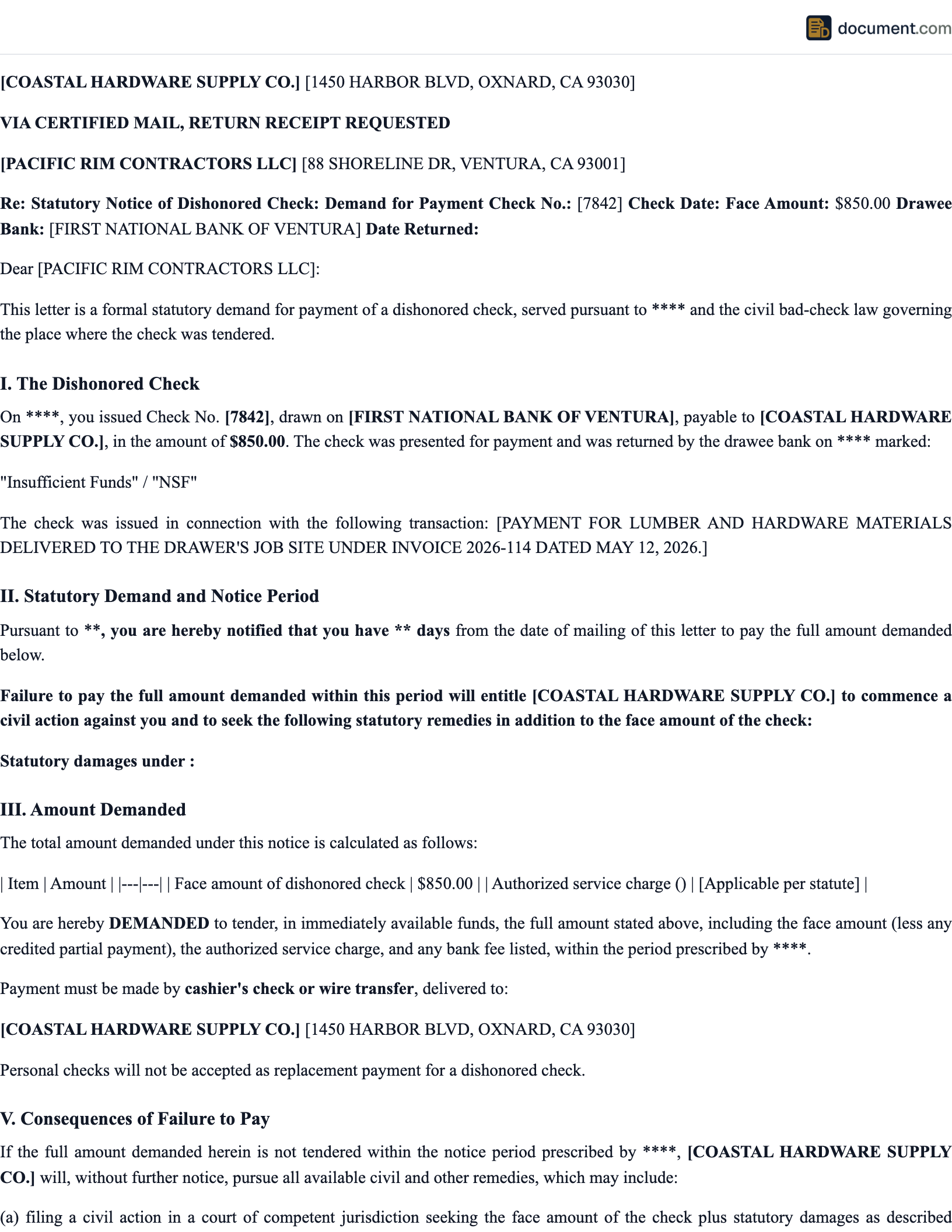



Arkansas Notice of Dishonored Check Overview
Arkansas gives the holder of a dishonored check a direct civil remedy under Ark. Code Ann. § 4-60-103, separate from any criminal prosecution the state might pursue under the Arkansas Hot Check Law. The two tracks run independently. A payee who receives a bounced check can pursue civil damages without waiting on a district attorney, and the civil notice procedure is straightforward enough that most holders can execute it without retaining counsel.
The civil framework rewards the payee who follows the statutory steps precisely. Send the required written demand, wait fifteen days without receiving full payment, and the right to double damages plus a service charge locks in. Skip the notice, or send it in a form that does not satisfy the statute, and the recovery is limited to the face amount of the check as a simple contract claim -- which is almost always worth less than the enhanced remedy.
Arkansas's minimum-damage floor of $50 is a meaningful feature for holders of small checks. On a $20 NSF check, double damages would otherwise yield only $40, but the statute guarantees at least $50 in civil damages on top of the face amount. Combined with the service charge of up to $30, a holder of even a trivial check can recover a sum that meaningfully exceeds the check itself, creating real deterrence for repeat check writers.
2x check amount, not less than $50
Civil damages
15 days after written demand before enhanced damages apply
Notice period
Up to $30, plus any bank fees
Service charge
Ark. Code Ann. § 4-60-103
Controlling statute
The Controlling Statute: Ark. Code Ann. § 4-60-103
Ark. Code Ann. § 4-60-103 creates a civil cause of action for the holder of any check, draft, or order for payment that is dishonored by the drawee bank. The statute covers the two most common dishonor reasons -- insufficient funds and a closed or nonexistent account -- and applies regardless of whether the drawer is later prosecuted criminally. The civil remedy is a standalone right belonging to the payee or any subsequent holder.
The structure of the statute is a prerequisite-then-penalty model. The holder must first send a written demand to the drawer notifying that person that the check was dishonored and that civil damages will be sought if payment is not made. The demand triggers a fifteen-day cure window. If the drawer makes the check good within that window -- paying the face amount plus any authorized service charge -- the enhanced civil remedy does not arise. Only after the fifteen days pass without full payment does the holder gain the right to sue for double damages.
The statute covers the service charge as a separately recoverable item, currently set at up to $30, plus any actual bank fees the holder incurred because of the returned check. This means the total the holder can demand in the notice letter is the check amount, the service charge, and documented bank fees -- all itemized so the drawer understands exactly what must be paid to avoid litigation.
Nothing in § 4-60-103 requires the holder to elect between the civil remedy and a criminal referral. A payee can send the civil notice, wait fifteen days, and if the drawer fails to pay, pursue a civil judgment while simultaneously requesting that the local prosecuting attorney's office evaluate the check for criminal prosecution under the separate Arkansas Hot Check Law, Ark. Code Ann. § 5-37-302 et seq. The civil demand letter often strengthens the criminal referral by documenting that the drawer received notice and made no attempt to make the check good.
Statute Reference
Ark. Code Ann. § 4-60-103
Damages: 2x check amount, not less than $50; plus collection fee
What You Can Recover in Arkansas
Under § 4-60-103, the holder who has sent proper notice and waited fifteen days without payment is entitled to recover twice the amount of the check, subject to a floor of $50 in civil damages. The multiplier applies to the face amount of the check, not to the service charge or bank fees. So on a $400 check, the civil damages component alone is $800. On a $20 check, the statute guarantees $50 in civil damages rather than the $40 that strict doubling would produce. The floor matters most to landlords, small retailers, and service providers who regularly accept smaller checks.
The service charge of up to $30 is recoverable on top of the doubled check amount, and the holder may also claim any actual bank fees charged for the returned item. These are separate line items, not folded into the doubling calculation. A holder presenting a complete claim on a $500 check that generated a $15 bank return fee and for which the holder is claiming the full $30 service charge can state a total demand of $1,045: $1,000 in civil damages (2 x $500) plus $30 service charge plus $15 bank fee.
Arkansas does not appear to cap the civil damages at a fixed dollar ceiling the way some other states cap their treble-damage formulas at $500 over face value. The 2x multiplier applies to the full check amount, making the statute proportionally more valuable to holders of large checks than statutory schemes with absolute caps. A holder of a $3,000 dishonored check can seek $6,000 in civil damages plus the service charge and bank fees -- a meaningful recovery that justifies attorney involvement when the check writer is judgment-collectible.
- Civil damages: 2x check amount, not less than $50; plus collection fee
- Service charge: Up to $30, plus any bank fees
- Notice period before suit: 15 days after written demand before enhanced damages apply
Notice Procedure and Timeline in Arkansas
The written demand must be sent to the drawer before the civil penalty attaches. The statute requires fifteen days to pass after the demand without payment before the holder can bring a civil action for double damages. The clock starts from the date the drawer receives the notice, or from the date of mailing if service is made by certified mail. Because the fifteen-day period is shorter than the thirty-day window used by most states, Arkansas holders can move to litigation relatively quickly, but that also means the cure window closes fast and the holder needs to be prepared to file promptly if payment does not arrive.
Send the demand by certified mail, return receipt requested, to the address printed on the check or to the drawer's last known address if that address is different and verifiable. Arkansas's statute does not expressly require a simultaneous first-class mailing the way California and Illinois do, but sending a parallel first-class copy the same day is sound practice for one reason: if the certified piece comes back unclaimed, the first-class copy establishes that the drawer had an opportunity to learn of the demand. Retain the certified mail receipt, the tracking confirmation, and the returned envelope if the piece is refused or unclaimed -- these are the exhibits you will need if the case goes to court.
The notice itself should state the check number, the date the check was written, the face amount, the name of the bank on which it was drawn, and the specific reason for dishonor as reported by your bank. State the total amount demanded -- check amount, service charge, and any bank fee -- as a single sum and show the arithmetic. State the fifteen-day deadline as a specific calendar date, not just as 'fifteen days from mailing.' A notice that says 'You have until July 10, 2026 to pay $530.00 in full' leaves no ambiguity about when the window closes. Cite § 4-60-103 and state plainly that failure to pay within fifteen days will result in a civil action seeking double the check amount plus costs.
Arkansas-Specific Notes
Arkansas operates two entirely separate legal frameworks for dishonored checks, and understanding which one you are in matters. The civil remedy under § 4-60-103 is the payee's private action for money. The criminal prosecution under the Arkansas Hot Check Law, Ark. Code Ann. § 5-37-302, is a state action that can result in fines or incarceration. Under § 5-37-302, the criminal severity scales with check amount: a check of $1,000 or less on a first offense is an unclassified misdemeanor; $1,000 to $5,000 is a Class D felony; $5,000 to $25,000 is a Class C felony; and $25,000 or more, or an aggregation of multiple checks within 90 days reaching that threshold, is a Class B felony. The 90-day aggregation rule means that a drawer who writes several smaller bad checks within a three-month window can face felony exposure even if no single check exceeded the misdemeanor threshold.
Arkansas district court small claims jurisdiction reaches claims up to $5,000. Most civil bad-check claims fall within that ceiling, which means holders can file without an attorney in the district court for the county where the drawer resides or where the check was presented. Above $5,000, the case belongs in circuit court, where the formalities of civil procedure apply. For holders with large checks, the civil remedy's lack of a damage cap makes the circuit court route worth the additional procedural burden, especially when the 2x multiplier on a $4,000 check already pushes the claim to $8,000 plus fees before the service charge is added.
Arkansas Specific Note
Arkansas's fifteen-day notice period is among the shorter windows in the country. A holder who sends the notice but then waits to see whether payment arrives informally should keep the calendar carefully. Filing suit even one day before the fifteen days have run from the date the drawer received or was charged with receiving the notice can result in dismissal of the enhanced-damage claim. Build in a buffer: if the notice was delivered on a Friday, count fifteen full calendar days from that date and file no earlier than Monday of the third week following delivery.
The civil notice letter serves a secondary evidentiary function when you later seek criminal prosecution. Most prosecuting attorneys handling hot-check matters want evidence that the drawer received notice and failed to make the check good, because that failure is probative of the fraudulent intent the criminal statute requires. Sending a compliant § 4-60-103 demand and retaining the certified-mail proof positions you well for a criminal referral if civil judgment proves uncollectible. Keep copies of the original check, both sides, the bank's dishonor notice, the demand letter, and the mailing proof in a single file from the moment the check is returned.
Arkansas Bad Check FAQ
Other State Bad Check Laws
Each state sets its own notice period, damage formula, and service charge. Browse sibling state pages for the specific rules that apply to your situation, or return to the full 50-state guide.
Create your Arkansas Notice of Dishonored Check in minutes.
Answer a few questions and download a Arkansas-compliant bad check demand letter that cites Ark. Code Ann. § 4-60-103 and is ready to mail certified.