
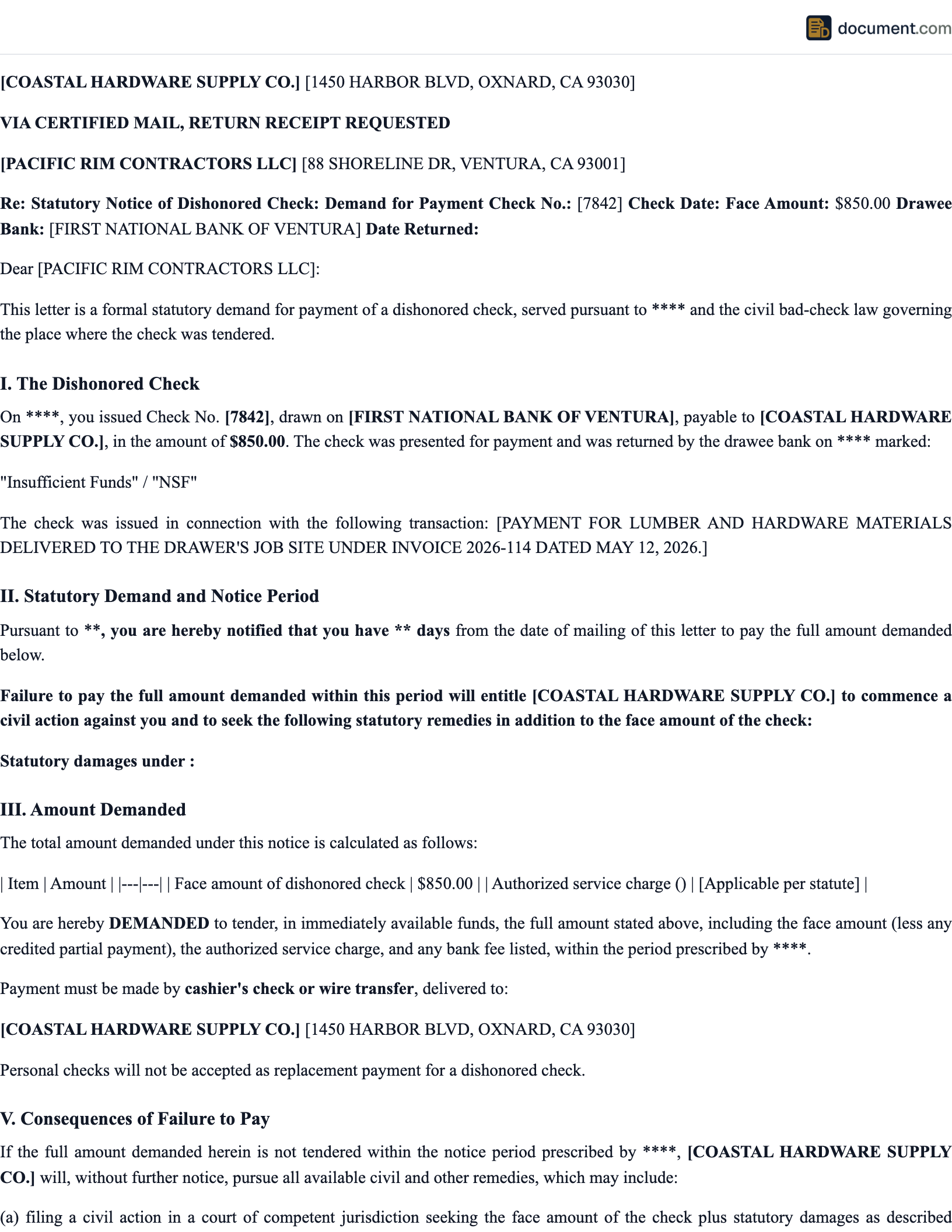



Connecticut Notice of Dishonored Check Overview
Connecticut takes an unusual approach to civil bad-check recovery. Where most states award treble damages on a simple multiplier formula, Conn. Gen. Stat. § 52-565a uses hard dollar caps that vary based on the reason the check was dishonored. A holder whose check was drawn on a nonexistent or closed account can recover the lesser of the face amount or $750 in civil damages. A holder with an NSF check -- one drawn on a real account that simply lacked sufficient funds -- can recover the lesser of the face amount or $400. On top of either figure, the holder may also collect a service charge of up to $20. These are civil penalties separate from the check face amount itself, which remains owed regardless.
The distinction between reason-for-dishonor categories is not cosmetic. A $300 NSF check yields a maximum civil penalty of $300 (less than the $400 cap), while a $300 closed-account check yields a maximum civil penalty of $300 as well, but a $600 closed-account check yields a penalty of $600, and a $900 closed-account check is capped at $750. The math changes depending on where the check amount sits relative to the applicable ceiling, and holders who misread which cap applies may underclaim or send procedurally flawed notices.
Alongside the civil track, Connecticut's criminal bad-check statute, Conn. Gen. Stat. § 53a-128, runs on a parallel and entirely separate path. A check for $500 or less is a class C misdemeanor; above $500 but not more than $1,000, it rises to a class B misdemeanor; above $1,000 but not more than $2,000, it becomes a class A misdemeanor; and above $2,000 it is a class D felony. Criminal prosecution requires the state's involvement and proof of intent. The civil notice procedure under § 52-565a does not depend on a criminal conviction and does not require proof of fraudulent intent -- it operates on the fact of dishonor and the drawer's failure to cure after proper written demand.
No account: lesser of face amount or $750
Civil damages
30 days after two statutory written notices
Notice period
Up to $20
Service charge
Conn. Gen. Stat. § 52-565a
Controlling statute
The Controlling Statute: Conn. Gen. Stat. § 52-565a
Conn. Gen. Stat. § 52-565a creates a standalone civil cause of action for the holder of a dishonored check. The statute does not graft onto contract law or UCC Article 3 for the penalty calculation; it is its own framework. The holder is entitled to bring an action against the drawer if two conditions are met: the holder has given the drawer two written statutory notices demanding payment, and the drawer has failed to pay the full amount owed within 30 days after those notices have been given.
The statute specifies the penalty as a civil recovery 'in addition to the face amount of the check.' That phrase matters. The civil damages authorized by § 52-565a are not a substitute for the check amount; they sit on top of it. A holder who collects the check face amount through other means before judgment still has the right to the statutory penalty if the notice procedure was completed and the drawer failed to cure within the window. The penalty compensates the holder for the trouble of collection, not merely for the loss of the check proceeds.
Section 52-565a also authorizes a service charge of up to $20, which the holder may demand along with the face amount. The service charge is a pre-penalty recovery -- it can be demanded in the notice itself and is collectible whether or not the full civil penalty is later pursued in court. A drawer who pays the face amount plus the $20 service charge within the 30-day cure window has satisfied the statutory demand and the civil penalty does not accrue.
The statute does not prescribe mandatory notice language verbatim, but it does require two separate written notices before the 30-day cure period runs. This is a procedural requirement that Connecticut courts have treated as a prerequisite to the civil penalty: skipping one of the two required notices or conflating them into a single letter defeats the enhanced damages claim, even if the drawer had actual knowledge of the dishonor and chose not to pay.
Statute Reference
Conn. Gen. Stat. § 52-565a
Damages: No account: lesser of face amount or $750; insufficient funds: lesser of face amount or $400
What You Can Recover in Connecticut
Connecticut's civil recovery under § 52-565a has three components. First, the face amount of the check -- the sum the drawer agreed to pay when the check was written and which remains owed regardless of whether the civil penalty attaches. Second, the civil damages penalty: for a check returned because of a nonexistent or closed account, the lesser of the face amount or $750; for an NSF check, the lesser of the face amount or $400. Third, a service charge of up to $20.
To see how the caps interact in practice: a $200 NSF check yields a civil penalty of $200 (the face amount is less than the $400 ceiling), so total recovery is $200 face plus up to $200 in civil damages plus a $20 service charge -- $420 maximum. A $500 NSF check yields a civil penalty capped at $400 (the face amount exceeds the ceiling), so total recovery is $500 face plus $400 in civil damages plus a $20 service charge -- $920 maximum. A $900 closed-account check yields a civil penalty capped at $750, so total recovery is $900 plus $750 plus $20 -- $1,670 maximum. On the closed-account side, once the check exceeds $750 the penalty is always $750 flat; on the NSF side, the $400 ceiling is hit whenever the check exceeds $400.
Connecticut does not award treble damages in the way California or Florida do, and there is no attorney-fee provision written into § 52-565a itself. A holder who retains counsel to pursue a bad-check claim in Connecticut cannot automatically tack attorney fees onto the judgment as a statutory line item. That said, the service charge and civil penalty together create a meaningful incentive to cure: a $400 NSF check that a drawer ignores after two written notices becomes a $820 judgment ($400 + $400 + $20), doubling the drawer's exposure relative to simply making the check good.
- Civil damages: No account: lesser of face amount or $750; insufficient funds: lesser of face amount or $400
- Service charge: Up to $20
- Notice period before suit: 30 days after two statutory written notices
Notice Procedure and Timeline in Connecticut
Connecticut's statute requires two written notices before the 30-day cure period opens. This sets Connecticut apart from most states, which require only a single demand letter. Both notices must be written and must communicate to the drawer that the check was dishonored and that payment is demanded. Neither the statute nor Connecticut appellate authority prescribes a precise interval between the two notices, but practitioners commonly send the first notice shortly after the bank's dishonor notification and a second notice a week or two later, then count the 30-day window from the date the second notice is given.
Method of service is not expressly dictated in the statutory text with the same specificity found in some neighboring states, but standard practice -- and the practice that will hold up in Superior Court or small claims court -- is certified mail, return receipt requested, to the address on the check or the drawer's last known address. Send a simultaneous first-class copy. If the certified piece is returned unclaimed, the first-class copy and the certified-mail tracking printout together establish that the drawer had a reasonable opportunity to receive the demand. Keep the bank's dishonor notice, both notice letters, both certified-mail receipts, and any tracking confirmations as a litigation packet.
The 30-day cure window runs from the date the second notice is given, not the date it is received. Date your letters and retain proof of mailing with matching dates. After 30 days, if the full face amount plus the service charge have not been paid, the civil damages penalty accrues and you may file suit. Connecticut Superior Court handles these cases; small claims jurisdiction in Connecticut is capped at $5,000, which covers many bad-check situations where the check face amount plus damages stays below that threshold. Cases where combined recovery exceeds $5,000 belong in the regular civil docket.
Connecticut-Specific Notes
Connecticut is one of a small number of states that structures its civil bad-check penalty as a fixed cap tied to the reason for dishonor rather than as a multiplier of the check face amount. Because the cap is absolute rather than proportional, a holder with a large NSF check does not benefit from a larger base -- the civil penalty tops out at $400 regardless of whether the check was for $500 or $5,000. Holders of large checks in Connecticut will find that the civil penalty under § 52-565a is a relatively minor addition to the face-amount recovery; the more significant lever on large checks is the threat of criminal prosecution under § 53a-128, which reaches class D felony territory above $2,000.
Connecticut's small claims court ceiling is $5,000 for most civil claims. An NSF check of up to roughly $4,580 can be pursued in small claims (face amount plus $400 penalty plus $20 service charge stays under $5,000); a closed-account check of up to roughly $4,230 stays within the ceiling (face plus $750 plus $20). Checks with face amounts above those approximate figures, or where any additional costs push combined recovery past $5,000, require a Superior Court civil filing. Small claims filings in Connecticut carry a $95 filing fee as of 2025.
Connecticut Specific Note
Connecticut courts have not published a uniform rule on exactly what the two written notices must contain. A notice that is vague about the nature of the dishonor or that fails to demand a specific dollar amount may be found insufficient to trigger the statutory penalty period. Draft each of the two notices to include the check date, check number, face amount, reason for dishonor as stated by the bank, the service charge being demanded, the total amount owed, and a clear statement that civil damages will be pursued if payment is not received. Sending a form letter that omits these details creates a procedural vulnerability.
Connecticut Specific Note
The civil bad-check remedy under § 52-565a and the criminal track under § 53a-128 are independent proceedings, but choices made on the civil side can affect the criminal one. A holder who accepts partial payment and gives the drawer additional time risks creating an implied waiver argument in a subsequent criminal referral. If criminal prosecution is a genuine goal, consult with the state's attorney's office before settling for less than the full amount. Many Connecticut prosecutors will not accept a bad-check case for prosecution unless the holder has completed the civil demand process and can show the drawer was given proper notice and refused to cure.
Connecticut Bad Check FAQ
Other State Bad Check Laws
Each state sets its own notice period, damage formula, and service charge. Browse sibling state pages for the specific rules that apply to your situation, or return to the full 50-state guide.
Create your Connecticut Notice of Dishonored Check in minutes.
Answer a few questions and download a Connecticut-compliant bad check demand letter that cites Conn. Gen. Stat. § 52-565a and is ready to mail certified.