
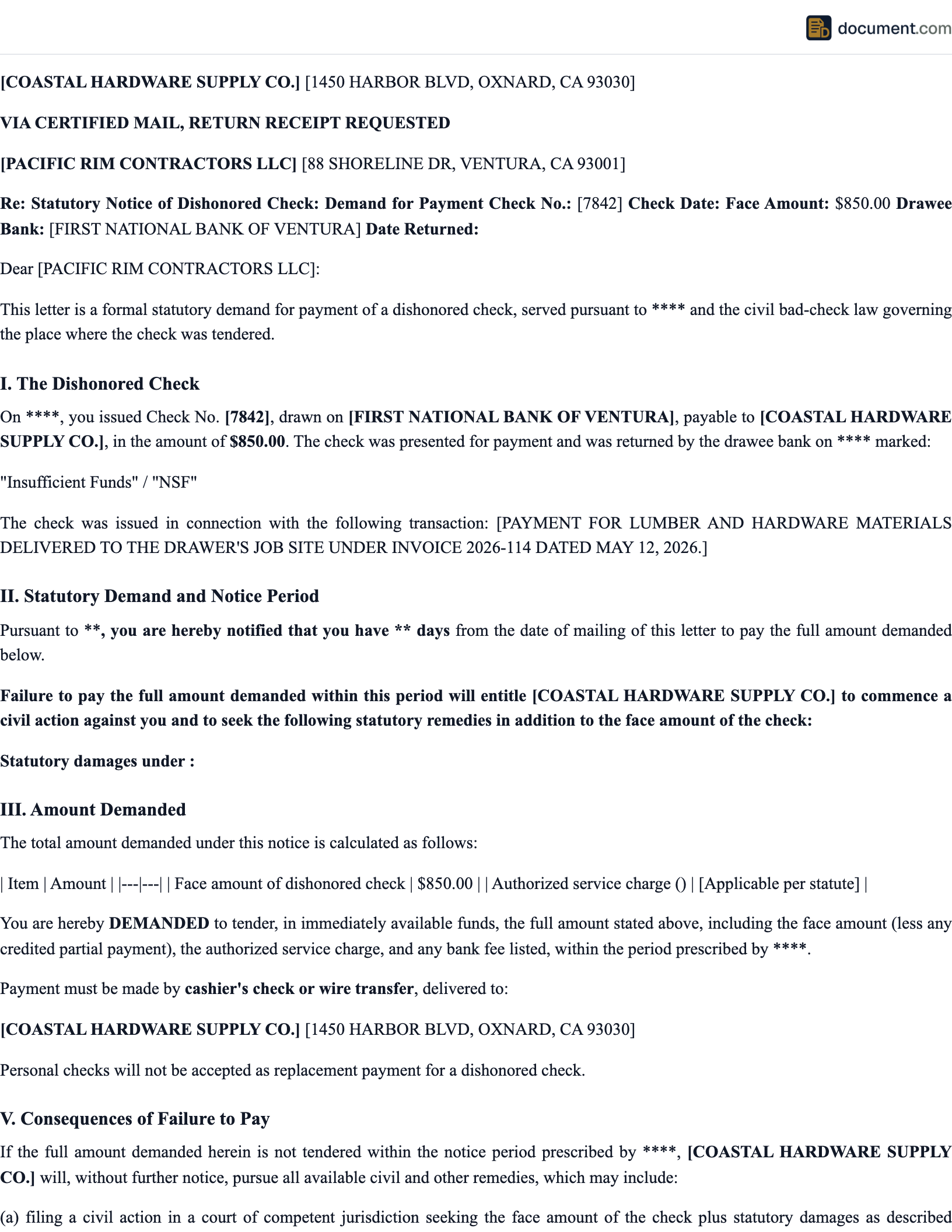



District of Columbia Notice of Dishonored Check Overview
The District of Columbia gives merchants a civil remedy for dishonored checks under DC Code § 28-3152, a statute with a structure that differs from most state bad-check laws in one consequential way: before a merchant can claim the double-damage penalty, the statute requires that the business have already posted conspicuous notice of the civil remedy at its place of business. That posting requirement is not aspirational boilerplate. Courts have treated it as a substantive condition on the enhanced-damages claim, meaning a merchant who sends a textbook-perfect demand letter but never displayed the required notice may walk away with only the face amount of the check.
The civil remedy runs on a 30-day clock that begins when the merchant mails a written demand by both certified and first-class mail. If the drawer pays in full within that window, the civil penalty never matures. If payment does not arrive and all procedural prerequisites have been satisfied, the merchant may sue for twice the check amount or $100, whichever is greater, plus court costs and reasonable attorney fees. On a $50 check, the minimum $100 floor for additional damages makes the civil statute worth using. On a $2,000 check, the double-damage formula produces up to $4,000 in additional damages on top of recovering the face amount.
The civil action and any criminal prosecution proceed on separate tracks. DC Code § 28-3152(i) states explicitly that civil recovery does not prohibit criminal prosecution under DC Code § 22-1510, the statute that makes it a crime to write a check with intent to defraud knowing the account lacks sufficient funds. The two remedies serve different ends: the civil action returns money to the merchant, while the criminal statute is handled by the government and aims at punishment. A merchant can pursue both without one foreclosing the other.
2x check amount or $100, whichever is greater, plus costs and attorney fees
Civil damages
30 days after certified and first-class mail demand
Notice period
No separate cap; damages replace service charge
Service charge
D.C. Code § 28-3152
Controlling statute
The Controlling Statute: D.C. Code § 28-3152
DC Code § 28-3152 sits within Chapter 31A of Title 28, a dedicated dishonored-check chapter that the D.C. Council created to give merchants a predictable civil collection tool. The chapter defines terms in § 28-3151, then sets out the liability framework in § 28-3152. The structure is merchant-specific: the statute refers throughout to the 'merchant' as the potential claimant, distinguishing DC's framework from states that extend the civil bad-check remedy to any 'holder' regardless of whether they operate a business.
Liability under the statute is triggered by two conditions: the check must be dishonored, and the drawer must fail to pay the face amount within 30 days following a written demand mailed in the proper form. Both conditions must be met. A check that was dishonored but where the drawer paid in full within the notice period does not produce enhanced liability. Section 28-3152(k) makes clear that no criminal conviction is required to pursue the civil action, so the merchant can move forward even if the district attorney declines the case or the drawer was never charged.
The damages formula under § 28-3152(c) has three components: (1) the face amount of the check, (2) additional damages equal to two times the check amount or $100, whichever is greater, and (3) costs and reasonable attorney fees. The formula is additive: the additional damages are layered on top of the face amount, not substituted for it. On a check for $500, total recovery could reach $1,500 ($500 face + $1,000 double damages) plus fees and costs, subject to satisfying the notice and posting prerequisites.
Section 28-3152(e) sets the conspicuous-notice posting requirement. Additional damages are only available to merchants who 'post or otherwise give conspicuous notice at their place of business' of both the fact that dishonored checks may result in additional damages and the specific statutory reference. For businesses that accept checks remotely or online rather than at a physical counter, this requirement merits careful thought: a notice buried in fine-print terms of service is unlikely to meet the 'conspicuous' standard. Merchants who accept checks at a physical location should display the notice prominently near the point of sale before they need to rely on the statute.
Statute Reference
D.C. Code § 28-3152
Damages: 2x check amount or $100, whichever is greater, plus costs and attorney fees
What You Can Recover in District of Columbia
Under § 28-3152(c), a merchant who satisfies all conditions recovers the face amount of the dishonored check plus additional damages of twice the check amount or $100, whichever is greater. That floor matters on small checks: if the check was for $40, twice the check amount would be only $80, but the $100 minimum applies, producing $140 in additional damages on top of the $40 face amount, for a total of $180 before fees and costs. The floor disappears quickly as check amounts rise -- at $51 and above, double the check amount exceeds the $100 minimum, and the formula scales linearly from there.
Attorney fees and costs are expressly part of the recovery, not merely discretionary. A merchant who retains counsel to pursue the claim may recover reasonable attorney fees as part of the judgment, which shifts the economics of smaller claims. A $300 check producing $600 in additional damages and $400 in attorney fees becomes a $1,300 judgment, making it viable for the merchant to involve counsel even when the check itself would not justify the cost. For cases within DC Superior Court's Small Claims Branch ceiling of $10,000, the merchant can file without an attorney and still recover the statutory damages and costs.
The statute does not impose a separate cap on total recovery the way several state bad-check statutes do. There is no provision analogous to the $500 ceiling common in other jurisdictions. The double-damage formula applies to the full check amount without an upper limit, so on a larger check -- say, $8,000 -- the potential additional damages of $16,000 push the total well beyond the Small Claims Branch's $10,000 ceiling, requiring filing in the Civil Division instead. For amounts above that threshold, the fee-shifting provision for attorney fees becomes especially meaningful.
- Civil damages: 2x check amount or $100, whichever is greater, plus costs and attorney fees
- Service charge: No separate cap; damages replace service charge
- Notice period before suit: 30 days after certified and first-class mail demand
Notice Procedure and Timeline in District of Columbia
Section 28-3152(f) prescribes a dual-mailing requirement. The written demand must be sent to the drawer's last known residence address and, if applicable, the drawer's last known place of business. Both addresses must receive the demand, and each mailing must go out by two methods simultaneously: first-class mail and certified mail with return receipt requested, with delivery restricted to the drawer. The restricted-delivery condition on the certified piece is significant -- it means the postal carrier will not hand the envelope to a family member or colleague at the address; the drawer must accept it personally. Keep the certified mail receipt, the tracking record, and the return receipt card as your core evidence of compliance.
The 30-day notice period runs from the date the merchant mails the demand, not from the date the drawer signs the return receipt. If the certified piece is refused or goes unclaimed, that does not restart the clock or defeat the demand; the simultaneous first-class mailing establishes that notice was attempted at the correct address in the proper form. Document the mailing date precisely: if you file suit the day the check was written plus 31 days without ever having mailed the demand, you have not satisfied the notice requirement, and the enhanced damages will not be available regardless of how meritorious the underlying claim is.
Calculate the deadline as a specific calendar date in the demand letter itself. If the mailing date is the 1st of a month, the demand period runs through the 1st of the following month. When that date falls on a weekend or DC legal holiday, allow through the next business day. Write the deadline out plainly -- 'You have until [date] to pay the full amount stated above' -- rather than leaving the drawer to count days from the postmark. Ambiguity about when the cure window closes can become a factual dispute at trial that distracts from the merits of the check claim.
District of Columbia-Specific Notes
DC's statute is expressly limited to 'merchants,' a term defined in § 28-3151 as a person who deals in goods or services of a particular type. The civil remedy does not extend to any private individual who receives a bad check in a non-commercial context -- a person who sells a used car to a neighbor and receives a bounced check does not have a § 28-3152 claim. That limitation sets DC apart from roughly half of US states, which extend their civil bad-check remedies to any 'holder' of a dishonored instrument. A non-merchant in DC would need to pursue recovery through ordinary breach-of-contract or fraud theories, without the treble- or double-damage multiplier.
The criminal counterpart to § 28-3152 is DC Code § 22-1510, which penalizes making or uttering a check with intent to defraud knowing the account lacks sufficient funds. The felony threshold is $1,000: a check for $1,000 or more can result in one to three years of imprisonment; amounts below $1,000 carry up to 180 days. Notably, § 22-1510 creates a presumption of intent to defraud if the maker fails to pay the holder within five days of receiving notice that the check was dishonored. That five-day criminal-notice clock is separate from and shorter than the 30-day civil-notice period under § 28-3152. A merchant sending the civil demand also starts the clock toward the criminal presumption, though the district attorney retains full discretion over whether to prosecute.
District of Columbia Specific Note
The conspicuous-notice posting requirement under § 28-3152(e) is a condition that must be satisfied before the merchant accepts the check, not cured afterward. A merchant who sets up the required posting after a check bounces and then argues retroactive compliance will not succeed. If you accept checks at a physical location and have not yet displayed the required notice, do so before the next transaction, not after the first dispute. For online or remote check acceptance, legal counsel is advisable to determine what form of disclosure will satisfy the 'conspicuous' standard under current DC case law.
DC Superior Court's Small Claims Branch handles money claims of $10,000 or less, and civil bad-check cases fall squarely within its jurisdiction when the total claimed -- face amount plus additional damages plus any recoverable costs -- stays at or below that ceiling. Claims that exceed $10,000 must be filed in the Civil Division, where procedural requirements are more demanding. Because the double-damage formula on larger checks can push the total above $10,000 quickly, assess the full potential recovery before choosing your filing venue. Filing in Small Claims on a claim worth $12,000 in damages does not cap your recovery at $10,000; it is simply the wrong venue, and the court will direct you to the Civil Division.
District of Columbia Bad Check FAQ
Other State Bad Check Laws
Each state sets its own notice period, damage formula, and service charge. Browse sibling state pages for the specific rules that apply to your situation, or return to the full 50-state guide.
Create your District of Columbia Notice of Dishonored Check in minutes.
Answer a few questions and download a District of Columbia-compliant bad check demand letter that cites D.C. Code § 28-3152 and is ready to mail certified.