


Florida Notice of Dishonored Check Overview
Florida gives the holder of a dishonored check a powerful civil remedy under Fla. Stat. § 68.065. The statute covers checks, drafts, debit card orders, and electronic fund transfers, so it applies whether the instrument was paper or an ACH debit. When the bank returns a payment because of insufficient funds, a closed account, or a stop payment made with intent to defraud, the holder can pursue the check writer for three times the unpaid amount -- on top of the original face value, a service charge, court costs, and reasonable attorney fees. None of that is automatic. The statute conditions every element of the enhanced remedy on the holder first sending a proper written demand and giving the drawer a 30-day window to make it right.
The civil action under § 68.065 runs on a separate track from the criminal bad-check statute at Fla. Stat. § 832.05. A payee does not need a criminal conviction, a police report, or any involvement from the state attorney's office to use the civil remedy. The notice letter is a direct, private demand between the payee and the person who wrote the check. That independence matters practically: the criminal process is slow and the state controls it, while the civil process belongs to the payee and can move from notice to small-claims judgment in a matter of weeks if the drawer ignores the demand.
Florida's statute covers more ground than most people realize. In addition to the treble-damage remedy, § 68.065 expressly authorizes attorney fees and collection costs as part of any judgment, which makes it economical to litigate even relatively modest checks. The statute also includes an economic hardship provision that gives the court or jury discretion to reduce or waive the statutory damages if the drawer's failure to pay was genuinely driven by financial hardship -- a narrow exception, but one worth knowing if you expect the drawer to raise it as a defense.
3x amount owing
Civil damages
30 days after written demand before treble damages
Notice period
$25 if check up to $50; $30 if $50.01-$300; $40 if over $300
Service charge
Fla. Stat. § 68.065
Controlling statute
The Controlling Statute: Fla. Stat. § 68.065
Fla. Stat. § 68.065 is titled 'Actions to collect worthless payment instruments; attorney fees and collection costs.' The statute defines 'payment instrument' broadly to include checks, drafts, orders of payment, debit card orders, and electronic funds transfers -- so the civil remedy is not limited to paper checks. When a payment instrument is returned by the drawee bank for lack of funds, lack of credit, lack of an account, or a stop payment made with intent to defraud, the statute gives the holder the right to bring a civil action for the face amount plus damages. The enhanced damages become available only after the holder sends a written demand and the maker or drawer fails to pay the full amount owed within 30 days.
The structure of the enhanced-damages formula is straightforward. On top of the amount still owed, the holder is entitled to triple that amount as damages, subject to the caps described below. The statute sets a floor: in no case may the damages be less than $50. The holder is also entitled to recover any bank fees actually incurred in tendering the payment, the service charge authorized by the statute, court costs, and reasonable attorney fees incurred in bringing the action. The attorney-fee provision is significant because it means a prevailing payee can recover litigation costs that would otherwise wipe out the economic benefit of suing on a small check.
The statute includes an economic hardship exception that is not found in most other states' civil bad-check laws. If the court or jury finds that the drawer's failure to satisfy the dishonored instrument was caused by economic hardship, the court or jury has discretion to waive all or part of the statutory damages. This exception applies only to the damages component, not to the face amount of the check itself. In practice, the exception is raised as an affirmative defense, and the drawer bears the burden of producing evidence supporting it. A drawer who simply ignored the demand without offering any explanation is unlikely to benefit from it.
Statute Reference
Fla. Stat. § 68.065
Damages: 3x amount owing; not less than $50 (checks up to $50), not more than $2,500
What You Can Recover in Florida
The core damages formula under § 68.065 is triple the amount owing on the instrument at the time the 30-day demand period runs. So if a $400 check is returned and the drawer pays nothing before the deadline, the holder can sue for $400 (the face amount) plus $1,200 in statutory damages (three times $400), for a total of $1,600, before adding the service charge, bank fees, and attorney fees. The statute puts a floor on the damages of $50, which protects holders of very small checks: even on a $10 check, the minimum damages exposure is $50. There is no statutory ceiling on the treble-damage calculation itself, but Florida's small-claims court ceiling of $8,000 (excluding costs, interest, and attorney fees) will be the practical limit for cases filed in county small-claims court.
The service charge is a separate recovery item that the holder can demand before litigation begins. The authorized amounts are tiered by check size: $25 for instruments with a face value up to $50; $30 for face values above $50 and up to $300; $40 for face values above $300. The statute adds that if 5 percent of the face value of the instrument would produce a higher figure than the flat-dollar tier, the holder may collect the greater amount. On a $600 check, for example, 5 percent ($30) equals the floor amount and produces no additional benefit, but on a $900 check, 5 percent ($45) exceeds the flat $40 tier. The holder is also entitled to recover bank fees actually incurred, which typically means the returned-item fee the payee's bank charged.
Taken together, the recoverable amounts on a mid-size dishonored check add up quickly. On a $300 check that is never cured: $300 face amount, $900 in treble damages, a $30 service charge, a typical $15 to $35 bank fee, and reasonable attorney fees if counsel was retained. That means a $300 check can produce a judgment in the range of $1,250 or more depending on attorney fees. For a landlord or contractor who regularly receives checks, the structure creates a strong financial incentive to document every bounced check correctly from the outset and send the statutory notice promptly.
- Civil damages: 3x amount owing; not less than $50 (checks up to $50), not more than $2,500
- Service charge: $25 if check up to $50; $30 if $50.01-$300; $40 if over $300
- Notice period before suit: 30 days after written demand before treble damages
Notice Procedure and Timeline in Florida
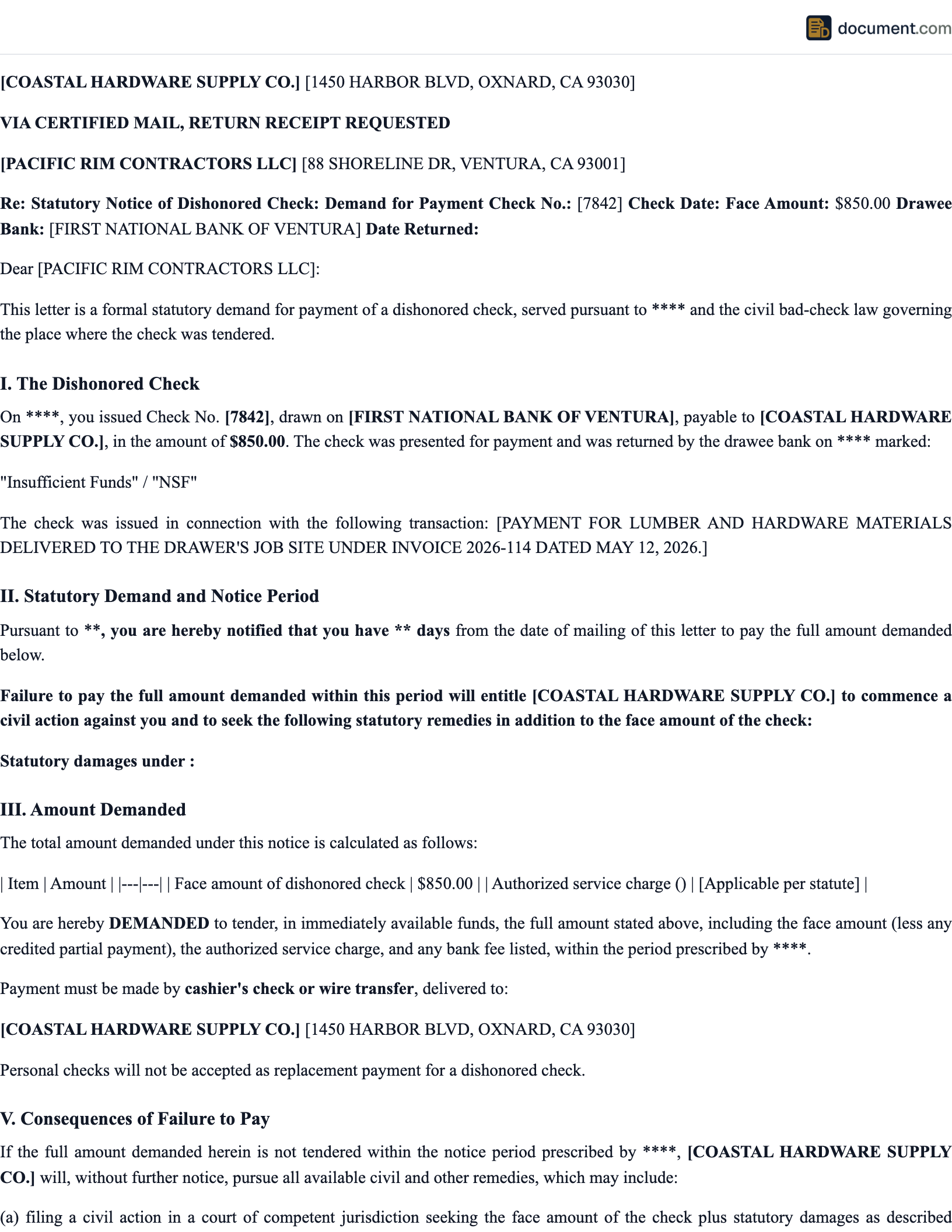
The written demand required by § 68.065 must be sent before the holder can claim treble damages. The statute does not prescribe exact language for the notice, but several elements are essential as a practical matter: the date of the check, the check amount, the name of the drawee bank, the reason for dishonor (as stated on the bank's return notice), the total amount demanded including any authorized service charge, a citation to § 68.065, and a clear statement that if payment is not received within 30 days, the holder will pursue civil action for triple damages plus attorney fees and costs. Setting out the total demanded to the penny -- face amount, service charge, and any bank fee -- removes any dispute about what constitutes full payment under the statute.
The 30-day period runs from the date of the written demand. To be safe, address the demand to the address printed on the check and send it by certified mail, return receipt requested, with a simultaneous copy by first-class mail. Florida's statute does not expressly require a simultaneous first-class mailing the way some other states do, but sending one insulates the notice from a claim that the drawer never received the certified piece. If the certified mailing is returned unclaimed, the first-class copy provides evidence the holder satisfied the notice obligation. Keep the certified-mail receipt, the tracking confirmation, and the returned envelope if it comes back; those are your exhibits if the drawer later claims no notice was received.
Calculate the deadline as a specific calendar date and put it in the letter: '30 days from the date of this notice, on or before [date].' Do not file suit before that date arrives. Filing even one day early gives the drawer a procedural argument that the notice period had not run, which can knock out the statutory damages. If the drawer makes a partial payment during the 30-day window, record the receipt and note the date and amount. The treble-damage calculation applies to the amount still owed after that partial payment, so a $100 payment toward a $400 check during the notice period reduces the damages base to $300.
Florida-Specific Notes
Florida's civil bad-check statute expressly covers electronic fund transfers and debit card orders, not just paper checks. If a customer pays by ACH debit or debit card and the transaction is returned, the same notice procedure and the same treble-damage framework apply under § 68.065. This matters for landlords who collect rent electronically and for any business that accepts ACH payment. Confirm the reason for the return -- returned ACH transactions for reasons unrelated to insufficient funds or stop payment (such as an incorrect account number) may fall outside the statute's scope.
Florida's criminal bad-check statute, Fla. Stat. § 832.05, runs on a parallel track. Writing a check knowing funds are insufficient is a first-degree misdemeanor when the check is under $150 and a third-degree felony when the check is $150 or more and the payee received something of value. Several Florida state attorney offices operate bad-check restitution and diversion programs: the Office of the State Attorney for the 15th Judicial Circuit (Palm Beach County), Miami-Dade, and the 6th Judicial Circuit (Pinellas/Pasco) each maintain programs that collect restitution from first-time offenders in exchange for withholding criminal prosecution. These programs typically require the victim to have first made a written demand, which is another reason to send the civil notice promptly even if your primary goal is criminal referral rather than a civil judgment.
Florida Specific Note
Florida's civil bad-check statute includes an economic hardship defense that gives the court or jury discretion to waive all or part of the treble damages if the drawer proves the failure to pay was caused by financial hardship. This defense has no counterpart in most other states' civil bad-check frameworks. A drawer who lost a job, experienced a medical emergency, or can otherwise document genuine hardship at the time the check bounced may be able to limit the damages to the face amount and perhaps the service charge. This does not eliminate the civil claim, but it is a real litigation risk on smaller checks where the cost of contested proceedings may approach the potential recovery.
For checks under $8,000, Florida county court small-claims division is the appropriate venue, with modest filing fees and no requirement for an attorney. The small-claims ceiling is $8,000 excluding costs, interest, and attorney fees as of the most recent increase. Because § 68.065 awards attorney fees as part of the judgment, a prevailing payee can recover counsel fees separately from the $8,000 cap. For claims above $8,000, file in the county civil division or circuit court depending on the total amount in controversy. Keep in mind that the treble-damage calculation can push a modest check well above the small-claims threshold: a $3,000 check fully unpaid produces $9,000 in treble damages alone, which would require filing in county civil court.
Florida Bad Check FAQ
Other State Bad Check Laws
Each state sets its own notice period, damage formula, and service charge. Browse sibling state pages for the specific rules that apply to your situation, or return to the full 50-state guide.
Create your Florida Notice of Dishonored Check in minutes.
Answer a few questions and download a Florida-compliant bad check demand letter that cites Fla. Stat. § 68.065 and is ready to mail certified.