



Georgia Notice of Dishonored Check Overview
Georgia gives holders of dishonored checks a civil remedy that is faster and more direct than criminal prosecution. Under O.C.G.A. § 13-6-15, a payee whose check is returned for insufficient funds or a closed account can recover double the amount still owed on the check, a statutory service charge, any bank fees the payee incurred, and court costs -- all without needing a conviction or a prosecutor's cooperation. The civil action belongs entirely to the payee.
The statute's 10-day notice period is among the shortest in the country. Most states give check writers 30 days to make good on a dishonored instrument before civil penalties attach. Georgia requires only 10 days from the drawer's receipt of a certified-mail demand. That compressed window reflects a policy choice: Georgia treats the failure to fund a check not merely as a collection problem but as conduct that warrants a short fuse before enhanced damages come into play.
The civil remedy and the criminal statute -- O.C.G.A. § 16-9-20, Georgia's deposit account fraud law -- run on separate tracks. A payee can pursue both simultaneously, and many do. The certified-mail demand required under § 13-6-15 also satisfies the written-notice prerequisite that most Georgia district attorneys require before they will accept a criminal warrant application. Sending the civil demand letter first costs nothing extra and preserves every option.
2x amount owed
Civil damages
10 days after certified mail demand
Notice period
Up to $30 or 5% of face amount, whichever is greater, plus bank fees
Service charge
O.C.G.A. § 13-6-15
Controlling statute
The Controlling Statute: O.C.G.A. § 13-6-15
O.C.G.A. § 13-6-15 establishes a cause of action that belongs to the holder of a dishonored check -- the payee, or any assignee who acquired the check. The statute covers checks returned because of insufficient funds and checks drawn on closed accounts. It does not require the holder to prove fraud or intent; dishonor of the instrument combined with a written demand that goes unsatisfied within 10 days is sufficient to establish the civil claim.
The statute's damages structure has two distinct components. First, the holder recovers the face amount of the check itself -- that is the underlying debt. Second, the holder may recover civil damages equal to double the amount owed on the check, subject to a ceiling of $500 above the face value. On top of both, the holder may recover court costs incurred in bringing the action. The service charge -- up to $30 or 5 percent of the check's face amount, whichever is greater, plus any bank-assessed return fee -- is authorized separately and can be demanded in the notice letter before litigation begins.
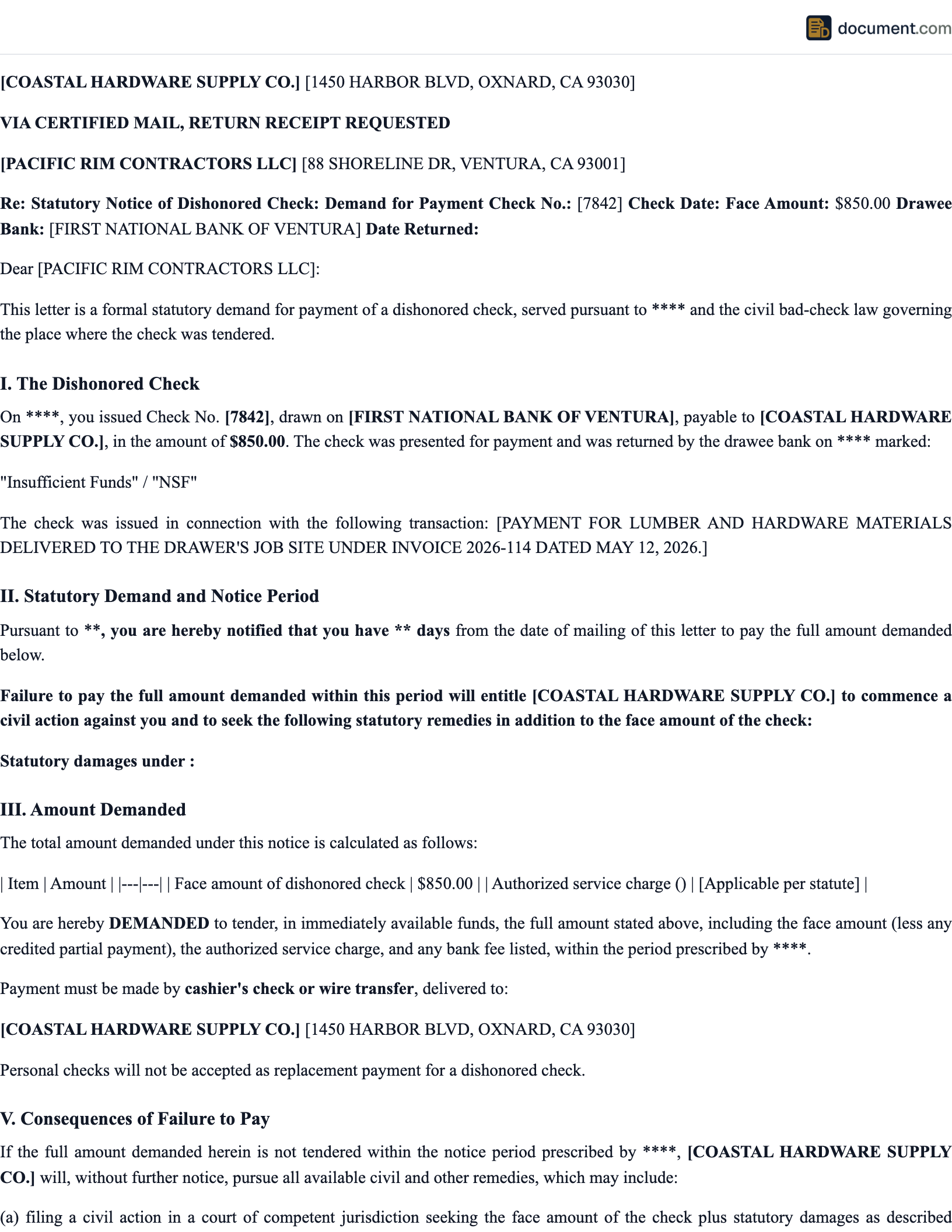
The statute also prescribes the form and content of the demand notice itself. Georgia does not leave the notice language to the payee's discretion. The statute sets out the specific text that must appear in the demand, including language that clearly identifies the check, states the amount owed, and advises the drawer that failure to pay within 10 days will expose them to civil damages. Using paraphrased or abbreviated versions of the required statutory language is one of the most common mistakes payees make, and courts have denied enhanced damages on that ground.
One practical point the statute does not spell out but that Georgia courts have addressed: the 10-day clock runs from the drawer's receipt of the certified mailing, not from the date the payee drops the envelope in the mail. That distinction matters when you are calculating whether a suit filed shortly after mailing was premature. Build in realistic mail-transit time when you set the payment deadline in the notice letter, and state the deadline as a specific calendar date rather than a number of days.
Statute Reference
O.C.G.A. § 13-6-15
Damages: 2x amount owed; not more than $500; plus court costs
What You Can Recover in Georgia
Georgia's damages formula under § 13-6-15 is straightforward but has a ceiling that payees sometimes misread. The civil penalty is two times the amount owed on the check -- not two times the face value if partial payment has already reduced the balance. That distinction matters when the drawer sent a partial payment between dishonor and demand. If the original check was for $400 and the drawer paid $150 before the demand letter went out, the base for the double-damages calculation is $250, yielding a maximum civil penalty of $500 -- which in this case hits the statutory cap. The $500 cap on civil damages is absolute; no matter how large the check, the penalty portion of the judgment cannot exceed $500 above the amount of the instrument.
The practical effect of the cap: on small checks, the multiplier is the story. A $100 dishonored check can yield $100 (face) plus up to $200 in civil damages (double the $100 owed) plus court costs and the service charge -- a total recovery of $300 or more on a $100 instrument. On larger checks, the cap takes over quickly. A $1,000 check produces only $500 in civil damages on top of the $1,000 face amount, meaning the holder's effective multiplier is 1.5x, not 2x. For large commercial checks, the civil remedy under § 13-6-15 supplements the face-amount claim rather than dominating it.
The service charge -- up to $30 or 5 percent of the face amount, whichever is greater, plus any bank fee the payee was charged for the return -- is recoverable separately from the civil penalty and should be calculated and stated explicitly in the demand letter. On a $50 check, the service charge is $30 (the flat floor). On a $700 check, it is $35 (5 percent of $700). The payee also recovers court costs if the action is filed and judgment obtained. Attorney fees are not expressly authorized under § 13-6-15, which is a meaningful difference from states like California, Florida, and Louisiana that include fees in their bad-check remedies.
- Civil damages: 2x amount owed; not more than $500; plus court costs
- Service charge: Up to $30 or 5% of face amount, whichever is greater, plus bank fees
- Notice period before suit: 10 days after certified mail demand
Notice Procedure and Timeline in Georgia
The notice must be sent by certified mail, return receipt requested, to the address printed on the check or to the drawer's last known address if that address is more current. Georgia does not require a simultaneous first-class mailing the way California and New York do, but many practitioners send one anyway -- if the certified mailing comes back unclaimed, the parallel first-class copy is evidence that the drawer had a reasonable opportunity to learn of the demand. Retain the certified mail receipt and the tracking printout regardless of whether the envelope is signed for, returned, or unclaimed.
The 10-day notice period is short enough that mailing logistics deserve careful attention. Send the notice as soon as you have the bank's return document in hand; do not wait to see whether the drawer will voluntarily make good. The period runs from receipt, so a notice mailed Monday in Atlanta to a Savannah address is typically received Wednesday or Thursday. A notice letter that states the deadline as '10 days from the date of your receipt of this letter, on or before [specific date]' is cleaner than one that just says '10 days' with no calendar anchor. Courts and opposing counsel will scrutinize the timeline.
If the certified mailing is returned unclaimed or refused, Georgia courts have generally found the notice requirement satisfied so long as the mailing was addressed to the correct address and sent in the required form. The unclaimed envelope -- with the postal service's notation and date -- is your exhibit. Keep it intact and do not destroy it. Once the 10-day period has run from the date the mailing was attempted or received (whichever the court applies in that circumstance), you may file your civil action in magistrate court or the appropriate civil court.
Georgia-Specific Notes
Georgia's Magistrate Court is the natural venue for civil bad-check claims. Magistrate Court handles civil cases up to $15,000 -- one of the highest small-claims ceilings in the Southeast -- which means that most dishonored check claims can be filed without an attorney in a court built for exactly this type of dispute. Filing fees are modest, the process is designed for self-represented parties, and judges in Magistrate Court handle bad-check cases routinely. For amounts above $15,000, the claim moves to State Court or Superior Court.
Georgia runs two tracks for dishonored checks that operate in parallel. The civil remedy under § 13-6-15 is a private action between the payee and the drawer. The criminal remedy under O.C.G.A. § 16-9-20, Georgia's deposit account fraud statute, is a public prosecution. Criminal exposure depends on the amount: checks under $500 are generally misdemeanor-level, while checks of $500 or more -- or checks drawn on an out-of-state bank regardless of amount -- can be prosecuted as felonies, with higher thresholds triggering greater penalties. Most Georgia magistrate courts and district attorney offices require proof of a written civil demand before they will process a criminal warrant application; the § 13-6-15 notice letter satisfies that requirement.
Georgia Specific Note
Georgia's § 13-6-15 requires that the demand letter reproduce specific statutory language, not merely a general demand for payment. A notice that omits or paraphrases the required text may fail to trigger the civil penalty even if the drawer ignores it. Before you send the notice, compare your letter against the current enrolled text of the statute at legis.ga.gov. The language requirement is the most frequently litigated procedural defect in Georgia bad-check civil cases.
Stop-payment checks sit in a different legal posture under Georgia law. The deposit account fraud statute and the civil bad-check remedy both contemplate dishonor due to insufficient funds or a closed account as the core scenarios. A drawer who stopped payment because of a genuine dispute about the underlying goods or services has a colorable defense that the check was not issued with fraudulent intent. Where the stop payment was made without legitimate cause, the civil claim under § 13-6-15 remains viable -- but the payee should expect the drawer to raise the underlying dispute as a counterclaim in magistrate court. Consider whether a combined demand addressing both the dishonored check and any underlying contract breach makes strategic sense before filing.
Georgia Bad Check FAQ
Other State Bad Check Laws
Each state sets its own notice period, damage formula, and service charge. Browse sibling state pages for the specific rules that apply to your situation, or return to the full 50-state guide.
Create your Georgia Notice of Dishonored Check in minutes.
Answer a few questions and download a Georgia-compliant bad check demand letter that cites O.C.G.A. § 13-6-15 and is ready to mail certified.