



Indiana Notice of Dishonored Check Overview
Indiana gives the holder of a dishonored check a direct civil remedy that goes well beyond recovering the face value of the instrument. Under Ind. Code § 34-24-3-1, a payee who follows the required notice procedure can pursue treble damages, attorney fees, and interest against the drawer, all through a single civil action, without waiting on a criminal proceeding or involving the prosecutor's office. For most bad checks, the entire case can be heard in small claims court.
The civil remedy and the criminal check-deception statute, Ind. Code § 35-43-5-5, run on separate tracks. A payee who wants compensation goes the civil route. A payee who wants to report the conduct to law enforcement does that separately. Indiana courts have consistently recognized that filing a civil action does not foreclose a criminal referral, and vice versa. In practice, most payees use the civil statute because it produces a money judgment they can collect without waiting for a prosecution that may never come.
Indiana's damage formula is more targeted than a simple multiplier. The statute sets a cap that prevents the penalty from dwarfing the original check amount on large checks while still making the recovery meaningful on small ones. Understanding exactly how the cap interacts with the treble-damage multiplier, and what the notice letter must accomplish before either applies, is the practical starting point for any Indiana bad-check claim.
3x check amount
Civil damages
Notice required; treble damages available after failure to cure
Notice period
Reasonable fees
Service charge
Ind. Code § 34-24-3-1
Controlling statute
The Controlling Statute: Ind. Code § 34-24-3-1
Ind. Code § 34-24-3-1 creates a standalone civil cause of action for the holder of a check that has been dishonored by the drawee bank. The statute covers checks returned for insufficient funds, checks drawn on closed accounts, and checks on which the drawer stopped payment without legal justification. The holder need not prove fraud in the common-law sense; dishonor plus the failure to pay after notice is sufficient to establish the claim.
The statute conditions the enhanced civil remedy on a two-step sequence. First, the holder must send written notice to the drawer demanding payment. Second, the drawer must fail to tender the full amount owed within the period the notice provides. Once both conditions are met, the holder may sue for the face amount of the check plus the statutory penalty. The civil action can be filed in any court of competent jurisdiction, which for claims at or below $10,000 means the small claims docket of an Indiana circuit, superior, or county court.
The scope of the statute reaches natural persons and business entities alike. A sole proprietor, a corporation, a landlord, or an individual consumer can use it. Assignment of a dishonored check to a collection agency does not extinguish the civil remedy, though the assignee should make sure the assignment is properly documented before filing in the assignee's name, because the statute protects 'holders' and courts have examined whether an assignee qualifies.
Indiana did not prescribe a mandatory number of calendar days for the notice period in the way that some states do; instead, the statute requires that notice be given and that the drawer be afforded a reasonable opportunity to cure before the holder proceeds to court for the penalty. In practice, thirty days is the standard used by most Indiana practitioners and is the period referenced in many county court local rules and attorney fee-schedule guidelines. Using a shorter window risks a challenge that the cure opportunity was not genuine.
Statute Reference
Ind. Code § 34-24-3-1
Damages: 3x check amount; not to exceed $500 above check amount; plus attorney fees (min. $100) and 18% interest
What You Can Recover in Indiana
Indiana's damages formula under § 34-24-3-1 awards the holder treble damages, three times the amount of the dishonored check, subject to a ceiling that limits the enhancement to $500 above the face value of the check. On a $100 check, the maximum total recovery under the multiplier is $300 (three times $100), which is $200 above the face value, well within the $500 cap. On a $500 check, treble damages would produce $1,500, but the cap cuts in: the holder may recover the $500 face amount plus $500 in enhanced damages, for a ceiling of $1,000. On any check above roughly $250, the $500 cap becomes the binding constraint rather than the multiplier.
On top of treble damages, the statute separately authorizes attorney fees with a floor of $100. That floor matters in small claims cases where the check amount is modest and a court might otherwise be inclined to award a nominal fee. The $100 minimum makes attorney fees worth claiming even on a $50 or $75 check. The statute also provides for 18% annual interest on the amount owed, which accrues from a date tied to the dishonor rather than the filing date, adding a further recovery element in cases that drag toward trial.
The practical effect of the cap is that the civil statute is most economically powerful on checks between roughly $50 and $500, where the treble multiplier can meaningfully exceed the face value without bumping against the ceiling. On larger checks, say, $2,000, the holder still recovers the face amount, the $500 statutory enhancement, attorney fees, and 18% interest, but the enhancement itself is a smaller fraction of the total. The interest award becomes more significant on larger, longer-running claims precisely because the 18% rate compounds the recovery in a way the flat $500 cap does not limit.
- Civil damages: 3x check amount; not to exceed $500 above check amount; plus attorney fees (min. $100) and 18% interest
- Service charge: Reasonable fees
- Notice period before suit: Notice required; treble damages available after failure to cure
Notice Procedure and Timeline in Indiana
The notice is the prerequisite to the enhanced civil remedy. A holder who sues before sending written demand, or whose demand letter is legally deficient, can recover the face amount of the check as a contract or UCC Article 3 claim but will almost certainly lose the right to treble damages, attorney fees, and interest. Indiana courts have taken the notice requirement seriously, and defendants regularly raise defective notice as a defense in small claims proceedings where the stakes are modest and procedural compliance is easy to challenge.
The notice must be sent to the address the drawer placed on the check or the drawer's last known address. Certified mail, return receipt requested, is the standard method and the one best supported by Indiana case law and practice. Sending a simultaneous first-class copy to the same address is a sound precaution: if the certified piece is returned unclaimed, the first-class copy establishes that the drawer had an adequate opportunity to learn of the demand. Keep the certified mail receipt, the tracking confirmation, and any returned-unclaimed envelope as exhibits; they will be the first documents the court examines.
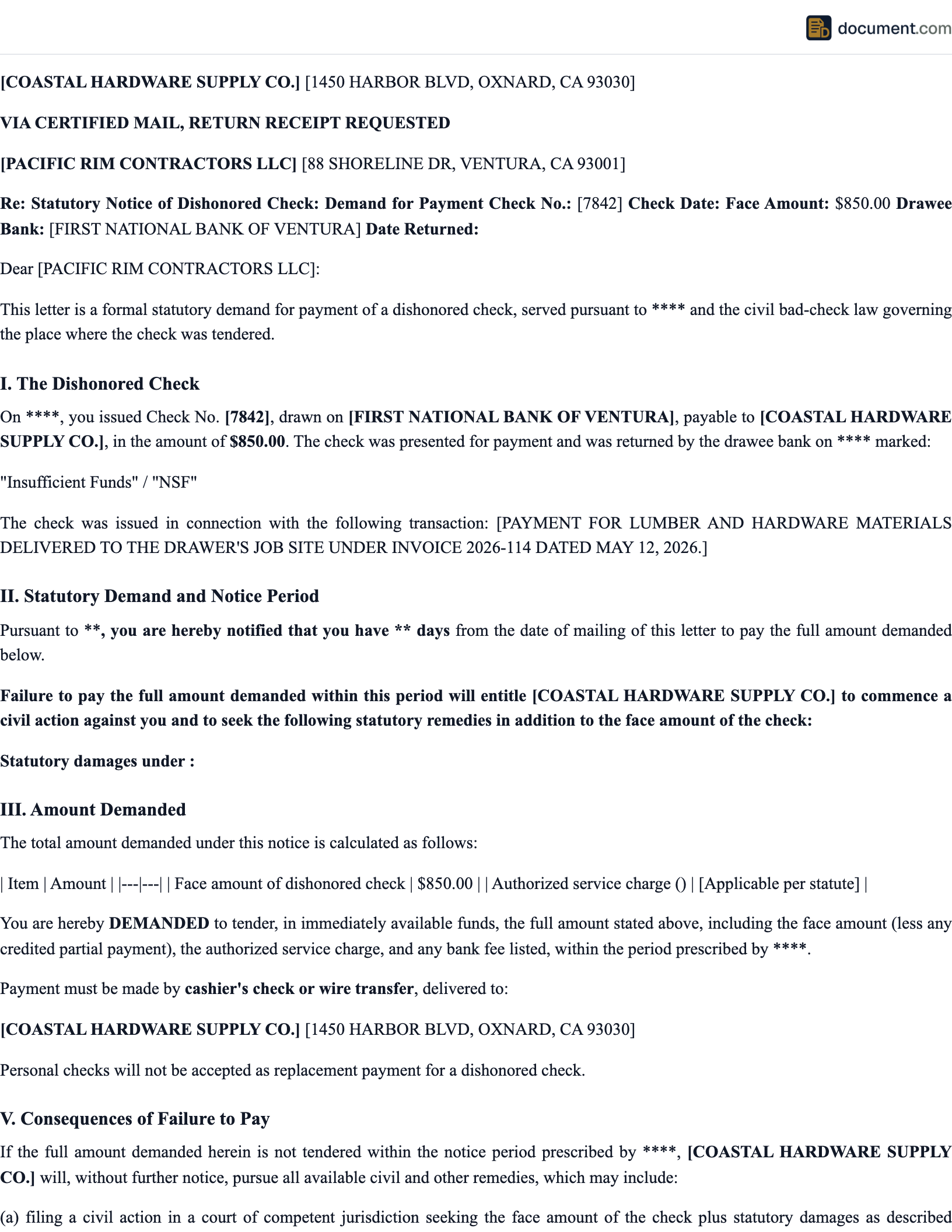
The demand letter should identify the check by number, date, and amount; state the reason for dishonor as shown on the bank's return notice; quote or cite § 34-24-3-1; specify the total amount demanded (face amount plus any authorized service charge); state the consequence of non-payment (treble damages, attorney fees, and interest); and give a clear calendar deadline for payment. Showing the arithmetic in the letter removes any ambiguity about what 'full payment' means when a response arrives. After the notice period runs without full payment, the holder may file the civil action. Do not file before the deadline stated in the letter, even by a day.
Indiana-Specific Notes
Indiana's criminal check-deception statute, Ind. Code § 35-43-5-5, runs on a separate track from the civil remedy but interacts with it in practical ways. Check deception is a Class A misdemeanor for checks under $750. The offense rises to a Level 6 felony for checks of $750 or more but less than $50,000, and to a Level 5 felony for checks of $50,000 or more. Because the civil notice letter creates a documented record of dishonor, written demand, and non-response, it also supplies the evidentiary foundation that most Indiana county prosecutor bad-check programs require before accepting a check for criminal prosecution. Sending the civil demand first does not obligate the holder to forgo criminal referral, and Indiana courts have not treated the civil action as a waiver of the criminal avenue.
Indiana operates pretrial diversion programs in many counties, Marion, Lake, Monroe, Madison, Kosciusko, and others, that allow first-time check-deception defendants to complete a program (which typically requires making the check good, paying a program fee, and completing a financial-education component) in exchange for dismissal of the criminal charge. These programs are prosecutor-administered, not court-administered, and they operate independently of the civil statute. A drawer who completes a diversion program satisfies the criminal liability but does not automatically satisfy the civil claim. The holder retains the right to pursue § 34-24-3-1 damages regardless of whether the drawer participates in or completes a criminal diversion.
Indiana small claims courts have jurisdiction over civil cases where the amount sought does not exceed $10,000. Because the § 34-24-3-1 claim packages the face amount of the check, treble damages (capped at $500 above face), attorney fees, and interest into a single civil action, most bad-check cases fall comfortably within the small claims ceiling. The small claims docket is designed for self-represented litigants and moves faster than the regular civil docket. A complete set of exhibits, the original check or a clear copy, the bank's dishonor notice, the demand letter, and the certified mail proof, will typically resolve an uncontested case on the papers.
Indiana Specific Note
Indiana has not amended § 34-24-3-1 to expressly cover dishonored ACH electronic debits in the way that California, Florida, and Illinois have extended their civil bad-check statutes. A holder whose ACH debit was returned by the drawee bank should not assume that the § 34-24-3-1 notice procedure and penalty framework automatically apply to that transaction. The safer approach for a returned ACH is to pursue the claim as a breach of contract or through the ACH network's own dispute resolution procedures while consulting current Indiana case law to determine whether courts in the relevant county have extended the statute to electronic transfers.
Indiana Bad Check FAQ
Other State Bad Check Laws
Each state sets its own notice period, damage formula, and service charge. Browse sibling state pages for the specific rules that apply to your situation, or return to the full 50-state guide.
Create your Indiana Notice of Dishonored Check in minutes.
Answer a few questions and download a Indiana-compliant bad check demand letter that cites Ind. Code § 34-24-3-1 and is ready to mail certified.