



Louisiana Notice of Dishonored Check Overview
Louisiana gives payees a civil remedy for dishonored checks that works alongside the state's criminal worthless-check statute, La. R.S. § 14:71. The civil track, found at La. R.S. § 9:2782, is a private action between the payee and the drawer. It does not depend on a criminal conviction or a referral to the district attorney, and it can produce a money judgment that the payee enforces directly. For many merchants, landlords, and service providers, the civil route is faster and more predictable than waiting on a criminal docket.
The civil damages formula in Louisiana is different from the treble-damage rule most other states use. Louisiana awards double the check amount, subject to a floor of $100, rather than tripling the face value. That structure benefits holders of smaller checks, where the $100 floor means a $40 dishonored check can still generate $100 in civil damages rather than $80. On larger checks the doubling formula produces substantial recoveries, and attorney fees stack on top of the damages calculation, making the civil remedy meaningful at virtually any check size.
Louisiana also has a parallel civil statute for stop-payment checks, La. R.S. § 9:2782.2, which applies when a drawer stops payment without a good-faith dispute as its basis. The two statutes overlap in purpose but differ in procedure and in how intent is analyzed. A payee holding a stop-payment check should confirm which statute applies before sending the demand notice, because sending a notice under the wrong provision can leave the payee with only ordinary contract remedies.
2x check amount or $100, whichever is greater
Civil damages
15 working days after certified/registered mail notice
Notice period
$25 or 5% of face amount, whichever is greater
Service charge
La. R.S. § 9:2782
Controlling statute
The Controlling Statute: La. R.S. § 9:2782
La. R.S. § 9:2782 applies to any check or draft drawn on a bank or other depository institution that is returned unpaid because the drawer's account had insufficient funds or did not exist. The statute creates a civil cause of action in favor of the payee (or any subsequent holder) against the drawer. The action is separate from and does not preclude a criminal prosecution under La. R.S. § 14:71, but the two proceed independently. A criminal conviction is not a prerequisite to civil recovery, and civil recovery is not a bar to prosecution.
To activate the statutory civil damages, the holder must send written notice to the drawer demanding payment. The notice must be sent by certified or registered mail to the drawer's address as it appears on the check, or to the drawer's last known address if different. Once mailed, the drawer has 15 working days to tender the face amount of the check plus any authorized service charge. That 15-working-day window is the cure period. If the drawer pays in full within that window, the civil penalty does not attach. If the window closes without full payment, the holder's right to double damages, court costs, and attorney fees is established.
The service charge authorized by the statute is the greater of $25 or 5 percent of the face amount of the check. On a $400 check, 5 percent is $20, so the $25 floor applies. On a $600 check, 5 percent is $30, so the percentage controls. On a $1,000 check, the service charge is $50. The service charge is a separate line item from the civil penalty and from the check face amount; all three can be demanded and recovered together in a successful civil action.
Louisiana's statute requires working days, not calendar days, for the notice period. That distinction matters in practice. A notice mailed on a Tuesday before a holiday week runs its 15-working-day clock across business days only, skipping weekends and Louisiana public holidays. Computing the deadline correctly is important because filing suit before the window closes can jeopardize the civil penalty claim. Count forward 15 working days from the date of mailing and convert that to a specific calendar date before you file anything in court.
Statute Reference
La. R.S. § 9:2782
Damages: 2x check amount or $100, whichever is greater; plus court costs and attorney fees
What You Can Recover in Louisiana
Under La. R.S. § 9:2782, a holder who complies with the notice requirement and whose drawer fails to pay within 15 working days may recover: the face amount of the check, civil damages equal to the face amount of the check (bringing the total to twice the check amount), a service charge of the greater of $25 or 5 percent of the check amount, court costs, and reasonable attorney fees. The $100 floor on the damage component means that even if the check was for $40, the civil damages award cannot fall below $100 for the penalty portion alone, apart from the face amount. A $40 check that goes unpaid after proper notice can yield $40 (face) plus $100 (minimum civil damages) plus the $25 service charge plus costs and fees.
The doubling formula works as follows: a $500 check generates $500 in face-amount recovery plus $500 in civil damages, for $1,000 before the service charge, costs, and attorney fees. A $2,000 check generates $4,000 on the same math, plus the $100 service charge (5 percent of $2,000), plus costs and fees. Unlike many states, Louisiana does not cap the civil damages at a fixed dollar amount above the check face, so the doubling multiplier scales with the check amount without an upper ceiling.
Attorney fees under § 9:2782 are recoverable by the prevailing holder as part of the judgment, not merely as a prayer in the complaint. That provision makes the civil remedy viable even when the check amount alone would not justify retaining counsel, because the fee award shifts the cost of collection to the drawer who failed to cure. Courts have discretion to determine what fees are reasonable given the complexity of the matter, the amount involved, and the result obtained, but the right to fees is statutory and does not depend on proving bad faith beyond the dishonored check itself.
- Civil damages: 2x check amount or $100, whichever is greater; plus court costs and attorney fees
- Service charge: $25 or 5% of face amount, whichever is greater
- Notice period before suit: 15 working days after certified/registered mail notice
Notice Procedure and Timeline in Louisiana
The demand must be sent by certified or registered mail. Ordinary first-class mail does not satisfy the statute. Address the notice to the name and address printed on the check or to the drawer's last known address if you have reliable information that a different address is current. Keep the certified mail receipt and the delivery confirmation or, if the piece is returned unclaimed, the envelope with the postal notation. These documents are the core of your evidentiary record if the case goes to court. A check that comes back unclaimed does not defeat the notice requirement so long as the mailing was properly addressed.
The 15-working-day clock runs from the date of mailing, not the date the drawer signs for the piece. Count forward 15 working days on a calendar, skipping Saturdays, Sundays, and Louisiana state holidays. Convert the result to a specific date and write that date into the body of the demand letter. If you mail on a Monday and the following week contains a Louisiana holiday, the deadline shifts forward by one day for each non-working day in the count. Being precise about the deadline in the letter removes any argument that the drawer did not know when the cure window closed.
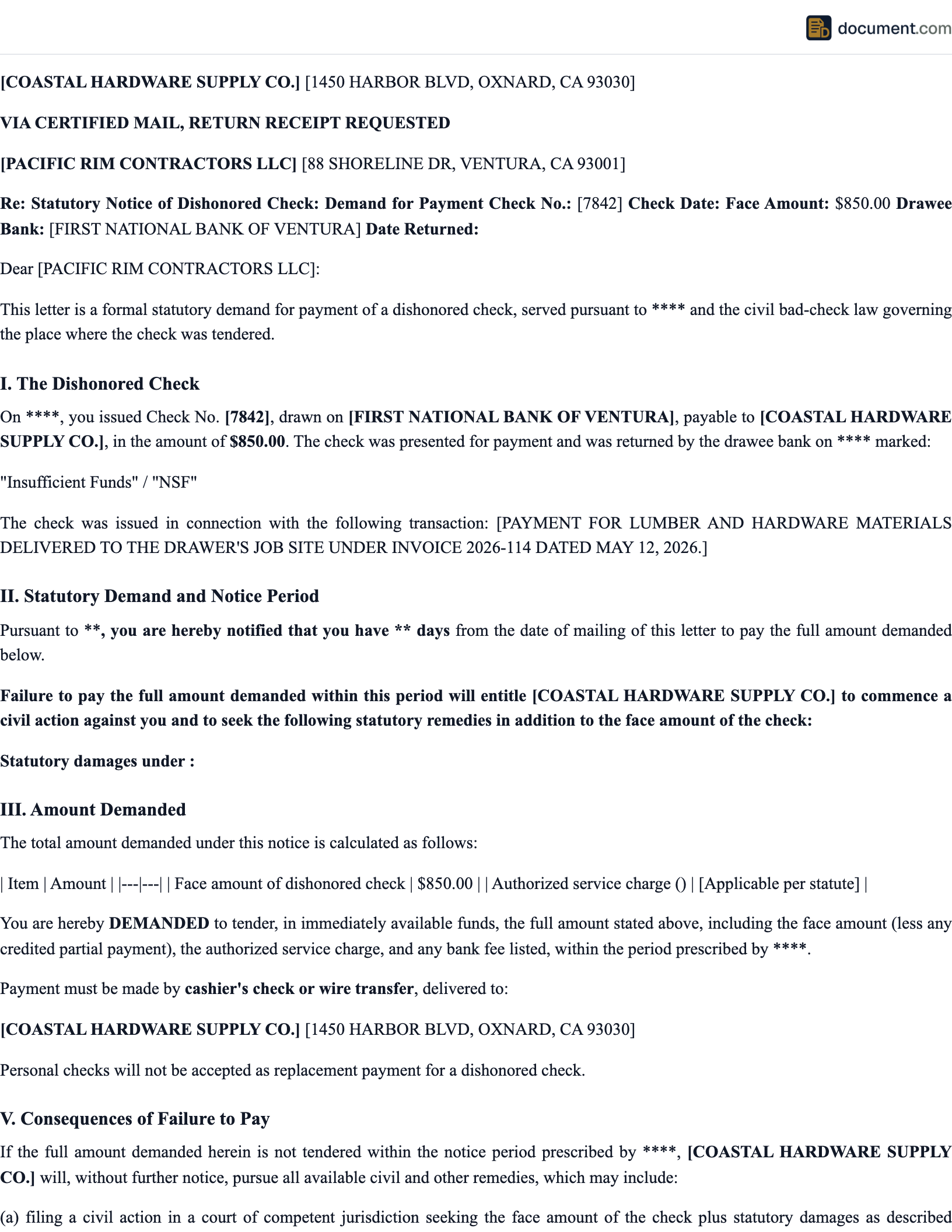
The notice itself should state the date and amount of the check, the name of the drawee bank, the reason the bank returned it, the total amount demanded (check face plus the service charge), the statutory citation (La. R.S. § 9:2782), the 15-working-day cure deadline expressed as a specific calendar date, and payment instructions. Instruct the drawer to pay by money order or cashier's check; a personal check from a drawer whose check has already bounced is not reasonable tender. Retain a complete copy of the letter you send, and do not accept partial payment without a written acknowledgment that you are reserving the right to pursue the remaining balance and any civil penalty on the unpaid portion.
Louisiana-Specific Notes
Louisiana's criminal worthless-check statute, La. R.S. § 14:71, runs on a separate track from the civil remedy and carries graduated penalties based on check amount. Checks under $1,000 are punishable as misdemeanors by up to six months in jail or a fine up to $500. Checks between $1,000 and $5,000 can result in up to five years imprisonment with or without hard labor. The $5,000-to-$24,999 tier carries up to ten years, and checks of $25,000 or more carry up to twenty years at hard labor. When a drawer issues multiple worthless checks within a 180-day period, the amounts may be aggregated to determine which penalty tier applies, so a series of smaller checks can collectively constitute a felony.
Most Louisiana parish district attorney offices operate a worthless-check division that handles prosecution separately from civil collection. The East Baton Rouge DA's Check Department, for example, requires the merchant to send a certified-mail demand and provide the stamped original check before the DA will accept the matter. The 22nd Judicial District (St. Tammany and Washington Parishes) similarly requires a prior certified-mail demand and enforces a 10-day response window as a condition of accepting the case. These DA programs are free to the merchant but require the check writer to pay full restitution plus DA fees. Filing with the DA and pursuing the civil remedy under § 9:2782 are not mutually exclusive, but coordinating them requires care, because accepting direct payment after filing with the DA can create complications with the DA's office under certain programs.
Louisiana Specific Note
Louisiana's civil bad-check statute does not cover postdated checks in the same way it covers checks presented as current instruments. A check that both parties understood would not be deposited until a future date raises a good-faith dispute about whether the drawer had the intent required by the statute. Courts have found that a genuinely postdated check does not fit the model of a check 'drawn upon a bank' with the expectation of immediate payment. If you accepted a postdated check and it was later returned, the civil penalty analysis under § 9:2782 is less straightforward, and you should confirm applicability before sending the statutory demand.
For stop-payment checks, the separate statute La. R.S. § 9:2782.2 provides the applicable framework. That provision addresses checks on which the drawer directed the bank to refuse payment. The stop-payment civil remedy has its own notice requirements and conditions. Sending a § 9:2782 NSF-check notice on a stop-payment instrument and citing the wrong statute can leave a gap in the payee's statutory claim, particularly if the drawer asserts a good-faith dispute as the basis for stopping payment. Identify from the bank's return notation whether the dishonor was due to NSF or a closed account (both covered by § 9:2782) or a stop-payment order (covered by § 9:2782.2) before drafting the demand.
Louisiana Bad Check FAQ
Other State Bad Check Laws
Each state sets its own notice period, damage formula, and service charge. Browse sibling state pages for the specific rules that apply to your situation, or return to the full 50-state guide.
Create your Louisiana Notice of Dishonored Check in minutes.
Answer a few questions and download a Louisiana-compliant bad check demand letter that cites La. R.S. § 9:2782 and is ready to mail certified.