
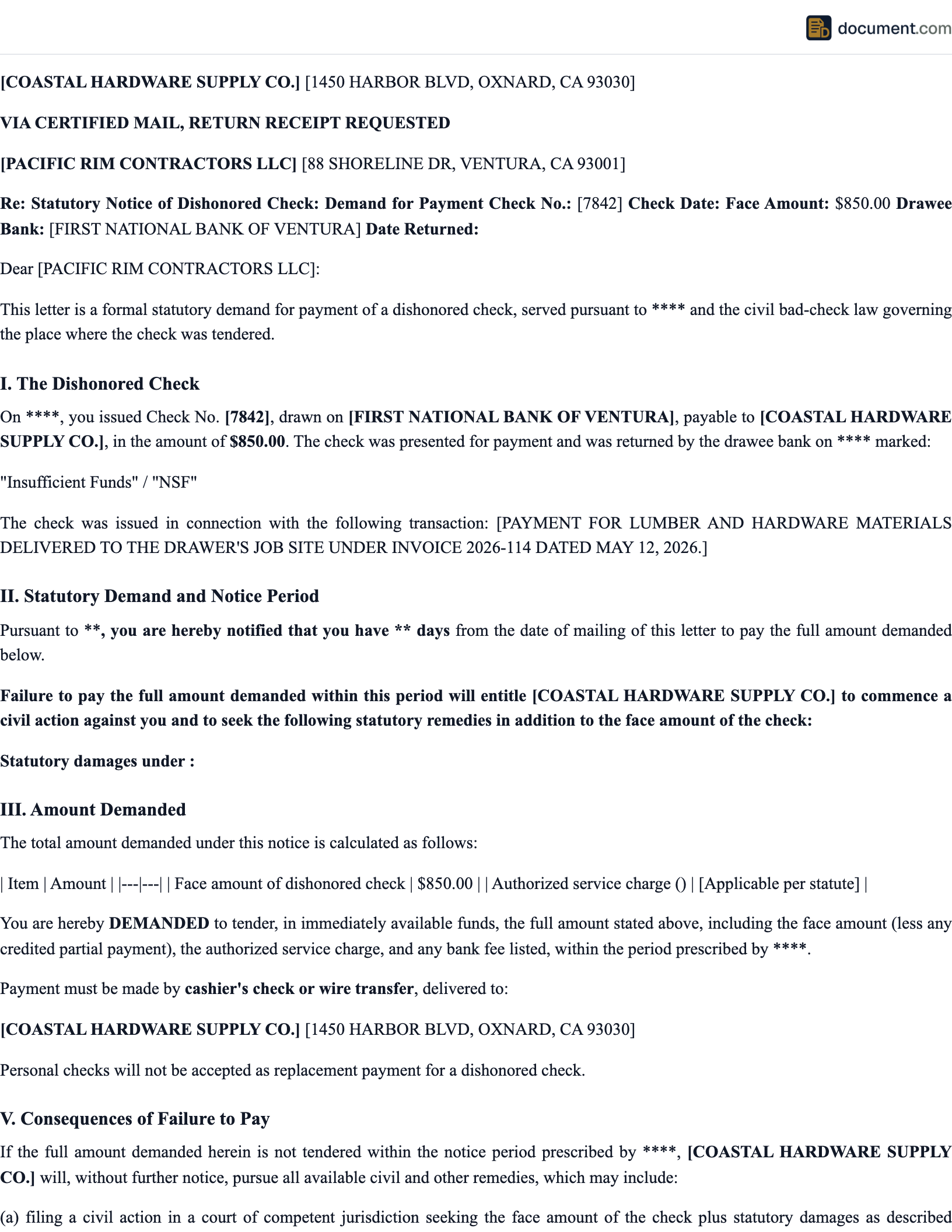



Maine Notice of Dishonored Check Overview
Maine gives check holders a civil remedy that sits alongside the state criminal code but runs entirely on its own track. The controlling statute is Title 14, Section 6071 of the Maine Revised Statutes, a provision that lets payees recover enhanced liquidated damages, interest, and in some circumstances attorney fees without ever filing a criminal complaint. The framework rewards holders who follow the notice procedure precisely and penalizes those who skip steps or send deficient letters.
The statute distinguishes between two types of dishonor -- insufficient funds and nonexistent accounts -- and sets different damage caps for each. That distinction matters from the moment you look at your bank's return notice, because which cap applies determines how much you can demand in the letter and how much a court can award. Getting the reason for dishonor right at the outset avoids an embarrassing correction at the hearing.
Maine also maintains a separate criminal statute for worthless instruments under Title 17-A, Section 708, with thresholds that graduate from a Class E misdemeanor for amounts of $500 or less all the way to a Class B felony for instruments exceeding $10,000. The civil and criminal procedures are independent: a payee can pursue the civil remedy without any involvement from the district attorney, and the two tracks can run simultaneously. Knowing both systems allows a holder to use the civil notice procedure as the first step and, if the drawer remains unresponsive, to hand the case to the prosecutor with a documented demand already in the file.
2x face amount or $400 (insufficient funds) / $750 (no account), whichever is less
Civil damages
10 days after written notice of dishonor; 30 days for enhanced damages
Notice period
Up to $25
Service charge
Me. Rev. Stat. tit. 14, § 6071
Controlling statute
The Controlling Statute: Me. Rev. Stat. tit. 14, § 6071
Me. Rev. Stat. tit. 14, § 6071 creates a civil cause of action that is separate from a contract claim on the underlying debt. Subsection 1 authorizes recovery of the check amount, court costs, processing charges the holder actually incurred, and interest at 12 percent per annum from the date of dishonor -- but only if the holder has provided the notice required by Section 6073 and the drawer has failed to pay within 10 days of receiving that notice. The 10-day window is the initial cure period; it gives the drawer a short but meaningful opportunity to make the check good before the claim becomes one for enhanced damages.
Subsection 2 addresses what happens when a case reaches a hearing without full payment having arrived. At that stage the court may award reasonable attorney fees to the prevailing party and may further award a civil penalty of up to $150. The penalty is discretionary rather than mandatory, which means a court can calibrate the award based on the drawer's conduct and the circumstances of the dishonor. A drawer who paid within days of the demand but after the cure window likely faces a smaller penalty than one who ignored multiple notices entirely.
Subsection 5 is where Maine's enhanced liquidated damages live, and it has a structure unlike most states. The enhanced damages are not a general treble multiplier; they apply when either a second dishonored check has been issued to the same payee within a one-year period, or when a first check went unpaid for 45 days after issuance. In those circumstances, if the full amount remains unpaid 30 days after written demand, the holder is entitled to liquidated damages equal to twice the check amount or the applicable statutory cap, whichever is less. The cap depends on the reason for dishonor: $400 for insufficient funds, $750 for a check on a nonexistent account.
Subsection 4 defines 'check' broadly to include any check, draft, or order for the payment of money, so the statute is not limited to personal checks drawn on a checking account. A business draft or a money order that bounces can fall within the statute if it meets the other requirements. Subsection 3 provides that the civil penalty framework does not displace terms the parties have agreed to in writing, so a contract that specifies a different returned-check fee or cure period controls over the statute for that transaction.
Statute Reference
Me. Rev. Stat. tit. 14, § 6071
Damages: 2x face amount or $400 (insufficient funds) / $750 (no account), whichever is less; plus civil penalty up to $150
What You Can Recover in Maine
Maine's damages formula is layered rather than a single multiplier. At the base level, Subsection 1 entitles a holder who has sent proper notice to the face amount of the check, plus processing charges (the bank fee and related costs you actually paid), plus interest at 12 percent per year running from the date of dishonor. On a $600 check dishonored in January and paid after a June judgment, the interest component alone adds a meaningful amount to the recovery. The service charge the holder may demand in the notice letter is capped at $25 under Maine's statute.
The enhanced liquidated damages under Subsection 5 sit on top of those base amounts, but only when the qualifying conditions are met. For an NSF dishonor, the enhancement is twice the check amount or $400, whichever is less. That means a $150 check generates a $300 enhancement; a $350 check generates a $400 enhancement (because twice $350 equals $700, which exceeds the $400 cap); and any check over $200 generates the flat $400 cap for insufficient-funds dishonors. For a check on a nonexistent account, the cap rises to $750, so a holder of a $300 closed-account check can recover the full $600 enhancement (2x $300), while a holder of a $500 closed-account check hits the $750 ceiling.
On top of those amounts, the court has discretion to add a civil penalty up to $150 and, if the case went to a hearing without full payment, reasonable attorney fees. A holder with a qualifying NSF check for $250, documented processing costs of $30, properly sent notice, and a draw that ignored the 30-day demand could present to the court: $250 face amount + $30 processing + $500 in accrued 12% interest (proportional) + $400 enhanced damages + up to $150 civil penalty + attorney fees. That total can substantially exceed the face of the check, which is exactly the structure the legislature intended to encourage compliance with the civil demand.
- Civil damages: 2x face amount or $400 (insufficient funds) / $750 (no account), whichever is less; plus civil penalty up to $150
- Service charge: Up to $25
- Notice period before suit: 10 days after written notice of dishonor; 30 days for enhanced damages
Notice Procedure and Timeline in Maine
Maine's notice procedure runs through two statutes working together. Section 6071 sets out the remedies; Section 6073 sets out the required form and delivery of the demand. To preserve the right to the base damages under Subsection 1, the holder must send written notice and then wait 10 days for the drawer to cure. To preserve the right to the enhanced liquidated damages under Subsection 5, the holder must send written demand and wait 30 days without receiving full payment. Running both clocks simultaneously is practical: a single notice letter sent on Day 1 starts both the 10-day cure window and the 30-day enhanced-damages period at the same time. If the drawer pays the face amount and service charge within 10 days, the Subsection 1 base claim is satisfied. If the drawer pays nothing and 30 days pass, the enhanced liquidated damages become available.
Method of mailing matters under Maine law and is worth confirming against the current text of Section 6073 before you send. Certified mail, return receipt requested, addressed to the address on the check or the drawer's last known address, is the standard approach and creates the best evidentiary record. If the drawer does not retrieve the certified mailing, keep the returned envelope with the postal notation; Maine courts generally do not penalize a holder whose properly addressed certified mailing was not accepted by the recipient, so long as the holder made the required attempt. Some practitioners send a simultaneous first-class copy to reduce the chance that a refused certified piece defeats the notice, though the statute should be consulted on whether a parallel first-class mailing is required.
Calculating the 30-day deadline precisely is not optional -- it is the difference between having an enhanced-damages claim and losing it. If you mail the notice on June 10, the 30-day period runs through July 10. State the deadline as a calendar date in the letter itself rather than a number of days; a notice that says 'you have 30 days from the date of this letter, on or before July 10,' is clear on its face and removes any argument about when the clock started. Retain the certified mail receipt, the tracking confirmation showing the delivery address, and a copy of the letter with the date it was sent. These three documents are the evidentiary foundation at trial.
Maine-Specific Notes
Maine's enhanced damages under Subsection 5 do not apply to every dishonored check automatically. The statute requires either a second dishonored check from the same drawer to the same payee within a one-year window, or a first check that remained unpaid for 45 days after issuance. A holder whose first check from a particular drawer was dishonored and who sends a timely notice is still entitled to the base damages, interest, processing costs, the $25 service charge, and the court's discretionary $150 civil penalty -- but the doubled cap of $400 or $750 is only available under the conditions in Subsection 5. Holders with a single first-time returned check should still send the statutory notice promptly; it preserves all available base remedies and starts the documentation trail that a district attorney may later require.
Maine's criminal bad-check statute, Title 17-A, Section 708 ('Negotiating a Worthless Instrument'), creates a ladder of offense classes based on the instrument's face value. A check under $500 is a Class E crime (misdemeanor); $501 to $1,000 is Class D; $1,001 to $10,000 is Class C (felony); and above $10,000 is Class B (felony). The statute also allows prosecutors to aggregate multiple instruments issued under a single scheme, so a drawer who wrote several smaller checks as part of one course of conduct can face felony charges even if no individual check exceeds the Class D threshold. Importantly, the criminal statute expressly creates a permissible inference of knowledge -- that the instrument would not be honored -- if the drawer failed to pay within five days of receiving notice of dishonor. That is a shorter window than the civil statute's 10-day cure period, so the civil demand letter doubles as documentation relevant to the criminal intent element.
Maine authorizes pretrial diversion programs for worthless check cases under Title 32, Section 11013-A. District attorneys may establish programs -- operated directly or through private entities under contract -- that allow accused check writers to avoid criminal prosecution by completing the program requirements. The programs are limited to checks that are not postdated payday-loan instruments, not stop-payment orders entered in good faith, and not checks involving identity theft or fraud. A civil demand letter sent under Section 6071 is the natural prerequisite: most district attorney offices will look for evidence of an attempted civil demand before accepting a check for criminal processing or diversion enrollment. Sending the statutory notice is therefore useful even when you intend to refer the matter criminally.
Maine Specific Note
Maine's small claims court jurisdictional ceiling increased to $10,000 as of January 1, 2026. Most civil bad-check claims -- including the face amount of the check plus enhanced damages, interest, the service charge, and the civil penalty -- will fall well within that ceiling, making the District Court small claims session the practical venue for the vast majority of cases. But if the check itself is large and the base claim plus enhanced damages and interest approaches $10,000, calculate the total carefully before filing in small claims. If the total could exceed $10,000, filing in the civil division of the District Court avoids a later jurisdictional challenge that could require refiling and restarting the process.
Maine Bad Check FAQ
Other State Bad Check Laws
Each state sets its own notice period, damage formula, and service charge. Browse sibling state pages for the specific rules that apply to your situation, or return to the full 50-state guide.
Create your Maine Notice of Dishonored Check in minutes.
Answer a few questions and download a Maine-compliant bad check demand letter that cites Me. Rev. Stat. tit. 14, § 6071 and is ready to mail certified.