


Maryland Notice of Dishonored Check Overview
Maryland payees holding a returned check have a focused civil remedy under the Commercial Law Article, sections 15-801 through 15-804. The statute is narrower in its damage multiplier than the treble-damage schemes common in other states, but it is direct: send the required written notice, wait thirty days, and if the drawer still has not paid, you may sue for twice the check amount plus a $35 collection fee on top of the face value of the check.
The civil remedy sits alongside Maryland's criminal bad-check law, which runs through Criminal Law Article sections 8-101 to 8-108. Those two tracks are independent. The civil action requires no criminal conviction and no district attorney involvement. For most payees pursuing a check under $500, the civil statute delivers a faster and more predictable result than waiting on a criminal referral.
Maryland's statute applies to both individuals and businesses. A landlord whose tenant's rent check is returned, a contractor who received a bad check at job completion, and a retailer who accepted a bad check at the register all have access to the same civil framework. The prerequisite is identical in each case: a proper written notice sent to the drawer's address and a clean thirty-day waiting period before any suit is filed.
2x check amount, not more than $1,000
Civil damages
30 days after mailing notice of dishonor
Notice period
Up to $35
Service charge
Md. Code, Com. Law §§ 15-801 to 15-804
Controlling statute
The Controlling Statute: Md. Code, Com. Law §§ 15-801 to 15-804
Md. Code, Com. Law § 15-801 defines the covered instruments. The statute applies to a check or similar instrument drawn on a financial institution that is dishonored on presentment. Section 15-802 establishes the civil cause of action: a holder who sends the required written notice and does not receive full payment within thirty days may bring a civil action against the drawer.
Section 15-803 sets the damages formula. The holder may recover the amount of the check, a civil penalty equal to the amount of the check (up to $1,000), and a collection charge of up to $35. Read carefully: the civil penalty is a one-times multiplier on the check amount, not two times the check amount added to the face value. The total recovery on a $400 check is $400 (the check) plus up to $400 (the penalty) plus $35 (the collection fee), for a maximum of $835 on that particular instrument. The $1,000 cap on the penalty portion means that a check larger than $1,000 yields a penalty of $1,000 rather than the full check amount.
Section 15-804 contains the notice requirement. Written notice must be sent to the drawer at the address on the check or the drawer's last known address. The statute specifies that the holder must wait thirty days after mailing the notice before commencing a civil action. The thirty-day period is measured from the date of mailing, not from the date of receipt. That distinction matters when you are calendaring the lawsuit filing date.
The statute does not mandate a specific form of mail, but certified mail with return receipt requested is the standard practice because it produces a receipt and a tracking record the holder can present in court. If the drawer claims the notice was never received, a certified mail return card or a delivery confirmation from USPS eliminates that argument. Sending a simultaneous first-class copy, while not required by the statute's text, is a sound precaution if the certified piece comes back unclaimed.
Statute Reference
Md. Code, Com. Law §§ 15-801 to 15-804
Damages: 2x check amount, not more than $1,000; plus $35 collection fee
What You Can Recover in Maryland
Under § 15-803, a successful plaintiff recovers three components: the face amount of the check, a civil penalty up to the amount of the check capped at $1,000, and a collection fee of up to $35. On small checks the math is straightforward. A $200 returned check yields a maximum recovery of $200 (face) + $200 (penalty) + $35 (fee) = $435. A $600 check yields $600 + $600 + $35 = $1,235. A $1,500 check yields $1,500 + $1,000 (penalty capped) + $35 = $2,535.
The $1,000 ceiling on the penalty is the key constraint that distinguishes Maryland from states using uncapped treble damages. Once the check amount exceeds $1,000, the penalty flatlines. A payee holding a $5,000 returned check can recover $5,000 + $1,000 + $35 = $6,035 in statutory damages, regardless of the check's size beyond that threshold. For very large checks, ordinary contract damages or other civil theories may supplement the statutory claim, but the civil bad-check statute itself stops growing at the $1,000 penalty cap.
The collection fee of up to $35 compensates for bank returned-check charges and administrative costs. State the specific fee amount in the notice letter rather than just referencing the statutory ceiling. Courts have declined to award fees that were not adequately demanded in the notice. If your bank charged a $30 NSF fee, demand $30; if it charged $35, demand $35. Do not claim more than the bank actually charged, because the fee is intended to be compensatory rather than punitive.
- Civil damages: 2x check amount, not more than $1,000; plus $35 collection fee
- Service charge: Up to $35
- Notice period before suit: 30 days after mailing notice of dishonor
Notice Procedure and Timeline in Maryland
Before any civil action can be filed under § 15-804, the holder must send written notice to the drawer and wait thirty days from the date of mailing. The notice must go to the address printed on the check or, if that address is outdated, to the drawer's last known address. Using the check's face address is both the simplest approach and the most defensible: you are relying on an address the drawer chose to provide on the instrument.
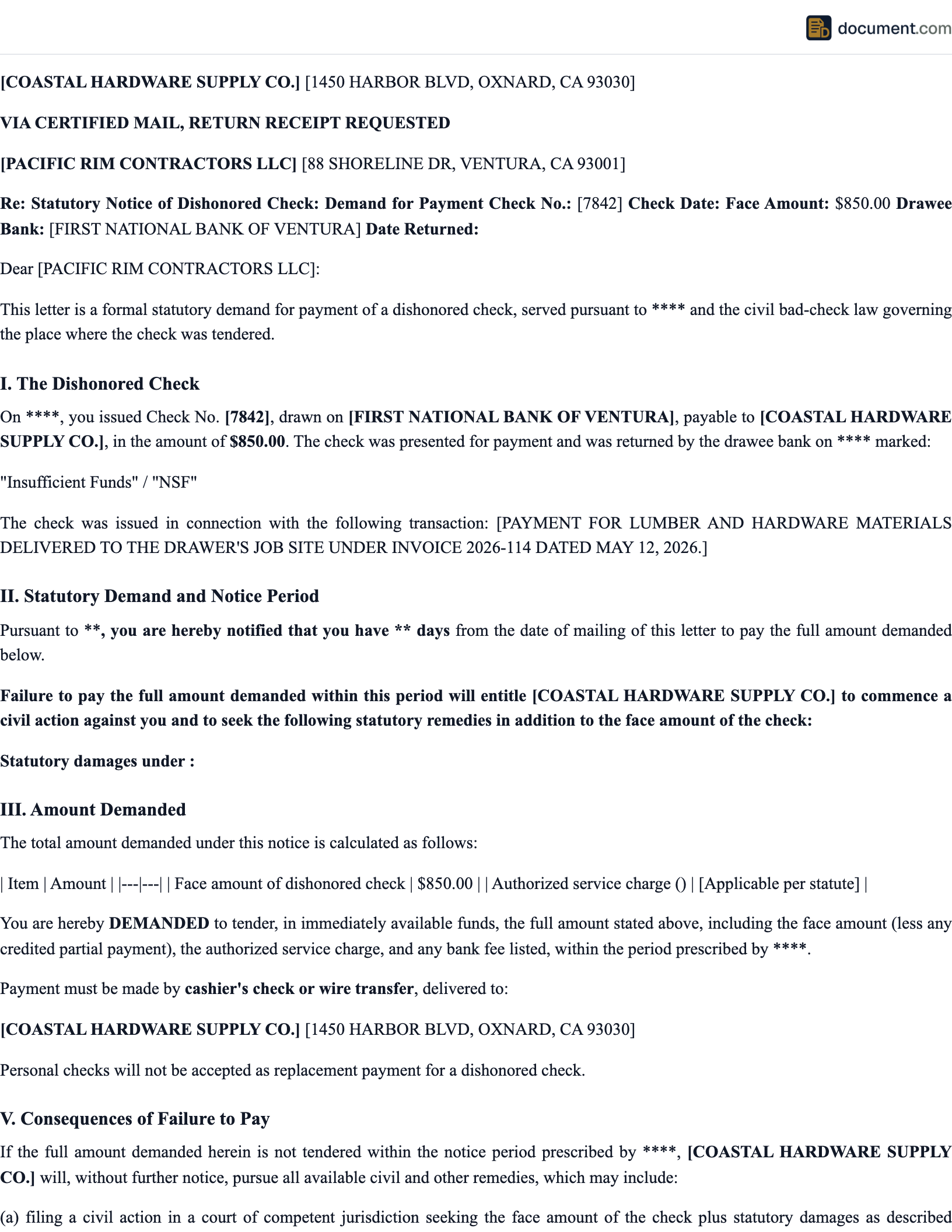
The notice should state the check amount, the date of the check, the name of the drawee bank, the reason for dishonor as shown on the bank's return notice, the total amount demanded (face amount plus the $35 fee if you are claiming it), and a plain statement that if payment is not received within thirty days of the date this letter was mailed, you intend to file a civil action under Md. Code, Com. Law §§ 15-801 to 15-804. Citing the statute by section number is not required by the statute's text, but it signals that the demand is made under a specific legal framework rather than as an informal request.
Calculate the thirty-day deadline as a calendar date and write it in the letter. If you mail the notice on June 10, the thirty-day period runs through July 10. Write: 'Payment must be received on or before July 10 to avoid a civil action.' Do not file before that date has passed. A suit filed on day twenty-nine is premature, and a Maryland District Court judge reviewing the timeline will dismiss the enhanced-damage claim even if everything else is in order. Hold the certified mail receipt, the tracking printout, and a copy of the notice in the same folder as the original returned check and the bank's dishonor notice. Those four documents are the complete evidentiary record for an uncontested bad-check claim.
Maryland-Specific Notes
Maryland's civil bad-check statute caps the penalty at the amount of the check, not at three times the check amount. Payees who are accustomed to the treble-damage regimes in neighboring Virginia or Pennsylvania should adjust their expectations. Virginia allows up to $250 in damages above the check face plus attorney fees. Pennsylvania allows treble damages with a $500 floor and a $15,000 ceiling. Maryland's formula is more conservative, though the $35 collection fee and the one-times penalty still make the civil remedy substantially better than suing for the face amount alone.
Maryland's criminal bad-check law, Criminal Law Article §§ 8-101 to 8-108, runs on a separate track entirely. Under that statute, issuing a bad check to obtain property or services worth less than $100 is a misdemeanor carrying up to 90 days and a $500 fine. Checks between $100 and $499 in value are a misdemeanor carrying up to 18 months. A check for $500 or more is a felony carrying up to 15 years. Aggregation is possible: multiple checks each under $500, written to the same payee within a 30-day period and totaling $500 or more, can be charged as a single felony. None of this requires a prior civil action, but the civil notice letter -- especially one that was sent, ignored, and retained with proof of mailing -- documents the element of intent that criminal prosecutors look for before accepting a check for prosecution.
Some Maryland counties, including Queen Anne's County, operate state's attorney bad-check programs that allow first-time offenders to avoid criminal prosecution by paying restitution and completing a short diversion program. These programs are administered at the county level and funded through fees paid by the check writer, so there is no cost to the payee who participates. Availability and program terms vary by county. Check with the State's Attorney's Office in the county where the check was passed before filing a criminal application for statement of charges, since a referral to diversion can result in faster restitution than a contested criminal case.
Maryland Specific Note
Maryland District Court has a small claims ceiling of $5,000 (exclusive of interest and costs). Civil bad-check claims within that ceiling can be filed in small claims court without an attorney using the standard money judgment complaint forms. Claims above $5,000 must be filed as large claims in District Court, which follows more formal procedures, or in Circuit Court. For most returned checks, the total statutory recovery will fall well under $5,000 -- a $2,000 check yields at most $3,035 in statutory damages -- meaning small claims court is the typical venue. Confirm the current jurisdictional threshold with the Maryland Judiciary's self-help resources before filing, as the ceiling has been adjusted by the General Assembly periodically.
Maryland Bad Check FAQ
Other State Bad Check Laws
Each state sets its own notice period, damage formula, and service charge. Browse sibling state pages for the specific rules that apply to your situation, or return to the full 50-state guide.
Create your Maryland Notice of Dishonored Check in minutes.
Answer a few questions and download a Maryland-compliant bad check demand letter that cites Md. Code, Com. Law §§ 15-801 to 15-804 and is ready to mail certified.