
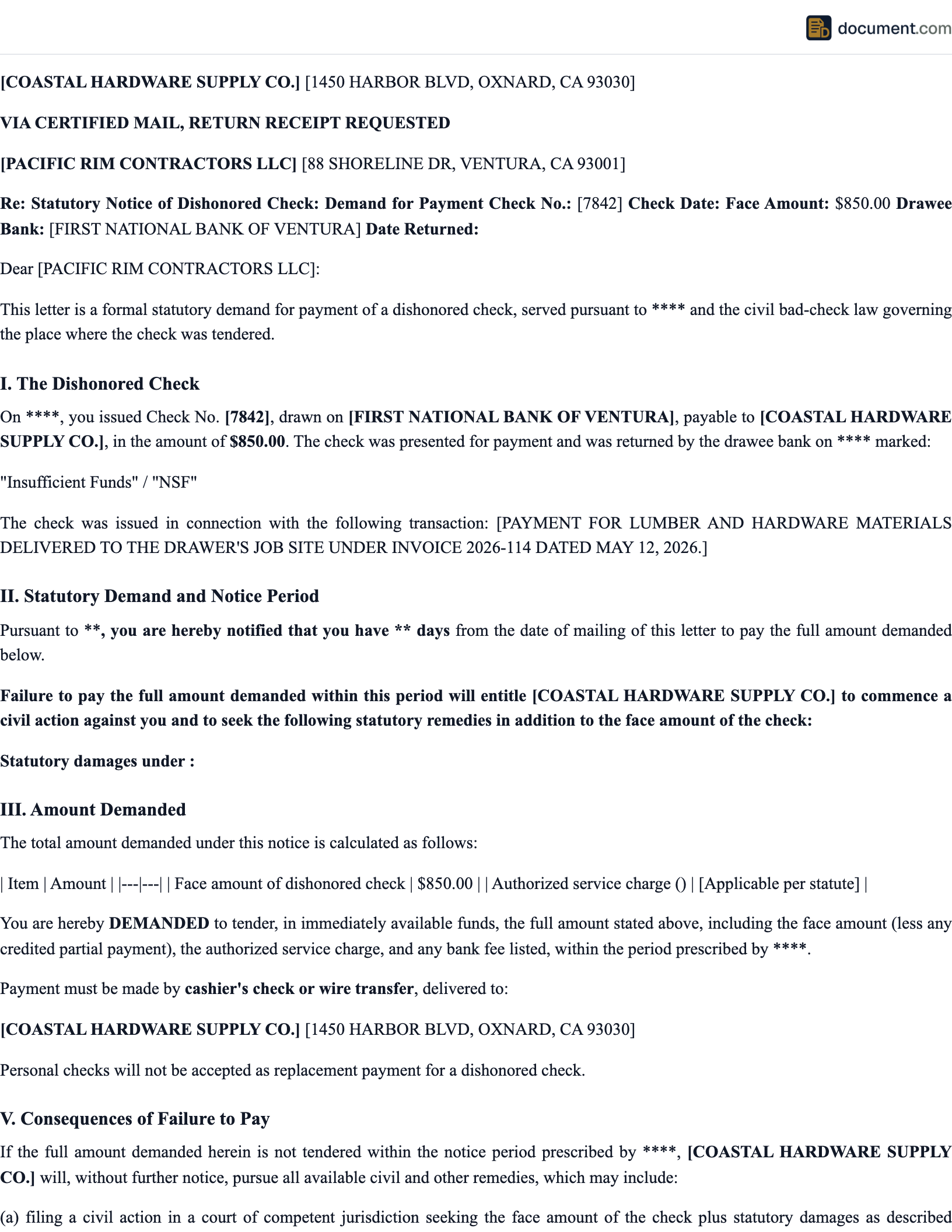



Massachusetts Notice of Dishonored Check Overview
Massachusetts has a civil bad-check statute that sits inside its consumer protection chapter rather than its criminal code. Mass. Gen. Laws ch. 93, § 40A lets any payee who receives a dishonored check pursue court-determined liquidated damages on top of the face amount of the instrument, so long as the payee first sends a properly formatted written demand and waits thirty days. The framework is self-contained: no small-claims filing, no police report, and no coordination with a prosecutor is required to invoke it.
The statute covers the two most common dishonor reasons: checks returned because the drawer has no account at the drawee bank, and checks returned for insufficient funds. Stop-payment checks are not addressed by § 40A's text and are better pursued as a contract or conversion claim unless the stop was entered fraudulently, in which case the criminal track under ch. 266, § 37 becomes relevant. Payees should identify the exact reason for dishonor from the bank's return item notice before deciding which avenue to pursue.
Unlike the treble-damage formulas found in California, Florida, and many other states, Massachusetts uses a flat liquidated-damages band. The court decides where within the $100-to-$500 range the award falls, giving judges modest discretion to calibrate the penalty to the circumstances. The check amount itself does not multiply; the penalty is a supplement. That structure makes the Massachusetts civil remedy most useful for checks in the low-to-mid range where a $100-to-$500 bonus represents a meaningful share of the total recovery.
Additional liquidated damages not less than $100 nor more than $500
Civil damages
30 days after certified and regular mail demand
Notice period
Actual bank fees recoverable
Service charge
Mass. Gen. Laws ch. 93, § 40A
Controlling statute
The Controlling Statute: Mass. Gen. Laws ch. 93, § 40A
Mass. Gen. Laws ch. 93, § 40A imposes civil liability on any person who makes, draws, utters, or delivers a check or draft for the payment of money on any bank or depository, and whose instrument is dishonored because the maker has no account or insufficient funds there, provided the maker then fails to pay within thirty days after written demand is delivered by both regular mail and certified mail with return receipt requested. The statute places the obligation squarely on the maker: once the check is dishonored and the demand is properly sent, the thirty-day clock runs regardless of whether the maker actually retrieves the certified piece from the post office.
The statute specifies a bilingual notice requirement that is unusual compared to most other states. The demand must be printed in at least 10-point type in both English and Spanish, following the statutory form set out in § 40A itself. A notice drafted entirely in English, or printed in smaller type, does not satisfy the statute's requirements. Courts applying § 40A look at whether the form substantially complied with the prescribed text; a notice that omits the Spanish version or uses sub-standard type can forfeit the liquidated-damages claim even if the maker received actual notice by some other means.
The liable amount has two components. First, the payee recovers the face value of the dishonored check. Second, the court awards additional liquidated damages in an amount it determines, subject to a floor of $100 and a ceiling of $500. The statute calls these additional damages, meaning they are separate from and on top of the check face amount. A $250 check that goes unpaid through the thirty-day window can thus yield a judgment of $350 to $750, depending on where within the band the court sets the penalty.
Section 40A expressly preserves any criminal liability that may exist under other law. The civil proceeding and a criminal prosecution under ch. 266, § 37 can run simultaneously, and a civil judgment under § 40A does not bar a criminal charge, nor does a criminal acquittal bar the civil claim. The civil statute requires no showing of fraudulent intent; a maker who simply had insufficient funds and ignored the demand is liable. Criminal liability under ch. 266, § 37 does require that the maker acted with intent to defraud, which is a higher threshold.
Statute Reference
Mass. Gen. Laws ch. 93, § 40A
Damages: Additional liquidated damages not less than $100 nor more than $500
What You Can Recover in Massachusetts
Under § 40A, recovery has two layers. The face amount of the dishonored check is recoverable as a matter of right once the maker fails to pay within thirty days of demand. The additional liquidated damages, set by the court at no less than $100 and no more than $500, are awarded on top of that. On a $50 check, the minimum recovery is therefore $150 ($50 face plus $100 in liquidated damages), and the maximum is $550. On a $2,000 check, the additional damages are still capped at $500, so the maximum statutory award is $2,500. The penalty band does not scale with the check amount.
Massachusetts does not authorize a pre-litigation service charge in § 40A the way many states do. There is no statutory provision permitting the payee to add a fixed fee to the demand letter for bank charges or administrative costs. If the payee incurred a returned-check bank fee, that actual cost may be arguable as consequential damages in a contract or UCC claim running alongside the § 40A claim, but the statute itself does not create a separate fee remedy. Payees who are accustomed to adding a $30 service charge on a statutory basis, as they can in California or Virginia, should not assume that charge is recoverable under Massachusetts law without consulting separate contract or commercial code theories.
Attorney fees are not expressly provided for under § 40A. The American Rule applies: each party generally bears its own legal costs unless a separate fee-shifting statute applies. Where the returned check also implicates Massachusetts Chapter 93A (the consumer protection statute) and the drawer's conduct was knowing and willful, a separate Chapter 93A claim could yield double or treble damages on the broader loss plus mandatory attorney fees. However, that is a different claim with different elements, and layering § 40A and 93A requires confirming that the transaction qualifies as a consumer or business context covered by 93A.
- Civil damages: Additional liquidated damages not less than $100 nor more than $500
- Service charge: Actual bank fees recoverable
- Notice period before suit: 30 days after certified and regular mail demand
Notice Procedure and Timeline in Massachusetts
The demand must be sent by two methods simultaneously: certified mail with return receipt requested, and regular first-class mail. Both pieces should go out the same day to the same address. The statute measures the thirty-day cure period from delivery of the written demand, so the clock arguably runs from the date the certified piece is received or, if unclaimed, from when the first-class copy would ordinarily arrive. To avoid any ambiguity about the trigger date, send both mailings on the same day and keep the certified mail receipt, the USPS tracking record, and a copy of the first-class envelope with postage.
Address the demand to the address printed on the check. If the check carries no address, use the maker's last known residential or business address. Do not send the notice only to an attorney or employer without also attempting the address of record. Courts applying notice requirements look first at whether the mailing was directed to the person responsible for the instrument. If the certified mail piece is returned unclaimed, the first-class copy should still be intact in transit, and the combination of the certified-mail proof of mailing and the returned envelope generally satisfies the statutory service requirement.
The notice must follow the statutory form prescribed in § 40A, printed in at least 10-point type in both English and Spanish. Draft the demand using the language in the statute, then have both versions reviewed side by side before mailing. State the check amount, the date of dishonor, the bank on which it was drawn, and the thirty-day deadline as a specific calendar date rather than just a number of days. A demand that says 'you have thirty days' without specifying the resulting date invites a dispute about when the window closed. Write: 'You have thirty days from the date of mailing of this demand, until [specific date], to pay the full amount of $[X].' Retain copies of every piece of paper in the mailing for use as exhibits if the matter proceeds to court.
Massachusetts-Specific Notes
Massachusetts small claims court currently has a jurisdictional ceiling of $7,000. Because § 40A recovery on even a modest check rarely exceeds $500 in liquidated damages plus the check face, most civil bad-check cases in the Commonwealth fall well within small claims jurisdiction. The filing fee is low and no attorney is required. Bring to the hearing: a copy of the original check, the bank's return notice, the statutory demand letter, the certified mail receipt and tracking printout, and proof that the regular-mail copy was sent. Small claims sessions in Massachusetts district courts handle these matters efficiently when the documentation is clean.
The criminal parallel track runs under Mass. Gen. Laws ch. 266, § 37, which criminalizes drawing a check with intent to defraud when the maker knows at the time of writing that there are insufficient funds. The misdemeanor threshold is checks under $1,200, punishable by up to one year in jail or a fine of up to $1,500. For checks of $1,200 or more, the offense is a felony carrying up to five years in state prison or two years in a house of correction and a fine up to $25,000. District attorney offices do not operate a uniform statewide diversion program for bad-check cases; practices vary by county. Some prosecutors will accept a referral only after the payee has sent a civil demand and the maker has failed to respond, so the § 40A notice letter serves as useful predicate documentation regardless of whether criminal referral is the ultimate goal.
Massachusetts Specific Note
The bilingual and minimum-type-size requirements in § 40A are firm conditions, not optional courtesies. A demand printed only in English, or that uses 9-point type to fit text on a single page, does not comply with the statute. Several Massachusetts courts have declined to award liquidated damages where the notice form was deficient, even when the maker received actual notice and clearly knew a demand had been made. Use the statutory form, verify the Spanish translation, and measure the type before printing.
Massachusetts Specific Note
The § 40A civil remedy applies only to checks dishonored for no-account or insufficient-funds reasons. If the bank returned the check because of a stop-payment order, a missing signature, a stale date, or a technical instrument defect, § 40A does not apply on its face. A payee who sends a § 40A demand on a stop-payment check may still have a valid contract or UCC Article 3 claim for the face amount, but the liquidated-damages supplement is not available under the bad-check statute without a valid dishonor of the type the statute covers.
Massachusetts Bad Check FAQ
Other State Bad Check Laws
Each state sets its own notice period, damage formula, and service charge. Browse sibling state pages for the specific rules that apply to your situation, or return to the full 50-state guide.
Create your Massachusetts Notice of Dishonored Check in minutes.
Answer a few questions and download a Massachusetts-compliant bad check demand letter that cites Mass. Gen. Laws ch. 93, § 40A and is ready to mail certified.