
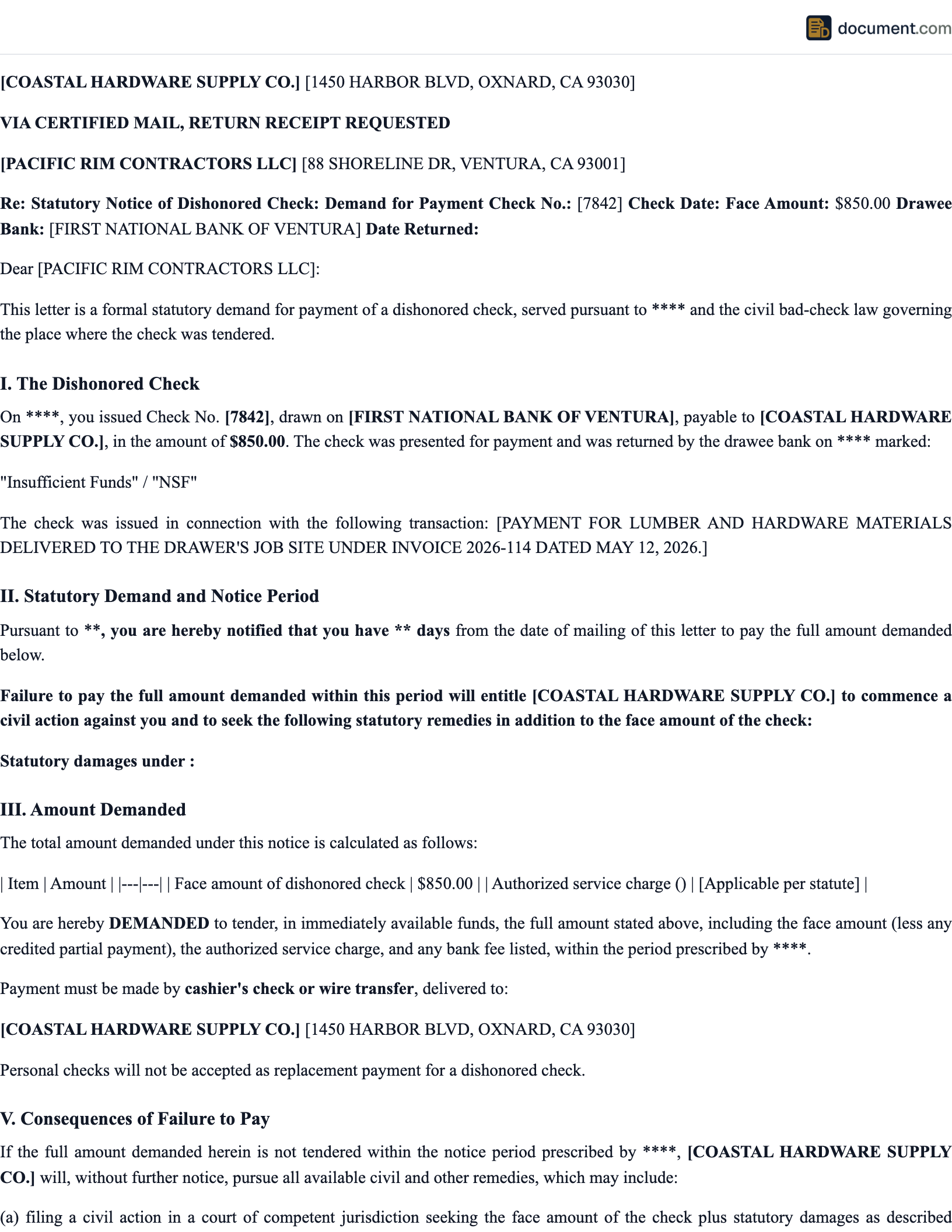



Missouri Notice of Dishonored Check Overview
Missouri gives the holder of a dishonored check a civil remedy that runs directly alongside the criminal statute in the same code section. Mo. Rev. Stat. § 570.120 is primarily a criminal law, passing a bad check is a criminal offense, but the legislature built a civil damages track into it, and that civil track is the faster, more practical route for most payees trying to collect on a bounced check. You do not need a criminal conviction, a police report, or a prosecutor's cooperation to use it. You need a returned check, a properly drafted and mailed written demand, and patience for 30 days.
The civil remedy is structured as a penalty multiplier. Once a holder sends written demand and waits the statutory period without receiving full payment, the holder may recover three times the face amount of the check or $100, whichever sum is greater, but that recovery is capped so that the enhancement does not exceed the face amount of the check plus $500. On a $50 check, the minimum recovery floor of $100 is likely what controls. On a $250 check, three times the face amount is $750, but the cap limits the total enhancement to $750 ($250 face plus $500), so the multiplier and the cap converge at the same figure. On checks larger than $250, the cap effectively limits the bonus to $500 above the face amount, making the check-plus-$500 ceiling the controlling figure.
The statute also authorizes the holder to collect a service charge of up to $25, which can be demanded in the initial notice and collected before any court filing. That charge compensates for the bank's returned-check fee and the cost of sending the demand. A check writer who pays the full face amount plus the service charge within the 30-day window avoids the penalty entirely, even if the notice was validly sent. Most disputes that reach litigation do so because the drawer either ignored the notice or disputed the underlying transaction, not because they were unaware a demand had been made.
3x face amount or $100, whichever is greater
Civil damages
30 days after written demand
Notice period
Up to $25
Service charge
Mo. Rev. Stat. § 570.120
Controlling statute
The Controlling Statute: Mo. Rev. Stat. § 570.120
Mo. Rev. Stat. § 570.120 is titled 'Crime of passing bad checks' and sits in Chapter 570, Missouri's theft and fraud chapter. It makes it a criminal offense to pass a check knowing that the account either lacks sufficient funds or does not exist. But the legislature embedded a civil mechanism in the same section: after written demand and 30 days without payment, the holder is entitled to the civil damages the statute specifies. The civil remedy is not a separate code section in Missouri, it lives inside the criminal statute, which means courts interpret both tracks using the same definitional framework. A check is 'dishonored' under the statute when the drawee bank refuses payment; the reason (NSF, closed account) is relevant mainly to the criminal side.
The criminal penalty thresholds in § 570.120 matter to a civil claimant for one important reason: they signal the prosecutor's interest in parallel action. Passing a bad check is a Class A misdemeanor when the face amount is under $750 and the drawer had a valid account with the drawee. It becomes a Class E felony when the check amount is $750 or more, or when the account did not exist at all at the time the check was written, regardless of the dollar amount. When multiple checks are passed within a 10-day window, the statute permits the face amounts to be aggregated to reach the $750 felony threshold. Understanding this matters because the civil claimant who has exhausted the civil notice procedure holds documentation that a prosecuting attorney will typically require before accepting a case for criminal referral.
The notice requirement embedded in § 570.120 is a condition precedent to the civil remedy, not a mere best practice. The statute requires written demand to be sent to the check writer before the three-times multiplier becomes available. Missouri's courts have treated this requirement as jurisdictional in the sense that a suit for civil penalties filed before the 30-day period runs, or without any demand at all, will not support the enhanced damages. The holder can always sue for the face amount as a garden-variety breach of contract claim without sending the notice, but that yields nothing beyond what the check was worth. The civil multiplier is the entire point, and the notice is what unlocks it.
The statute also addresses payroll checks specifically. When the dishonored check was issued in payment of wages or salary, the employer who issued the check faces heightened exposure under the statute's payroll-check provision, which gives employees an additional civil action. For ordinary commercial transactions, a payment for goods, services, rent, or a personal obligation, the standard 30-day demand procedure applies without modification.
Statute Reference
Mo. Rev. Stat. § 570.120
Damages: 3x face amount or $100, whichever is greater; not to exceed check + $500
What You Can Recover in Missouri
Missouri's damages formula has three moving parts: the multiplier, the floor, and the cap. The multiplier is three times the face amount of the check. The floor provides that if three times the face amount is less than $100, the holder recovers $100 instead. The cap provides that total recovery, meaning the penalty component, not the face amount itself, may not exceed the face amount plus $500. Working through concrete numbers makes the formula clearer. On a $30 check, three times the face is $90, which falls below the $100 floor, so the holder recovers $100 in civil damages (plus the face amount and the service charge). On a $200 check, three times the face is $600, which would exceed the face amount by $400, still within the $500 cap, so the full $600 applies. On a $300 check, three times the face is $900, but the cap limits recovery to $300 plus $500, or $800 total. For any check above $250, the cap is what controls.
In addition to the civil damages, the holder may separately demand and collect a service charge of up to $25. This charge is authorized by § 570.120 itself and is independent of the penalty calculation. It is not added into the base for the treble-damage computation; it sits alongside it. A holder pursuing a $150 check would demand: $150 (face) plus $25 (service charge) in the notice, and if the drawer fails to pay within 30 days, would be entitled to sue for three times $150 (or $450) plus $25 in service charge costs, for a total of $475, subject to the overall cap check (face $150 plus $500 cap equals $650, so the $450 multiplier is within the cap and controls). Show the arithmetic in the demand letter itself; courts and small claims judges appreciate a demand that is internally consistent and easy to audit.
Missouri does not provide a separate attorney fees provision within § 570.120's civil remedy framework. Unlike California, Florida, or Tennessee, which expressly authorize fee awards to successful plaintiffs in bad-check actions, Missouri's statute is silent on attorney fees in the civil context. That does not bar a fee claim based on other authority, but it removes the automatic entitlement that makes litigation financially viable on small checks in some other states. For checks under $500, the math on hiring counsel often does not work; the civil bad-check notice and small claims court are the practical tools for that range.
- Civil damages: 3x face amount or $100, whichever is greater; not to exceed check + $500
- Service charge: Up to $25
- Notice period before suit: 30 days after written demand
Notice Procedure and Timeline in Missouri
The 30-day notice period under § 570.120 runs from the date of the written demand, not from the date the check was returned by the bank. That distinction matters: a holder who waits six weeks after dishonor before drafting the demand is not penalized for the delay (there is no statutory requirement to send the notice within a fixed number of days of dishonor), but the 30-day cure window does not begin ticking until the demand actually goes out. Draft the notice promptly after you confirm dishonor, but take the time to get the amount and the statutory language right. A demand letter sent two days after dishonor with incorrect amounts is worth less than a careful letter sent two weeks later.
Missouri's statute does not specify certified mail by name in the same manner as California's or Florida's civil bad-check statutes, but the notice must be written and must reach the drawer. The most defensible approach is certified mail, return receipt requested, sent to the address printed or written on the check. Send a simultaneous first-class copy to the same address. Retain the certified mail receipt, the tracking number, and, if the certified piece is returned unclaimed, the envelope bearing the postal service's notation. An unclaimed certified mailing sent to a properly identified address generally satisfies the demand requirement; the drawer cannot defeat the claim by refusing to collect certified mail. The first-class copy supports the argument that the drawer had a reasonable opportunity to learn of the demand regardless of what happened to the certified piece.
Calculate the 30-day deadline as a calendar date and state it explicitly in the notice. If the letter goes out on June 10, the deadline is July 10. Do not write '30 days from the date hereof' and leave the drawer to do the arithmetic. State the date. Include the total amount demanded, face amount plus service charge, and specify that payment must be made by cashier's check or money order, since the drawer's personal check is presumably not a reliable instrument at this point. If the drawer tenders partial payment during the 30-day window, note it in writing and determine whether the payment satisfies the full amount demanded; partial payment does not restart the clock or reset the demand, but it reduces the unpaid balance on which you calculate any remaining civil claim.
Missouri-Specific Notes
Missouri's criminal and civil bad-check tracks are housed in the same statute, and prosecuting attorneys' offices in many Missouri counties run bad check divisions or check enforcement units that accept referrals from payees who have already made a civil demand and received no response. Clay County's prosecuting attorney maintains a dedicated Check Division for that purpose. Before a case is typically accepted, the office generally requires that the check have been presented to the bank and formally dishonored, that the check writer be identifiable, and that the payee can provide the writer's date of birth and a government-issued ID number. Most offices will not accept forged, altered, or stop-payment checks without a prior police investigation. A civil demand letter with certified mail proof is the documentation that positions your case for a criminal referral if the civil track stalls.
Missouri's small claims court (formally the small claims division of the circuit court) has a jurisdictional ceiling of $5,000. Because Missouri's civil bad-check penalty is capped at the face amount plus $500, virtually every dishonored check case falls within that ceiling. You may file up to 12 small claims cases per calendar year in Missouri, and filing fees are modest. Small claims is the natural venue for bad-check civil actions under § 570.120: no attorney is required, the statutory claim is straightforward, and judges in the division are familiar with the notice-and-demand framework. Bring the original check (or a clear copy), the bank's dishonor notice, the demand letter, and the certified mail receipt. Those four documents establish every element of the claim.
Missouri Specific Note
Missouri's § 570.120 does not expressly extend the civil bad-check remedy to dishonored ACH transactions or electronic fund transfers the way California, Florida, and Illinois have done. If the underlying transaction involved a returned ACH debit rather than a paper check, the statutory three-times multiplier may not apply. A dishonored electronic transfer in Missouri would typically be pursued as a breach of contract or under common-law fraud theories rather than under § 570.120's civil penalty framework. Confirm the instrument type before sending a § 570.120 demand; relying on the wrong statute exposes the demand to a technical challenge that voids the enhanced remedy.
The aggregation rule in § 570.120's criminal provisions, which allows the state to combine multiple checks passed within a 10-day window to reach the $750 felony threshold, does not have a direct parallel on the civil side. Each civil claim is based on the face amount of the individual check, and the damages formula applies per check. A payee holding multiple dishonored checks from the same drawer should send a single notice that itemizes each check separately, calculates the civil penalty on each, and demands the aggregate total. Courts have permitted consolidated civil bad-check claims on multiple instruments from the same drawer in a single filing, which saves court costs and establishes a clear record if criminal referral follows.
Missouri Bad Check FAQ
Other State Bad Check Laws
Each state sets its own notice period, damage formula, and service charge. Browse sibling state pages for the specific rules that apply to your situation, or return to the full 50-state guide.
Create your Missouri Notice of Dishonored Check in minutes.
Answer a few questions and download a Missouri-compliant bad check demand letter that cites Mo. Rev. Stat. § 570.120 and is ready to mail certified.