
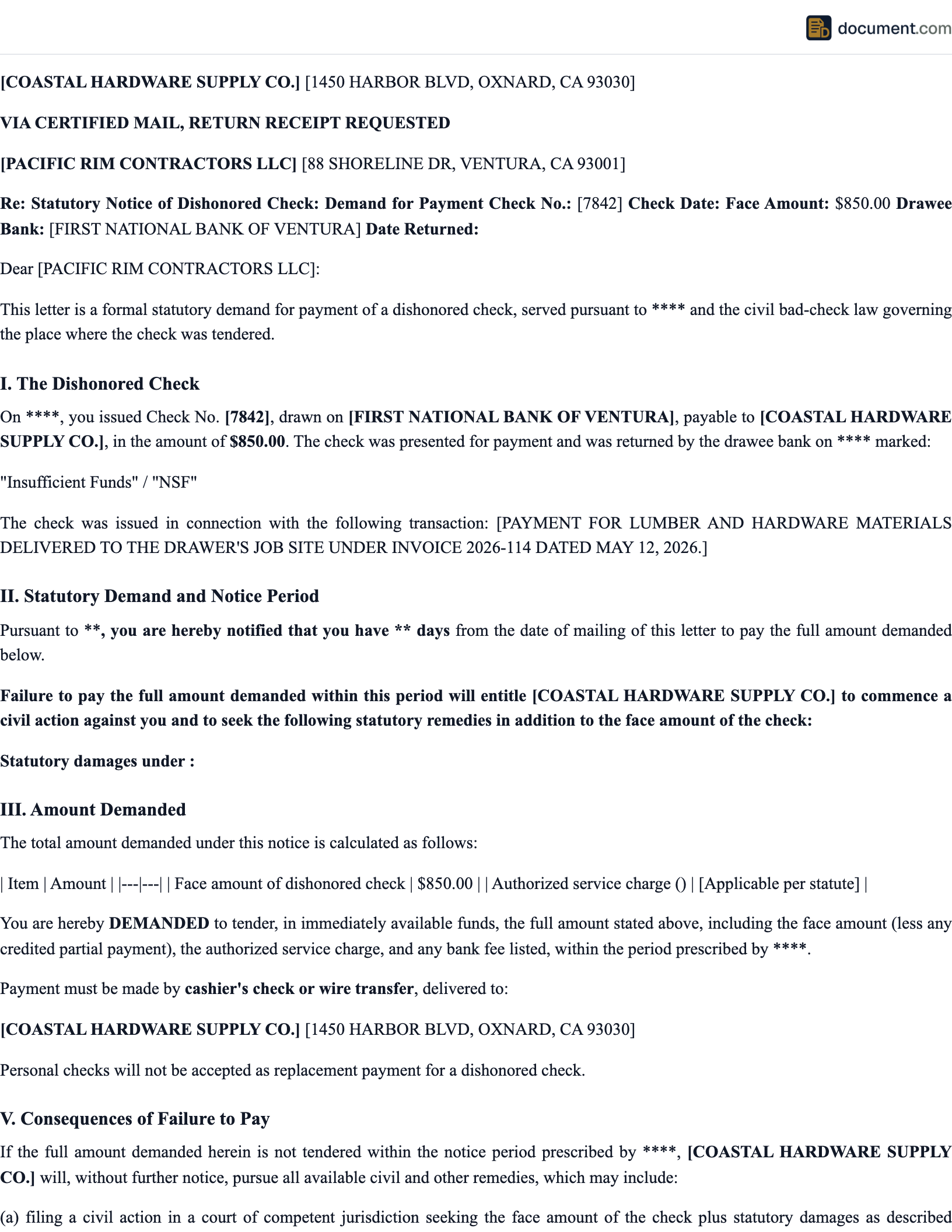



New Hampshire Notice of Dishonored Check Overview
New Hampshire takes a measured approach to civil bad check liability. Rather than treble damages, the state's civil remedy under RSA ch. 544-B operates on a per-day accrual model: once a properly noticed demand goes unpaid past the ten-day cure window, the drawer owes $10 for each business day the debt remains outstanding, capped at $500 above the face amount of the check. That cap is lower than what many states authorize, but it applies on top of the face value of the check plus documented court costs, mailing fees, bank charges, and collection costs -- so the total recovery on a small check can still be meaningful.
The statute rewards holders who follow procedure. A payee who sends a conforming written notice by certified or registered mail, waits the full ten days, and then files a tidy small-claims action with complete documentation stands a good chance of walking out with judgment for the check amount plus the accrued daily penalty and costs. A payee who skips the notice, sends it to the wrong address, or files suit before the ten-day window closes forfeits the statutory extras and is left with only a face-value contract claim.
Understanding where New Hampshire's civil remedy ends and its criminal statute begins matters too. RSA 638:4 -- the criminal bad check provision -- covers the same conduct but classifies the offense by check amount, ranging from a class B misdemeanor for small checks up to a class A felony for checks exceeding $1,500. The civil notice procedure is not a prerequisite to criminal referral, but in practice many district-level enforcement offices look for evidence of a prior civil demand before treating a returned check as a criminal matter worth pursuing.
$10/day until paid, up to $500 maximum
Civil damages
10 days after written notice
Notice period
Actual court and collection costs
Service charge
N.H. Rev. Stat. Ann. ch. 544-B:1
Controlling statute
The Controlling Statute: N.H. Rev. Stat. Ann. ch. 544-B:1
RSA ch. 544-B consists of two sections working in tandem. Section 544-B:1 establishes the civil cause of action and the damages formula. Section 544-B:2 defines how notice must be given and sets the presumption-of-delivery rules that determine when the ten-day clock starts. Both sections have been in place since January 1, 1986, and the core structure has remained largely unchanged -- though holders should always confirm the enrolled text before sending a notice intended for litigation.
Under 544-B:1, the holder's right to the daily penalty accrues only after two conditions are satisfied: first, the holder must give notice as prescribed by 544-B:2; and second, the maker must fail to tender the full check amount plus any bank and mailing fees within ten days of that notice. If the drawer pays in full -- check amount, bank returned-item fee, and actual mailing costs -- within the ten-day window, the civil penalty never attaches. That cure-by-payment structure is the legislature's way of resolving most dishonored checks without litigation.
Once the ten-day period expires without full payment, 544-B:1 authorizes recovery of $10 per business day that the debt remains outstanding from the date judgment is entered. The statute caps total accrued daily penalties at $500. On top of that, the judgment may include court costs, service costs, and collection costs -- categories broad enough to cover filing fees, process service fees, and documented expenses incurred in pursuing the debt. Actual bank returned-check fees and certified-mail costs are recoverable separately as part of the pre-judgment demand.
The scope of the statute tracks the most common forms of dishonor: insufficient funds and checks drawn on nonexistent accounts. Stop-payment situations are not expressly addressed in RSA ch. 544-B, which means a payee holding a stop-payment check should evaluate whether the civil bad-check framework applies or whether the underlying transaction dispute calls for a different remedy. In practice, stop-payment checks with no colorable underlying dispute have been pursued under 544-B in New Hampshire courts, but the cleaner path in a contested stop-payment case is often a straightforward breach of contract claim.
Statute Reference
N.H. Rev. Stat. Ann. ch. 544-B:1
Damages: $10/day until paid, up to $500 maximum; plus costs and collection fees
What You Can Recover in New Hampshire
The starting point for any recovery calculation is the face amount of the dishonored check. To that, add the bank's returned-item fee you were charged and the actual cost of sending the required certified-mail notice. If the drawer pays those three items within ten days of your notice, the matter is closed with no further civil remedy available. If the drawer does not pay, the daily penalty begins running from the date judgment is entered at $10 per business day, up to a maximum of $500 in accrued daily charges.
To see the cap in concrete terms: a judgment entered on a Monday that remains fully unsatisfied for fifty business days generates exactly $500 in daily penalties, after which the meter stops. In practice the cap is often reached well before the drawer pays, because fifty business days is roughly ten calendar weeks -- and drawers who do not respond to the demand letter rarely pay immediately after judgment either. The more important practical point is that the daily penalty reward goes to holders who move promptly to judgment, because accrual begins at judgment, not at the end of the notice period.
Beyond the daily penalty, 544-B:1 allows the court to award court costs, service costs, and collection costs as part of the judgment. New Hampshire does not provide for statutory attorney fees under ch. 544-B, which distinguishes it from states like California, Florida, and Louisiana where a successful bad-check plaintiff can recover reasonable counsel fees. If you retain an attorney to pursue a New Hampshire dishonored-check claim, litigation costs above the statutory damages may not be recoverable, which makes the economics of attorney-assisted collection more important to evaluate before filing.
- Civil damages: $10/day until paid, up to $500 maximum; plus costs and collection fees
- Service charge: Actual court and collection costs
- Notice period before suit: 10 days after written notice
Notice Procedure and Timeline in New Hampshire
RSA 544-B:2 permits notice to be given either in person or in writing. For any situation where you intend to pursue the civil penalty, written notice sent by certified or registered mail, return receipt requested, is the right choice. The statute provides that notice sent by certified or registered mail with return receipt requested, properly addressed, is conclusively presumed to have been given when deposited in the United States mail with postage prepaid. That presumption is valuable: it means an unclaimed or unsigned certified-mail piece does not defeat your notice if the mailing was properly addressed.
Address the notice to the maker at the address appearing on the check itself. If that address is outdated and you have a verified current address, use the last known address -- but document how you identified it, because any dispute about the address goes to whether notice was properly given. After mailing, retain the post office receipt, the certified-mail tracking number, and any delivery confirmation or returned-envelope documentation. These are the exhibits that prove your notice element at trial or in a default judgment proceeding.
The ten-day cure period begins running from the date notice is given -- which under the certified-mail presumption is the date of mailing. Count calendar days, not business days, for the notice period itself. (The $10 daily penalty accrues in business days post-judgment, but the cure window is simply ten days from notice.) A notice mailed on a Wednesday means the cure period expires the following Saturday, and the holder may file suit beginning the following Monday if no payment has been received. Do not file before the ten-day period has run; premature filing can complicate or defeat the enhanced remedy.
New Hampshire-Specific Notes
New Hampshire's small claims court -- the District Division of the Circuit Court -- has jurisdiction over civil claims up to $10,000 exclusive of interest and costs, making it the natural venue for most dishonored-check cases under RSA 544-B. The $10,000 ceiling comfortably covers the check amount plus the $500 penalty cap and costs in virtually every consumer and small-business scenario. For claims between $5,001 and $10,000, the court currently requires mandatory mediation before the case proceeds to a judge, so factor that step into your timeline if the check is large. Claims above $10,000 must be filed in Superior Court.
On the criminal side, RSA 638:4 classifies the offense of issuing a bad check on a sliding scale. A check with a face amount of $1,000 or less, with no prior conviction in the preceding twelve months, is a class B misdemeanor. A prior conviction within twelve months elevates it to a class A misdemeanor. Checks between $1,000 and $1,500 are a class B felony. Checks exceeding $1,500 -- or multiple checks with an aggregate face amount above $1,500 written within twelve months -- are a class A felony. Civil and criminal proceedings are independent, and the civil notice is not a prerequisite to criminal referral, but many local police departments and prosecutors' offices treat documented evidence of a civil demand as relevant background before opening a criminal investigation.
New Hampshire Specific Note
New Hampshire's $500 cap on daily penalties is lower than the penalty ceiling in most neighboring states. Vermont allows treble damages up to the amount of the check; Massachusetts operates under a different framework entirely. If a check was accepted in connection with a transaction that crosses state lines, confirm which state's civil bad-check statute applies before sending the 544-B notice. Sending a New Hampshire notice when the governing statute is another state's law, or vice versa, can leave the enhanced remedy off the table even if you follow the New Hampshire procedure perfectly.
The notice under 544-B:2 contains no prescribed statutory language requirements -- the statute specifies delivery method and addressing but does not mandate particular words. That distinguishes New Hampshire from states like Georgia and New Mexico, where omitting certain phrases from the notice text can defeat the entire civil penalty claim. In New Hampshire, a clearly written letter identifying the check, stating the reason for dishonor, demanding payment of the face amount plus bank fees and mailing costs, and giving the maker ten days to pay will satisfy the statutory notice requirement. Including the 544-B citation in the letter is good practice -- it signals that you understand the remedy and are prepared to enforce it -- but the statute does not condition the penalty on any particular quoted language.
New Hampshire Bad Check FAQ
Other State Bad Check Laws
Each state sets its own notice period, damage formula, and service charge. Browse sibling state pages for the specific rules that apply to your situation, or return to the full 50-state guide.
Create your New Hampshire Notice of Dishonored Check in minutes.
Answer a few questions and download a New Hampshire-compliant bad check demand letter that cites N.H. Rev. Stat. Ann. ch. 544-B:1 and is ready to mail certified.