
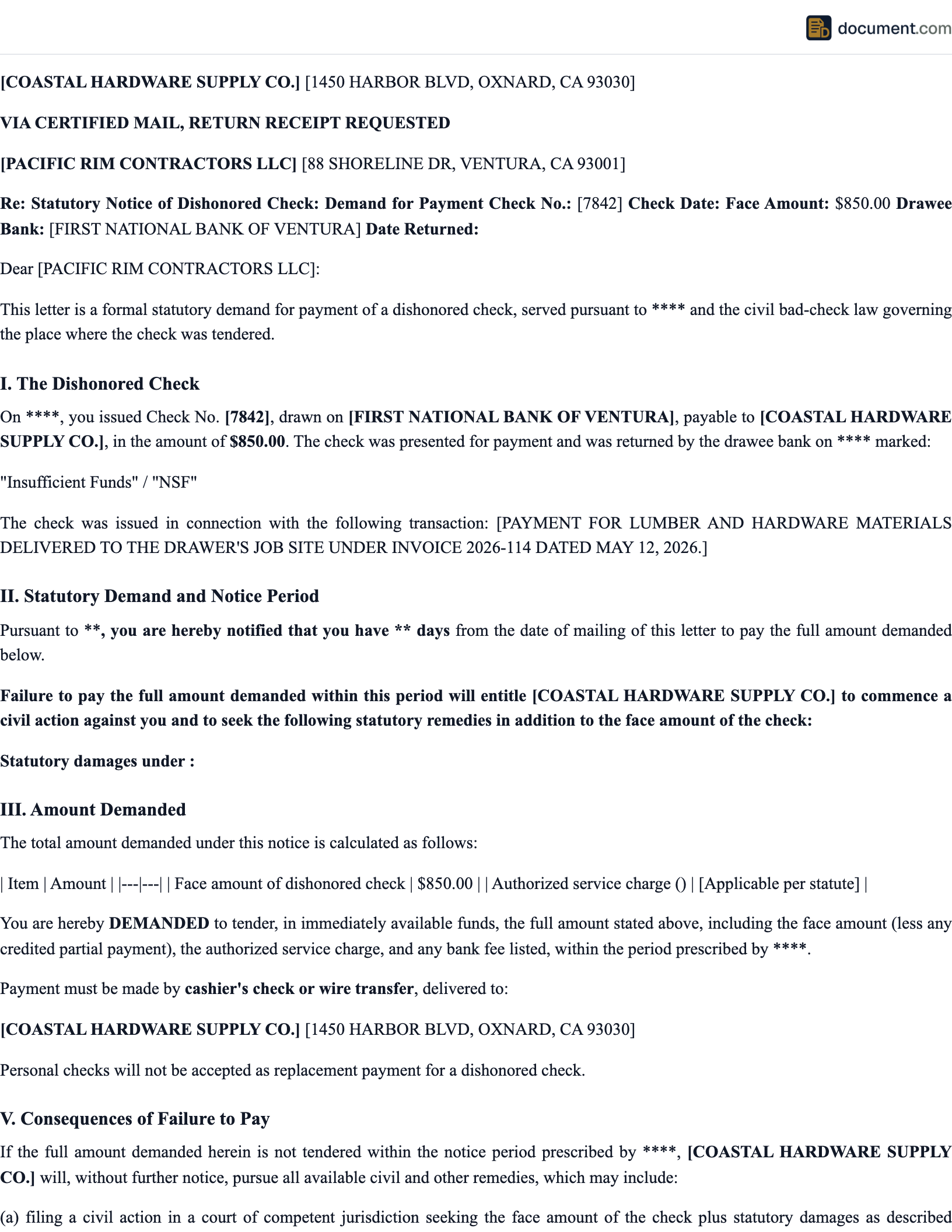



North Carolina Notice of Dishonored Check Overview
North Carolina gives holders of returned checks a straightforward civil remedy under N.C. Gen. Stat. § 6-21.3. A payee who sends a proper demand by certified mail, waits 30 days without receiving full payment, and then files suit can recover three times the amount owed on the check, subject to a statutory floor of $100 and a ceiling of $500 on the penalty above the check face. That structure makes the civil remedy most powerful on smaller checks, where the minimum penalty alone can dwarf the check amount, but it remains a viable collection tool on checks of any size.
The notice requirement is the gatekeeper to the enhanced remedy. A payee who proceeds straight to court without sending the statutory demand forfeits the treble-damage claim and is left with an ordinary contract or account action for the face amount plus whatever bank fees the drawer owes. Given that the minimum civil penalty under § 6-21.3 is $100, skipping the notice step on even a modest check can mean leaving more money on the table than the check itself was worth.
North Carolina also maintains a parallel criminal track for worthless checks under N.C.G.S. § 14-107, and most district attorney offices in the state operate worthless check diversion programs that funnel first-time check writers through a structured repayment and education process. The civil notice you send under § 6-21.3 and the criminal referral route under § 14-107 are independent procedures. A payee can pursue both, or either, and the outcome on one track does not bar recovery on the other.
3x amount owed
Civil damages
30 days after certified mail demand
Notice period
Actual bank fee plus processing fee under N.C.G.S. 25-3-506
Service charge
N.C. Gen. Stat. § 6-21.3
Controlling statute
The Controlling Statute: N.C. Gen. Stat. § 6-21.3
N.C. Gen. Stat. § 6-21.3 creates a civil cause of action for the holder of a check that was dishonored after being presented for payment. The statute applies when a check is returned because of insufficient funds, a closed account, or a nonexistent account, and the drawer fails to make the check good within the time allowed after a proper written demand. The civil action under § 6-21.3 is entirely separate from any criminal proceeding; it is brought by the payee directly, without the involvement of the district attorney, and it produces a money judgment enforceable like any other civil judgment.
The statute conditions the enhanced damages on the holder following the notice procedure. If the holder skips the demand letter, or sends it by the wrong method, or sends it to the wrong address, the § 6-21.3 remedy is off the table. What remains is a garden-variety breach-of-contract or account claim for the face amount. The statute does not create a new cause of action for the face value of the check; it creates an enhanced remedy layered on top of the underlying debt, and that enhancement requires the notice step.
The service charge authorized by N.C.G.S. § 25-3-506 sits alongside the § 6-21.3 civil penalty as a separate element of the demand. Under § 25-3-506, the holder of a dishonored check may collect the actual bank fee charged for the return plus a processing fee, and that amount can be demanded in the initial notice letter. The drawer who pays the face amount of the check, the service charge, and any bank fee within the 30-day window cures the default and avoids the treble-damage exposure entirely.
The General Assembly has not substantially amended § 6-21.3 in recent years; the core structure of the statute, including the 30-day notice period, the treble-damage formula, and the $100 minimum/$500 maximum penalty range, has remained stable. Courts applying the statute have consistently held that the notice must be sent before the action is filed, that the 30-day period is calculated from the date of mailing, and that sending the notice by first-class mail rather than certified mail will not satisfy the statutory requirement.
Statute Reference
N.C. Gen. Stat. § 6-21.3
Damages: 3x amount owed; not less than $100 nor more than $500
What You Can Recover in North Carolina
Under § 6-21.3, the successful plaintiff recovers the amount owed on the check plus a civil penalty equal to three times that amount, with the penalty subject to a minimum of $100 and a maximum of $500 above the check face. The structure means the total judgment is the check amount plus the penalty, not three times the check amount as a total figure. On a $150 check, for example, treble damages would arithmetically be $450, but the statute caps the penalty at $500 over the face amount and floors it at $100, so the penalty here is $450 and the total judgment is $600. On a $25 check, treble damages would be $75, but the $100 minimum applies, producing a total judgment of $125.
The cap becomes the controlling figure on larger checks. On a $600 check, the treble formula produces a $1,800 penalty, but the statute caps the enhanced recovery at $500 above the face, so the holder's total recovery is $1,100 ($600 face plus $500 cap), not $1,800. The practical effect is that the treble multiplier matters most on checks between roughly $50 and $167; once the check exceeds $167, the $500 ceiling limits the penalty and the multiplier becomes irrelevant to the final number.
In addition to the § 6-21.3 penalty, the holder may recover the bank's actual returned-check fee and the processing fee authorized by § 25-3-506. Those service charges are separate from the civil penalty and are not subject to the $500 cap; they represent reimbursement of out-of-pocket costs rather than a statutory enhancement. Attorney fees are not expressly provided for in § 6-21.3, unlike several neighboring states whose bad-check statutes include a fee-shifting provision. If the check is large enough that the cost of counsel makes sense, the holder should factor in that attorney fees will likely have to come from the recovery rather than from the drawer.
- Civil damages: 3x amount owed; not less than $100 nor more than $500
- Service charge: Actual bank fee plus processing fee under N.C.G.S. 25-3-506
- Notice period before suit: 30 days after certified mail demand
Notice Procedure and Timeline in North Carolina
The demand must be sent by certified mail to the address printed on the check or to the drawer's last known address. The 30-day notice period runs from the date of mailing, not from the date of actual receipt. Once 30 days have passed without full payment of the check amount plus any authorized service charges, the holder may file suit and claim the treble-damage penalty. Filing before the 30-day window closes will defeat the enhanced claim even if the underlying check was clearly dishonored with notice.
North Carolina practice mirrors what the parent statute prescribes for notice method in most other states: certified mail with return receipt creates the cleanest proof of mailing and delivery. Some practitioners also send a simultaneous first-class copy to the same address; while § 6-21.3 does not expressly require a parallel first-class mailing the way some other states' statutes do, the parallel mailing protects against the argument that the certified piece was never received when the drawer refuses delivery or fails to pick it up from the post office. A refused or unclaimed certified mailing sent to the correct address generally does not defeat the notice, but the documentary record must be clean.
Calculate the payment deadline as a specific calendar date and state it in the notice letter. A notice sent on a Thursday should state both the 30-day period and the resulting date by which payment must arrive. If the 30th day falls on a weekend or a state holiday, payment tendered on the next business day is typically treated as timely, but do not rely on that margin: state the hard calendar date, require the payment to arrive by that date, and, if you are filing suit, do not file until the day after the deadline has passed without full payment. Keep the certified mail receipt, the tracking confirmation, any return receipt card, and a copy of the notice letter itself as your litigation exhibit set.
North Carolina-Specific Notes
North Carolina's criminal worthless check statute, N.C.G.S. § 14-107, runs on a parallel track and has its own threshold structure that affects how a holder might decide to proceed. A check of $2,000 or less is a Class 3 misdemeanor in most cases, and the penalty exposure for the drawer is modest enough that criminal referral rarely produces restitution on its own. A check drawn on a nonexistent account or on an account the drawer knew had been closed is elevated to a Class 1 misdemeanor regardless of the amount. Any check above $2,000 is a Class I felony. These thresholds matter to the payee because the severity of the potential criminal charge affects how seriously a drawer treats the demand and whether the drawer is likely to pay within the 30-day civil window to avoid a criminal referral.
North Carolina General Statute § 14-107.2 authorizes district attorney offices to establish worthless check collection programs, and most of the state's larger judicial districts operate one. These programs accept checks that have been dishonored, issue a formal demand on behalf of the district attorney's office, and route compliant check writers through a fee-based diversion process that results in restitution without a criminal conviction. Most DA programs require the payee to make a civil demand first, or at minimum to provide documentation showing the check was presented and returned. The civil notice you send under § 6-21.3 typically satisfies that documentation requirement. Payees who use the DA's program give up some control over the collection timeline but gain the leverage of the criminal threat without having to manage the process themselves.
North Carolina Specific Note
North Carolina's § 6-21.3 penalty cap of $500 above the check face means that the civil bad-check remedy alone is not particularly lucrative on large checks. A holder with a $3,000 dishonored check will recover a maximum of $3,500 under the civil bad-check statute, the same absolute penalty ceiling that applies to a $600 check. On large-check matters, the holder should evaluate whether to combine the § 6-21.3 civil action with a separate breach-of-contract claim for consequential damages caused by the dishonor, or whether referral to the DA's program for felony-level prosecution (checks above $2,000) creates more practical leverage than the civil notice alone.
North Carolina's small claims court, known as Magistrate's Court, handles civil claims up to $10,000, which covers the great majority of bad-check matters given the $ 500 statutory penalty ceiling. A holder whose total claim (check face plus $500 penalty plus service charges) falls within that ceiling can file in Magistrate's Court without an attorney, present the notice letter and certified mail proof, and typically receive a judgment on the papers if the drawer defaults or fails to appear. The filing fee is modest, and judges in Magistrate's Court are familiar with the § 6-21.3 framework. For amounts above $10,000, the action moves to District Court.
North Carolina Bad Check FAQ
Other State Bad Check Laws
Each state sets its own notice period, damage formula, and service charge. Browse sibling state pages for the specific rules that apply to your situation, or return to the full 50-state guide.
Create your North Carolina Notice of Dishonored Check in minutes.
Answer a few questions and download a North Carolina-compliant bad check demand letter that cites N.C. Gen. Stat. § 6-21.3 and is ready to mail certified.