
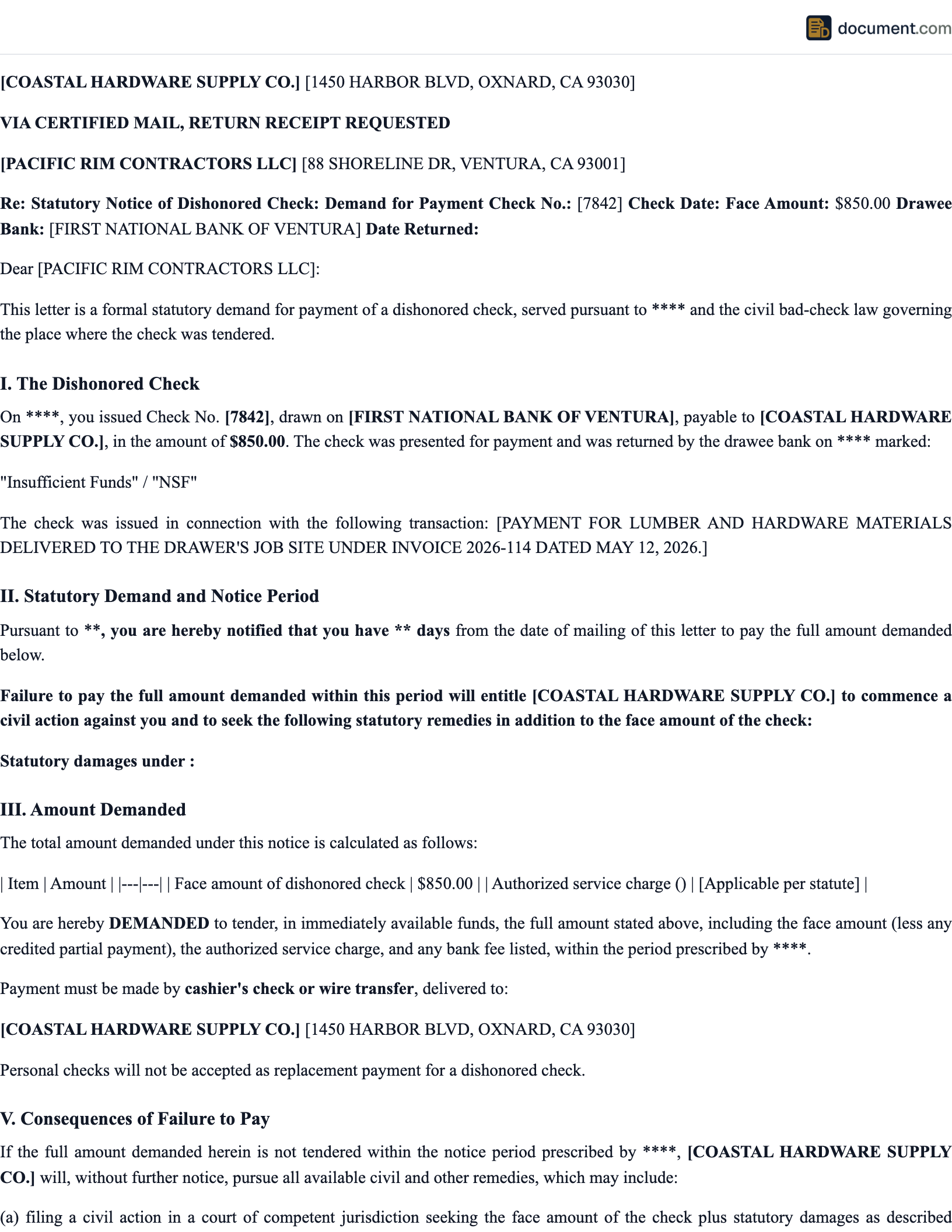



Oregon Notice of Dishonored Check Overview
Oregon gives the holder of a bounced check a civil remedy that goes well beyond the face amount of the instrument. Under ORS 30.701, a payee who follows the required notice procedure can recover three times the check amount or $100, whichever is greater, subject to a cap, plus attorney fees on top of that. The statute covers checks returned for insufficient funds, closed accounts, and stop payments made without good cause -- putting most common dishonor scenarios within reach of the civil remedy.
The civil track under ORS 30.701 is separate from Oregon's criminal bad-check statute, ORS 165.065. The payee does not need to involve the district attorney or wait for a criminal outcome to use the civil remedy. Many Oregon payees prefer the civil route because it produces a money judgment they can enforce directly through wage garnishment or bank levy, without dependence on a criminal prosecution that may or may not be pursued.
What makes Oregon's civil bad-check law work in practice is the notice requirement. The statute conditions the enhanced damages on the holder having sent a proper written demand and waited the full 30 days before filing. Skipping or fumbling that step -- wrong mailing method, wrong address, missing statutory language -- can reduce a strong ORS 30.701 claim to a face-value contract action and eliminate the multiplier and the attorney fee award entirely.
$100 or 3x check amount, whichever is greater
Civil damages
30 days written demand before commencing action
Notice period
Up to $35
Service charge
ORS § 30.701
Controlling statute
The Controlling Statute: ORS § 30.701
ORS 30.701 creates a civil cause of action against the maker or drawer of any check or order for the payment of money that is dishonored on presentment. The statute is not limited to commercial transactions; it applies equally to personal checks, business checks, and any similar sight order. The drawer's knowledge that the check would not be honored is an element of the claim, but the statute builds in a presumption: if the bank returns the check for insufficient funds and the drawer fails to pay within 10 days of receiving notice of the dishonor, knowledge is presumed. A closed-account return creates a similar inference. These presumptions shift the burden of production to the drawer without requiring the payee to prove subjective intent.
The civil remedy under ORS 30.701 is available to the original payee and to anyone who acquires the check as a holder in due course or by assignment. A landlord, a contractor, a retailer, or a collection agency that takes the check by assignment can all pursue the civil remedy so long as they comply with the notice requirements and can establish that the check was properly presented and dishonored.
For stop-payment checks, the statute draws a line that matters. Oregon's civil bad-check remedy applies to a stop payment only when the drawer issued the stop without good cause. If the drawer stopped payment because of a genuine dispute about the underlying goods or services -- a contractor who walked off the job, a merchant who delivered defective product -- the drawer may assert that the stop payment was made in good faith, which takes the transaction outside ORS 30.701's reach. The payee in a stop-payment situation must be prepared to address the good-cause question, because a drawer who raises it forces a factual inquiry that a simple NSF case does not involve.
The statute of limitations for an ORS 30.701 civil action follows Oregon's general two-year period for tort claims, though some practitioners argue the UCC Article 3 three-year period for actions on instruments should apply when the underlying claim sounds in contract. The safer practice is to proceed within two years of dishonor or, at the very latest, from the date the notice period ran without payment. Waiting on the assumption that more time is available has cost Oregon payees their enhanced-damage claims in cases where the limitations question was litigated.
Statute Reference
ORS § 30.701
Damages: $100 or 3x check amount, whichever is greater; cap: check + $500; plus attorney fees
What You Can Recover in Oregon
Oregon's damages formula under ORS 30.701 starts with a floor, not just a multiplier. The holder recovers the greater of $100 or three times the amount of the check. That floor matters on small checks: a $25 returned check yields $100 in civil damages rather than $75, because three times $25 falls below the floor. On a $50 check, three times the face amount is $150, which clears the floor and becomes the applicable figure. Once the check amount reaches roughly $34 or more, the 3x multiplier produces a number above $100 and the floor becomes irrelevant. The practical effect is that Oregon's statute is especially payee-friendly on the low end -- a bounced check for any amount triggers at least $100 in civil damages if the notice procedure is properly followed.
The statute caps the total civil recovery at the face amount of the check plus $500. That cap operates as a ceiling on the enhancement, not on the total judgment. A $200 check yields a maximum of $700 total ($200 face plus up to $500 in enhancement); the 3x formula would produce $600, which fits under the cap, so the formula controls. A $300 check with a 3x multiplier produces $900 in enhanced damages, but the cap limits the enhancement to $500, making the total $800 rather than $900. For checks above roughly $250, the cap starts to bite and the 3x formula no longer drives the final number. At the high end -- a $2,000 check, a $5,000 check -- the enhancement is always capped at $500 regardless of the multiplier, so the total recovery is the check amount plus $500.
On top of the face amount and the statutory enhancement, ORS 30.701 authorizes the court to award reasonable attorney fees to a prevailing holder. That fee award is what makes it economically viable to hire an attorney for checks in the mid-range -- a $400 check with a $500 cap on the enhancement produces an $900 damages award, but with attorney fees attached, the total judgment can be considerably higher. Oregon courts apply a reasonableness standard to attorney fees and will consider the complexity of the case, the time spent, and the result achieved. The holder may also recover the service charge of up to $35 that the statute separately authorizes, which is intended to compensate for the bank's returned-check fee and the administrative burden of the collection effort.
- Civil damages: $100 or 3x check amount, whichever is greater; cap: check + $500; plus attorney fees
- Service charge: Up to $35
- Notice period before suit: 30 days written demand before commencing action
Notice Procedure and Timeline in Oregon
Before filing an ORS 30.701 civil action, the holder must send a written demand to the drawer and wait 30 days for payment. The notice must be sent by certified mail or by personal delivery to the drawer's last known address, which in most cases is the address printed or written on the check itself. If the drawer has moved and the address on the check is stale, the holder should use the best address available and document how it was identified -- a process server's skip trace, a prior mailing returned with a forwarding address, or a public records search. A certified mailing sent to the address on the check is generally sufficient to start the clock even if the drawer no longer lives there, so long as the holder did not have actual knowledge of a different address.
The written demand must state that the check was returned dishonored and specify the amount the holder is demanding -- face amount of the check plus the authorized service charge if the holder is claiming it. Including the statutory citation to ORS 30.701 in the notice is good practice and makes clear to the drawer that civil penalties, not just face-value collection, are on the table if the demand goes unanswered. Set the payment deadline as a specific calendar date, not just '30 days from the date of this letter.' A notice mailed on June 10 should read 'on or before July 10' in the body of the letter. Ambiguity about when the window closes gives the drawer an argument that the claim was filed prematurely.
The 30-day clock runs from the earlier of actual receipt by the drawer or the date the certified mail is delivered or deemed undeliverable. If the drawer refuses the certified mailing or it comes back unclaimed, keep the envelope with the postal notation and the tracking confirmation. Oregon courts have generally held that a properly addressed certified mailing that is refused or not picked up does not defeat the civil claim so long as the notice was sent to the correct address and the full 30-day period was measured from the mailing date. Do not file suit before the 30 days run. An action filed even one day early can result in dismissal of the enhanced-damage claim, and re-filing after the period runs does not always cure the defect if the limitations period has become an issue.
Oregon-Specific Notes
Oregon has a statutorily authorized bad-check diversion program under ORS 135.925 that operates through district attorney offices. Any district attorney may establish such a program, and several do. When the DA's office accepts a check for the diversion program, it sends the drawer a notice and gives that person a window to contact the office, pay full restitution to the payee, and complete a check-writing class. If the drawer completes the program within six months, prosecution is deferred and typically dismissed. The DA may charge the drawer a fee of up to $35 per bad check under the program, in addition to the actual bank charges the victim incurred. For a payee, the diversion program can accelerate restitution without litigation, but it is a criminal-side mechanism, not a substitute for the civil notice. Sending the ORS 30.701 civil demand and pursuing the DA's diversion program simultaneously is permitted, and the two tracks can run in parallel -- though statements made in connection with diversion proceedings are inadmissible in a civil action related to the same check under ORS 135.925.
Oregon's criminal bad-check statute, ORS 165.065, does not set dollar thresholds the way some states do. The base crime of negotiating a bad check is a Class A misdemeanor regardless of the amount of the check. It escalates to a Class C felony only when the drawer has a prior conviction within the preceding five years for negotiating a bad check or for theft by deception by means of a bad check. The absence of a dollar threshold means that even a small check can trigger a criminal referral if the evidence of intent is strong. The DA diversion program is the practical safety valve for lower-amount, first-offense cases that would otherwise clog the criminal docket.
Oregon Specific Note
Statements the drawer makes during the ORS 135.925 diversion eligibility determination, during participation in the program, or after becoming eligible for it are inadmissible in any related civil or criminal action. If you are a payee pursuing both the civil claim and a DA referral at the same time, be aware that admissions made on the criminal side cannot be brought into your civil case. Structure your civil evidence around the check itself, the bank's dishonor notice, and the certified-mail record -- not on anything the drawer said to the DA's office or in the diversion class.
Oregon's small claims court hears civil bad-check actions as a matter of routine. The mandatory small claims ceiling under ORS 46.405 is $750 -- any action claiming $750 or less must be filed in small claims -- and the permissive ceiling is $10,000. Because the ORS 30.701 damages formula caps the total enhancement at the check face plus $500, most bad-check civil claims fall comfortably within the $10,000 small claims ceiling. Small claims procedure in Oregon does not allow attorney representation at the hearing itself, which cuts both ways: the holder does not need a lawyer to present the claim, but the fee-shifting advantage of ORS 30.701 is only realized if the holder prevails in a court where attorneys are permitted to appear. For claims where attorney fees are the primary driver of the economics, filing in circuit court rather than small claims preserves the full fee award.
Oregon Bad Check FAQ
Other State Bad Check Laws
Each state sets its own notice period, damage formula, and service charge. Browse sibling state pages for the specific rules that apply to your situation, or return to the full 50-state guide.
Create your Oregon Notice of Dishonored Check in minutes.
Answer a few questions and download a Oregon-compliant bad check demand letter that cites ORS § 30.701 and is ready to mail certified.