
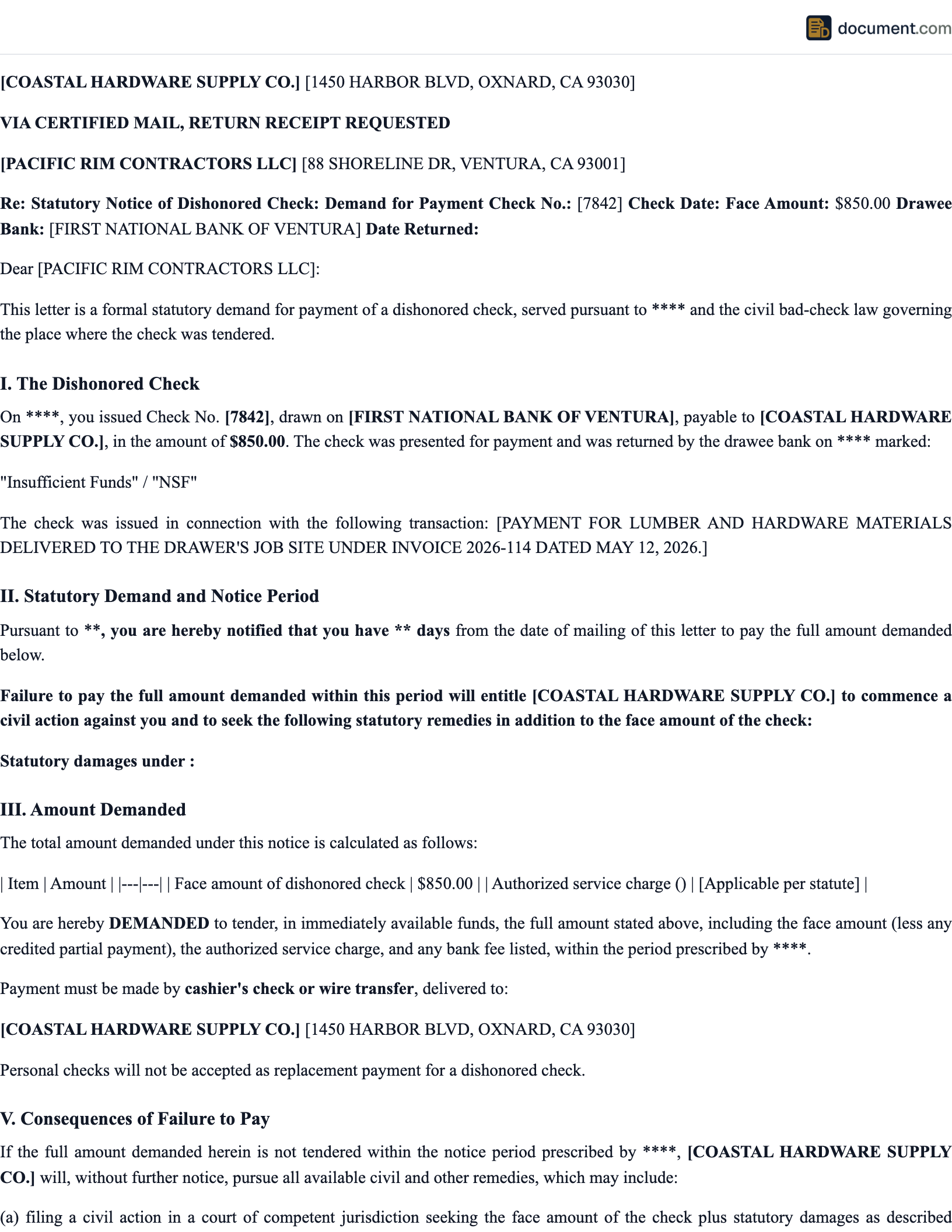



South Dakota Notice of Dishonored Check Overview
South Dakota gives check holders a direct civil remedy against any person who writes a check that the bank refuses to pay. Under SDCL § 21-57-1, the core of Title 21, Chapter 57, Recovery of Damages for Instruments Not Paid Upon Presentment, the holder of a dishonored check can pursue treble damages, court costs, and legal interest without waiting for the criminal justice system to act. The civil path is entirely separate from criminal prosecution and sits squarely in the hands of the payee.
The statute covers checks, drafts, and orders of payment. A check returned for insufficient funds, written on a closed account, or otherwise dishonored triggers the same civil framework. Before enhanced damages become available, the holder must send a written notice of dishonor that complies with SDCL §§ 21-57-4 and 21-57-5 and then wait a full 30 days for the drawer to cure. If no payment arrives in that window, the holder may file suit and seek the statutory penalty.
South Dakota's structure differs from many neighboring states in one notable respect: the treble-damages formula is bounded on both ends by a minimum and a maximum enhancement above the check face amount. That caps the civil upside on large checks while providing a guaranteed minimum recovery on small ones. Understanding exactly how the cap operates before you calculate what to demand in the notice letter will save time and avoid drafting errors.
3x face amount
Civil damages
30 days after mailing notice of dishonor
Notice period
Actual collection costs
Service charge
SDCL § 21-57-1
Controlling statute
The Controlling Statute: SDCL § 21-57-1
SDCL § 21-57-1 establishes liability in any civil action brought to collect a dishonored check, draft, or order of payment. The statute reaches the maker, drawer, or issuer of the instrument, whoever signed and passed the check, and it extends that liability to both the original holder and any assignee who has acquired the check for collection. An accounts-receivable firm that purchases a returned check from the original payee can invoke the statute on its own behalf, provided the assignment is properly documented.
The core damages formula is three times the face amount of the dishonored check. But the statute immediately qualifies that multiplier with a collar: the total liability for damages may not be less than $100 nor greater than $200 above the face amount of the check. Those are absolute bounds on the enhanced portion of the award, not on the total judgment. The face amount itself remains fully recoverable on top of the enhancement. In practice, for any check above roughly $67, the maximum enhancement is $200 over face; below that threshold the minimum enhancement of $100 applies.
On top of the face amount and the damages enhancement, SDCL § 21-57-1 separately authorizes allowable court costs, filing fees, and interest computed at the legal rate from the date the check was issued. Legal interest in South Dakota accrues at the rate set by SDCL § 54-3-4, which tracks the Wall Street Journal prime rate with a floor. For a check that sat unpaid for several months before suit was filed, the interest component can add a measurable amount to the total judgment, particularly on larger checks.
The statute also enumerates specific defenses that relieve the maker of liability for the enhanced damages and costs. These include situations where the account contained sufficient funds at the time the check was written but a simultaneously deposited paycheck was itself dishonored, where funds were garnished or attached without the maker's knowledge, or where the maker lacked contractual capacity. These defenses track the element of culpability: the civil remedy is aimed at the drawer who knowingly or negligently wrote a check without funds to cover it, not at someone whose account was legitimately impaired after issuance.
Statute Reference
SDCL § 21-57-1
Damages: 3x face amount; not less than $100 nor more than $200 above face amount; plus court costs and legal interest
What You Can Recover in South Dakota
The damages calculation under SDCL § 21-57-1 works in layers. The starting point is always full recovery of the face amount of the check, that portion is never in question. The penalty enhancement is three times the face amount, but it is capped at no more than $200 above the face amount and floored at no less than $100 above the face amount. So on a $50 check, treble damages would theoretically be $150, but since the floor is $100 over face, the total damages (enhancement only) are $100, yielding a total judgment of $150 before costs and interest. On a $300 check, three times face would be $900, but the $200 ceiling means the enhancement is $200, bringing the total to $500 before costs and interest. On a $1,000 check, the ceiling holds the enhancement to $200, so the holder recovers $1,200 plus costs and interest.
To those figures, add court costs, filing fees, and accrued legal interest from the date the check was drawn. In small claims court, where most bad-check actions in South Dakota are filed, filing fees are modest, but they are explicitly included in the judgment by the statute. Legal interest continues to accrue from the date of the check, not the date of the lawsuit, which means delay between dishonor and judgment expands the interest component. For a $500 check that went uncollected for a full year, several additional percentage points in interest stack on top of the $700 total ($500 face plus $200 enhancement).
South Dakota's enhancement formula is tighter than the common nationwide pattern of three times face with no ceiling, or a ceiling of $500 above face. A holder pursuing a substantial dishonored check, say, $5,000 for contractor services, will recover the $5,000 face amount plus only $200 in statutory enhancement, plus costs and interest. For large checks, the practical value of the civil remedy lies primarily in the certainty of the face-amount recovery and the availability of a court-cost and interest award, rather than in a transformative multiplier. For small checks under $150, the guaranteed $100 minimum enhancement can exceed treble face value and makes the statute particularly useful for businesses receiving low-dollar returned checks in volume.
- Civil damages: 3x face amount; not less than $100 nor more than $200 above face amount; plus court costs and legal interest
- Service charge: Actual collection costs
- Notice period before suit: 30 days after mailing notice of dishonor
Notice Procedure and Timeline in South Dakota
The notice of dishonor must comply with SDCL §§ 21-57-4 and 21-57-5 before the 30-day period begins to run. Those sections govern the method of service: the notice must be sent by registered or certified mail, return receipt requested, or by first-class mail supported by an affidavit of mailing sworn and retained by the sender. Address the mailing to the address printed on the check or, if that address is not current, to the drawer's last known address. Keep the certified mail receipt, the tracking confirmation, and, if the letter is returned unclaimed, the envelope with the postal notation intact.
The 30-day period runs from the date the notice of dishonor is mailed, not from the date it is received or signed for. To calculate the deadline with precision, note the date you drop the envelope in the mail or hand it to a postal clerk, then count forward 30 calendar days. If day 30 falls on a Saturday, Sunday, or South Dakota legal holiday, the period extends to the next business day under general court computation rules. Express the deadline as a specific calendar date in the notice letter itself, writing 'on or before [date]' rather than 'within 30 days' eliminates any dispute about when the window closed.
Do not file suit before the full 30 days have elapsed. Filing even one day early can forfeit the enhanced damages claim, because the statutory remedy is conditioned on the expiration of the notice period without payment. If the drawer tenders partial payment during the 30-day window, apply it to the amount owed and reassess the balance. The statute's damages formula applies to the dishonored instrument; the holder can demand any remaining unpaid amount plus costs and interest on that balance. Document every partial payment, including the date received, and retain that record for the court file.
South Dakota-Specific Notes
South Dakota also criminalizes the writing of a bad check under SDCL Chapter 22-30A (Theft). Passing a check with knowledge of insufficient funds constitutes theft by insufficient funds check, and the severity of the charge scales with the face amount of the check. Checks of $400 or less are a Class 2 misdemeanor; checks between $401 and $1,000 are a Class 1 misdemeanor; checks above $1,000 can be charged as a felony. Multiple checks written within any 30-day period may be aggregated to reach the higher threshold. The six-month statute of limitations on criminal prosecution runs from the date the holder receives the bank's notice of dishonor, which makes prompt civil action and documentation important even if criminal referral is not the primary goal.
Several South Dakota counties operate bad-check programs through the state's attorney's office. Clay County, Brookings County, and others accept dishonored checks for criminal prosecution, but most of those programs require evidence that a written civil demand was sent and that the drawer failed to pay within the cure period before the office will take the matter. The civil notice procedure under SDCL §§ 21-57-1 through 21-57-5 satisfies that prerequisite. If you intend to pursue both the civil remedy and a criminal referral, send the statutory notice first, retain proof of mailing, and document the expiration of the 30-day period without payment before presenting the matter to the state's attorney.
South Dakota's small claims court, the magistrate court's minor civil division, has jurisdiction over claims of $12,000 or less, exclusive of costs and interest. The vast majority of bad-check civil actions fall well within that ceiling, and the informal small claims process makes it practical for individuals and small businesses to pursue the claim without retaining counsel. The filing fees are modest, and judges in small claims court are familiar with statutory bad-check claims. Bring a copy of the original check, the bank's dishonor notice, the demand letter, and certified mail proof; those four documents establish each element of the claim.
South Dakota Specific Note
SDCL § 21-57-1 does not authorize separate recovery of attorney fees the way several other states' bad-check statutes do. The holder can recover court costs and filing fees, but the statute does not include a fee-shifting provision for counsel fees. On a small check, the economics of hiring an attorney to pursue the statutory remedy rarely work in the client's favor; small claims court without counsel is the practical answer for most claims. On a larger check where face-amount recovery justifies legal fees, those fees must be weighed against the $200 ceiling on the enhancement, because the penalty itself will not fund litigation over a substantial instrument.
South Dakota Bad Check FAQ
Other State Bad Check Laws
Each state sets its own notice period, damage formula, and service charge. Browse sibling state pages for the specific rules that apply to your situation, or return to the full 50-state guide.
Create your South Dakota Notice of Dishonored Check in minutes.
Answer a few questions and download a South Dakota-compliant bad check demand letter that cites SDCL § 21-57-1 and is ready to mail certified.