
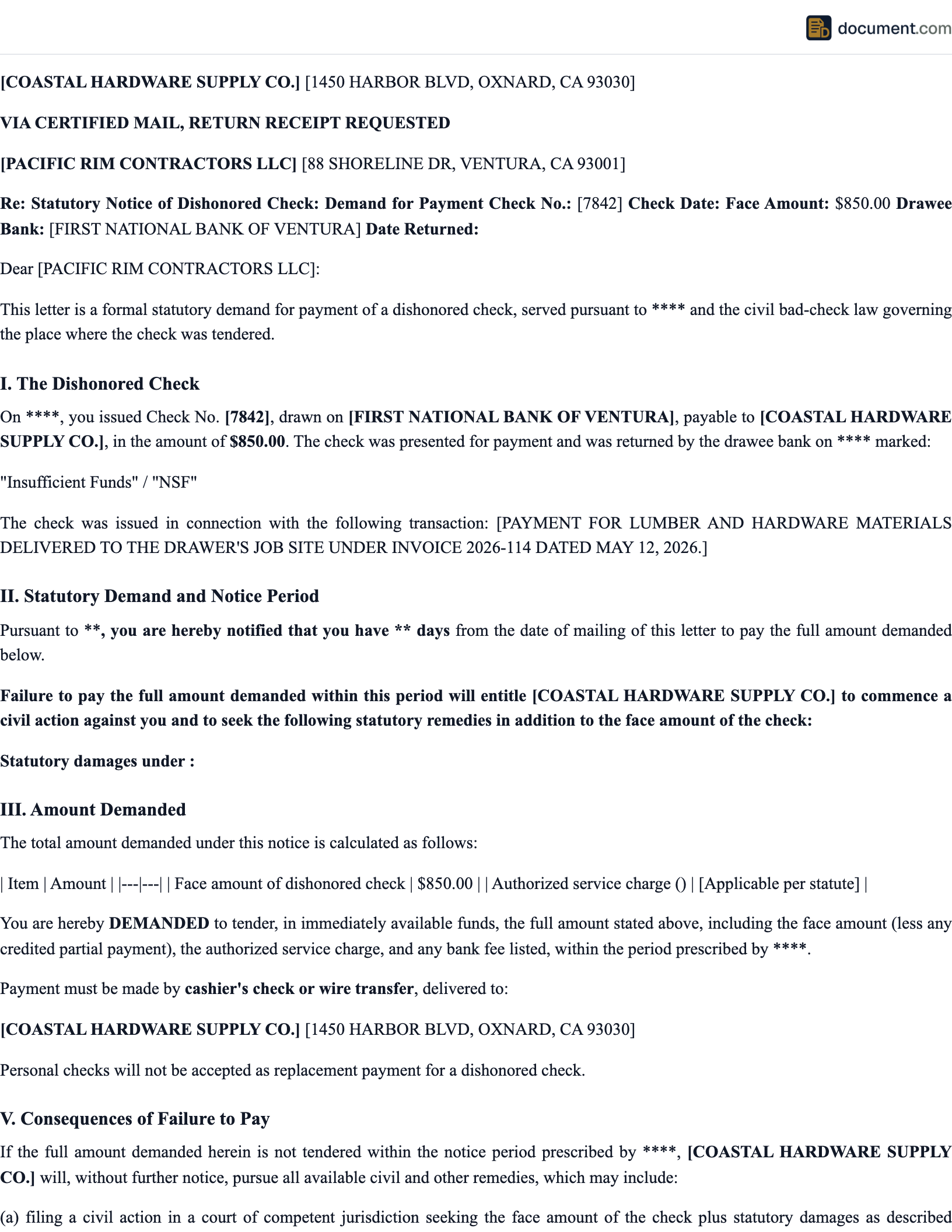



Texas Notice of Dishonored Check Overview
Texas gives the holder of a dishonored check two interlocking statutory tools: the commercial-paper dishonor provision in the Texas Business and Commerce Code, and the separate civil bad-check action in the Texas Civil Practice and Remedies Code. Together, these statutes authorize treble damages on the unpaid check amount, attorney fees, and a service charge of up to $30, provided the payee sends a proper written demand and the drawer fails to pay within 30 days.
Texas courts interpret the notice requirement strictly. A demand sent by regular mail when the statute anticipates written notice, or addressed to a location other than the one on the check, has caused holders to lose the enhanced-damage claim even in cases where the underlying dishonor was clear. The preparation and delivery of the demand letter is not a formality; it is the jurisdictional predicate for the civil penalty.
This page walks through the Texas statutory framework, what the payee can recover, the step-by-step notice procedure, and state-specific rules that differ from the national baseline. All figures and statutory citations are drawn from the verified 51-jurisdiction dataset and confirmed against the enrolled text of Texas law.
3x check amount
Civil damages
30 days after written demand (Tex. Bus. & Com. Code § 3.506)
Notice period
Up to $30
Service charge
Tex. Bus. & Com. Code § 3.506 / Tex. Civ. Prac. & Rem. Code § 17.505
Controlling statute
The Controlling Statute: Tex. Bus. & Com. Code § 3.506 / Tex. Civ. Prac. & Rem. Code § 17.505
The primary statutory authority is Tex. Bus. & Com. Code Ann. Section 3.506, which governs dishonored instruments under Texas's enactment of Uniform Commercial Code Article 3. Section 3.506 provides that a holder of a dishonored check is entitled to damages equal to the amount of the check, plus interest at the legal rate from the date the check was returned, plus the holder's incurred bank fees. This provision is the baseline; it does not by itself authorize treble damages.
Treble damages enter through Tex. Civ. Prac. & Rem. Code Section 17.505, which creates a separate cause of action for the drawer's failure to cure a dishonored check after written demand. Under Section 17.505, if the drawer does not tender the full amount owed within 30 days after receiving the written demand, the holder may sue and recover: (1) the original amount of the check; (2) damages in an amount not to exceed three times the amount of the check; (3) reasonable attorney fees; and (4) court costs. The treble-damage cap structure in Texas means that the total enhancement above the check amount cannot exceed two times the face value, and the combined award cannot exceed three times the face value. There is no separate minimum award in the statute, unlike California which floors treble damages at $100.
Texas also imposes a specific cap on the treble-damage enhancement: the additional damages above the check face amount cannot exceed $500. This means that a $100 check can yield up to $300 total in treble damages, but a $5,000 check still caps the total treble-damage award at $5,500 (the $5,000 face amount plus the $500 cap on the enhancement). The $500 cap is the statutory ceiling on the bonus amount, not on total recovery, so the face amount itself is always recoverable in full regardless of size.
Texas does not have a separate civil bad-check statute outside the CPRC and the UCC chapter. Unlike some states that have enacted a freestanding consumer or commercial collection statute for dishonored checks, Texas relies on these two interlocking provisions. Practitioners should cite both when filing a civil bad-check action: Section 3.506 for the underlying instrument claim and Section 17.505 for the enhanced civil penalty.
Statute Reference
Tex. Bus. & Com. Code § 3.506 / Tex. Civ. Prac. & Rem. Code § 17.505
Damages: 3x check amount; not less than $100 nor more than $500 above check amount; plus attorney fees
What You Can Recover in Texas
Under Texas law, the payee who follows the statutory notice procedure can recover three categories of money from the drawer who fails to cure. The first is the face amount of the dishonored check, which is owed regardless of whether the enhanced damages apply. The second is the service charge, which Texas caps at $30 per dishonored check. The service charge compensates the payee for the bank's returned-check fee and the administrative burden of the collection process; it is separate from the civil penalty and can be demanded in the notice letter at the outset.
The third category is the treble-damage enhancement under Tex. Civ. Prac. & Rem. Code Section 17.505. This is the civil penalty that gives the civil bad-check framework most of its collection leverage: the holder can seek up to three times the check amount in additional damages, subject to the $500 ceiling on the extra amount above the check face. On top of these three categories, Texas authorizes recovery of reasonable attorney fees and court costs in a successful civil bad-check action. Attorney fees are awarded at the court's discretion and are proportional to the complexity and size of the matter, but they are explicitly authorized in the statute.
For a concrete example: if a $400 check is returned NSF, the Texas holder can demand $400 (face) + $30 (service charge) + bank fee = approximately $445 in the initial demand letter. If the drawer does not pay within 30 days, the holder can sue for $400 (face) + up to $800 in treble damages (the lesser of 2x the face or the $500 cap results in a cap of $500 here) + attorney fees + court costs. The $500 cap applies to the enhancement above the face amount, so total recovery on a $400 check in a fully litigated case can reach $900 plus attorney fees.
Texas courts have confirmed that the treble-damage calculation runs on the amount owed at the time the 30-day demand period expires, not the original check face value. If the drawer makes a partial payment of $100 during the 30-day window on a $400 check, the enhanced damages are calculated on the remaining $300 unpaid balance rather than the full $400 original amount. Payees should track any partial payments received during the notice period and adjust their damages calculation accordingly when filing suit.
- Civil damages: 3x check amount; not less than $100 nor more than $500 above check amount; plus attorney fees
- Service charge: Up to $30
- Notice period before suit: 30 days after written demand (Tex. Bus. & Com. Code § 3.506)
Notice Procedure and Timeline in Texas
The 30-day notice period under Tex. Civ. Prac. & Rem. Code Section 17.505 runs from the date the holder mails the written demand, not from the date the check was returned. The statute does not expressly mandate certified mail, but Texas courts and commentators strongly recommend using certified mail with return receipt requested because it creates the documentary evidence needed to prove the notice element at trial. Sending the demand by first-class mail alone is technically permitted but creates evidentiary risk: if the drawer claims non-receipt, you have no tracking record to rebut the claim.
The demand letter must be sent to the address printed or written on the check or to the drawer's last known address if that information is more current. Address the demand to the same name as appears on the check. If the check was written by a business, send the notice to the business's last known address and, if known, to the authorized signatory individually. Texas does not require that the demand be mailed to a specific form of address (such as personal name only or business name only), but sending to both the business and the individual signatory where applicable maximizes the chance that the demand is received and protects against a later claim of defective service.
The demand letter must state: (1) that the check was returned and the reason for dishonor; (2) the total amount owed, itemized to show the check face amount, the service charge, and any recoverable bank fee; (3) the statutory basis for the civil penalty, citing Tex. Civ. Prac. & Rem. Code Section 17.505; (4) that the drawer has 30 days from the date of mailing to pay the total amount owed or enhanced civil damages may be sought; and (5) a specific calendar date by which payment must be received. Specifying the payment deadline as a calendar date (not just '30 days') removes any ambiguity that a drawer could exploit in litigation.
Once the 30-day period runs without full payment, the holder may file suit in the appropriate Texas court. For amounts within the small claims ceiling (currently $20,000 in Texas justice of the peace courts), the holder can file without an attorney in JP court. For larger amounts, the case must be filed in county or district court, where the attorney-fee provision becomes meaningfully valuable because the cost of representation is more likely to be proportional to the recovery. File the complaint with the following exhibits attached: the original check or a clear copy, the bank's dishonor notice, the demand letter as sent, the certified mail receipt, and the USPS tracking confirmation showing delivery or attempted delivery.
Texas-Specific Notes
Texas is a community-property state, which can have downstream effects in a civil bad-check action if the drawer is married and the judgment debtor is the drawer individually. A judgment against one spouse in a personal civil action may be collectible from that spouse's separate property and from community property that is under that spouse's sole management, but not necessarily from the other spouse's separate property or from jointly-managed community property. This distinction matters at the enforcement stage, particularly for checks written on joint accounts or checks signed by one spouse on behalf of a household.
Texas small claims courts, called justice of the peace courts, handle civil bad-check cases up to $20,000 without requiring attorney representation. The $20,000 ceiling is the total claim limit, including the treble-damage enhancement and any service charges but generally not attorney fees (which are awarded by the court separately). This ceiling is meaningfully higher than in many other states, making JP court an accessible venue for pursuing bad-check claims without counsel.
Texas has a two-year statute of limitations for most civil bad-check actions under the general personal-injury and property-damage limitations framework, though some practitioners argue the four-year UCC Article 3 limitations period (running from dishonor) applies to the instrument-based claim under Section 3.506. The safest practice is to file within two years of the date the 30-day demand period expired without payment. Filing beyond two years from dishonor risks limitations arguments from the drawer.
Texas Specific Note
Texas does not have a separate statute specifically extending the civil bad-check framework to ACH or electronic fund transfer returns. Holders of returned ACH debits in Texas must pursue those claims under breach of contract or UCC Article 4A theories rather than under the bad-check civil penalty framework. This is a meaningful distinction from California and Florida, which have expressly extended their civil bad-check statutes to cover electronic transfers. Texas payees who receive returned ACH payments should consult counsel before sending a statutory bad-check notice, since relying on the wrong legal theory in the demand letter can create problems at trial.
Stop-payment checks are covered under Texas's civil bad-check framework when the stop payment was entered fraudulently or without good cause. Texas courts have held that a drawer who stops payment in order to avoid a legitimate debt is not protected from civil bad-check liability, even though the drawer technically instructed the bank to dishonor the check. However, if the drawer stopped payment because of a legitimate dispute about the underlying goods or services, the Texas courts have sometimes been reluctant to extend the treble-damage penalty. Payees holding a stop-payment check should carefully document that the underlying transaction was legitimate and that the stop payment was not entered for good cause.
Texas Bad Check FAQ
Other State Bad Check Laws
Each state sets its own notice period, damage formula, and service charge. Browse sibling state pages for the specific rules that apply to your situation, or return to the full 50-state guide.
Official Texas Resources
Create your Texas Notice of Dishonored Check in minutes.
Answer a few questions and download a Texas-compliant bad check demand letter that cites Tex. Bus. & Com. Code § 3.506 / Tex. Civ. Prac. & Rem. Code § 17.505 and is ready to mail certified.