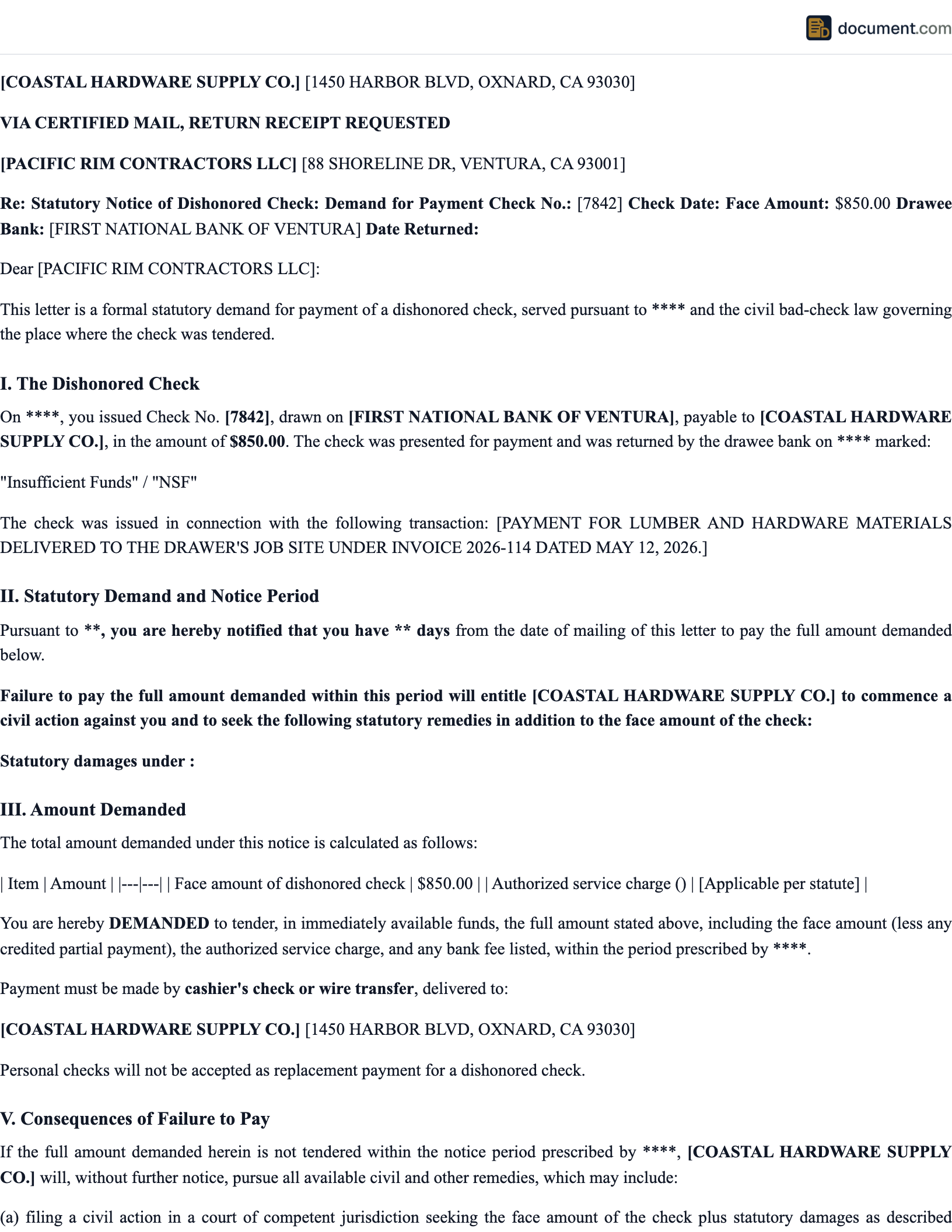



California Notice of Dishonored Check Overview
California Civil Code Section 1719 is one of the most payee-friendly bad-check statutes in the country. The statute awards treble damages on the amount still owed when the 30-day notice period expires, with a floor of $100 and a ceiling of $1,500 above the check face amount. That $1,500 ceiling is roughly three times the $500 cap in most other states, which makes California the preferred jurisdiction to litigate a bad-check claim when a choice of forum exists.
California requires both a certified mailing (return receipt requested) and a simultaneous first-class mailing of the demand letter. The dual-mailing requirement exists because certified mail is sometimes refused or left uncollected, and the first-class copy establishes that the drawer had a reasonable opportunity to learn of the demand. California courts have upheld bad-check claims where the certified piece was returned unclaimed, as long as the first-class copy was simultaneously mailed to the correct address.
California also extended Section 1719 to cover dishonored electronic fund transfers in 2013, making it one of the states where the bad-check notice procedure and treble-damage remedy apply to returned ACH debits as well as paper checks. Payees who receive a returned ACH debit in California should confirm that the underlying authorization agreement creates a transaction equivalent to a check for purposes of the statute before sending the Section 1719 notice.
3x amount owed
Civil damages
30 days after certified mail demand
Notice period
$25 for first check; $35 for subsequent checks
Service charge
Cal. Civ. Code § 1719
Controlling statute
The Controlling Statute: Cal. Civ. Code § 1719
California Civil Code Section 1719 was originally enacted to create a civil remedy parallel to the state's criminal bad-check statute (Penal Code Section 476a). The civil statute operates independently of any criminal proceeding and does not require a criminal conviction or referral. It creates a straightforward private cause of action: if a check is dishonored and the drawer does not cure within 30 days of a proper written demand, the holder may sue for treble damages.
Section 1719 defines the treble-damage calculation with precision. The 'amount owed' for purposes of the treble calculation is the face amount of the check minus any partial payments made toward the check amount or the service charge during the 30-day demand period. This means that if a drawer pays $200 toward a $600 check during the notice window, the treble-damage calculation runs on the remaining $400 balance, not the original $600 face. California courts have applied this calculation consistently since the statute was amended to clarify the point.
The statute specifies that the treble-damage award cannot be less than $100 above the amount owed and cannot exceed $1,500 above the amount owed. The $100 floor guarantees the holder a meaningful recovery even on a small check, while the $1,500 ceiling caps the windfall on large checks at a level three times the common $500 cap in other states. For checks above $750, the $1,500 ceiling effectively limits total treble damages to the face amount plus $1,500, regardless of what three times the face amount would otherwise yield.
California's 2013 amendment expressly extended Section 1719 to cover 'dishonored electronic fund transfer demands' where the transfer was initiated with the written authorization of the account holder. The amendment means that a landlord who collects rent via ACH authorization and receives a return for insufficient funds can use the same Section 1719 notice procedure and recover the same treble damages as if the tenant had written a paper check. The 30-day notice period, the dual-mailing requirement, and the treble-damage formula all apply identically to paper checks and authorized electronic transfers.
Statute Reference
Cal. Civ. Code § 1719
Damages: 3x amount owed; not less than $100 nor more than $1,500
What You Can Recover in California
California Civil Code Section 1719 authorizes three layers of recovery for the holder of a dishonored check who follows the notice procedure. The first layer is the face amount of the check itself, which the drawer owes regardless of whether enhanced damages are available. The second layer is the service charge: $25 for the first dishonored check from a given drawer, and $35 for each subsequent dishonored check from the same drawer within a 12-month period. The service charge can be demanded in the initial written notice and is recoverable even if the drawer cures before the treble-damage window opens.
The third layer is the treble-damage award under Section 1719(a). Once the 30-day notice period expires without full payment of the amount owed (face amount plus service charge plus any recoverable bank fee), the holder may sue and recover treble the amount still owed at the time the notice period expired. The treble amount must be at least $100 and no more than $1,500 above the unpaid balance at the time of filing. This floor-and-ceiling structure makes California's formula the most granular of any state's: the holder always gets at least $100 extra, and the ceiling is high enough to matter even on mid-sized commercial checks.
As a practical example: a $500 bad check in California. The holder sends the demand letter for $500 (face) + $25 (first-check service charge) = $525. The drawer ignores the demand for 30 days. The holder sues for $525 (unpaid balance) + treble damages of three times $525 = $1,575, capped at $1,500 above the face amount. The total recoverable amount is $525 + $1,500 = $2,025 before attorney fees and court costs. If the court awards reasonable attorney fees, the total recovery on a $500 check can readily exceed $3,000 in a contested case.
California courts may also award reasonable attorney fees to the prevailing holder in a Section 1719 action. The fee award is within the court's discretion and proportional to the complexity of the case. For small-check cases in small claims court (California's limit is $12,500 for individuals, $6,250 for businesses), attorney fees are not typically at issue because self-represented parties prevail on the statutory notice alone. For larger checks in superior court, the attorney-fee provision makes representation economically viable.
- Civil damages: 3x amount owed; not less than $100 nor more than $1,500
- Service charge: $25 for first check; $35 for subsequent checks
- Notice period before suit: 30 days after certified mail demand
Notice Procedure and Timeline in California
The California notice must be sent by certified mail, return receipt requested, to the address printed on the check or the drawer's last known address. Simultaneously, on the same date the certified letter goes out, the holder must also mail a copy by first-class mail to the same address. Both mailings are required; sending only the certified piece is not sufficient under Section 1719 to establish the full notice that the statute contemplates. Retain the certified mail receipt, the USPS tracking confirmation, and proof that the first-class copy was mailed on the same day (a dated postal receipt or a notarized certificate of mailing both work).
The notice letter must include: (1) the date, amount, and drawee bank of the check; (2) the reason for dishonor as stated on the bank's return notice; (3) the total amount demanded (face amount plus service charge plus any bank fee); (4) explicit language stating that the holder intends to seek treble damages under California Civil Code Section 1719 if payment is not received within 30 days; and (5) the specific calendar date by which payment must arrive. California case law has emphasized that the statutory-language requirement about treble damages is not optional; a notice that omits the treble-damage warning has been found insufficient to trigger the enhanced remedy.
The 30-day period runs from the date the demand is mailed, not the date of receipt. California courts applying Section 1719 have consistently measured the window from the mailing date shown on the certified mail receipt. Do not count the mailing date itself; the 30-day window begins the following calendar day. If the 30th day falls on a California legal holiday or a Saturday or Sunday, the holder should wait until the next business day before filing to avoid any argument that the period had not fully run.
If the certified letter is returned unclaimed or refused, California law permits the holder to proceed with the civil action as if proper notice was given, provided the first-class copy was sent simultaneously and was addressed to the correct address. Keep the returned certified envelope as an exhibit; it demonstrates that the notice was properly addressed and that the drawer's failure to receive it was due to the drawer's own conduct rather than any defect in the notice.
California-Specific Notes
California extended Section 1719 to cover ACH returns in 2013. The statute now expressly covers 'written demand for payment of a dishonored draft, check, or order, or for payment of a dishonored demand for payment of an electronic fund transfer.' This means that landlords and businesses using recurring ACH billing can invoke Section 1719 for returned ACH payments if the underlying authorization was in writing. The authorization agreement should be in the payee's files before sending the notice; if the authorization is verbal, the electronic transfer may not qualify as an 'electronic fund transfer' within the meaning of the amended statute.
California's small claims limit is $12,500 for individuals and $6,250 for most businesses (with exceptions for certain businesses that may only use small claims court twice per year). Many dishonored-check cases involving the $1,500 maximum treble enhancement plus the service charge and face amount fall within the small claims ceiling, making small claims court an accessible venue. Small claims procedure in California does not permit attorney representation at the hearing for most parties, which means the holder must appear in person and present the documentary evidence directly.
California Penal Code Section 476a makes issuing a bad check a crime, and the civil and criminal tracks can run simultaneously. The district attorney's bad-check restitution programs in counties like Los Angeles (the DA Bad Check Program), San Diego, and Orange operate on their own procedures and do not require the holder to have already sent a civil Section 1719 notice. However, because many DA programs require documented evidence that the holder made a civil demand before they will accept a check for prosecution, sending the Section 1719 notice first is the natural sequencing.
California Specific Note
California's dual-mailing requirement (certified mail plus simultaneous first-class mail) is one of the most frequently missed procedural steps in California bad-check cases. Courts have denied treble damages where the holder sent only the certified letter without the simultaneous first-class copy. The first-class mailing does not need to be identical to the certified letter in format, but it must be sent on the same day and to the same address. Retain a dated USPS receipt or certificate of mailing for both pieces.
California's statute of limitations for a Section 1719 civil bad-check action is generally three years from the date the cause of action accrued, which is the date the 30-day notice period expired without payment. This is consistent with the general three-year limitations period for liabilities created by statute under California Code of Civil Procedure Section 338(a). Some practitioners rely on the four-year UCC Article 3 limitations period for the underlying instrument claim; the safest approach is to file within three years of the notice-period expiration.
California Bad Check FAQ
Other State Bad Check Laws
Each state sets its own notice period, damage formula, and service charge. Browse sibling state pages for the specific rules that apply to your situation, or return to the full 50-state guide.
Official California Resources
Create your California Notice of Dishonored Check in minutes.
Answer a few questions and download a California-compliant bad check demand letter that cites Cal. Civ. Code § 1719 and is ready to mail certified.