
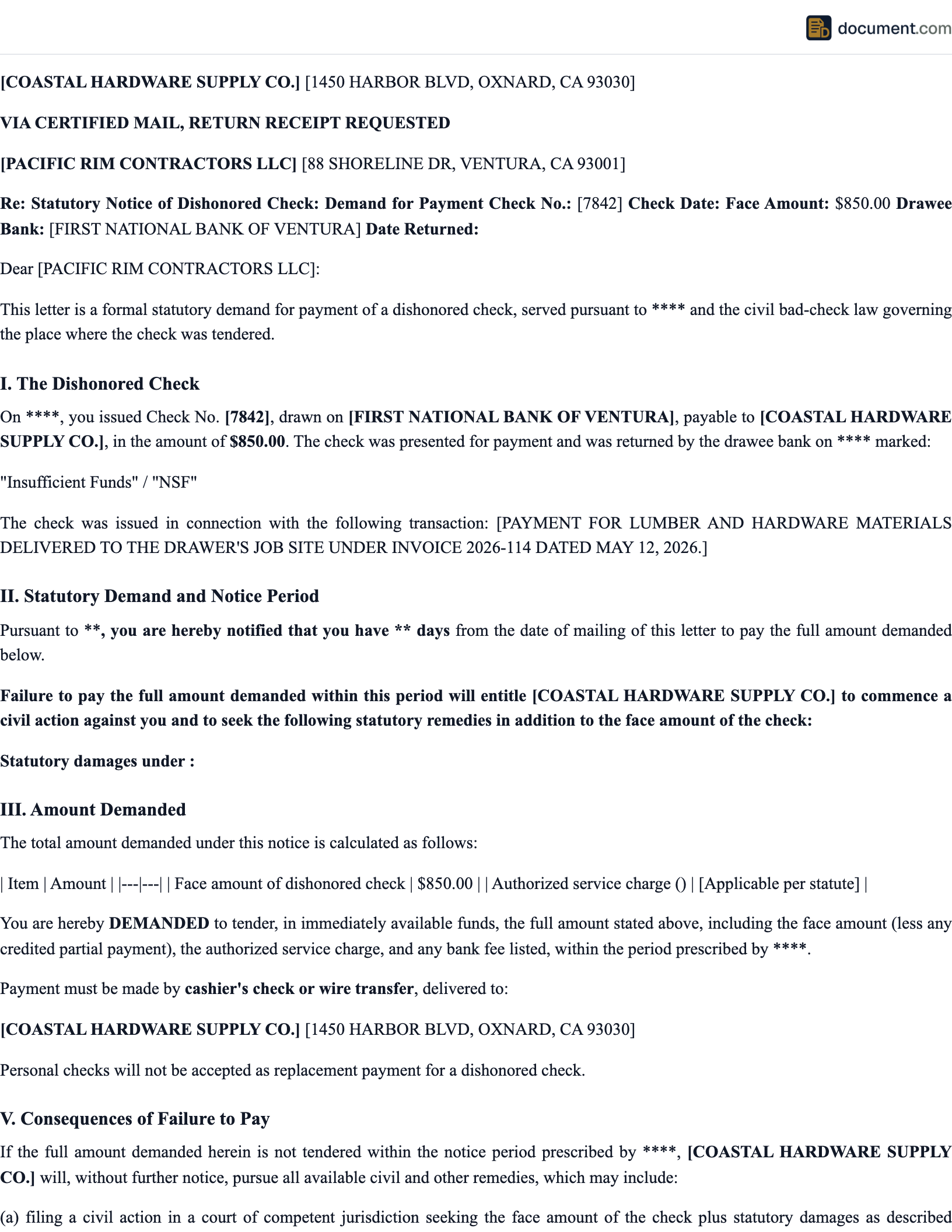



Tennessee Notice of Dishonored Check Overview
Tennessee gives payees a powerful civil remedy for dishonored checks. Under Tenn. Code Ann. § 47-29-101, a holder who follows the required notice procedure can recover up to three times the face amount of the returned check, plus 10% annual interest, reasonable service charges, attorney fees, and court costs. That combination frequently makes the civil track more valuable than simply suing for the check amount alone, and it gives the payee real leverage before any courtroom is involved.
The statute applies to checks returned for insufficient funds, closed accounts, or any other reason that prevents the bank from honoring the instrument. Tennessee courts have read the statute to cover the full range of dishonor situations that a payee is likely to encounter in commercial practice, from the tenant whose rent check bounces to the contractor whose project payment comes back marked account closed.
Tennessee also maintains a separate criminal bad-check framework under Tenn. Code Ann. § 39-14-121, and the state operates Worthless Check Units through district attorney offices in many counties. The civil and criminal tracks run independently: sending a § 47-29-101 notice does not require, trigger, or preclude a criminal referral, but it does satisfy the written-demand prerequisite that most DA worthless-check programs require before they will accept a check for prosecution. For most payees, the civil notice is the logical first step regardless of which track they ultimately pursue.
3x face amount
Civil damages
30 days after certified mail notice warning of treble damages
Notice period
Reasonable service charges incurred by payee
Service charge
Tenn. Code Ann. § 47-29-101
Controlling statute
The Controlling Statute: Tenn. Code Ann. § 47-29-101
Tenn. Code Ann. § 47-29-101 creates a cause of action for the holder of a dishonored check against the person who issued it. The core structure is familiar: the holder must send a written demand by certified mail, wait 30 days for payment, and only after that window closes without full payment may the holder sue for civil penalties. The statute is explicit that the notice must warn the drawer of the potential for treble damages; a demand that omits that warning does not satisfy the statutory prerequisite.
The damages formula in § 47-29-101 awards the holder three times the face amount of the check, subject to an important cap. The total recovery for the treble component may not exceed the face amount of the check plus $500. So a $200 check can yield up to $700 in combined check-plus-enhancement recovery, while a $5,000 check still caps the enhancement at $500 above the $5,000 face amount. On top of that, the statute adds 10% annual interest on the check amount, any reasonable service charges the payee incurred, attorney fees the court finds reasonable, and court costs.
The statute's reference to 'reasonable service charges incurred by the payee' covers what the payee's own bank charged for the returned item, the cost of certified mail, and similar out-of-pocket collection expenses directly tied to the dishonor. These are separate from the civil penalty and from attorney fees. Unlike some state statutes that set a flat authorized service charge, Tennessee uses a reasonableness standard, so the amounts actually incurred and documented by the payee control.
One structural point worth noting: the treble-damage multiplier applies to the face amount of the check, not to the service charges or interest. When calculating what you are entitled to demand in the notice letter, start with the check face value, multiply by three (subject to the face-plus-$500 cap), add 10% annual interest from the date of dishonor to the date of demand, add actual documented service charges, and add a reservation for attorney fees and court costs. Showing this arithmetic in the notice letter itself removes any dispute about the total sum demanded.
Statute Reference
Tenn. Code Ann. § 47-29-101
Damages: 3x face amount; cap: check + $500; plus 10% interest, service charges, attorney fees, court costs
What You Can Recover in Tennessee
Tennessee's recovery structure stacks several components. The starting point is the face amount of the dishonored check. The civil penalty adds up to three times that amount, but the total of the check plus the penalty cannot exceed the check amount plus $500. On a $150 bad check, three times the face amount would be $450 in penalties, for a total of $600 -- which is within the cap of $150 + $500 = $650, so the full treble penalty is available. On a $1,000 check, three times the face would yield $3,000 in penalties, but the cap limits the enhancement to $500, so the total statutory recovery is $1,500. The cap bites hard on larger checks.
Beyond the penalty, the statute separately authorizes 10% annual interest on the check amount running from dishonor, reasonable service charges the payee actually incurred, attorney fees, and court costs. Attorney fees can materially change the economics on mid-sized checks. A payee who retains counsel to collect a $800 check may recover the check, a $500 penalty, interest, and a reasonable legal fee that together exceed the face value several times over. Courts award fees based on the work actually performed, so documentation of counsel's time matters.
The cap structure means the civil remedy is most powerful on checks in the $1 to $500 range, where three times the face amount still falls within the face-plus-$500 ceiling. On checks above roughly $250, the multiplier starts to be constrained by the cap. For larger dishonored amounts, the attorney-fee provision becomes the most significant recovery lever, particularly when the drawer ignores the demand and the case proceeds to judgment.
- Civil damages: 3x face amount; cap: check + $500; plus 10% interest, service charges, attorney fees, court costs
- Service charge: Reasonable service charges incurred by payee
- Notice period before suit: 30 days after certified mail notice warning of treble damages
Notice Procedure and Timeline in Tennessee
The § 47-29-101 notice must be sent by certified mail to the drawer's address as it appears on the check, or to the drawer's last known address if that differs. Tennessee does not require a simultaneous first-class mailing, but sending one the same day as a precaution is sound practice: if the certified mail comes back unclaimed, the first-class copy supports the argument that the drawer had a reasonable opportunity to receive the demand. Retain the certified mail receipt, the tracking confirmation, and any delivery or refusal notation from the postal service.
The demand letter must state that the check was dishonored, identify the check by date and amount, state the total amount being demanded, and explicitly warn the drawer that failure to pay within 30 days may result in civil liability for treble damages under § 47-29-101. That treble-damage warning is not optional language; it is what triggers the enhanced-damage right. A notice that merely demands payment without citing the statute and warning of the penalty multiplier has been treated in Tennessee courts as an ordinary demand letter, not the statutory prerequisite that opens the treble-damage remedy.
The 30-day clock runs from the date of mailing, not the date the drawer actually receives the letter. Calculate the deadline as a specific calendar date in the notice itself -- state the mailing date and the resulting deadline date in the body of the letter. Do not file suit before the 30th day has passed. Tennessee courts have enforced the waiting period strictly, and a complaint filed even one day early risks dismissal of the penalty claim. If the drawer makes partial payment during the 30-day window, document the receipt and apply it against the balance; the treble-damage calculation at the end of the period is based on whatever remains unpaid.
Tennessee-Specific Notes
Tennessee operates Worthless Check Units through many county district attorney offices. The Knox County DA's office, the Lee County DA's office, and others accept applications from payees whose checks have been dishonored. These units typically require proof that a written demand was sent and the drawer failed to respond before the unit will pursue criminal referral. The § 47-29-101 civil notice letter, together with the certified mail proof, satisfies that prerequisite. A payee who sends the civil notice and retains the documentation is simultaneously positioned for the civil remedy and for a DA referral if the drawer ignores the demand.
Tennessee's criminal bad-check statute, Tenn. Code Ann. § 39-14-121, grades the offense by the amount of the check using the same theft-by-deception framework. A worthless check of $1,000 or less is a Class A misdemeanor, carrying up to 11 months and 29 days in jail and fines up to $2,500. A check exceeding $1,000 but under $2,500 is a Class E felony. The thresholds continue upward through Class D, C, B, and A felonies for progressively larger amounts. The criminal track requires proof of intent to defraud, which is not a requirement for the civil remedy. Many payees who cannot prove the drawer's intent will still prevail on the civil claim based on the dishonor and the demand alone.
Tennessee's General Sessions Court -- the court that handles small claims in the state -- has a $25,000 jurisdictional ceiling for civil money judgments. Most civil bad-check cases fall comfortably within that limit. A payee can file a bad-check action in General Sessions Court without an attorney, the filing fee is modest, and judges in that court are familiar with § 47-29-101 claims. For claims where the face amount of the check plus damages and fees could push past $25,000, the Circuit Court has concurrent jurisdiction and no dollar ceiling on civil claims.
Tennessee Specific Note
Tennessee's DA worthless-check programs in some counties use third-party administrators who charge fees to both the payee and the drawer. Read any program participation agreement carefully before enrolling. Enrollment in a DA diversion program does not prevent the payee from pursuing the § 47-29-101 civil remedy independently, but some program agreements include provisions that could affect the payee's ability to collect directly. If the amounts at stake are significant, consult counsel before choosing between the civil notice route and the DA program route -- the two can be pursued in sequence, but coordination matters.
Tennessee Bad Check FAQ
Other State Bad Check Laws
Each state sets its own notice period, damage formula, and service charge. Browse sibling state pages for the specific rules that apply to your situation, or return to the full 50-state guide.
Create your Tennessee Notice of Dishonored Check in minutes.
Answer a few questions and download a Tennessee-compliant bad check demand letter that cites Tenn. Code Ann. § 47-29-101 and is ready to mail certified.