
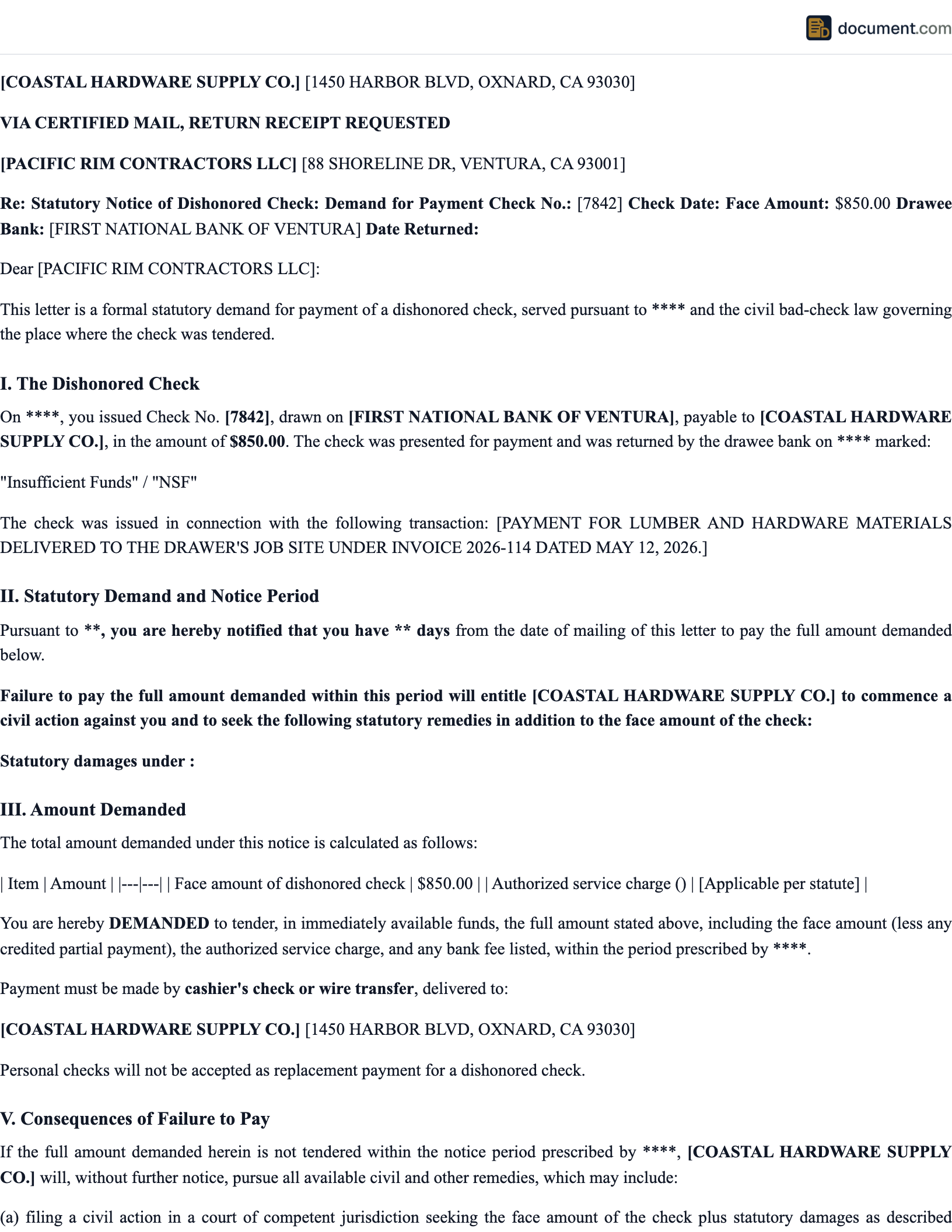



Vermont Notice of Dishonored Check Overview
Vermont gives holders of returned checks a clean civil remedy under 9 V.S.A. § 2311, a statute that sits in Title 9's consumer protection chapter and is modeled on the notice-then-sue framework common to the Northeast. The structure is straightforward: send proper written notice, wait thirty days, and if the drawer still has not paid, you may sue for the face amount of the check plus a flat $50 in statutory damages, plus actual bank fees, accrued interest, attorney fees, and court costs. Vermont does not use a treble-damage formula, so the arithmetic looks different from states like Oregon or Florida, but attorney fees and court costs frequently close the gap on smaller checks where litigation costs would otherwise swallow the recovery.
The statute covers any check, draft, or order for the payment of money that is dishonored because of insufficient funds, a nonexistent account, or a stop-payment order issued without cause. That last category matters: a drawer who stops payment to manufacture a dispute over goods or services already received does not get the shelter of a good-faith stop-payment defense in Vermont. The statute's explicit inclusion of baseless stop-payment orders gives payees a tool that some neighboring states reserve for NSF and closed-account situations only.
Vermont's small claims court handles civil bad-check actions up to $10,000, a ceiling raised from $5,000 in 2023 and sufficient to cover most consumer and small-business dishonored-check disputes. For amounts above $10,000, the claim moves to the Superior Court Civil Division, where the attorney-fee provision in § 2311 makes professional representation more economically viable. Either way, the prerequisite is the same: a compliant written notice, properly mailed, with the thirty-day window fully elapsed before the complaint is filed.
$50 plus face amount, bank fees, interest, attorney fees, and court costs
Civil damages
30 days after certified and first-class mail notice
Notice period
Actual bank fees recoverable
Service charge
9 V.S.A. § 2311
Controlling statute
The Controlling Statute: 9 V.S.A. § 2311
Title 9, Section 2311 of the Vermont Statutes Annotated is the exclusive civil bad-check remedy in the state. It authorizes any holder of a dishonored check to bring a civil action and to recover a specific bundle of items: the face amount of the check, a flat $50 statutory damage award, the bank fees the holder actually incurred, interest on the unpaid amount, reasonable attorney fees, and court costs. There is no multiplier applied to the face amount, no cap on attorney fees beyond reasonableness, and no upper bound on bank fees beyond what the holder actually paid.
The statute defines a check as dishonored in three situations: insufficient funds in the drawer's account, no account existing at all at the named drawee bank, or a stop-payment order placed without cause. The without-cause language distinguishes Vermont from states that exclude all stop-payment checks from the civil bad-check remedy. A drawer who ordered the bank to stop payment because of a genuine dispute about the underlying transaction may still raise that dispute as a defense, but the absence of cause is a factual question, and the civil bad-check statute does not immunize every stop-payment check from § 2311 liability.
The attorney-fee and $50 damages provisions carry a specific trigger: they become available only after the holder has sent the required written notice and the maker has failed to pay within thirty days of that notice. This means a holder who files suit the day after dishonor, without ever sending a demand, can recover the face amount of the check under ordinary contract or UCC Article 3 principles but cannot claim the $50 statutory award or attorney fees under § 2311. The notice is not a courtesy; it is the jurisdictional gateway to the enhanced recovery.
The notice itself must include the date of the check, the identity of the payee, the amount of any bank fees the holder incurred, mailing costs, the face amount of the check, and a payment deadline. Vermont law sets the presumption of proper service: notice sent by both certified mail and first-class mail to the address printed on the check is conclusively presumed received. Alternatively, the holder may send by first-class mail alone and support it with an affidavit, with receipt presumed after three days have elapsed from mailing. The dual-mail route is generally preferable because it produces the certified-mail receipt, which is a cleaner exhibit if the case goes to court.
Statute Reference
9 V.S.A. § 2311
Damages: $50 plus face amount, bank fees, interest, attorney fees, and court costs
What You Can Recover in Vermont
Vermont's § 2311 recovery is additive rather than multiplicative. Start with the face amount of the check, which is owed regardless of how the action is framed. Add $50 in statutory damages, a flat award that does not scale with the check amount, meaning it has proportionally more impact on smaller checks and less on large ones. Add the actual bank fees the holder paid when the check was returned, typically the returned-item fee charged by the holder's bank, which commonly runs between $10 and $35 depending on the institution. Add interest on the unpaid amount, accruing from the date of dishonor at the rate applicable under Vermont law. Then add reasonable attorney fees and the filing and service costs associated with the civil action.
The attorney-fee provision is the most practically significant component for claims above a few hundred dollars. Vermont courts award fees based on the reasonableness of the hours spent and the attorney's customary rate, not on a fixed statutory schedule. On a $1,500 bounced check where the drawer ignored the notice and forced a small-claims filing, the holder might recover $1,500 on the check, $50 in statutory damages, $25 in bank fees, interest from dishonor, and several hundred dollars in attorney fees if counsel was involved, producing a total judgment that substantially exceeds the check face. For pro se holders in small claims court, the court-costs recovery covers filing fees and service fees even without an attorney.
Unlike treble-damage states, Vermont does not penalize delay in payment during the notice period in an escalating way. If the drawer pays the full face amount and bank fees before the thirty-day window closes, the holder has been made whole on those items, and the $50 statutory award and attorney fees under § 2311 are not yet in play. Partial payment during the notice period reduces what remains outstanding but does not extinguish the holder's right to send a notice on the unpaid balance and restart the thirty-day clock on that portion.
- Civil damages: $50 plus face amount, bank fees, interest, attorney fees, and court costs
- Service charge: Actual bank fees recoverable
- Notice period before suit: 30 days after certified and first-class mail notice
Notice Procedure and Timeline in Vermont
The thirty-day clock in § 2311 begins running from the date the written notice is sent, not from the date it is received or signed for. That distinction matters for deadline calculation: if you mail the notice on June 10, the thirty-day period runs through July 10, and you may not file a § 2311 action until July 11 at the earliest. Courts have dismissed enhanced-damage claims where the complaint was filed while the notice period was still open, so count the days carefully and file no earlier than the day after the period expires.
Vermont law gives holders two compliant mailing methods. The first and more defensible route is sending the notice simultaneously by certified mail, return receipt requested, and by first-class mail, both addressed to the address printed on the check or to the drawer's last known address if that differs. The certified-mail receipt, combined with the first-class copy, creates a presumption of receipt that the drawer cannot easily rebut by claiming nondelivery. The second route is first-class mail alone, supported by an affidavit of mailing, with receipt presumed three days after mailing. The first-class-only method is adequate under the statute, but it produces a thinner paper record; if the drawer later claims ignorance of the demand, the certified-mail approach is easier to prove.
The notice must contain specific information: the date of the check, the payee's name, the bank fees incurred, mailing costs, the face amount of the check, and the payment deadline. Write out the deadline as a specific calendar date rather than a reference to '30 days from mailing.' A notice that says 'you have until July 10, 2026 to pay the total amount of $XXX' is unambiguous; one that says 'you have thirty days' leaves the drawer room to argue about when the clock started. Include the total amount demanded, broken down by component, so there is no dispute about what constitutes full payment and no argument that the demand was vague.
Vermont-Specific Notes
Vermont's criminal bad-check statute, 13 V.S.A. § 2022, treats all dishonored-check offenses as misdemeanors carrying up to one year in prison and a $1,000 fine, regardless of the check amount. There is no felony threshold in Vermont's criminal bad-check law based solely on check value, which distinguishes Vermont from states like Florida that escalate to felony treatment above a dollar cutoff. The criminal statute also carries a restitution obligation, but the service charge the court may impose under the criminal track is limited to $5.00, far less than what the civil statute allows in bank fees and costs. The civil and criminal tracks are independent; a holder who sends the § 2311 civil notice is not foreclosed from also reporting the check to the state's attorney.
Vermont's civil bad-check statute explicitly covers stop-payment checks issued without cause, but the without-cause element can become contested in litigation. A drawer who stopped payment because of a legitimate dispute over defective goods, services not rendered, or a mutual mistake has a credible defense to § 2311 liability on the dishonored-check theory, though the holder may still pursue an ordinary breach-of-contract claim. Before sending a § 2311 notice on a stop-payment check, confirm that you have no open dispute with the drawer about the underlying transaction that could give the stop-payment a legitimate factual basis.
Vermont Specific Note
Vermont small claims court has a $10,000 jurisdictional ceiling on most claims, but that ceiling applies to the total amount sought, including statutory damages, bank fees, and interest. A holder seeking to recover attorney fees in small claims proceedings faces a practical constraint: small claims judges award fees only where they are documented and reasonable, and an attorney who billed hours substantially in excess of the underlying check amount may see the fee award reduced significantly. If your § 2311 claim with all components approaches or exceeds $10,000, file in the Superior Court Civil Division, where full fee documentation and formal discovery tools are available.
Vermont does not have a statewide district attorney bad-check diversion program with a published uniform structure. Local state's attorney offices in Vermont have discretion to decline prosecution, pursue restitution agreements, or refer matters to restorative programs, but practice varies significantly by county. A § 2311 civil notice that the drawer ignores will generally satisfy the demand-before-referral threshold that state's attorneys informally apply when evaluating whether a drawer had opportunity to cure before criminal consequences attached. Send the civil notice first, retain the proof of mailing, and let the response, or silence, guide the decision about criminal referral.
Vermont Bad Check FAQ
Other State Bad Check Laws
Each state sets its own notice period, damage formula, and service charge. Browse sibling state pages for the specific rules that apply to your situation, or return to the full 50-state guide.
Create your Vermont Notice of Dishonored Check in minutes.
Answer a few questions and download a Vermont-compliant bad check demand letter that cites 9 V.S.A. § 2311 and is ready to mail certified.