
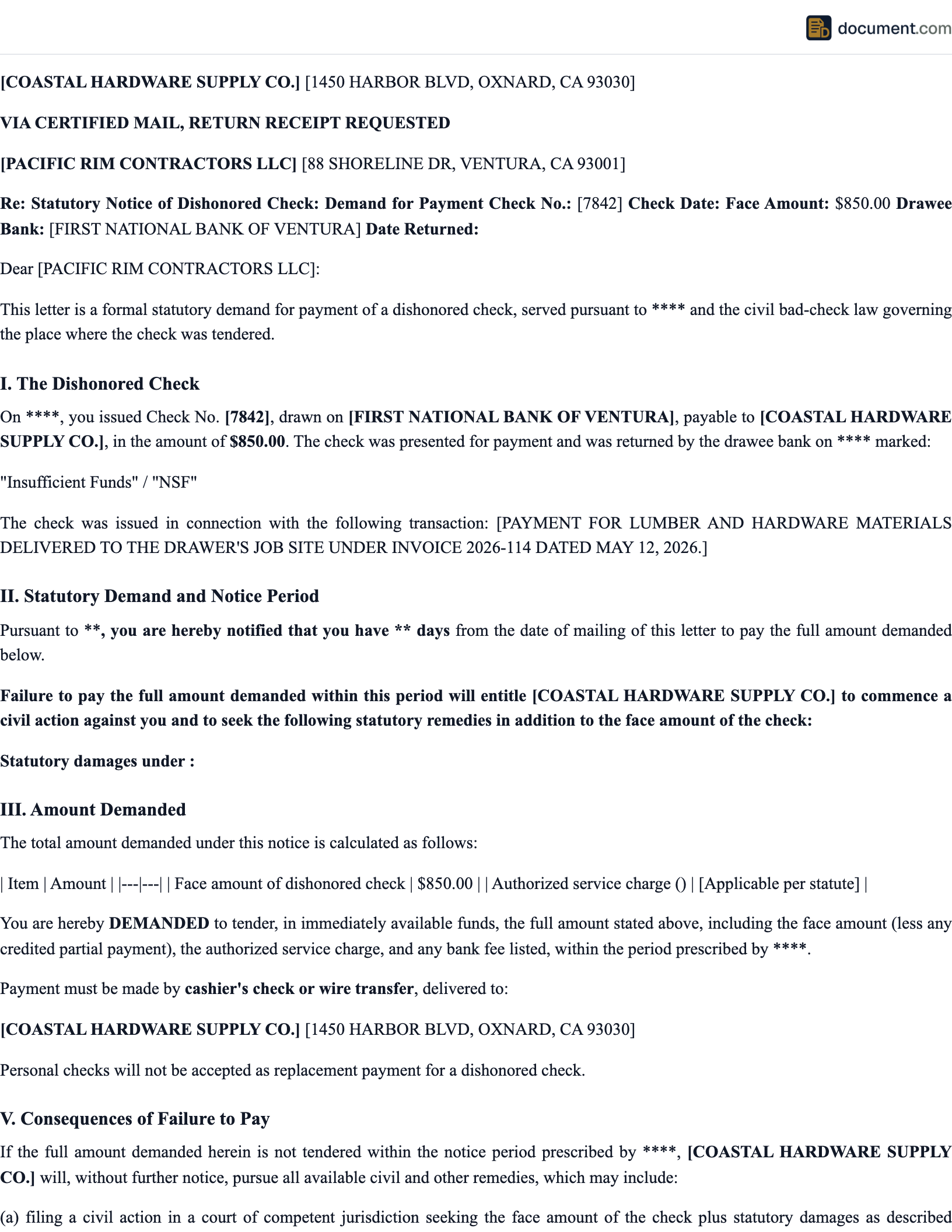



Wisconsin Notice of Dishonored Check Overview
Wisconsin gives holders of dishonored checks a powerful civil remedy under Wis. Stat. § 943.245, a provision located in the Crimes Against Property chapter of the statutes but operating as a purely civil cause of action. When a check is returned for insufficient funds, a closed account, or any other reason that makes it worthless, the payee can demand the face amount, actual damages, and exemplary damages on top of that -- all before ever setting foot in a courtroom -- simply by mailing a proper written notice.
The statute covers any person who incurs a pecuniary loss, including holders in due course. That means a business that accepted a check in the ordinary course, a landlord holding a returned rent or security deposit payment, or a contractor whose final payment bounced can all use this framework directly. The civil remedy runs parallel to the criminal statute at § 943.24; Wisconsin explicitly contemplates that the two tracks may proceed independently, and the legislature built in a specific carve-out protecting good-faith civil actions from criminal extortion liability under § 943.30.
What distinguishes Wisconsin from many states is the architecture of its damages formula. The exemplary damages multiplier is generous on paper -- up to three times the combined face value and actual damages -- but the statute then places a hard cap of $500 on the combined total of exemplary damages and attorney fees per violation. Understanding both numbers, the multiplier and the cap, is essential before deciding whether to pursue this remedy and how to frame the demand.
Face value + actual damages + exemplary damages up to 3x combined
Civil damages
20 days written notice before commencing action
Notice period
No separate statutory cap in civil section
Service charge
Wis. Stat. § 943.245
Controlling statute
The Controlling Statute: Wis. Stat. § 943.245
Wisconsin Statute § 943.245 creates a standalone civil cause of action for any person who suffers a pecuniary loss because an adult or emancipated minor issued a check knowing, or recklessly disregarding the fact, that the check was drawn on a nonexistent account, an account with insufficient funds, or was otherwise worthless. The statute cross-references § 943.24, which is the criminal worthless-check provision, but the civil claim under § 943.245 does not require a criminal conviction or even a criminal filing. The holder pursues it directly, in civil court, as a money claim.
Subsection (2) sets the damages structure. A prevailing holder recovers the face amount of the check plus any actual damages not already covered by the face amount. On top of that, the court may award exemplary damages -- the statute says 'not more than 3 times the amount' of the combined face value and actual damages. The exemplary damages are discretionary; the court 'may' award them, not 'shall.' That means the facts of the case, particularly the drawer's conduct and apparent intent, will influence whether the full multiplier is applied.
Subsection (3) then imposes the outer limit: the total of exemplary damages and reasonable attorney fees together cannot exceed $500 per violation, regardless of how large the check was or how much the treble calculation would otherwise produce. On a $5,000 check, the exemplary uplift is still capped at $500 minus whatever attorney fees are awarded. The practical effect is that § 943.245 functions as a potent remedy for smaller checks and a modest penalty supplement for larger ones.
Subsection (4) contains the procedural prerequisite: written notice sent at least 20 days before commencing the action. Subsection (9) creates one scenario where the civil path is closed: if the holder already requested that criminal prosecution be deferred under § 971.41 and the drawer has complied with the terms of that deferred prosecution agreement, the holder may not also bring the civil action. Wisconsin does not permit a holder to run both the criminal diversion track and the civil exemplary-damages track against the same check at the same time once a deferred prosecution has been invoked.
Statute Reference
Wis. Stat. § 943.245
Damages: Face value + actual damages + exemplary damages up to 3x combined; total exemplary damages and attorney fees capped at $500 per violation
What You Can Recover in Wisconsin
On a prevailing civil claim under § 943.245(2), a Wisconsin holder recovers three things. First, the face value of the dishonored check or checks at issue. Second, any actual damages the holder suffered that go beyond the face amount -- think bank returned-check fees, costs of re-presenting the check, or losses caused by the holder's own downstream obligations that the check was meant to satisfy. Third, exemplary damages at the court's discretion, up to three times the combined total of face value and actual damages.
The $500 per-violation cap on exemplary damages plus attorney fees under subsection (3) is the number that controls the practical upside. Consider a $300 check: face value is $300, say actual damages are $15 in bank fees, combined base is $315, and three times that is $945. The court may award exemplary damages up to $945 in theory, but the statute caps the total of exemplary damages and attorney fees at $500. If the court awards $350 in attorney fees, exemplary damages are limited to $150. The holder still walks away with $300 (face) + $15 (actual) + $150 (exemplary) + $350 (fees) = $815 on a $300 check -- a meaningful recovery for a small-claims filing.
For larger checks, the $500 ceiling becomes a fixed bonus rather than a multiplier. A holder of a $4,000 dishonored check recovers the $4,000 face amount, actual damages, and at most $500 combined in exemplary damages and fees. Wisconsin does not scale the cap to the size of the check. That is a deliberate legislative choice; the statute aims to deter small-check fraud while keeping the civil penalty predictable for both sides. Attorney fees within that $500 envelope are expressly authorized, so a holder who retains counsel can seek fee reimbursement as part of the recovery, subject to the shared cap.
- Civil damages: Face value + actual damages + exemplary damages up to 3x combined; total exemplary damages and attorney fees capped at $500 per violation
- Service charge: No separate statutory cap in civil section
- Notice period before suit: 20 days written notice before commencing action
Notice Procedure and Timeline in Wisconsin
Section 943.245(4) requires written notice sent to the drawer at least 20 days before the holder commences the civil action. The statute specifies regular mail to the drawer's last-known address or to the address appearing on the check, whichever is applicable. Wisconsin does not require certified mail under the civil statute itself, but sending the notice by certified mail with return receipt is sound practice: it produces documented proof of mailing that a court can examine if the drawer disputes receipt or timing.
Because the statute measures the 20-day window from the mailing of notice rather than from receipt, the holder should mail the notice on a date that, with 20 clear days added, lands before the intended filing date. If the notice is mailed on a Monday and the holder wants to file on the earliest permissible day, count 20 full calendar days forward from the mailing date. Do not file on day 20; file on day 21 or later. Ambiguity about when the clock started has caused courts in other jurisdictions to dismiss enhanced-damage claims on the same type of statutory prerequisite, and Wisconsin courts apply the notice requirement as a real condition, not a formality.
The written notice should state the date and amount of the check, the name of the drawee bank, the reason for dishonor, the total amount the holder demands, and clear reference to § 943.245 and the right to exemplary damages if payment is not made within 20 days. The notice does not need to use magic words, but it should put the drawer on actual notice of the civil consequences. Retain a copy of the notice and the mailing evidence -- the postal receipt, tracking confirmation, or any certificate of mailing -- because those will be the first exhibits at trial or in any motion practice.
Wisconsin-Specific Notes
Wisconsin's criminal bad-check statute, § 943.24, runs alongside the civil remedy and sets tiers the holder should understand. A single check of $2,500 or less issued with intent not to pay is a Class A misdemeanor. A single check over $2,500, or multiple checks within any 90-day period that together exceed $2,500, is a Class I felony. These thresholds are relevant to holders deciding whether to refer a check to the district attorney alongside or instead of pursuing the civil action. Under § 943.24, prima facie evidence of intent to defraud is established if the drawer lacked an account with the drawee bank, or had insufficient funds and failed to pay within five days of written notice.
Many Wisconsin counties operate worthless-check diversion programs through the district attorney's office. Under these programs, a drawer who has not yet been charged can enroll, pay restitution and a program fee, and complete the program in exchange for no criminal prosecution. The existence of a county DA diversion program affects the holder's strategy in two ways. First, the civil path under § 943.245 remains available unless the holder affirmatively requested the deferred prosecution under § 971.41 -- the mere existence of a county diversion program does not foreclose the civil action. Second, if the holder does refer the check to the DA and the drawer enters and completes the deferred prosecution agreement, subsection (9) closes the civil exemplary-damages door. Holders who want both restitution and the possibility of exemplary damages should pursue the civil notice track first, and only involve the DA's office after evaluating what the § 943.245 recovery will actually yield.
Wisconsin's small claims court ceiling is $10,000 for most civil actions, which means the vast majority of bad-check claims -- where the face value of the check, actual damages, and the $500 exemplary cap together sit well below that threshold -- can be filed in small claims court without an attorney. The streamlined process makes the civil bad-check notice genuinely practical for landlords, small retailers, and contractors. For a check in the $500 to $9,500 range, a holder with a clean certified-mail receipt, a copy of the notice, and the bank's dishonor document has all the exhibits needed to obtain a default or summary judgment in small claims.
Wisconsin Specific Note
Wisconsin does not appear to authorize a separate statutory service charge in the civil bad-check provision the way some other states do. The verified structure of § 943.245(2) covers face value, actual damages, and exemplary damages. Bank fees the holder actually incurred may be recoverable as actual damages, but holders should not demand a flat statutory service charge by citing § 943.245 the way they might under, say, California Civil Code § 1719(a)(1). If you intend to claim bank fees or administrative costs beyond the face amount, document them specifically and present them as actual damages. Demanding fees without a statutory basis is a quick way to undermine the credibility of the notice and the claim.
Wisconsin Bad Check FAQ
Other State Bad Check Laws
Each state sets its own notice period, damage formula, and service charge. Browse sibling state pages for the specific rules that apply to your situation, or return to the full 50-state guide.
Create your Wisconsin Notice of Dishonored Check in minutes.
Answer a few questions and download a Wisconsin-compliant bad check demand letter that cites Wis. Stat. § 943.245 and is ready to mail certified.