



Alaska Notice of Dishonored Check Overview
Alaska's civil bad-check statute, Alaska Stat. § 09.68.115, gives the holder of a returned check a straightforward path to damages well above the face amount of the instrument. The statute combines a relatively short notice window -- 15 days -- with a damages formula that can yield meaningful recovery even on modest checks. A payee who receives a dishonored check, sends the required written demand, and waits out the notice period without being made whole is entitled to pursue civil penalties in court without waiting for the criminal system to act.
The statute applies broadly across Alaska's dispersed geography and legal landscape. Whether the check was written in Anchorage, Fairbanks, Juneau, or a remote community served by a magistrate court, the civil remedy under § 09.68.115 is available in the same form. Alaska's district courts handle small claims up to $10,000, which covers the large majority of dishonored-check disputes that land in court. For check amounts that fall below that threshold, the holder can pursue the statutory penalty without an attorney, using the small claims procedure.
The civil remedy and the criminal statute are separate tracks that can run simultaneously. Alaska Stat. § 11.46.280 makes issuing a bad check a criminal offense, with the classification scaling from a class B misdemeanor for checks under $250 to a class C felony for checks of $750 or more. A payee who sends the civil demand letter is not foreclosing criminal prosecution; many holders pursue both, using the civil notice letter as documentation of the intent element the criminal statute requires. Understanding how the two tracks interact -- and where the civil statute's damage formula actually goes -- positions a payee to extract maximum recovery and, where warranted, refer the matter to the appropriate prosecuting authority.
$100 or 3x check amount, whichever is greater
Civil damages
15 days written demand before commencing action
Notice period
Up to $30
Service charge
Alaska Stat. § 09.68.115
Controlling statute
The Controlling Statute: Alaska Stat. § 09.68.115
Alaska Stat. § 09.68.115 is the controlling civil statute for dishonored checks in Alaska. It creates a cause of action that is separate from ordinary breach of contract: the holder does not have to prove that the drawer intended to defraud anyone. The statute requires only that the check was dishonored and that the holder sent the required written demand without receiving payment within the prescribed period. That structure makes the civil remedy accessible in straightforward NSF or closed-account situations without the holder having to build a fraud case.
The statute authorizes a damages award of $100 or three times the amount of the check, whichever is greater, subject to a cap. The cap limits total civil recovery to the amount of the check plus $1,000. That ceiling means the multiplier formula and the flat floor interact differently depending on check size. On small checks, the $100 floor protects the holder from a de minimis recovery; on larger checks, the 3x formula produces higher numbers until it hits the cap.
A service charge of up to $30 is authorized separately from the civil penalty. The service charge compensates the payee for the bank's returned-check fee and the administrative cost of the demand process, and it can be demanded in the same letter that triggers the notice period. The drawer who pays the full check amount plus the service charge within the 15-day window avoids the civil penalty; the holder's right to the penalty does not vest until the window closes without full payment.
The statute conditions the civil penalty on the holder having sent a written demand. The demand must give the drawer 15 days to pay before the holder may commence a civil action. That requirement is a genuine procedural gate: a holder who goes straight to court without sending the demand, or who files suit before the 15-day period expires, cannot collect the civil penalty and may face procedural dismissal of the enhanced-damage claim. The notice requirement is also the mechanism that establishes the drawer's opportunity to cure, which courts point to when they describe the statute's dual purpose of compensating payees and giving check writers a final chance to avoid litigation.
Statute Reference
Alaska Stat. § 09.68.115
Damages: $100 or 3x check amount, whichever is greater; cap: amount of check + $1,000
What You Can Recover in Alaska
The damages formula under § 09.68.115 works in two steps. First, compute three times the face amount of the check. Second, compare that figure to $100. The holder receives whichever is greater. On a $25 check, three times the amount is $75, which is less than $100, so the floor applies and the holder can recover $100. On a $50 check, 3x is $150, which exceeds the floor, so the holder recovers $150. On a $200 check, 3x is $600 -- and that is where the cap comes in.
The cap limits total civil recovery to the amount of the check plus $1,000. Working through the cap: a $200 check has a face amount of $200 and a cap ceiling of $1,200. Three times $200 is $600, which is below the cap, so the full treble amount is available. A $600 check has a cap ceiling of $1,600. Three times $600 is $1,800, which exceeds the cap, so the holder recovers $1,600. At a check amount of $500, 3x yields $1,500 and the cap is $1,500 -- they coincide exactly. For any check above $500, the cap is the binding constraint and the effective multiplier falls below three.
On top of the civil penalty, the holder may also recover the face amount of the check itself plus the up-to-$30 service charge. Those amounts are not part of the penalty formula; they are the underlying debt the drawer owes regardless. Combining the check amount, service charge, and civil penalty produces the holder's maximum recovery in a single action. Alaska's statute does not expressly authorize attorney fees for the civil bad-check claim the way some other states do, so fee recovery is generally limited to what the court may award under other applicable rules or where the underlying transaction gave rise to a contractual fee-shifting provision.
- Civil damages: $100 or 3x check amount, whichever is greater; cap: amount of check + $1,000
- Service charge: Up to $30
- Notice period before suit: 15 days written demand before commencing action
Notice Procedure and Timeline in Alaska
Before commencing a civil action under § 09.68.115, the holder must send a written demand and allow 15 days for the drawer to respond. The 15-day period is shorter than the 30-day window common in many other states, which means a payee in Alaska can move to litigation faster. The flip side is that the shorter window leaves less room for error: a demand that goes out even a day late relative to when you intended to file, or a filing that comes even a day before the window closes, can undermine the penalty claim. Count 15 calendar days from the date of mailing before filing any court action.
The written demand should be sent by certified mail, return receipt requested, to the address on the check or to the drawer's last known address. Certified mail with return receipt provides the documentary proof the holder will need at trial: the receipt establishes the date of mailing and the green card establishes receipt, starting the 15-day clock from that date. If the certified mailing is returned unclaimed, the fact that the notice was properly addressed and deposited is generally sufficient to satisfy the notice requirement, provided the holder can document the attempt. Consider sending a simultaneous copy by first-class mail to the same address, which creates a second evidentiary basis for the argument that the drawer had a reasonable opportunity to receive the demand.
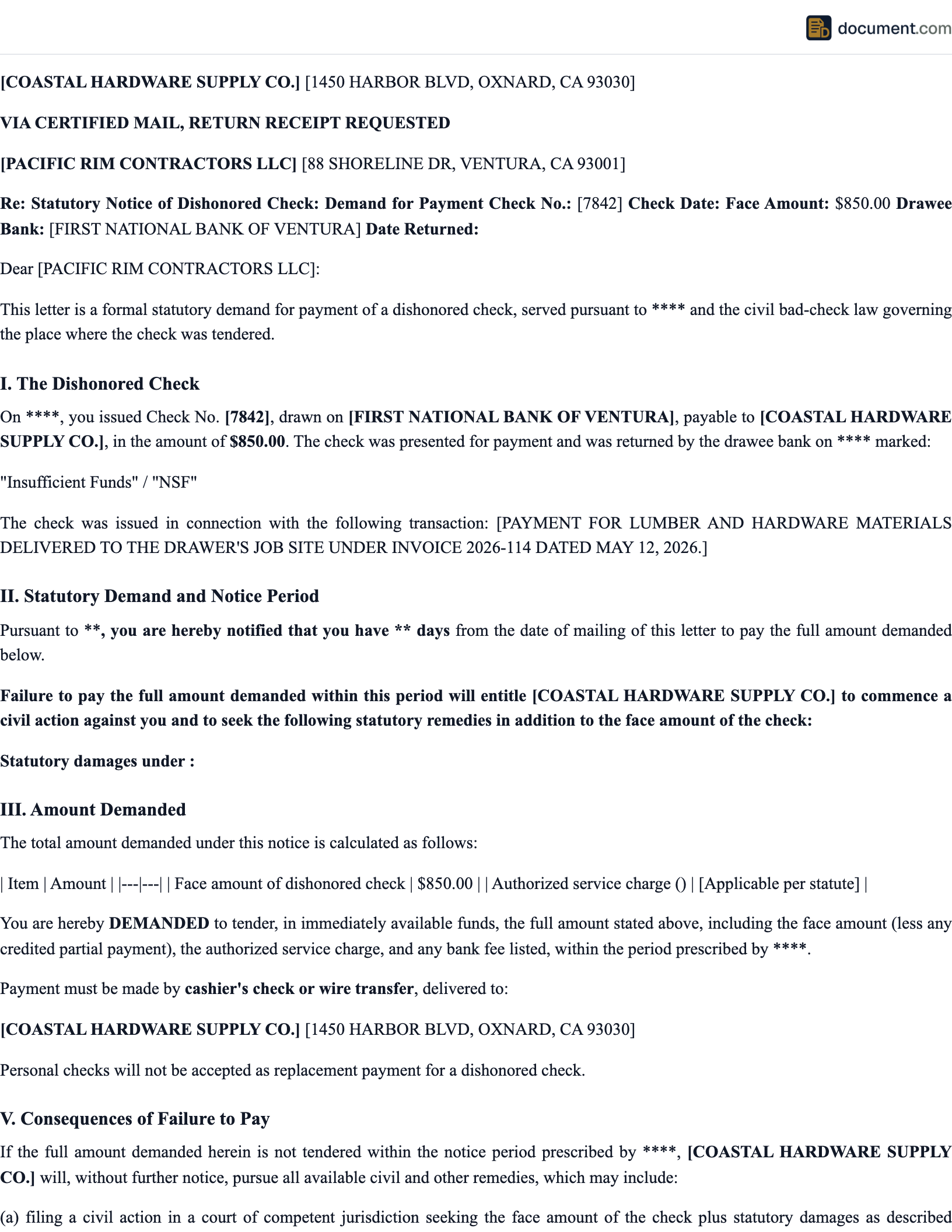
The demand letter itself should state the check amount, the date and number of the check, the name of the drawee bank, the reason for dishonor as shown on the bank's return notice, the service charge being claimed (if any), the total amount demanded, the 15-day deadline expressed as a specific calendar date, and a citation to Alaska Stat. § 09.68.115. Stating the deadline as a concrete date -- not just '15 days from mailing' -- removes any argument that the drawer miscalculated the window. Keep a copy of the letter, the certified mail receipt, the tracking confirmation, and the return card or notation showing delivery or non-delivery. These documents constitute the evidentiary core of the civil penalty claim if the matter proceeds to court.
Alaska-Specific Notes
Alaska's small claims ceiling is $10,000. That threshold covers most dishonored-check disputes filed under § 09.68.115. A holder whose total recovery -- check amount plus civil penalty plus service charge -- fits within $10,000 can file in Alaska District Court using the small claims procedure, without an attorney, at a filing fee well below the cost of formal civil litigation. The small claims track is procedurally accessible for individual payees and small businesses, and Alaska magistrate courts serving rural communities are available to hear these cases, which matters in a state where many residents are hours from the nearest staffed courthouse.
Alaska's criminal bad-check statute, AS § 11.46.280, runs on a separate track and uses dollar thresholds that interact with the civil remedy in a practical way. A check under $250 is a class B misdemeanor. A check of $250 or more but less than $750 is a class A misdemeanor. A check of $750 or more but less than $25,000 is a class C felony. A check of $25,000 or more carries higher classification still. These thresholds matter for the holder because the civil demand letter serves as documentation of the drawer's failure to make good on a returned instrument, which bears on the intent element under the criminal statute. Many prosecuting authorities look for evidence that the drawer had notice and an opportunity to pay before they will accept a bad-check complaint; the civil demand letter and the drawer's non-response provide exactly that record.
Alaska Specific Note
Alaska Stat. § 09.68.115 does not contain an express provision extending the civil bad-check remedy to dishonored ACH or electronic fund transfers the way California, Florida, and Illinois have amended their statutes to do. If the transaction giving rise to the dishonor was an ACH debit rather than a paper check, confirm with current statutory text or counsel whether the civil bad-check remedy applies, or whether your claim proceeds under a different theory -- breach of contract, unjust enrichment, or a consumer protection statute -- before sending a notice that cites § 09.68.115.
Alaska's geography creates a practical notice challenge that payees in smaller states rarely face. When the drawer's last known address is in a remote community without regular postal delivery, certified mail delivery and return-receipt timing can be slower and less predictable than in urban areas. Document your mailing carefully, retain all postal tracking records, and consider whether local service rules under the Alaska Rules of Civil Procedure affect how the notice period is calculated when you cannot confirm receipt. The core principle -- that the holder must give the drawer a fair opportunity to cure before filing suit -- is what courts examine when the mechanics of delivery are in dispute.
Alaska Bad Check FAQ
Other State Bad Check Laws
Each state sets its own notice period, damage formula, and service charge. Browse sibling state pages for the specific rules that apply to your situation, or return to the full 50-state guide.
Create your Alaska Notice of Dishonored Check in minutes.
Answer a few questions and download a Alaska-compliant bad check demand letter that cites Alaska Stat. § 09.68.115 and is ready to mail certified.