
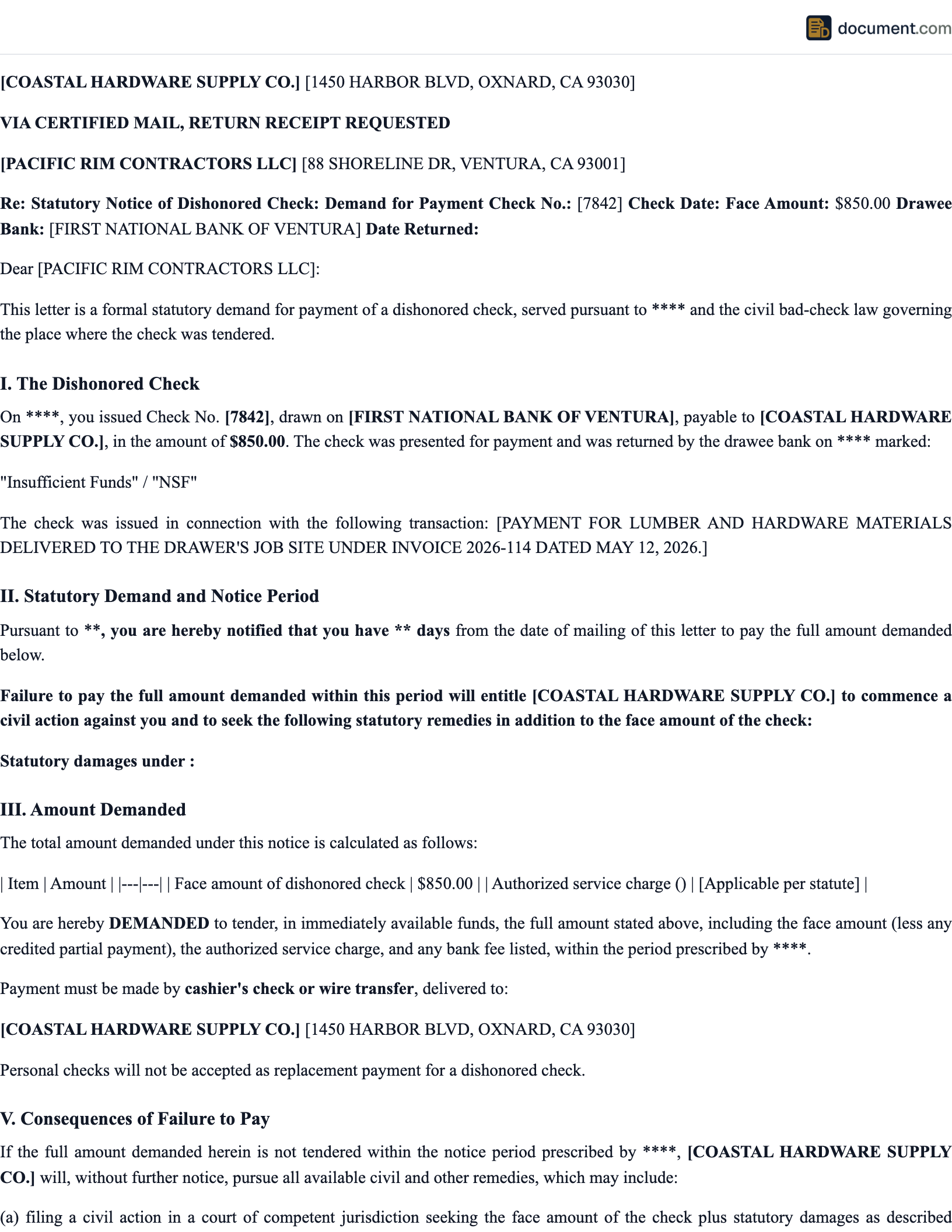



Colorado Notice of Dishonored Check Overview
Colorado gives payees a civil remedy that is sharper than most people expect. Under Colo. Rev. Stat. § 13-21-109, a holder who follows the notice procedure can recover three times the face amount of a dishonored check, with a statutory floor of $100 in enhanced damages, without waiting for a criminal conviction or referral. The civil and criminal tracks run independently, and most payees who want money rather than prosecution find the civil route faster and more certain.
The statute covers the full range of dishonor scenarios that Colorado businesses and individuals encounter: insufficient funds, closed accounts, and checks drawn on accounts that never existed. It applies to any person who obtains money, property, or services by means of a check the maker knew would not be honored at the time of tender. Both paper checks and, depending on how the transaction is documented, equivalent instruments fall within its scope.
Because the enhanced damages require the holder to give prior written notice and wait the full 15-day cure period, the notice letter is not optional paperwork. It is the trigger for the statutory remedy. A payee who skips the notice step and files suit immediately can still recover the face amount as a contract or UCC claim, but the treble-damage multiplier and the right to attorney fees under § 13-21-109 are conditioned on proper notice having been sent and the maker having failed to pay within the cure window.
3x face amount
Civil damages
15 days after notice before civil action
Notice period
Up to $20, plus bank fees
Service charge
Colo. Rev. Stat. § 13-21-109
Controlling statute
The Controlling Statute: Colo. Rev. Stat. § 13-21-109
Colo. Rev. Stat. § 13-21-109 is Colorado's civil bad-check statute. It creates a standalone civil cause of action, separate from the criminal fraud-by-check statute at C.R.S. § 18-5-205, for holders of dishonored checks who follow a specific notice procedure. The statute provides three alternative damage formulas, and the holder chooses the one that produces the best recovery on the facts.
Under subsection (1), the baseline option, the holder may recover the face amount of the check plus actual damages calculated under the Uniform Commercial Code's dishonored-instrument provisions. That track does not require any special notice and does not require a waiting period, but it produces no penalty beyond the check's value and any UCC consequential damages. It functions as an ordinary collection claim.
Subsection (1) also allows the holder to recover the face amount plus a service charge up to $20, plus bank fees actually incurred, or to assign the claim to a licensed collection agency and recover the face amount plus 20 percent of that amount as a collection fee, with a minimum collection charge of $20. These options are available before any litigation begins, through the demand-and-collect process.
Subsection (2) is where the civil bad-check remedy becomes significantly more powerful. If the holder sends proper written notice to the maker and the maker fails to pay within 15 days, the holder may bring a civil action and recover three times the face amount of the check, with a minimum enhanced award of $100. The treble-damage remedy is conditioned on a court judgment; it is not self-executing. The prevailing plaintiff may also recover court costs and attorney fees, which makes even modestly sized claims worth litigating when the notice was properly sent and the maker has ignored it.
Statute Reference
Colo. Rev. Stat. § 13-21-109
Damages: 3x face amount; not less than $100
What You Can Recover in Colorado
The core formula under § 13-21-109(2) awards three times the face amount of the dishonored check. On a $200 check, that means a potential judgment of $600. On a $500 check, $1,500. On a $2,000 check, $6,000. The statute does not cap the multiplied amount at a fixed dollar ceiling above the face value the way some other states do, so the treble calculation scales with the check's face amount. The $100 minimum means that even a very small check, one written for $25 or $30, generates at least $100 in civil damages if the maker fails to cure after proper notice.
On top of the treble damages, the holder can recover court costs and attorney fees if the civil action is successful. For payees who hire counsel, that provision can make the economics of litigation work on checks that might otherwise be too small to justify the expense. The right to fees is not automatic, and courts have discretion on amounts, but the statutory authorization exists and is regularly awarded in uncontested bad-check cases.
Colorado's statute also preserves actual damages under the UCC framework for situations where the check dishonor caused consequential losses beyond the face amount, such as a contractor who bounced a materials payment and caused a job delay. The holder is not limited to the treble-damage formula if actual damages exceed what the multiplier produces. The three formulas in § 13-21-109 are alternatives, and the holder picks the one that fits the circumstances, including going outside the statute for larger consequential losses under general contract or UCC theories.
- Civil damages: 3x face amount; not less than $100
- Service charge: Up to $20, plus bank fees
- Notice period before suit: 15 days after notice before civil action
Notice Procedure and Timeline in Colorado
The notice must be written and must be delivered to the maker by one of three methods: personal delivery, certified mail with return receipt requested, or regular first-class mail accompanied by a sworn affidavit of mailing. The third method, regular mail with affidavit, is broader than most states allow and gives Colorado payees an alternative when the maker refuses certified mail or is difficult to locate. Whichever method is used, the affidavit or certified mail receipt becomes a critical exhibit if the case reaches court.
The notice itself must contain specific information: the date of the check, the name of the financial institution on which it was drawn, the name of the payee, the face amount of the check, and an itemized statement of the total amount demanded including any service charge and fees. It must also expressly warn the maker that civil liability of three times the face amount may be imposed if the check is not paid. Omitting the treble-damage warning is the most common defect that defeats the enhanced-damages claim, because the statute treats that language as a condition precedent to the civil penalty.
The cure window is 15 days from the date the maker receives the notice, or from the date of mailing if regular mail with affidavit is used. Count calendar days, not business days, and do not file suit until the 15th day has passed with no payment. When the notice is sent by certified mail, the 15-day window typically runs from the date of delivery shown on the return receipt, not the mailing date. Set the payment deadline as a specific calendar date in the letter itself rather than stating '15 days from receipt'; a definite date removes any dispute about when the window closed and demonstrates that you calculated the period correctly.
Colorado-Specific Notes
Colorado's criminal bad-check statute, C.R.S. § 18-5-205, runs on a parallel track and uses separate amount thresholds. A check under $300 is a petty offense; $300 to $999 is a class 2 misdemeanor; $1,000 to $1,999 is a class 1 misdemeanor; $2,000 to $4,999 is a class 6 felony; and $5,000 or more is a class 5 felony. A check drawn on an account that was closed for 30 or more days before the check was written is also charged as a class 6 felony regardless of amount, because the legislature treats that scenario as strong evidence of intentional fraud. Multiple checks written within a 60-day period can have their amounts aggregated for threshold purposes, which means a series of small checks can combine into a felony charge. These criminal thresholds matter for civil practitioners because district attorney diversion programs in Colorado typically screen referrals based on these classifications.
The 18th Judicial District Attorney's Office, which covers Arapahoe, Douglas, Elbert, and Lincoln Counties, operates a Bad Check Restitution Program. Other Colorado judicial districts handle bad-check referrals through their general diversion and consumer-protection functions. These programs are significant for payees because many DA's offices will not accept a check for criminal prosecution until the payee has already sent a civil demand and the maker has failed to respond. The civil notice letter sent under § 13-21-109 documents that prerequisite. Sending the statutory notice first preserves both the civil remedy and the option of criminal referral; skipping it can close the criminal referral door even if the check amount is large enough to qualify.
Colorado Specific Note
Colorado's statute provides defenses that the maker can raise to defeat the treble-damage claim even after the notice period runs. The maker avoids enhanced liability by proving that sufficient funds existed in the account at the time the check was presented, that the check was for a paycheck drawn on a legitimate business account that was dishonored because a deposited paycheck failed, that the funds were garnished or attached without notice to the maker, that the maker lacked legal capacity at the time of signing, or that the check was obtained through fraud or duress. These defenses shift the burden to the maker to produce evidence, but they are real procedural tools that defendants raise in contested cases. A payee who has clear bank records showing the account had insufficient funds at the time of presentment is in the strongest position.
Colorado's small-claims court ceiling is $7,500 under C.R.S. § 13-6-403. Because the treble-damage formula scales with the check's face amount, a check larger than approximately $2,500 will produce a treble-damage claim above the small-claims ceiling, requiring the holder to file in county court rather than the more informal small-claims division. A $2,500 check yields $7,500 in enhanced damages, which sits exactly at the threshold. Payees with checks in the $1,000 to $2,500 range will typically keep their § 13-21-109 claim within small-claims jurisdiction while still generating a meaningful penalty over the face amount.
Colorado Bad Check FAQ
Other State Bad Check Laws
Each state sets its own notice period, damage formula, and service charge. Browse sibling state pages for the specific rules that apply to your situation, or return to the full 50-state guide.
Create your Colorado Notice of Dishonored Check in minutes.
Answer a few questions and download a Colorado-compliant bad check demand letter that cites Colo. Rev. Stat. § 13-21-109 and is ready to mail certified.