
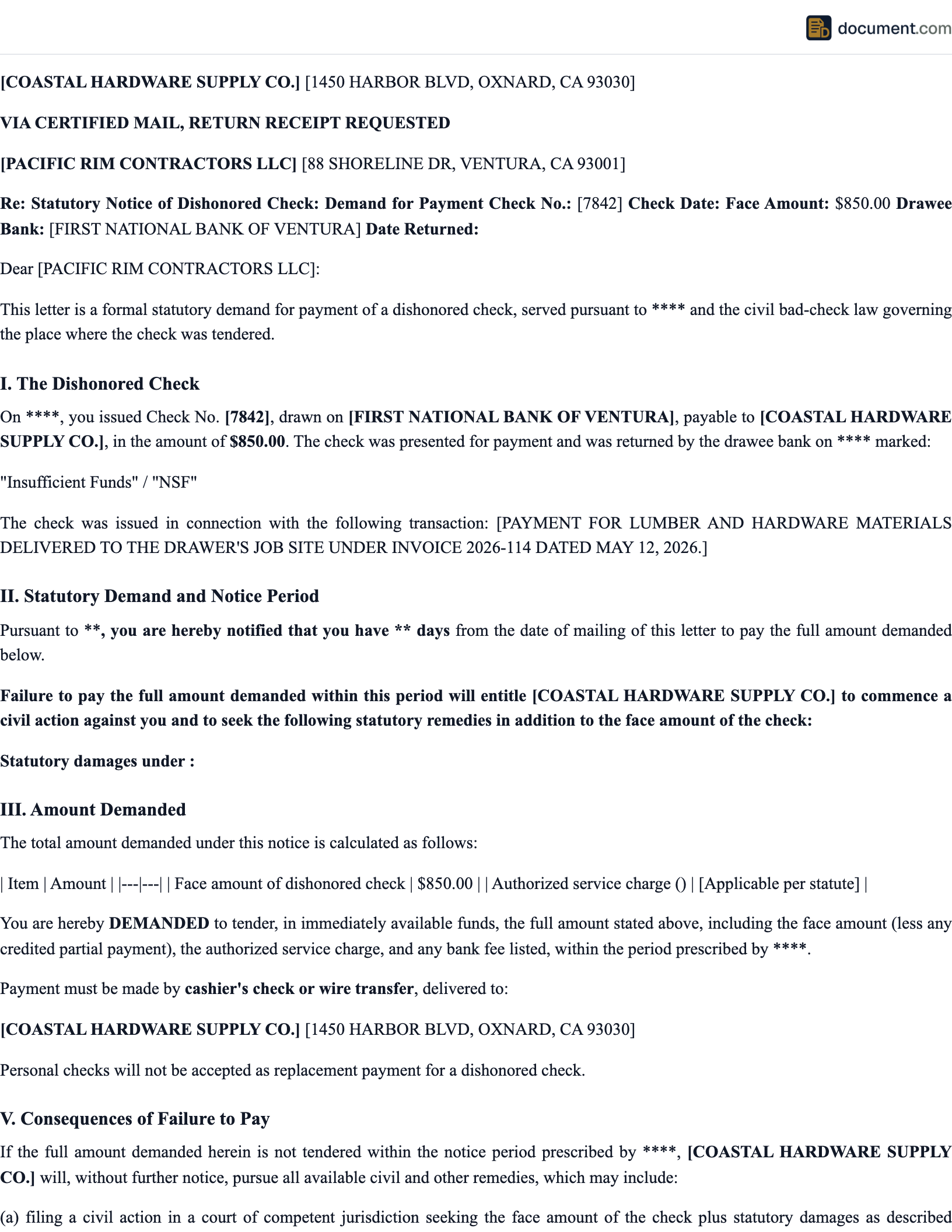



Delaware Notice of Dishonored Check Overview
Delaware gives the holder of a dishonored check a direct civil remedy that goes well beyond recovering the face amount. Under Del. Code Ann. tit. 6, § 1301A, a payee who sends the required written demand and waits the prescribed 30-day cure period can sue for three times the check amount if the drawer does not make good. The statute sets a floor of $100 and a ceiling of $500 above the check face on that penalty, plus a separate service charge of up to $40. For most small to mid-size returned checks, those numbers add up quickly and make the civil route worth pursuing.
The statute sits in Title 6 of the Delaware Code, the commercial law title, not the criminal title, which is an important distinction. A civil bad check action under § 1301A is a private remedy between the payee and the drawer. The holder sues in the Justice of the Peace Court, which handles claims up to $25,000 and is the natural forum for most dishonored check cases. Delaware's $25,000 small claims ceiling is among the highest in the country, meaning even a significant check can be pursued without leaving the simplified Justice of the Peace process.
Because the notice period and the damages formula are set by statute, the payee who follows the procedure correctly has a largely mechanical claim. The drawer either paid within 30 days or did not. Where the check was for $500 or more, the $500-above-face cap on the civil penalty is the binding limit regardless of what three times the check amount would otherwise equal. For smaller checks, the $100 floor ensures that pursuing a $50 returned check still yields a meaningful civil recovery on top of the face amount.
3x check amount, not less than $100 nor more than $500 above check amount
Civil damages
30 days after written demand
Notice period
Up to $40
Service charge
Del. Code Ann. tit. 6, § 1301A
Controlling statute
The Controlling Statute: Del. Code Ann. tit. 6, § 1301A
Del. Code Ann. tit. 6, § 1301A creates a civil cause of action for the holder of a check that is dishonored by the drawee bank. The statute applies when a check is returned because the drawer had insufficient funds, had no account at the drawee bank, or had closed the account. The holder must first send a written demand to the drawer and allow 30 days for the drawer to pay before filing suit. If the drawer fails to pay within that period, the holder may bring a civil action and recover both the amount of the check and the statutory penalty described below.
The damages formula under § 1301A works in two layers. The base recovery is the face amount of the dishonored check. On top of that, the holder is entitled to three times the check amount as a civil penalty, but that multiplier is bounded at both ends. The penalty may not be less than $100 regardless of what three times the check amount would produce, and it may not exceed the check amount by more than $500. In practical terms, the statute guarantees a minimum penalty enhancement of $100 even for very small checks, while it caps the enhancement at $500 no matter how large the check is.
In addition to the face amount and the civil penalty, § 1301A authorizes the holder to collect a service charge of up to $40. That charge is separate from the civil penalty and compensates the payee for the cost of the return. The service charge can be demanded in the notice letter itself, and a drawer who pays the face amount plus the service charge within the 30-day notice period avoids the civil penalty entirely.
The statute does not prescribe the exact words the written demand must contain, but the demand must be sufficient to put the drawer on notice that a check was dishonored and that civil penalties will follow if payment is not made within 30 days. The safer practice is to cite § 1301A by name, state the check amount and the reason for dishonor, state the total amount demanded including the service charge, and specify the calendar date on which the 30-day period expires.
Statute Reference
Del. Code Ann. tit. 6, § 1301A
Damages: 3x check amount, not less than $100 nor more than $500 above check amount
What You Can Recover in Delaware
For a check of $500 or more, the civil penalty under § 1301A will almost always be the maximum allowed: $500 above the face amount. Three times $500 is $1,500, and three times any larger check amount produces a larger multiplier result, but the statute caps the enhancement at $500 over face regardless. On a $1,000 returned check, the total civil recovery is $1,000 (face) plus $500 (maximum penalty) plus up to $40 (service charge), for a ceiling of $1,540 before any court costs.
For checks below $34, the $100 floor on the penalty matters more than the multiplier. Three times $30, for example, is $90, which falls below the floor. The statute brings the penalty up to $100, so the holder recovers $30 (face) plus $100 (minimum penalty) plus up to $40 (service charge), totaling up to $170. That floor makes it economically viable to pursue even small returned checks through the Justice of the Peace Court, where filing fees start at $35 for claims under $5,000.
The sweet spot where the three-times multiplier is most visible is the range between $34 and $167. On a $100 check, three times $100 is $300, which is above the $100 floor and below the $500 ceiling. The holder recovers $100 (face) plus $300 (penalty) plus up to $40 (service charge), for up to $440. On a $167 check, three times $167 is $501, which just clears the $500 ceiling, so the cap kicks in and the maximum penalty enhancement is $500 whether the check is $167 or $10,000.
- Civil damages: 3x check amount, not less than $100 nor more than $500 above check amount
- Service charge: Up to $40
- Notice period before suit: 30 days after written demand
Notice Procedure and Timeline in Delaware
The written demand triggers the 30-day cure period. Delaware's § 1301A requires that the demand be delivered or sent to the drawer before the civil action can be filed. Most holders send the notice by certified mail, return receipt requested, addressed to the address printed on the check or the drawer's last known address. Retain the certified mail receipt and the tracking confirmation. If the envelope comes back unclaimed, keep it; the fact that you properly addressed and sent the notice is what matters, not whether the drawer actually retrieved it.
Calculate the deadline as a fixed calendar date and state it in the letter. If you mail the notice on June 10, write that payment must be received on or before July 10. Leaving the deadline as a floating 30-days-from-mailing invitation to dispute when the clock started is avoidable. Courts measure the period from the date of mailing or delivery, so precision in the notice itself removes that argument.
The demand should state the check number, the date on the check, the face amount, the drawee bank, the reason for dishonor as reported by the bank, the service charge you are claiming (up to $40), the total amount you are demanding, and the citation to Del. Code Ann. tit. 6, § 1301A. Stating the statute by section puts the drawer on notice of the legal consequence of non-payment, and it establishes for the court that the notice was sent with the civil remedy in mind. Keep a copy of the demand letter with your certified mail documentation. Those two items are the core exhibits in a Justice of the Peace Court bad check case.
Delaware-Specific Notes
Delaware also has a criminal bad check statute at Del. Code Ann. tit. 11, § 900. Issuing a bad check is a class A misdemeanor when the check amount is below $1,500, and it becomes a class G felony when the check is $1,500 or more. The criminal provision requires that the drawer knew the check would not be honored at the time it was issued, and it creates a rebuttable presumption of that knowledge when the bank refuses payment for insufficient funds and the drawer does not make the check good within 10 days of receiving notice of dishonor. The civil and criminal tracks are independent; a payee can pursue both simultaneously, and many district attorneys will expect to see evidence of a prior written civil demand before accepting a check for prosecution.
Delaware's Justice of the Peace Court handles civil claims up to $25,000, which means most dishonored check cases, including those involving the maximum civil penalty, can be filed in small claims without needing to engage the Court of Common Pleas. The filing fee is $35 for claims under $5,000, $70 for claims between $5,001 and $15,000, and $95 for claims between $15,001 and $25,000. Venue lies in the Justice of the Peace district covering the defendant's residence or the location where the obligation arose, which is usually the place where the check was tendered.
Delaware Specific Note
The $500-above-face ceiling on the civil penalty means that for any check over $167, the three-times multiplier is effectively irrelevant to the size of your penalty recovery. The statute caps the enhancement at $500 regardless of check size. Payees who expect to recover three times a large check amount under § 1301A are reading the statute incorrectly. The face amount of the check is always fully recoverable; only the penalty enhancement is capped.
Delaware has not amended § 1301A to expressly cover dishonored ACH electronic debits the way California and Florida have amended their statutes. A payee pursuing a returned ACH transaction in Delaware should not assume that the § 1301A civil bad check procedure applies. The safer path for a dishonored electronic transfer in Delaware is a contract or account stated claim, unless and until the legislature extends the statute's coverage to electronic fund transfers.
Delaware Bad Check FAQ
Other State Bad Check Laws
Each state sets its own notice period, damage formula, and service charge. Browse sibling state pages for the specific rules that apply to your situation, or return to the full 50-state guide.
Create your Delaware Notice of Dishonored Check in minutes.
Answer a few questions and download a Delaware-compliant bad check demand letter that cites Del. Code Ann. tit. 6, § 1301A and is ready to mail certified.