
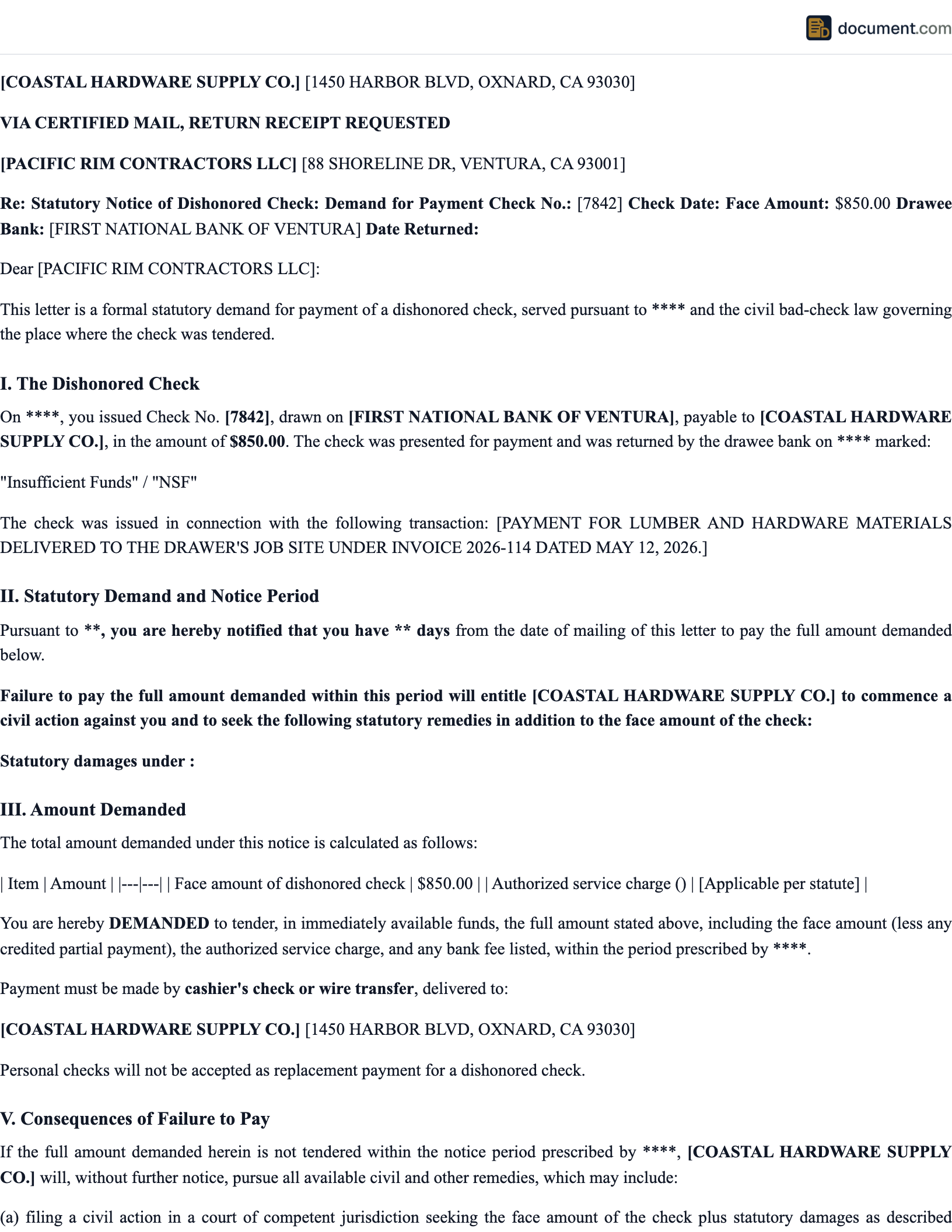



Hawaii Notice of Dishonored Check Overview
Hawaii gives payees a powerful civil remedy for dishonored checks, but it is conditioned entirely on sending the right demand letter before filing suit. Under Haw. Rev. Stat. § 490:3-506, a holder who receives a returned check must first mail a written demand by certified mail and then wait 10 days. If the drawer does not make full payment within that window, the holder may pursue three times the check amount in civil court, along with incurred costs and attorney fees. No other step triggers that multiplier.
The 10-day notice period is among the shortest in the country, which is an advantage for Hawaii payees. While most states require 30 days of waiting, Hawaii's framework lets a creditor move to court in under two weeks from the date of mailing. That compressed timeline makes the civil bad-check remedy particularly useful for small businesses, landlords, and contractors who need to collect quickly without the delays of a full contract claim.
Hawaii's statute does not distinguish between an NSF return and a closed-account return for purposes of the civil remedy. Both categories trigger the same 10-day notice requirement and the same three-times multiplier. What matters is the fact of dishonor, not its cause. The holder should obtain the bank's written return notice before drafting the demand, both to confirm the reason for dishonor and to establish the date from which any limitations clock runs.
3x check amount
Civil damages
10 days after certified mail demand
Notice period
$25 for first check; $35 for subsequent checks
Service charge
Haw. Rev. Stat. § 490:3-506
Controlling statute
The Controlling Statute: Haw. Rev. Stat. § 490:3-506
Haw. Rev. Stat. § 490:3-506 sits within Hawaii's codification of Uniform Commercial Code Article 3, which governs negotiable instruments including checks. The statute creates a civil cause of action that is entirely separate from the criminal provision at HRS § 708-857. The civil remedy is a private action between the holder and the drawer; it does not involve the prosecutor's office and does not depend on a criminal charge being filed or sustained.
The structure of the statute is straightforward: once a check is dishonored, the holder is entitled to recover the check amount, a service charge ($25 for the first dishonored check from a particular drawer, $35 for any subsequent check from that same drawer), and, if the holder sends the required written demand and the drawer fails to pay within 10 days, triple damages calculated on the check amount, plus any incurred costs and attorney fees. The statute does not cap the triple-damage award at an absolute dollar figure, which distinguishes Hawaii from states like California that limit the enhancement to a fixed amount above the check face.
The 10-day clock under § 490:3-506 runs from the date the drawer actually receives the certified mail demand, not from the date of mailing. This is a meaningful distinction. If the certified mail sits at the post office for three days before pickup, those three days do not count toward the drawer's 10-day cure period. Holders should account for this when calculating the earliest date they can file suit. Sending the demand promptly after dishonor, rather than weeks later, also reduces the window in which a drawer might claim they never received adequate time to respond.
Nothing in the statute limits its application to consumers. A business that issues a check that is returned NSF faces the same civil exposure as an individual drawer. Likewise, the holder need not be the original payee; an assignee or successor in interest who holds the instrument at the time of dishonor can send the statutory notice and pursue the civil remedy, provided the assignment is properly documented.
Statute Reference
Haw. Rev. Stat. § 490:3-506
Damages: 3x check amount; plus incurred costs and attorney fees
What You Can Recover in Hawaii
Hawaii's civil bad-check remedy has three components. First, the face amount of the check itself -- whatever the instrument was written for. Second, the service charge: $25 for the first returned check from a given drawer, rising to $35 for any subsequent returned check from the same person or entity. The service charge can be demanded in the notice letter and collected before litigation begins; a drawer who pays in full during the 10-day window pays the face amount plus the service charge and avoids the triple-damage penalty entirely. Third, once the 10-day period expires without full payment, the holder becomes entitled to triple the check amount, plus incurred costs and attorney fees.
The triple-damage multiplier applies to the check amount, not just the unpaid balance. This is worth understanding concretely. On a $1,000 returned check, the potential civil recovery is $3,000 in treble damages, plus the $25 or $35 service charge, plus whatever court costs and attorney fees the holder incurred. On a $500 check, the treble-damage component alone is $1,500. Unlike several other states, Hawaii's statute does not cap that enhancement at $500 or any other ceiling above the face amount, so the multiplier scales with the check value.
Attorney fees are explicitly recoverable under § 490:3-506 when the drawer fails to pay within the 10-day window. This makes the civil remedy meaningfully different from a straight contract claim, where each side typically bears its own legal costs. For holders with larger checks, the attorney-fee provision makes it economically rational to retain counsel, because a successful judgment carries fees as part of the award. For smaller checks in the $500 to $2,000 range, the Hawaii small-claims court ceiling of $5,000 is generally sufficient to capture treble damages plus costs without needing an attorney at all.
- Civil damages: 3x check amount; plus incurred costs and attorney fees
- Service charge: $25 for first check; $35 for subsequent checks
- Notice period before suit: 10 days after certified mail demand
Notice Procedure and Timeline in Hawaii
The demand must be sent by certified mail. Ordinary first-class mail does not satisfy § 490:3-506's notice requirement, and a notice sent by email or text has no statutory basis unless the drawer separately agrees to electronic service. Address the mailing to the address printed on the check or, if different, to the drawer's last known address. If you have reason to believe the address on the check is outdated, use whatever current address you can verify -- a more recent invoice, a lease, or a business registration record. Mailing to a stale address is not automatically fatal, but it creates a factual dispute about whether the drawer actually received the notice.
The 10-day cure period runs from actual receipt. Keep the certified mail tracking record and any return receipt card. If the letter is returned unclaimed or refused, you face a more complicated fact pattern: the statute conditions the triple-damage remedy on the drawer's failure to pay within 10 days after receiving the notice, and an unclaimed letter creates an argument that receipt never occurred. Some holders respond to this risk by also sending a simultaneous first-class copy, which is not required by the Hawaii statute but creates evidence that the drawer had a reasonable opportunity to learn of the demand. Retaining that first-class mailing receipt alongside the certified mail record strengthens the case if the certified piece comes back.
Set out the payment deadline as a specific calendar date, not just a count of days. The notice should read, for example: 'You have 10 days from the date of your receipt of this letter to pay the full amount demanded. If you received this letter on [assumed receipt date], payment is due by [specific date].' Spell out the total amount demanded -- check face amount, service charge, and any bank fee you are authorized to recover -- in a single sum, and explain the arithmetic. A demand that leaves the drawer to calculate what 'the check plus fees' means has generated disputes in other jurisdictions about what amount, if paid, would actually satisfy the demand.
Hawaii-Specific Notes
Hawaii's criminal bad-check statute, HRS § 708-857, covers the offense of negotiating a worthless negotiable instrument. The crime is a misdemeanor regardless of the dollar amount of the check -- Hawaii does not scale the criminal grade by check value the way it scales theft offenses. Under the statute, prima facie evidence that the drawer knew the instrument would not be honored arises when: (a) the drawer had no account with the drawee at the time the check was issued, or (b) the drawee refused payment for lack of funds on presentation within 30 days of issue and the drawer then failed to make good within 10 days of actual receipt of a dishonor notice. That 10-day cure window in the criminal statute mirrors the civil notice period, which is not a coincidence -- the legislature tied both to the same remedial framework. A drawer who cures within 10 days of the dishonor notice avoids both the civil triple-damage penalty and the prima facie evidence of criminal intent.
Hawaii's small-claims division of the District Court handles civil money claims up to $5,000. Because Hawaii's triple-damage formula is uncapped, a larger check can produce a civil recovery well above $5,000, which would need to be pursued in the regular civil division rather than small claims. For example, a returned check for $2,000 generates a potential treble-damage claim of $6,000 before costs and fees -- already above the small-claims ceiling. Holders with checks in that range should decide early whether to limit their claim to $5,000 (to stay in small claims and avoid attorney involvement) or file in the regular division and pursue the full statutory award with counsel.
Hawaii Specific Note
Hawaii's statute explicitly requires that the 10-day period run from the drawer's actual receipt of the notice, not from the date of mailing. A holder who mails the notice and files suit before 10 days have elapsed from confirmed receipt -- not mailing -- risks having the triple-damage claim dismissed on procedural grounds. If you cannot confirm the delivery date from the tracking record, add a reasonable buffer before filing.
Hawaii does not currently publish a statewide district attorney bad-check diversion program list, and the availability of prosecutorial diversion programs varies by county. Holders interested in referring a check for potential criminal prosecution should contact the prosecutor's office for the county where the check was presented (Honolulu, Maui, Hawaii, or Kauai County). Most prosecutorial offices will want evidence that a civil demand was sent and ignored before they will accept a check for review, so sending the § 490:3-506 notice is a practical prerequisite for a criminal referral regardless of whether a formal diversion program exists in that county.
Hawaii Bad Check FAQ
Other State Bad Check Laws
Each state sets its own notice period, damage formula, and service charge. Browse sibling state pages for the specific rules that apply to your situation, or return to the full 50-state guide.
Create your Hawaii Notice of Dishonored Check in minutes.
Answer a few questions and download a Hawaii-compliant bad check demand letter that cites Haw. Rev. Stat. § 490:3-506 and is ready to mail certified.