
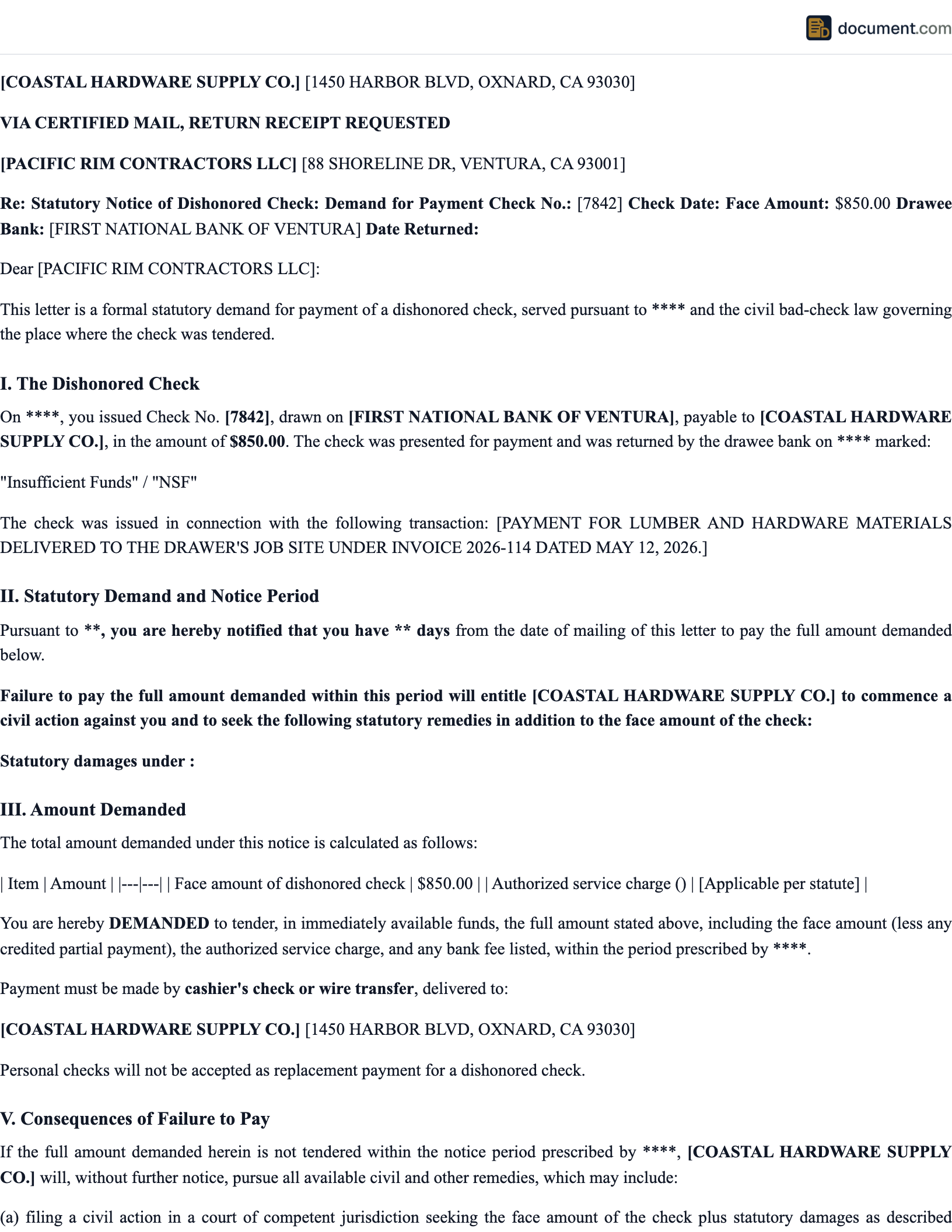



Idaho Notice of Dishonored Check Overview
Idaho treats dishonored checks as both a civil and a criminal matter, but the civil track under Idaho Code § 28-22-105 is the faster and more direct remedy for most payees. When a check is returned for insufficient funds or a closed account, the holder can send a statutory notice, wait fifteen days, and then file suit for the check amount plus interest at twelve percent per year, a service charge, and reasonable attorney's fees set by the court. That combination makes the civil remedy worth pursuing even on relatively small checks.
The statute sits in Title 28, Chapter 22, which governs money of account and interest. It is a focused provision: it does not create treble damages or a punitive multiplier, but it does shift the cost of litigation to the drawer once the notice period runs without payment. A holder who sends the notice, waits the full fifteen days, and files suit is entitled to attorney's fees as a matter of law, not as a matter of judicial discretion. That fee-shifting rule is one of the stronger incentives in Idaho's civil bad-check framework.
Idaho's criminal bad-check statute, Idaho Code § 18-3106, runs on a separate track. A check under $250 is a misdemeanor on first offense; a check of $250 or more, or a series of checks totaling $250 or more, is a felony regardless of prior record. Many holders use the civil notice as the first step even when criminal referral is the eventual goal, because district attorney offices generally want documented evidence that the holder made a written demand and the check writer failed to respond.
3x check amount
Civil damages
10 days after written demand (15 days to avoid liability for costs)
Notice period
Up to $20, or face amount if less
Service charge
Idaho Code § 28-22-105
Controlling statute
The Controlling Statute: Idaho Code § 28-22-105
Idaho Code § 28-22-105 covers any check, as defined in § 28-3-104, that has been dishonored by nonacceptance or nonpayment and has not been paid within fifteen days after the holder sends the required notice under § 28-22-106. Once those conditions are satisfied, the drawer becomes liable for three things in addition to the face amount of the check: interest at twelve percent per annum from the date of dishonor, a collection cost not to exceed twenty dollars or the face amount of the check (whichever is less), and, if suit is filed, reasonable attorney's fees awarded by the court.
The statute expressly excludes checks dishonored by reason of a justifiable stop-payment order. If the drawer stopped payment because of a legitimate dispute over the underlying goods or services, § 28-22-105 does not apply. A stop-payment check that is not covered by a good-faith dispute does fall within the civil remedy, but the holder should be prepared to address the stop-payment issue before demanding the statutory fees.
Section 28-22-106 is the companion provision that governs the form and delivery of the notice itself. It prescribes the specific language the notice must contain, the mailing methods the holder may use, and the timeline from which the fifteen-day window is measured. The two sections work together: § 28-22-105 sets the remedy, and § 28-22-106 sets the procedural prerequisites for reaching it.
Idaho also limits the availability of attorney's fees in small claims proceedings. Under Idaho Code § 1-2301A, collection agencies cannot recover attorney's fees in small claims court. Individual holders and the original payee are not subject to that restriction in the same way, but any claimant expecting to recover fees should confirm the procedural rules of the court where they plan to file.
Statute Reference
Idaho Code § 28-22-105
Damages: 3x check amount; cap: check amount + $500; plus 12% annual interest
What You Can Recover in Idaho
Idaho does not use a treble-damages multiplier. The civil remedy under § 28-22-105 has three components on top of the face amount: interest accruing at twelve percent per year from the date of dishonor, a collection cost capped at twenty dollars (or the face value of the check if the check is worth less than twenty dollars), and court-awarded attorney's fees once the fifteen-day notice period has expired without payment and suit has been filed. On a $500 check dishonored on June 1 and paid eight months later after a court judgment, twelve percent annual interest adds sixty dollars to the recovery. The attorney's fee award, set by the court based on the work performed, often exceeds the interest component on small to mid-sized checks.
The service charge of up to twenty dollars can be demanded in the notice letter itself, before any lawsuit is filed. A drawer who tenders the face amount plus the service charge within the fifteen-day window avoids the attorney's fee exposure entirely. The service charge is not optional on the holder's part: it should be itemized in the notice and included in the demand total so there is no dispute about whether it was properly claimed.
Unlike some states, Idaho does not cap attorney's fees at a flat dollar ceiling. The court sets fees based on what is reasonable given the work required, which means a contested collection on a larger check can produce a meaningful fee award. Holders who retain counsel for a straightforward small-claims-eligible case should weigh the cost of representation against the likely fee recovery, since small claims proceedings in Idaho are capped at $5,000 and are designed to be handled without an attorney.
- Civil damages: 3x check amount; cap: check amount + $500; plus 12% annual interest
- Service charge: Up to $20, or face amount if less
- Notice period before suit: 10 days after written demand (15 days to avoid liability for costs)
Notice Procedure and Timeline in Idaho
Idaho Code § 28-22-106 prescribes the form and method of the notice. The holder may send it by certified mail to the drawer's last known address, or by regular mail accompanied by a sworn affidavit of service documenting the mailing. When regular mail is used, the notice becomes conclusive three days after the affidavit is executed. The address printed on the check itself constitutes the drawer's acknowledgment that it is the correct address for correspondence about the check, so mailing to that address is proper service even if the drawer has since moved.
The required content of the notice is specific. The notice must identify the check by amount, date, check number, payee, and drawee bank. It must warn the drawer that unless payment is made within fifteen days after the date the letter is postmarked, the holder may seek the additional costs authorized by § 28-22-105, including twelve percent annual interest from the date of dishonor and reasonable attorney's fees to be set by the court. The statute provides the actual language that must be used substantially verbatim. A notice that omits the required language or understates the potential consequences may not satisfy the statutory prerequisite, which would leave the holder with only the face amount of the check and no fee recovery.
The fifteen-day clock runs from the postmark date of the notice, not from actual receipt. Count the days carefully and do not file suit until the full fifteen-day period has run. If the drawer mails payment during that window and it arrives after you have filed, the court will take the timing into account. Retain the certified mail receipt or the affidavit of regular mail, the tracking confirmation, and a copy of the notice exactly as sent. Those are the exhibits that establish the notice element at trial or on a motion for summary judgment.
Idaho-Specific Notes
Idaho's criminal bad-check statute, § 18-3106, creates a felony exposure for checks of $250 or more, or for a series of related transactions totaling $250 or more, regardless of whether it is a first offense. A single dishonored check for $300 is a felony under Idaho law, punishable by up to three years in state prison and a fine up to $50,000. Checks under $250 are misdemeanors on first and second offense, escalating to a felony on the third conviction. For a holder weighing civil versus criminal referral, the $250 threshold matters: a check above it carries meaningful criminal exposure that may encourage the drawer to settle the civil demand quickly.
The civil statute expressly excludes checks stopped for a justifiable reason. This matters in contractor, landlord, and service-business contexts where a drawer may assert that the goods or services underlying the check were defective or not delivered. If the drawer can show the stop-payment was made in good faith to protect a legitimate legal interest, § 28-22-105 does not apply. The holder in that situation is limited to a contract or warranty claim and cannot use the statutory fee-shifting mechanism. Before sending the civil notice on a stop-payment check, assess whether the drawer has a colorable dispute about the underlying transaction.
Idaho small claims court handles civil bad-check cases where the total claim, including the check amount, service charge, and interest, falls within the $5,000 jurisdictional limit. Filing fee is modest and no attorney is required. The magistrate division is familiar with § 28-22-105 claims and will review the notice, the certified mail documentation, and the bank's dishonor record. A clean paper trail through the notice procedure is typically sufficient to obtain a default or summary judgment if the drawer does not appear. For amounts above $5,000, the case must be filed in the magistrate division as a civil claim or in district court, where attorney representation becomes more practical.
Idaho Specific Note
the attorney's fee provision in § 28-22-105 is mandatory once the statutory prerequisites are met and the holder files suit, but the fee is set by the court, not by the holder. A holder who inflates the claimed fee or who files suit prematurely, before the fifteen-day period has expired, risks losing the fee award on procedural grounds. Idaho courts have denied fee recovery where the notice was defective or where suit was filed before the notice period ran. Send the notice in the exact form § 28-22-106 requires, wait the full fifteen days, and document every step before filing.
Idaho Bad Check FAQ
Other State Bad Check Laws
Each state sets its own notice period, damage formula, and service charge. Browse sibling state pages for the specific rules that apply to your situation, or return to the full 50-state guide.
Create your Idaho Notice of Dishonored Check in minutes.
Answer a few questions and download a Idaho-compliant bad check demand letter that cites Idaho Code § 28-22-105 and is ready to mail certified.