
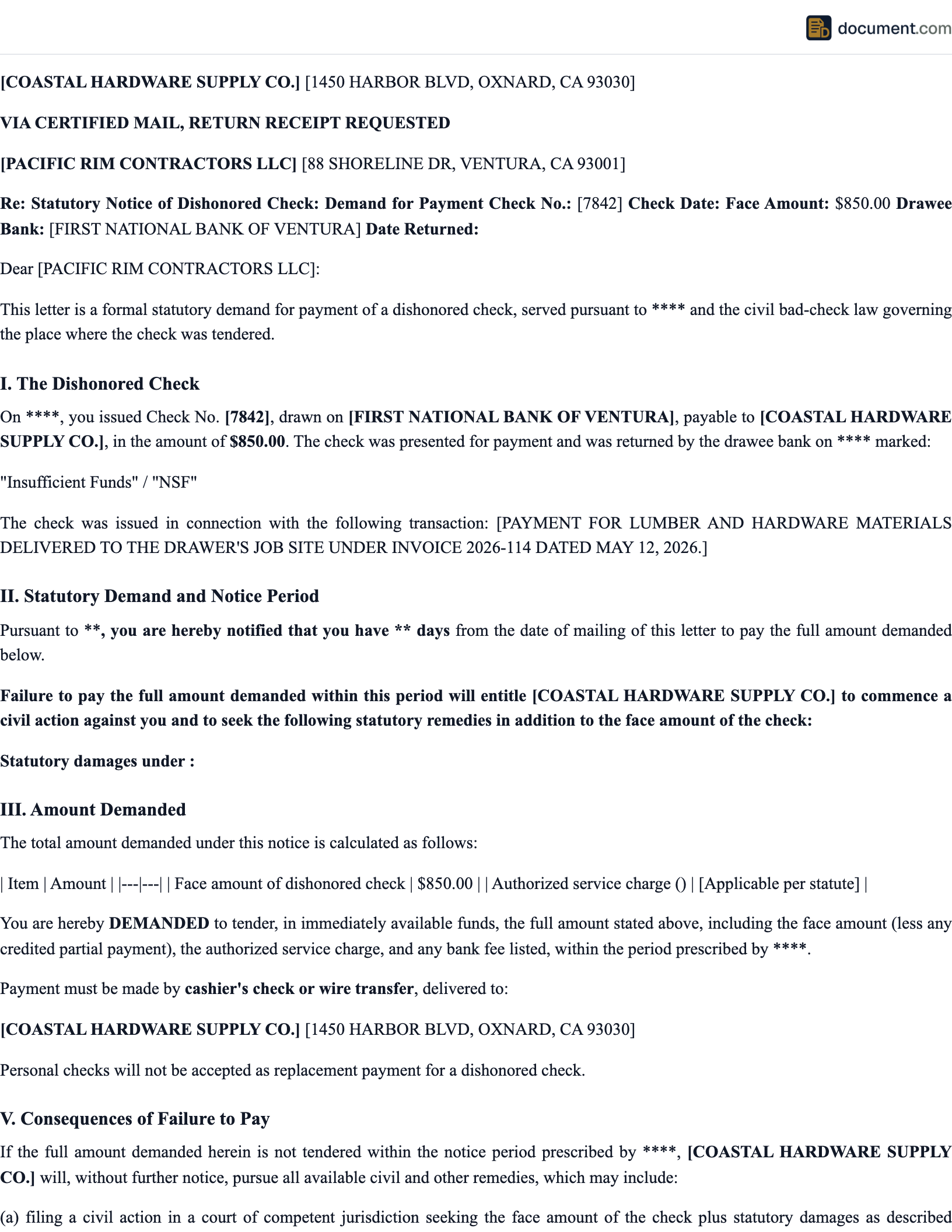



Kansas Notice of Dishonored Check Overview
Kansas gives holders of dishonored checks a civil remedy that often recovers far more than the face amount of the check. Kan. Stat. Ann. § 60-2610 authorizes the payee to sue for treble damages once a proper written demand has been sent and thirty days have passed without payment. A separate $30 service charge can be added on top. For many checks, the civil recovery substantially outpaces what small-claims courts would allow on a plain contract claim.
The practical effect of § 60-2610 is to put real leverage in the hands of the holder before any lawsuit is filed. A written demand citing the statute and stating the damages that become available after the thirty-day window typically produces payment without litigation. When it does not, the holder walks into court with a documented demand, a certified-mail receipt, and a statutory right to treble damages -- a strong position in any Kansas district court or small-claims division.
Kansas imposes a cap on the treble-damage recovery that is worth understanding before you calculate your demand. The civil penalty cannot exceed the face amount of the check plus $500, or $100, whichever of those totals is greater. That cap structure means the statute works differently on a $50 check than on a $2,000 check, and the notice you send should reflect those numbers accurately.
3x check amount, not to exceed check amount + $500
Civil damages
30 days after written demand
Notice period
Up to $30
Service charge
Kan. Stat. Ann. § 60-2610
Controlling statute
The Controlling Statute: Kan. Stat. Ann. § 60-2610
Kan. Stat. Ann. § 60-2610 is the exclusive civil remedy for holders of dishonored checks in Kansas. The statute applies when a check is returned by the drawee bank for insufficient funds or because the account has been closed. The holder -- the person or entity that accepted the check -- has the right to demand payment and, if the drawer does not pay within thirty days of a proper written demand, to sue for three times the amount of the check, subject to the statute's cap.
The statute conditions enhanced damages on the written-demand step. Without the notice, the holder can still sue for the face amount of the check, but the treble-damage award and the service charge are unavailable. That is not a technicality courts overlook; Kansas courts apply the notice requirement as a hard prerequisite to the enhanced civil remedy. Holders who skip the demand and go directly to litigation leave the most valuable part of the claim behind.
Section 60-2610 also authorizes a service charge of up to $30, which the holder can demand in the notice letter before any lawsuit is filed. The service charge compensates the payee for the bank's returned-check fee and the administrative cost of the collection effort. It is collectible on top of the check amount and separate from the civil penalty.
The statute covers both NSF checks and closed-account checks. It does not expressly extend to dishonored ACH electronic transfers, so holders of returned electronic debits in Kansas should confirm coverage under the current enrolled text before relying on § 60-2610 for that transaction type.
Statute Reference
Kan. Stat. Ann. § 60-2610
Damages: 3x check amount, not to exceed check amount + $500; or $100, whichever is greater
What You Can Recover in Kansas
Kansas allows recovery of three times the amount of the dishonored check, but the total enhancement is capped: the civil penalty cannot exceed the face amount of the check plus $500. A separate floor of $100 applies, meaning that even on a very small check, the holder may recover at least $100 in civil damages if the notice period runs without payment. These two figures -- the cap and the floor -- work together to define the realistic recovery range for any given check.
A worked example makes the cap concrete. Suppose the check was written for $300 and was returned for NSF. Three times that amount is $900. But the cap limits enhanced damages to $300 (the check face) plus $500, for a maximum of $800. The $100 floor is irrelevant here because $800 far exceeds it. Now take a $40 check. Treble damages would be $120, but the cap formula yields $40 plus $500, or $540 -- well above $120 -- so the treble amount of $120 actually controls. The floor matters for the smallest checks: on a $25 check, $25 times three is $75, the cap formula allows $525, and the floor sets a minimum of $100, so the holder may claim $100 regardless.
On top of the civil penalty, the holder can separately claim the authorized service charge of up to $30, plus the face amount of the check. Kansas courts handling these cases in small-claims court have a jurisdictional ceiling of $10,000 (Kan. Stat. § 61-2703), which easily accommodates most bad-check civil claims. For checks and penalties that together exceed $10,000, the case belongs in the district court's civil division.
- Civil damages: 3x check amount, not to exceed check amount + $500; or $100, whichever is greater
- Service charge: Up to $30
- Notice period before suit: 30 days after written demand
Notice Procedure and Timeline in Kansas
The written demand is what starts the thirty-day clock under § 60-2610. The demand must be sent to the drawer after the check has been dishonored, and it must clearly identify the check, state the reason for dishonor, demand payment of the check amount plus any authorized service charge, and put the drawer on notice that failure to pay within thirty days exposes them to civil liability under § 60-2610. Kansas courts have looked unfavorably on demands that omit the statutory citation or fail to specify the total amount the holder is claiming.
Method of service matters. Send the demand by certified mail, return receipt requested, addressed to the drawer at the address printed on the check or the drawer's last known address if you have reason to know that address has changed. Keep a copy of the letter, the certified-mail receipt, and -- when you get it back -- the green card showing delivery or the returned envelope showing it was unclaimed. If the envelope comes back unclaimed, retain it. Most Kansas courts treat a properly addressed certified mailing that was refused or unclaimed as effective service, because the drawer's failure to retrieve mail does not defeat a demand that was properly sent.
Count thirty calendar days from the date of mailing, not from the date of delivery or receipt. If the thirty-first day falls on a weekend or Kansas state holiday, allow through the next business day before filing suit. Write the actual deadline date into the letter -- 'on or before [specific date]' -- rather than leaving the drawer to calculate it from the mailing date. A deadline that is unambiguous eliminates a common defense that the drawer did not know when the window closed.
Kansas-Specific Notes
Kansas operates a parallel criminal track under Kan. Stat. Ann. § 21-5821 for the same conduct the civil statute addresses. A check drawn for less than $1,000 is a class A nonperson misdemeanor. Writing checks totaling $1,000 or more within a seven-day period elevates the charge. At $25,000 or more, the offense becomes a severity level 7 nonperson felony. These criminal thresholds are relevant to holders who want to consider criminal referral alongside or after the civil demand process.
Kansas district attorney offices handle worthless-check matters differently by county. Johnson County and Shawnee County both operate diversion programs under K.S.A. 22-2906 et seq., but eligibility for those programs varies by county and by the facts of the case. Douglas County's diversion guidelines expressly list K.S.A. 21-5821 (worthless checks) as a charge category where diversion is not presumed appropriate. Holders who want to refer a check for prosecution should contact the district attorney's office in the county where the check was passed and ask specifically about the county's current bad-check policy.
Kansas Specific Note
Do not rely on a criminal referral as a substitute for the civil notice procedure. The criminal and civil tracks serve different goals. A criminal prosecution, if it results in restitution, compensates the holder for the face amount of the check. It does not award the treble damages or service charge that § 60-2610 makes available on the civil side. Pursuing the civil notice procedure first preserves all civil remedies and also satisfies the documentary requirement that many Kansas district attorneys impose before accepting a check for prosecution.
Kansas small-claims court (the district court's small-claims division) has a $10,000 jurisdictional ceiling. A holder whose total civil claim -- check face, service charge, and treble damages -- falls within that amount can file without an attorney and typically resolves the case on a straightforward set of exhibits: the check, the bank's dishonor notice, the demand letter, and the certified-mail proof. For claims that exceed $10,000, the case moves to the district court's civil docket, where an attorney is more likely to be cost-effective.
Kansas Bad Check FAQ
Other State Bad Check Laws
Each state sets its own notice period, damage formula, and service charge. Browse sibling state pages for the specific rules that apply to your situation, or return to the full 50-state guide.
Create your Kansas Notice of Dishonored Check in minutes.
Answer a few questions and download a Kansas-compliant bad check demand letter that cites Kan. Stat. Ann. § 60-2610 and is ready to mail certified.