
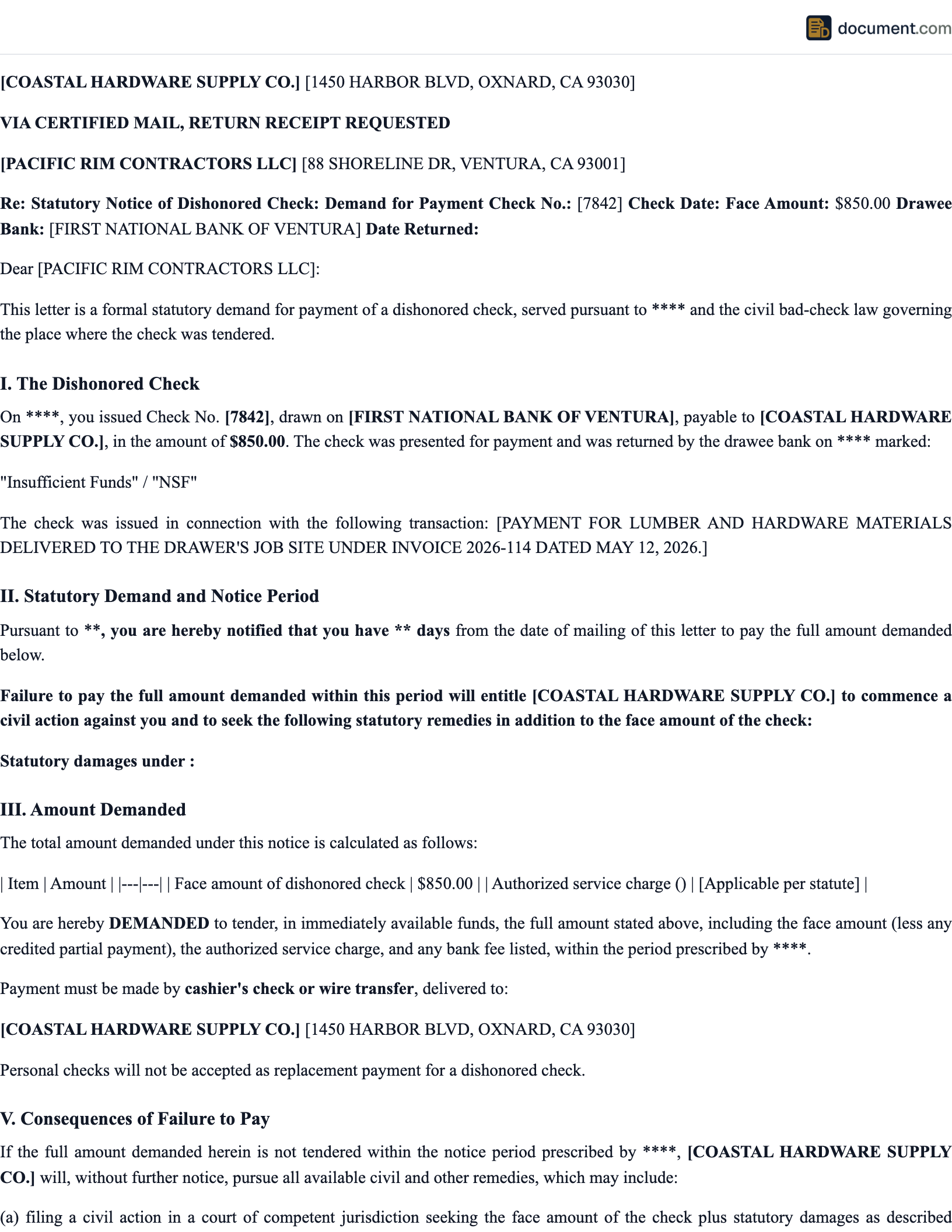



Kentucky Notice of Dishonored Check Overview
Kentucky routes most bad-check enforcement through its county attorney offices rather than leaving merchants to navigate the civil courts on their own. Under KRS § 514.040, writing a check with knowledge that the drawee bank will not honor it constitutes theft by deception. That criminal framework doubles as the pressure point that makes the county attorney program work: the drawer knows that failing to pay within the notice window can turn an uncashed check into a criminal charge, and that prospect drives a high rate of voluntary repayment before any court date is set.
The civil side of the remedy is deliberately accessible. A merchant or individual who received a dishonored check submits it to the county attorney's bad-check program, and the office sends written notice to the drawer. From the date of that notice, the drawer has 10 days to pay the face amount of the check plus a $50 merchant service fee. If the drawer pays, the matter closes without litigation or prosecution. If the drawer does not pay, the county attorney can proceed toward criminal referral and the holder retains the right to pursue the unpaid amount through a civil action for actual damages.
The program structure reflects a practical reality about bad-check enforcement in Kentucky: small-dollar checks are rarely worth independent civil litigation, but the county attorney's office can process them efficiently in volume. Merchants in Jefferson County, Warren County, Campbell County, and most other Kentucky counties have access to this program at no upfront cost to the merchant, making it the default first step for virtually any business that receives a returned check.
Civil action for actual damages
Civil damages
10 days after written notice from county attorney's office
Notice period
Up to $50 through county attorney program
Service charge
KRS § 514.040 / KRS § 514.030
Controlling statute
The Controlling Statute: KRS § 514.040 / KRS § 514.030
KRS § 514.040 is Kentucky's theft-by-deception statute, and subsection (1)(c) specifically covers the issuance of a check or similar sight order for the payment of money when the issuer knows the drawee will not honor it. The knowledge element is the pivot point: the statute does not punish an honest banking mistake, but it does reach the drawer who writes a check on a closed account, a severely overdrawn account, or an account the drawer knows will be short at presentment.
The penalty tier under KRS § 514.040 tracks the general theft-by-deception sentencing structure set out in KRS § 514.030. A check for less than $500 that goes unpaid is a Class A misdemeanor, carrying up to 12 months in jail and a fine up to $500. A check or series of related checks totaling more than $500 but less than $10,000 elevates the charge to a Class D felony, which carries one to five years in prison. Checks exceeding $10,000 reach Class C felony territory, with a sentencing range of five to ten years. These thresholds apply to the value of the check or checks in a single episode of theft by deception, so aggregation across multiple small checks to the same payee can push a case from misdemeanor to felony territory.
KRS § 514.040 also explicitly authorizes county attorneys to charge a $50 fee directly to the drawer when a notice is issued and the instrument is subsequently paid. That fee is separate from and in addition to any merchant service charge. The statutory basis for the county attorney fee means it is not discretionary county-by-county pricing; it is a legislatively fixed ceiling that county offices may collect when they issue notice and the check is redeemed. Some county attorney offices collect both a merchant fee and a county attorney fee, each capped at $50, making the drawer's total obligation the face amount of the check plus up to $100 in fees on top.
The civil action for actual damages runs alongside the criminal track, not in place of it. A holder who files a civil action can recover the face amount of the check and any consequential damages that can be proven, but Kentucky's framework does not provide automatic treble damages the way California or Florida do. The civil remedy is actual-damages based, which means the enhanced financial recovery Kentucky offers comes primarily through the fee structure in the county attorney program rather than through a court-imposed multiplier.
Statute Reference
KRS § 514.040 / KRS § 514.030
Damages: Civil action for actual damages; county attorney program collects $50 merchant fee per check
What You Can Recover in Kentucky
Kentucky's civil recovery for a dishonored check centers on actual damages rather than a treble-damage formula. The holder can recover the face amount of the check and provable consequential damages -- bank returned-check fees, costs incurred in pursuing collection, and any direct losses caused by the check's dishonor. The absence of an automatic multiplier means Kentucky's civil remedy is less generous than states like California, Florida, or Tennessee for payees with small-dollar checks but no computable consequential damages beyond the check itself.
The county attorney program adds a layer of financial recovery that partially offsets the absence of treble damages. When a merchant submits a returned check and the county attorney sends notice, the merchant may collect a $50 service fee from the drawer on top of the face amount if the check is redeemed. That fee runs to the merchant and is authorized by KRS § 514.040 separately from the county attorney's own $50 fee. On a $200 check, the merchant can collect $250 through the program -- the $200 face amount plus the $50 merchant fee -- without filing a lawsuit or appearing in court.
For checks above the program's practical range or where the drawer has not responded to the county attorney's notice, a civil suit in district court small claims division is available for amounts up to $2,500. Above that ceiling, a regular district court filing is required. Attorney fees are not automatically awarded in a Kentucky civil bad-check action the way they are in some other states, so the practical economics of hiring counsel matter at lower check amounts. Many Kentucky practitioners advise using the county attorney program first for any check under $2,500 and reserving independent civil litigation for larger checks or situations where the drawer has assets worth pursuing.
- Civil damages: Civil action for actual damages; county attorney program collects $50 merchant fee per check
- Service charge: Up to $50 through county attorney program
- Notice period before suit: 10 days after written notice from county attorney's office
Notice Procedure and Timeline in Kentucky
The notice under Kentucky's county attorney program is sent by the county attorney's office, not by the merchant directly. The merchant submits the returned check -- along with whatever identification information is available for the drawer -- to the county attorney's bad-check division, and the office generates and mails the demand. This process distinguishes Kentucky from states where the payee sends the statutory notice and simply waits for the clock to run; in Kentucky, the county attorney's office is the sending party, and its involvement is what gives the notice its criminal-referral weight.
Once the county attorney's notice is sent, the drawer has 10 days to pay the face amount of the check plus the merchant service fee. Some county offices extend a slightly longer window as a matter of local practice -- Warren County and certain other offices have used 17-day windows in their program materials -- but 10 days from written notice is the statutory baseline. The calculation runs from the date of the notice, not the date the drawer receives it, so a drawer who picks up certified mail on day three has seven days remaining, not a full ten days from receipt. Merchants submitting checks should note that the notice period begins running from the county attorney's mailing date and should not expect a longer voluntary window.
If the drawer pays within the notice period, the merchant receives the check proceeds and the service fee, and the county attorney closes the file. If the drawer does not pay, the file can be referred for criminal prosecution under KRS § 514.040. Merchants who want to preserve the option for civil suit alongside or instead of the criminal track should document the submission date, the notice date, and the expiration of the 10-day period carefully. A civil action filed before the notice period has run is procedurally premature, and a court may decline to award even actual damages on a filing that does not allow the drawer the statutory cure period.
Kentucky-Specific Notes
Kentucky's county attorney infrastructure is county-specific, not statewide. Jefferson County (Louisville), Warren County (Bowling Green), Campbell County (Newport), Henderson County, McCracken County, Scott County, and most other Kentucky counties each operate their own bad-check program with local submission procedures, forms, and, in some cases, slightly varying notice windows. Merchants who operate across multiple Kentucky counties should confirm the local program details for the county where the check was tendered, because submitting to the wrong county attorney's office can delay the process and affect which county's resources are applied to collection.
The aggregation principle under KRS § 514.030 is worth understanding before writing off a series of small checks from the same drawer. Kentucky treats related thefts by deception as a single offense for sentencing purposes, meaning that two $300 checks from the same drawer in the same transaction or scheme aggregate to $600 and push the offense from a Class A misdemeanor to a Class D felony. A merchant who has received multiple returned checks from one customer should present all of them together when submitting to the county attorney's program, not separately or on a rolling basis, to preserve the aggregation argument if the matter proceeds to criminal referral.
Kentucky Specific Note
Kentucky's civil bad-check remedy does not include automatic treble damages. A holder who expects to recover three times the check amount will be disappointed -- Kentucky courts award actual damages, not a statutory multiplier. If the check was written in connection with a transaction that also gives rise to a contract claim, the holder should consider filing a combined civil action for both the dishonored check and any contract damages, since the civil bad-check statute alone will not fill the gap that the absence of a multiplier creates.
Stop-payment checks occupy uncertain territory under KRS § 514.040. The statute requires that the drawer know the check will not be honored at the time of issuance, and a drawer who places a stop-payment order after delivery can argue that the check was valid when written. Whether a stop payment made to defeat a legitimate debt constitutes theft by deception is a fact-specific question, and county attorney offices in Kentucky vary in their willingness to process stop-payment checks through the bad-check program. A holder dealing with a stop-payment situation should be prepared to argue that the stop was placed in bad faith and should consult with counsel before relying solely on the county attorney program for enforcement.
Kentucky Bad Check FAQ
Other State Bad Check Laws
Each state sets its own notice period, damage formula, and service charge. Browse sibling state pages for the specific rules that apply to your situation, or return to the full 50-state guide.
Create your Kentucky Notice of Dishonored Check in minutes.
Answer a few questions and download a Kentucky-compliant bad check demand letter that cites KRS § 514.040 / KRS § 514.030 and is ready to mail certified.