
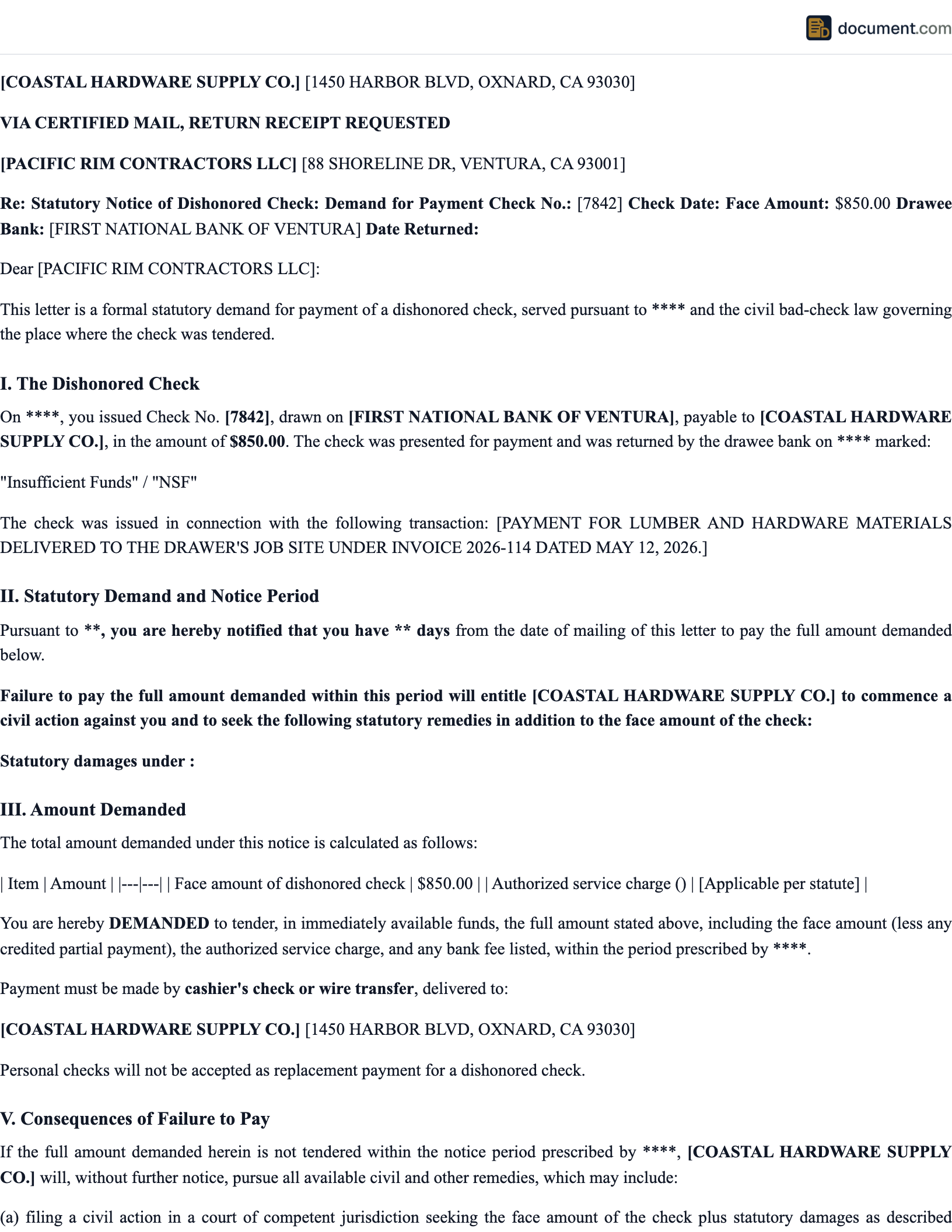



Arizona Notice of Dishonored Check Overview
Arizona takes a straightforward approach to civil bad check recovery. Under A.R.S. § 12-671, a payee who receives a dishonored check and follows the statutory notice procedure can collect two times the face amount of the check, or $50, whichever is greater, along with court costs and reasonable attorney fees. The multiplier is double, not treble as in most states, but the mandatory fee award and the relatively short notice period make Arizona's civil remedy one of the more efficient collection tools available to small businesses and individual payees.
The civil procedure under § 12-671 runs independently of the criminal track under A.R.S. § 13-1807. A payee can pursue both simultaneously or choose one over the other. Most payees start with the civil notice because it is fast, requires no law enforcement involvement, and produces a money judgment the payee can enforce directly. The criminal route can supplement the civil action if the drawer ignores both the written demand and a subsequent lawsuit.
Before any of the enhanced remedies are available, the payee must send a written notice to the drawer, wait the prescribed number of days, and allow the drawer a genuine opportunity to cure. The statutory notice is not a formality. Courts have denied the double-damage award when the notice was defective in method, timing, or content. Getting the notice right from the start determines whether the payee collects the check amount alone or the check amount multiplied plus fees.
2x check amount or $50, whichever is greater, plus costs and attorney fees
Civil damages
12 days (personal notice) or 17 days (mailed notice)
Notice period
Up to $25
Service charge
A.R.S. § 12-671
Controlling statute
The Controlling Statute: A.R.S. § 12-671
A.R.S. § 12-671 creates a civil cause of action in favor of a person who accepts a check that is subsequently dishonored. The statute applies to checks returned for insufficient funds, a closed account, or any other reason that leaves the instrument unpaid. The payee must have accepted the check in good faith and must not have had actual knowledge at the time of acceptance that the check would not be honored.
The statute conditions the enhanced civil remedy on prior written notice to the drawer. The notice requirement is not optional and is not satisfied by a phone call, a text, or an informal conversation about the returned check. Arizona courts treat the written demand as a jurisdictional prerequisite: skip it, and the double-damage claim is gone even if the check was clearly fraudulent and the drawer has never attempted to cure.
Once the statutory notice period expires without full payment, the payee may file a civil action and seek the greater of twice the amount of the check or $50. The statute also authorizes the court to award the costs of the action and reasonable attorney fees to the prevailing payee. The attorney-fee provision is significant because it can make litigation economically viable on checks that would otherwise be too small to justify hiring counsel.
The statute does not cap the double-damage award in absolute dollar terms. On a $5,000 check, the civil penalty alone is $10,000, plus costs and fees. This is materially different from states that cap enhanced damages at a fixed amount above the face value. In Arizona, the multiplier scales with the check amount throughout its full range.
Statute Reference
A.R.S. § 12-671
Damages: 2x check amount or $50, whichever is greater, plus costs and attorney fees
What You Can Recover in Arizona
Under A.R.S. § 12-671, a successful payee recovers two categories of damages. The first is the enhanced penalty: two times the amount of the dishonored check, with a floor of $50. On a $30 check, the double-damage calculation yields $60, but the floor lifts the recovery to $50 at minimum, so the payee collects $60 on that $30 check either way. On a $25 check, the floor matters: double is $50, and the floor is also $50, so the payee collects $50 plus the check face. The second category is costs and reasonable attorney fees, awarded by the court upon a finding for the payee.
The double-damage figure is calculated on the face amount of the check, not on whatever partial payment the drawer may have tendered after dishonor. If the drawer writes a $600 check, it is returned, and the drawer then sends $100 during the notice period without satisfying the full demand, the payee's civil penalty base remains the check amount under the literal terms of the statute. Payees should document every payment received after dishonor and confirm the payment dates relative to the notice period, because any partial cure argument the drawer raises at trial will turn on those dates.
The service charge of up to $25 authorized under Arizona law is a separate and additional recovery item, collectible on top of the face amount and the double-damage penalty. Include the service charge in the demand letter with the specific dollar figure claimed. A demand that states the service charge in general terms without a dollar figure risks having that component denied. On small checks, the $25 service charge, $50 floor penalty, and the check face amount can together exceed the check amount several times over, which is a meaningful incentive structure for drawers who otherwise might delay.
- Civil damages: 2x check amount or $50, whichever is greater, plus costs and attorney fees
- Service charge: Up to $25
- Notice period before suit: 12 days (personal notice) or 17 days (mailed notice)
Notice Procedure and Timeline in Arizona
Arizona's notice periods are shorter than most states. Personal notice, meaning delivery directly to the drawer, opens a 12-day cure window. Mailed notice opens a 17-day window. The extra five days for mailed notice accounts for delivery time and mirrors the structure found in the second web search result from Arizona county attorney materials: 12 days plus 5 days for mailing equals 17 days from the date the notice is sent. Count calendar days, not business days. If the 17th day falls on a Sunday, do not extend to Monday absent a specific provision for weekend tolling; the prudent approach is to let the full period run and file the day after.
The notice must be written. It should identify the check by date, amount, and check number; state the reason for dishonor as shown on the bank's return notice; cite A.R.S. § 12-671 by name and section; specify the total amount demanded including the service charge; and state the payment deadline as a calendar date, not just a day count. A demand that says '17 days from mailing' without spelling out the resulting date leaves open a dispute about when the clock started. Write the date: 'You have until [specific date] to pay the full amount of $[total].'
For mailed notice, send the demand by certified mail, return receipt requested, addressed to the drawer at the address written or printed on the check. Arizona's civil statute does not expressly require a simultaneous first-class mailing the way California's and New York's do, but sending a parallel first-class copy on the same day provides additional evidence of delivery and removes any argument that the drawer never received the notice. If the certified mailing comes back unclaimed, retain the envelope and the tracking printout. Certified mail returned as unclaimed to a correctly addressed envelope still satisfies the notice requirement under the general rule that the drawer cannot defeat the demand by refusing to accept it.
Arizona-Specific Notes
Arizona operates county-level bad check programs through most county attorney offices, including Maricopa, Pima, Pinal, Mohave, Yuma, Cochise, Navajo, Gila, and Yavapai counties. These programs assist payees in recovering the face amount of the check at no cost, and in many counties they also collect authorized fees. The programs are primarily a restitution tool, not a guaranteed route to the double-damage civil penalty, but they can be an effective first step when the drawer is unresponsive to a direct civil demand. Many programs require the payee to have already sent the written demand and waited the statutory period before they will accept the check for processing.
On the criminal side, A.R.S. § 13-1807 classifies issuing a bad check as a class 1 misdemeanor for checks under $5,000 and a class 6 felony for checks of $5,000 or more, provided the drawer fails to pay in full within 60 days of receiving written notice under A.R.S. § 13-1808. The criminal notice procedure under § 13-1808 is distinct from the civil demand under § 12-671, though in practice a well-drafted letter can satisfy both statutes simultaneously if it contains the required elements of each. Payees should confirm they have included the criminal-notice language if they intend the letter to serve double duty.
Arizona Specific Note
Arizona's civil bad check statute applies to checks accepted in good faith. A payee who knew at the time of acceptance that the check would not clear, who agreed to hold the check past the date shown on it without a fresh agreement, or who accepted the check as part of a transaction later found to involve deceptive conduct may find the double-damage claim challenged on equitable grounds. Post-dated checks occupy a gray area: if the payee and drawer explicitly agreed the check would be deposited on a future date and the check was dishonored on that date, the civil remedy is generally available, but the surrounding facts matter and have affected outcomes in Arizona cases.
Arizona's small claims court handles cases up to $3,500. A civil bad check claim for a check under that threshold, including the doubled penalty, can typically be filed in small claims court without an attorney. For checks whose doubled penalty pushes the total claim above $3,500, the case must be filed in the justice court or superior court depending on the total amount claimed. Because § 12-671 authorizes attorney fees, hiring counsel for a larger check claim can be worthwhile: the fee award shifts the cost of litigation to the losing drawer if the payee prevails.
Arizona Bad Check FAQ
Other State Bad Check Laws
Each state sets its own notice period, damage formula, and service charge. Browse sibling state pages for the specific rules that apply to your situation, or return to the full 50-state guide.
Create your Arizona Notice of Dishonored Check in minutes.
Answer a few questions and download a Arizona-compliant bad check demand letter that cites A.R.S. § 12-671 and is ready to mail certified.