


Alabama Notice of Dishonored Check Overview
Alabama takes a straightforward approach to civil bad-check liability. Under Ala. Code § 6-5-285, a payee who receives a dishonored check and follows the required notice procedure gains the right to sue for compensatory damages, punitive damages, and reasonable attorney fees. That combination puts Alabama among the states where the civil remedy can meaningfully exceed the face amount of the check, and where a properly documented demand letter carries real leverage.
The civil statute runs alongside Alabama's criminal worthless-check law at Ala. Code § 13A-9-13.1, which classifies negotiating a worthless negotiable instrument as a Class A misdemeanor. The two tracks are independent. A payee can pursue the civil remedy under § 6-5-285, refer the check to the local district attorney's worthless check unit, or do both simultaneously. Most counties in Alabama operate standalone worthless check programs through the district attorney's office, and several of those programs require that the payee have already sent the statutory 10-day demand before the DA's office will accept the matter.
This page covers the civil remedy only. Whether a particular check also meets the elements for criminal prosecution, and whether the local DA's program will accept it, depends on the county and the facts. The civil notice is the natural first step in either scenario, and getting it right from the start preserves all downstream options.
Punitive and compensatory damages plus reasonable attorney fees
Civil damages
10 days after certified/registered mail notice
Notice period
Actual bank charges or $10, whichever is greater
Service charge
Ala. Code § 6-5-285
Controlling statute
The Controlling Statute: Ala. Code § 6-5-285
Ala. Code § 6-5-285 creates a civil cause of action for the holder of a dishonored check. The statute conditions the enhanced civil remedy on the holder having sent written notice to the drawer by certified or registered mail with return receipt requested, and on the drawer's failure to pay the face amount of the check plus the authorized service charge within 10 days of that notice. Once those conditions are met, the holder may sue and seek not just the check amount but also punitive damages, compensatory damages, and reasonable attorney fees.
The service charge authorized under the statute is the actual bank charge the holder incurred or $10, whichever is greater. Unlike some states that set a flat statutory fee, Alabama ties the service charge to the real-world cost of the bounced check, with $10 as the floor. A holder whose bank charged a $35 returned-item fee is therefore entitled to demand $35 as the service charge, not just $10. Documenting the actual bank charge matters: keep the bank statement or account notification showing the exact fee.
The statute requires that the notice be sent to an address where the drawer can reasonably be expected to receive it. In practice, the address printed or written on the check itself satisfies this requirement for most purposes. If the drawer has moved and you have a more current address, send to both and retain proof of each mailing. Alabama courts have looked to whether the payee made a genuine effort to reach the drawer, not just whether the notice was technically addressed.
The 10-day cure window runs from the date the certified mail is received, not from the date of mailing. This is a meaningful distinction from states that start the clock on mailing. If the certified piece is unclaimed and returned, the practical posture is less clear, which is why many practitioners also send a simultaneous first-class copy. Keep the certified return receipt, the tracking record, and if applicable the returned unclaimed envelope, all of which become exhibits if the case proceeds to court.
Statute Reference
Ala. Code § 6-5-285
Damages: Punitive and compensatory damages plus reasonable attorney fees
What You Can Recover in Alabama
Alabama's damage framework under § 6-5-285 is broader in structure than the simple treble-damage formulas found in many other states. The statute authorizes punitive damages, compensatory damages, and reasonable attorney fees. Compensatory damages cover the face amount of the check and any direct losses flowing from the dishonor, such as consequential financial harm the holder can document. Punitive damages are layered on top, and their purpose is deterrence rather than simple restitution, so the amount is not mechanically capped at two or three times the check amount the way a treble-damage formula would be. Alabama courts apply a reasonableness standard, and the facts of the particular case, including whether the drawer acted with intent to defraud, will influence the punitive award.
Attorney fees are separately recoverable under the statute, which materially affects the economics of pursuing a claim. In states that follow the American Rule and do not authorize fee-shifting in bad-check cases, a small check may not justify retaining counsel. In Alabama, if the drawer contests the claim, the payee's attorney fees become part of the judgment against the drawer, changing the cost-benefit calculation for both sides. This fee-shifting provision is one reason why a well-documented demand letter from counsel, sent before suit, often produces payment without litigation.
There is no published statutory multiplier or hard ceiling on the combined damages award under § 6-5-285, unlike California's or Florida's fixed-cap structures. That means the size of the potential recovery is more fact-dependent in Alabama than in those states. For small checks, the practical recovery is still anchored by the face amount plus fees and whatever a court views as a reasonable punitive addition. For larger checks, or in cases where the drawer's conduct was deliberately fraudulent, the open-ended punitive exposure can be substantial.
- Civil damages: Punitive and compensatory damages plus reasonable attorney fees
- Service charge: Actual bank charges or $10, whichever is greater
- Notice period before suit: 10 days after certified/registered mail notice
Notice Procedure and Timeline in Alabama
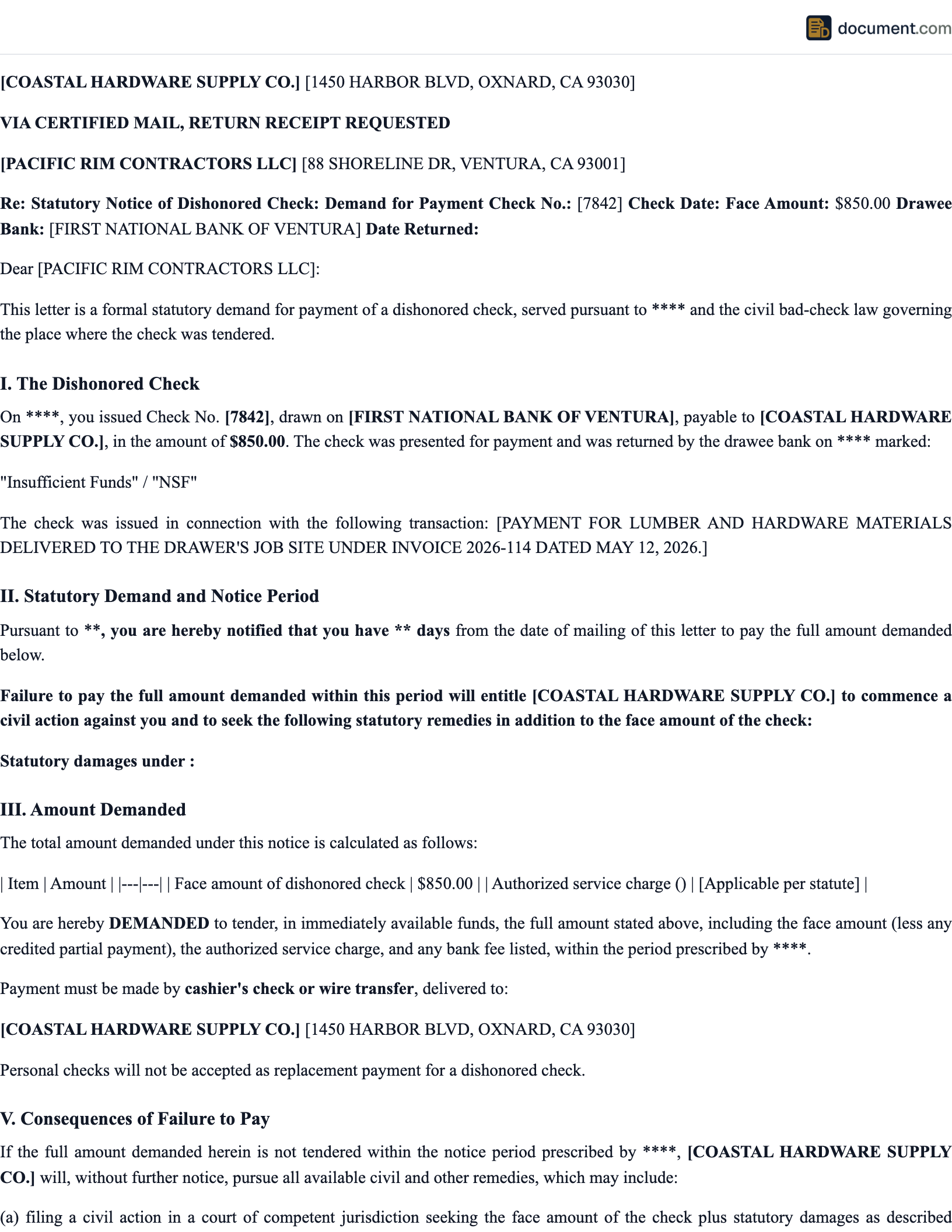
Before filing suit under § 6-5-285, the holder must send written notice to the drawer by certified or registered mail with return receipt requested. The notice should state the amount of the check, the reason for dishonor, the service charge being demanded, and a clear statement that the drawer has 10 days from receipt to pay the full amount or face civil action. Include the check number, the date it was written, the name of the drawee bank, and the total amount demanded so there is no ambiguity about which instrument is the subject of the demand.
The 10-day period begins when the drawer receives the notice, which is the date the certified mail is delivered and signed for. Draft the notice so the deadline is expressed as a specific calendar date: 'You have 10 days from your receipt of this notice to pay the full amount of $[total]. If this notice is received on [assumed receipt date], payment is due by [deadline date].' Expressing the deadline as a calendar date removes any dispute about when the window closed. If the drawer pays the face amount plus the service charge within the 10-day window, the civil penalty remedy is satisfied and no further civil action under § 6-5-285 is available for that check.
Retain the following documents as a packet: the original dishonored check or a legible copy, the bank's returned-item notice showing the reason for dishonor and the fee charged, the demand letter you sent, the certified mail receipt, and the return receipt card once it comes back. If the certified piece is returned unclaimed, also retain the envelope with the postal notation. These documents establish every element of the statutory claim: dishonor, written demand, proper service, expiration of the cure period, and nonpayment. Alabama district courts, including the small claims division, will expect this documentation if the matter is contested.
Alabama-Specific Notes
Alabama district attorneys operate county-level worthless check units that provide a parallel, no-cost collection path for payees. Active units include those in Baldwin County, Mobile County, Lee County, Morgan County, and others. Most of these programs require that the payee first send the 10-day certified-mail demand under § 6-5-285 before the unit will accept the check for processing. Lee County's program, for example, provides a Notice to the Maker template and requires that the civil demand be sent first. These units pursue restitution through the criminal process and are self-funded through fees collected from check writers, meaning there is no cost to the merchant or payee to use them.
Alabama's small claims docket in district court handles civil actions up to $6,000. The district court's broader civil jurisdiction extends to $20,000. A civil bad-check claim for a single check is almost always within small claims range, where filing fees are $35 for claims up to $1,500 and the process is designed for self-represented parties. If punitive damages push the total claimed above $6,000, the matter would proceed on the regular district court civil docket rather than the small claims track, which may affect whether retaining counsel makes sense.
Alabama Specific Note
Alabama's civil remedy under § 6-5-285 requires that the check have been dishonored by the bank, not merely disputed by the drawer. A stop-payment check presents a different legal scenario from an NSF or closed-account return. If the drawer stopped payment because of a genuine dispute about the underlying goods or services, the civil bad-check statute may not apply on its own terms, and the payee's remedy lies in breach of contract rather than under § 6-5-285. Confirm the reason for dishonor from the bank's return notice before proceeding under the statute.
The Alabama Retail Association publishes a worthless check guide for merchants that summarizes the state's requirements, including the identity-documentation steps a merchant should take at the point of sale, such as recording the check presenter's name, address, and phone number and witnessing the signature. While these documentation requirements are framed as steps for establishing the criminal prima facie case under § 13A-9-13.1, they are equally useful in civil litigation: a check accompanied by verified identity information is easier to collect on and harder for the drawer to disclaim. Merchants who accept checks regularly should treat the retail association's documentation checklist as standard operating procedure.
Alabama Bad Check FAQ
Other State Bad Check Laws
Each state sets its own notice period, damage formula, and service charge. Browse sibling state pages for the specific rules that apply to your situation, or return to the full 50-state guide.
Create your Alabama Notice of Dishonored Check in minutes.
Answer a few questions and download a Alabama-compliant bad check demand letter that cites Ala. Code § 6-5-285 and is ready to mail certified.