
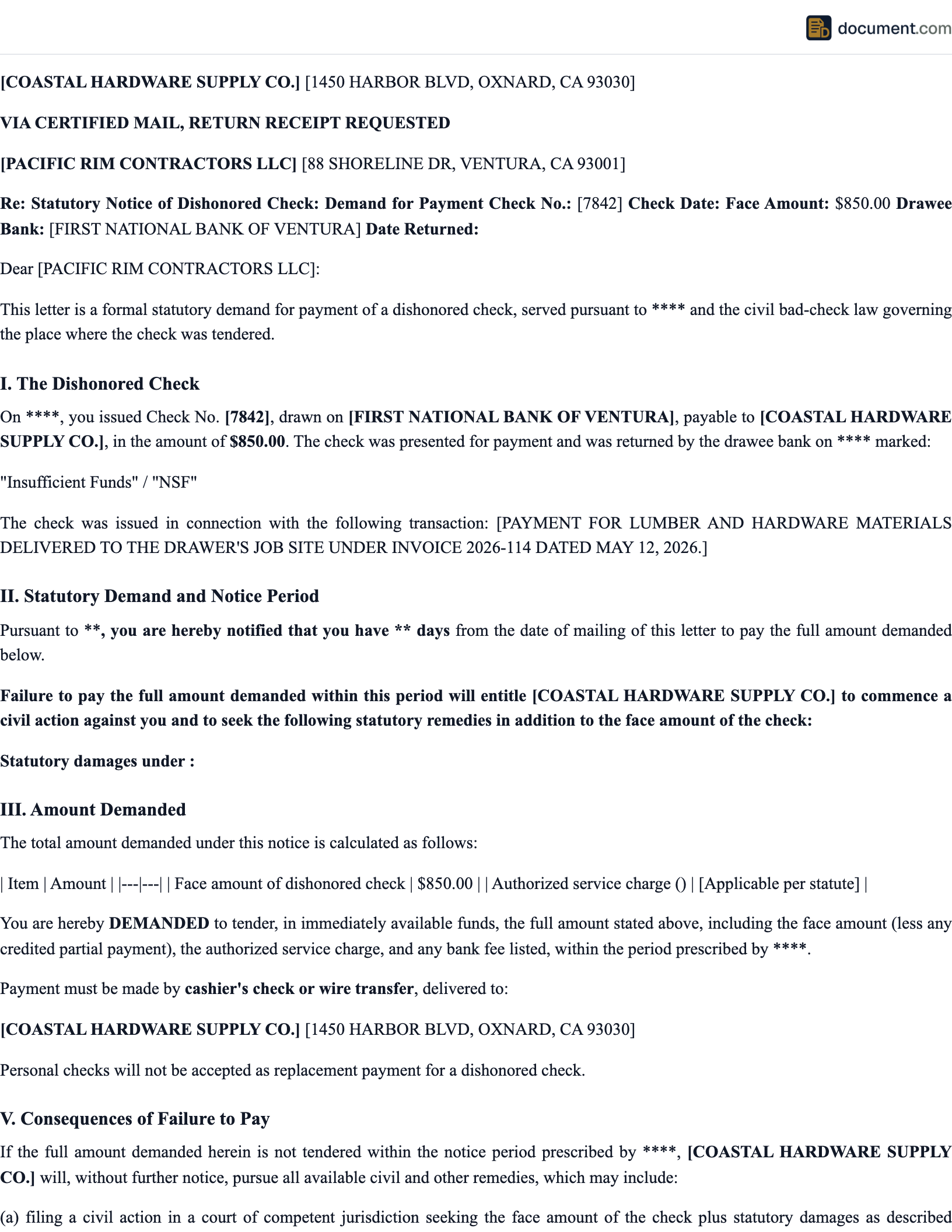



Washington Notice of Dishonored Check Overview
Washington handles dishonored check liability through RCW § 62A.3-515, a provision embedded in the state's adoption of Uniform Commercial Code Article 3. Unlike states that have free-standing bad-check civil statutes with large treble-damage multipliers, Washington's framework is more restrained: the civil penalty is three times the face amount of the check or $300, whichever is less. For small checks, that distinction is meaningless -- a $75 check yields the same $225 in treble damages either way. For checks above $100, the $300 ceiling becomes the controlling figure, so a $500 check and a $5,000 check produce the same maximum civil penalty. Knowing that ceiling matters before you decide whether civil recovery, criminal referral, or a combination of both is the right strategy.
The statute requires the payee to send written notice of dishonor to the drawer at the drawer's last known address and allow 15 days to pass before the enhanced civil remedy becomes available. That 15-day window is shorter than the 30-day period common in states like California, Oregon, and Florida, which means the civil track in Washington moves quickly once the check bounces. On top of the capped civil penalty, the holder is entitled to 12% annual interest running from the date of dishonor, reasonable attorney fees if the claim goes to court, and collection costs up to $40. Stacked together, those elements can make even a modest dishonored check worth pursuing formally.
One important carve-out: RCW § 62A.3-515 expressly excludes checks dishonored because of a justifiable stop-payment order. A drawer who had a legitimate reason -- a contractor who abandoned the job, a seller who failed to deliver -- to stop payment is outside the statute's civil-penalty framework. The payee is not without recourse in that situation, but the remedy is a contract claim, not the civil bad-check penalty.
3x face amount or $300, whichever is less
Civil damages
15 days after notice of dishonor
Notice period
Collection costs up to $40
Service charge
RCW § 62A.3-515
Controlling statute
The Controlling Statute: RCW § 62A.3-515
RCW § 62A.3-515 sits within Washington's codification of UCC Article 3, the uniform law governing negotiable instruments. The statute creates a civil cause of action for holders of dishonored checks that is separate from and parallel to Washington's criminal bad-check statute, RCW 9A.56.060. You do not need a criminal conviction -- or even a criminal referral -- to use the civil remedy. The two tracks can proceed simultaneously or independently.
The statute's mechanics follow a notice-then-wait structure. Once a check is dishonored, the holder must send written notice to the drawer's last known address. The statute does not specify certified mail as the exclusive method, but proving the notice was sent and received is the holder's burden. Using certified mail with return receipt, or a combination of certified and first-class mail sent the same day, is the prudent practice. The 15-day clock begins from the date of the notice of dishonor -- not the date the holder actually mails the demand. Confirm the bank's dishonor date from the return notice and count forward.
If 15 days pass without the drawer paying the check amount plus authorized fees, the holder's civil damages become available. The statute frames the enhanced remedy in the alternative: three times the face amount of the check or $300, whichever is less. The interest component accrues at 12% per year from the date of dishonor, not from the date the notice was sent or the date suit is filed. That distinction matters on older checks because the accrued interest may itself be a meaningful component of the total recovery.
Before trial, a drawer can cut off additional exposure by tendering the face amount of the check plus accrued interest, collection costs, court costs, service costs, and statutory attorney fees. That settlement window is built into the statute and gives a drawer who ignored the initial notice one more opportunity to resolve the matter before a judgment is entered. If the drawer uses that window, the civil penalty itself is avoided.
Statute Reference
RCW § 62A.3-515
Damages: 3x face amount or $300, whichever is less; plus reasonable attorney fees; plus 12% interest
What You Can Recover in Washington
Washington's recovery structure under RCW § 62A.3-515 has four components: (1) the face amount of the check; (2) civil damages equal to three times the face amount or $300, whichever is less; (3) collection costs up to $40; and (4) reasonable attorney fees if the matter goes to court. Interest at 12% per year runs from the date of dishonor on the face amount owed. On a $150 check dishonored eight months ago, for example, the holder would be entitled to $150 plus $300 in civil damages (since three times $150 equals $450, which exceeds $300, so $300 is the cap), plus $12 in accrued interest (roughly 12% of $150 for eight months), plus collection costs up to $40, plus attorney fees if the matter required litigation.
The $300 ceiling on the penalty component is the feature that most distinguishes Washington from neighboring states. Oregon's ORS 30.701 uses a treble-damage structure with a $200 minimum penalty and no absolute cap at $300. California's Civil Code Section 1719 awards treble damages up to a ceiling of $1,500 over the face amount. For large checks -- a $2,000 security deposit that bounces, or a $4,000 contractor payment that never clears -- the civil penalty component in Washington is the same $300 regardless of the check amount. That does not make the claim worthless: the face amount itself is fully recoverable, attorney fees can be significant in litigated cases, and the 12% interest rate is above current market rates. But the calculus on whether to hire counsel to pursue a large dishonored check in Washington is different from states where the civil multiplier scales with the check amount.
Attorney fees are available on a reasonable-fee standard, which courts measure by the time counsel reasonably spent and the prevailing hourly rates in the relevant market. On a small check, fees awarded are typically modest. On a contested case involving a larger check where the drawer disputes the underlying transaction, a fully litigated fee award can rival or exceed the civil penalty itself. For self-represented plaintiffs in small claims, attorney fees are generally not available because no attorney was retained, but the civil penalty, face amount, interest, and collection costs are all still recoverable.
- Civil damages: 3x face amount or $300, whichever is less; plus reasonable attorney fees; plus 12% interest
- Service charge: Collection costs up to $40
- Notice period before suit: 15 days after notice of dishonor
Notice Procedure and Timeline in Washington
Under RCW § 62A.3-515, the notice of dishonor must be sent to the drawer at the drawer's last known address. The statute does not mandate a specific mailing method, but the holder bears the burden of proving the notice was sent and received. Best practice in Washington is to send the demand by certified mail, return receipt requested, addressed to the address printed on the check, and simultaneously send a duplicate copy by first-class mail. If the certified mailing comes back unclaimed, the first-class copy establishes that the drawer had a reasonable opportunity to receive the notice. Retain the certified-mail receipt, the tracking confirmation, and the returned envelope if any -- these are your trial exhibits.
The 15-day window is measured from the date the holder sends the notice of dishonor, not the date the drawer receives it. Count all 15 days; do not file suit, and do not treat the claim as ripe for enhanced damages, until day 16 at the earliest. Fifteen days is a short window compared to most states, but there is no benefit to filing prematurely -- a court can deny the civil penalty on a claim filed before the period runs. If the drawer pays the full amount during the 15-day window, the civil penalty is avoided; accept the payment, note the date, and close the matter.
The notice should specify the check by number, date, amount, and drawee bank; state the reason for dishonor as reported by the bank; demand the face amount plus the collection costs you are claiming (up to $40); cite RCW § 62A.3-515 by name; and give the drawer a clear deadline. Stating the deadline as a specific calendar date -- not just '15 days from this letter' -- removes any argument about when the window closed. Keep a copy of the letter dated and signed. If the check was issued in a business context, send the notice to both the individual who signed it and the entity, to the extent both are potentially liable.
Washington-Specific Notes
Washington's small claims department operates within the district court system under RCW 12.40.010. For natural persons, the jurisdictional ceiling is $10,000. For business entities, the ceiling is $5,000. Most dishonored-check civil claims -- which in Washington are capped at $300 in civil penalties plus the face amount plus fees -- fit comfortably within small claims jurisdiction, and small claims is the most cost-effective venue for these cases. Attorneys are barred from small claims trials without the judge's express permission under RCW 12.40.080, which levels the playing field for self-represented plaintiffs. For claims that include a larger underlying debt beyond the check itself, regular district court handles civil matters up to $100,000.
Washington's criminal bad-check statute, RCW 9A.56.060, runs on a separate track. A check over $750 is a class C felony (up to five years, up to $10,000 fine). A check of $750 or less is a gross misdemeanor. Multiple checks written as part of a common scheme can be aggregated to reach the felony threshold. The criminal statute requires proof of intent to defraud, and insufficient funds at the time of presentation serves as prima facie evidence of that intent. A stop payment made with intent to defraud and not cured within 20 days also falls within the criminal statute. The civil notice under RCW § 62A.3-515 and the criminal complaint under RCW 9A.56.060 are not mutually exclusive -- a holder can send the civil demand while a criminal referral is pending, and many county prosecutors' offices require evidence of a prior written demand before accepting a check for prosecution.
Washington Specific Note
RCW § 62A.3-515 expressly does not apply when a check is dishonored because of a justifiable stop-payment order. If the drawer stopped payment because of a legitimate dispute -- defective goods, failure to perform services, a billing error -- the stop payment is likely justifiable, and the civil bad-check penalty is unavailable. The payee's remedy in that situation is a breach-of-contract claim or a dispute about the underlying transaction, not a bad-check action. Do not send a § 62A.3-515 demand on a stop-payment check without first assessing whether the drawer had a colorable reason to stop payment. Sending a statutory bad-check demand on a legitimately disputed check can itself create liability.
Washington does not have a statewide bad-check diversion program administered through the courts, unlike some states where district attorneys operate formal pre-prosecution restitution programs as an alternative to criminal charges. Individual county prosecutors have discretion to offer deferred prosecution arrangements on gross misdemeanor bad-check cases, particularly for first-time offenders who make full restitution, but there is no uniform statutory framework for this. Holders who want to pursue the criminal track alongside the civil remedy should contact the prosecutor's office in the county where the check was presented and ask about that office's intake process for bad-check referrals.
Washington Bad Check FAQ
Other State Bad Check Laws
Each state sets its own notice period, damage formula, and service charge. Browse sibling state pages for the specific rules that apply to your situation, or return to the full 50-state guide.
Create your Washington Notice of Dishonored Check in minutes.
Answer a few questions and download a Washington-compliant bad check demand letter that cites RCW § 62A.3-515 and is ready to mail certified.