
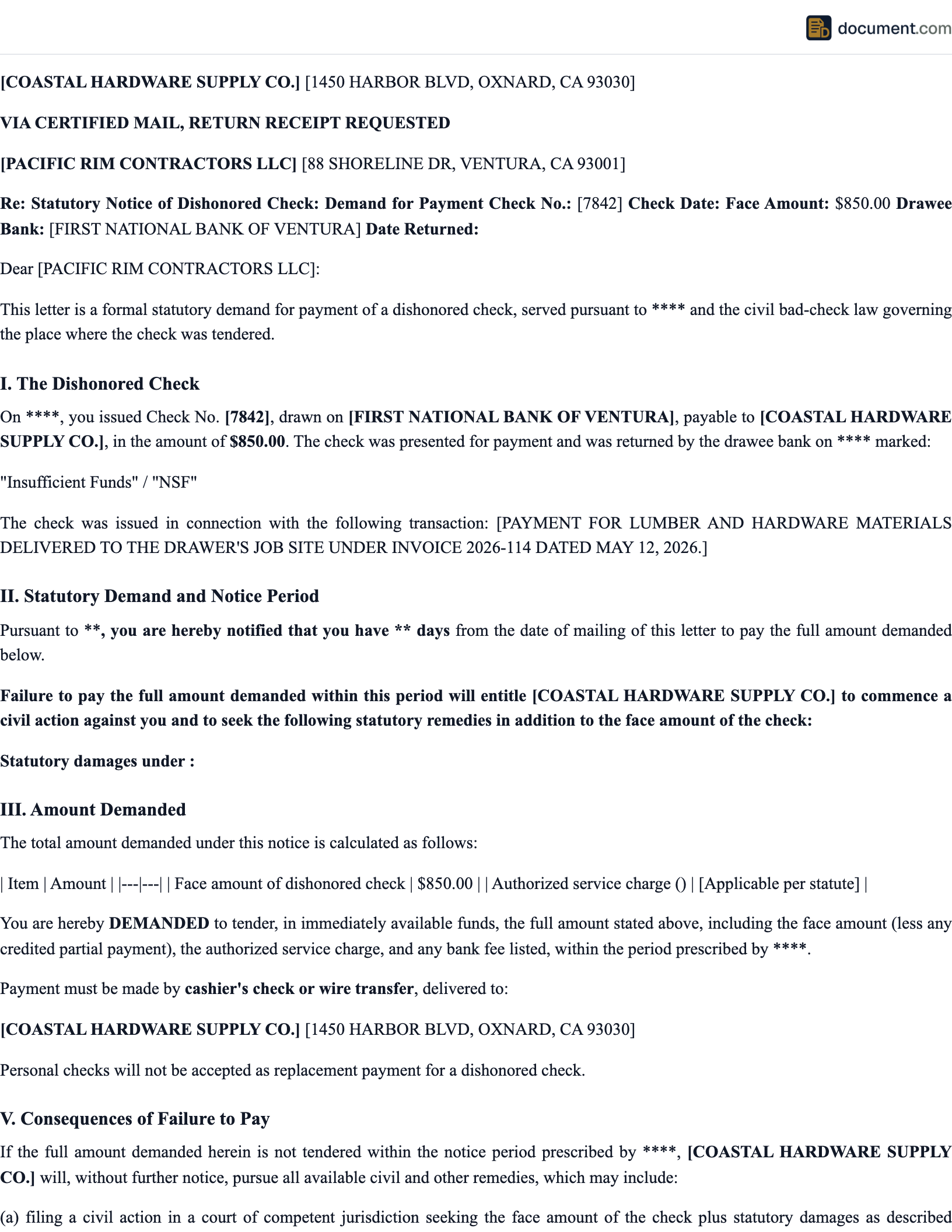



Utah Notice of Dishonored Check Overview
Utah gives the holder of a dishonored check a straightforward civil remedy with real teeth. Under Utah Code Ann. § 7-15-2, once you send a proper written demand and wait 30 days without receiving full payment, you can pursue three times the check amount in civil court, subject to a minimum recovery of $100 and a ceiling that keeps total enhanced damages within the check face value plus $500. Attorney fees, costs, and interest layer on top of that cap, so the actual judgment in a contested case can exceed what the formula alone suggests.
The statute's design reflects a deliberate policy choice. Utah wants to give the check writer a meaningful window to make good before litigation begins, but it also wants to make ignoring that window expensive. The 30-day demand period is not optional; courts have denied the statutory penalty to payees who skipped it or sent notice by a method that the statute did not authorize. Getting the demand right the first time is the single most important step in the process.
This page covers the mechanics of Utah's civil dishonored-check remedy: what the statute actually says, how to calculate damages on checks of different sizes, what the written demand must contain and how it must be sent, and the Utah-specific considerations that distinguish this state from the majority that share a similar statutory structure. The criminal framework under Utah Code Ann. § 76-6-505 runs on a separate track and is addressed in the state-specific notes below.
3x check amount or $100, whichever is greater
Civil damages
30 days written demand before filing
Notice period
Up to $20
Service charge
Utah Code Ann. § 7-15-2
Controlling statute
The Controlling Statute: Utah Code Ann. § 7-15-2
Utah Code Ann. § 7-15-2 creates the civil cause of action for dishonored checks. A person who issues a check that is subsequently dishonored, meaning the drawee bank refuses to pay it for any reason, including insufficient funds or a closed account, becomes civilly liable to the holder. The statute is not limited to merchants or business payees; any holder of a returned check can invoke it, including private individuals, landlords, contractors, and assignees who acquired the instrument after dishonor.
The liability provision has three components. First, the holder is entitled to the face amount of the check, the recovery baseline that exists in every state regardless of whether enhanced damages are available. Second, the holder is entitled to a service charge of up to $20, which can be demanded in the notice letter and is payable before any litigation begins. Third, and most significantly, once the 30-day written demand expires without payment, the holder gains the right to civil damages of three times the check amount or $100, whichever is greater. That enhanced award is subject to a cap: total damages (the multiple, not just the face amount) may not exceed the face amount of the check plus $500.
The statute separately authorizes recovery of interest, costs, and reasonable attorney fees. These awards sit outside the enhanced-damages cap, meaning a holder who retains counsel and wins a contested case can recover attorney fees on top of the full check-plus-$500 maximum. That combination makes even a modestly sized bad-check case economically viable to litigate through to judgment.
Utah Code Ann. § 7-15-2 covers checks dishonored for insufficient funds and checks drawn on closed accounts. Stop-payment checks require separate analysis: where the drawer stopped payment to contest the underlying transaction in good faith, the civil bad-check remedy may not apply, and the dispute resolves as an ordinary contract matter. A payee holding a stop-payment check should confirm that the stop was not grounded in a legitimate dispute before invoking the § 7-15-2 framework.
Statute Reference
Utah Code Ann. § 7-15-2
Damages: 3x check amount or $100, whichever is greater; cap: check + $500; plus interest, costs, and attorney fees
What You Can Recover in Utah
Utah's damage formula has two moving parts: a multiplier and a cap. The multiplier is three times the check amount, subject to a floor of $100. That floor matters for small checks, if someone wrote you a $25 check that bounced and never paid, your statutory damages are $100, not $75. For checks above roughly $34, the three-times formula exceeds the $100 minimum, so the multiplier drives the recovery. On a $200 check, you could claim $600 in enhanced damages; on a $500 check, $1,500, but the cap intervenes before you get there.
The cap is where Utah's structure becomes concrete. Total enhanced civil damages cannot exceed the face amount of the check plus $500. On a $200 check, that ceiling is $700 ($200 + $500). Since three times $200 is $600, which is below $700, the multiplier governs and the cap does not cut in, you recover $600. On a $500 check, three times the face is $1,500, but the cap is $1,000 ($500 + $500), so the cap governs. Any check above approximately $250 will hit the cap before the multiplier is exhausted, meaning the maximum enhanced-damage recovery for a $1,000 check and a $5,000 check is identical: face value plus $500.
Add to that the service charge of up to $20, which you can demand immediately in the notice letter regardless of whether you ultimately file suit, plus statutory interest on the unpaid balance, all costs of litigation, and reasonable attorney fees if you prevail. A landlord whose tenant's $800 rent check bounced and is ignored after the 30-day demand can realistically expect a judgment covering the $800 face amount, the $500 enhanced-damage cap, the $20 service charge, accrued interest, court filing fees, and any attorney fees the court finds reasonable, a recovery materially larger than the face amount of the check.
- Civil damages: 3x check amount or $100, whichever is greater; cap: check + $500; plus interest, costs, and attorney fees
- Service charge: Up to $20
- Notice period before suit: 30 days written demand before filing
Notice Procedure and Timeline in Utah
Before you can collect enhanced damages under § 7-15-2, you must send a written demand to the check writer and wait 30 days. That demand must be sent to the address printed on the check or the drawer's last known address if different. Utah's statute does not prescribe certified mail as the exclusive method, but using certified mail with return receipt requested, and mailing a simultaneous first-class copy, is the standard practice for a reason: it produces the proof-of-delivery evidence a court will expect if the drawer contests whether the notice was received. Keep the certified mail receipt, the tracking confirmation, and the envelope if it is returned unclaimed.
The notice must state the amount of the check, the reason it was dishonored, and the total amount the holder demands, including the service charge if you are claiming it. It must make clear that the holder intends to pursue civil damages under § 7-15-2 if payment is not received within 30 days. Show the arithmetic: list the check face amount and the $20 service charge separately, then state the total. A demand that refers generically to 'the check plus fees' without specifying figures invites a dispute about what full payment requires.
Calculate the 30-day deadline as a specific calendar date and put that date in the letter. If you mail the notice on June 10, the demand reads: 'Payment must be received on or before July 10.' Do not leave the drawer to perform the calculation. Once the 30-day window closes without payment, you may file suit in the appropriate court. Filing even one day early, before the period expires, risks losing the enhanced-damage claim entirely. If partial payment arrives during the window, apply it to the balance, note the receipt in writing, and confirm whether the reduced unpaid amount changes your damages calculation before filing.
Utah-Specific Notes
Utah's small claims court handles dishonored check cases where the amount in controversy does not exceed $11,000 under Utah Code Ann. § 78A-8-102. For most bounced checks, small claims is the right venue: the filing fee is modest, the process does not require an attorney, and small claims judges in Utah are accustomed to the § 7-15-2 notice procedure. Bring copies of the check, the bank's dishonor notice, the demand letter, and your certified mail documentation. A complete paper record often produces a default judgment without a contested hearing.
Utah's criminal bad-check statute, Utah Code Ann. § 76-6-505, runs on an entirely separate track from the civil remedy. Criminal charges are graded by the aggregate value of dishonored checks written within any six-month period: less than $500 is a class B misdemeanor; $500 to less than $1,500 is a class A misdemeanor; $1,500 to less than $5,000 is a third-degree felony; and $5,000 or more is a second-degree felony. The civil notice you send under § 7-15-2 is not a criminal referral, but many district attorney offices in Utah use it as preliminary evidence that the drawer had actual notice of the dishonor and an opportunity to cure, documentation that strengthens a later criminal referral if the drawer ignores the civil demand.
Utah Specific Note
The 30-day civil demand period and the criminal law's 'reasonable time to cure' standard are not the same deadline. The civil statute's clock runs from the mailing of the written demand. The criminal statute considers whether the drawer made the check good within a reasonable time after learning of the dishonor, a standard that is fact-specific and does not automatically align with the 30-day civil window. Do not assume that sending the § 7-15-2 demand and waiting 30 days exhausts the drawer's ability to raise a cure defense in a criminal proceeding. If criminal referral is your goal, consult with the relevant county attorney's office about their intake requirements before assuming the civil process satisfies them.
Utah has not yet extended § 7-15-2 expressly to dishonored ACH electronic fund transfers. Payees dealing with returned ACH debits rather than paper checks should not rely on the bad-check statute's enhanced-damage framework without first confirming whether a Utah court in their district has applied it by analogy to electronic transactions. A returned ACH debit in Utah is more safely pursued as a breach of contract or under the Uniform Commercial Code's Article 3 framework until the legislature amends § 7-15-2 to expressly cover electronic transfers, as California and Florida have done.
Utah Bad Check FAQ
Other State Bad Check Laws
Each state sets its own notice period, damage formula, and service charge. Browse sibling state pages for the specific rules that apply to your situation, or return to the full 50-state guide.
Create your Utah Notice of Dishonored Check in minutes.
Answer a few questions and download a Utah-compliant bad check demand letter that cites Utah Code Ann. § 7-15-2 and is ready to mail certified.