
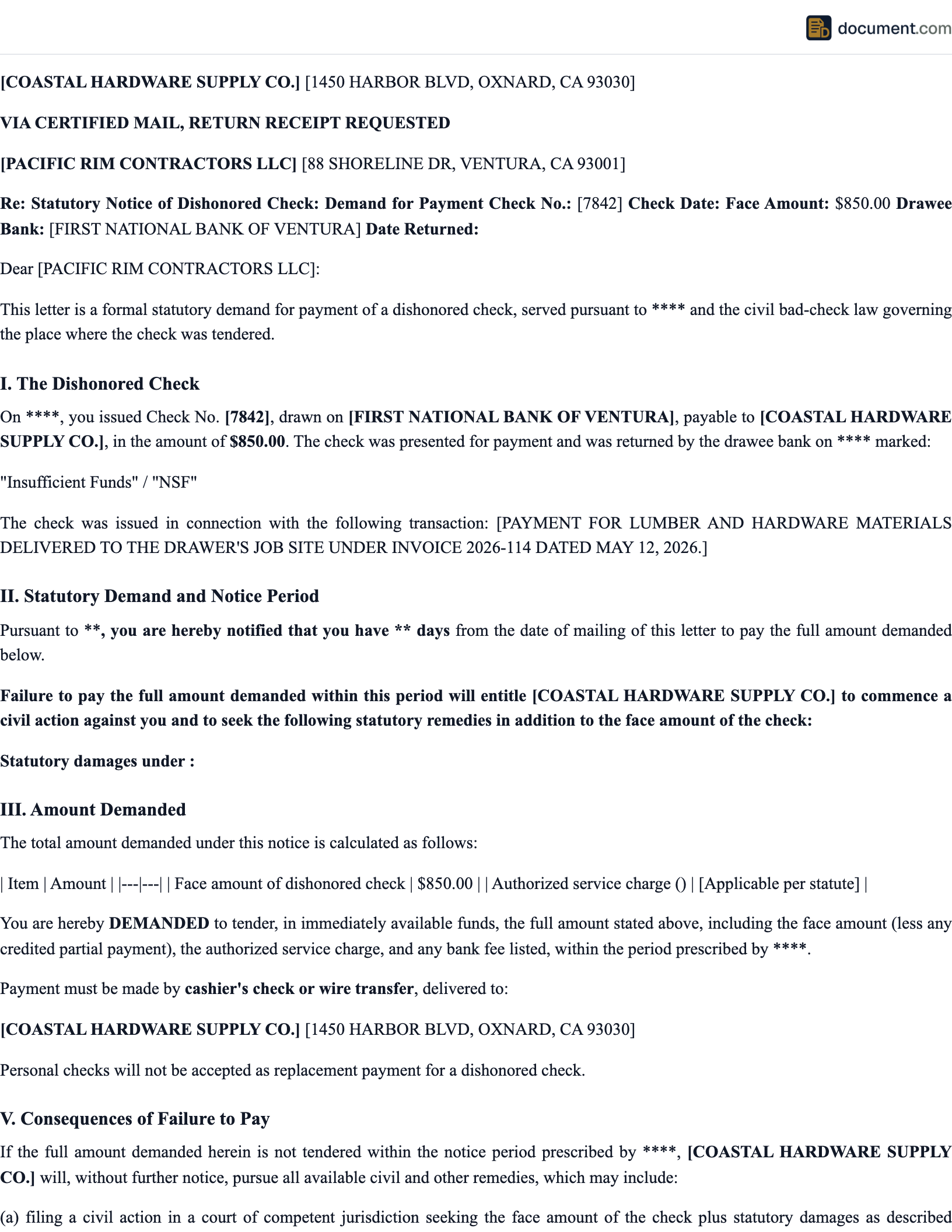



Pennsylvania Notice of Dishonored Check Overview
Pennsylvania gives the holder of a dishonored check one of the faster notice timelines in the country: ten days from the date the written demand is mailed. After that window closes without payment, the civil remedy under 42 Pa. C.S. § 8304 opens up, and the total you can collect is substantially more than the face value of the check. The statute applies to any check that is returned because of insufficient funds or a closed account, and it covers both individuals and businesses on either side of the transaction.
The civil remedy runs entirely on a private track. You, as the payee, send the demand directly to the check writer. There is no need to go through a government office first, and the claim can be brought in a magisterial district court -- Pennsylvania's version of small claims court -- for check amounts that fall within the $12,000 jurisdictional ceiling. Pennsylvania's magisterial district judges are familiar with § 8304 claims and handle them regularly. For amounts above $12,000, the case goes to the Court of Common Pleas.
Separate from the civil track, Pennsylvania's criminal bad-check statute sits at 18 Pa. C.S. § 4105, and many county district attorney offices run structured bad-check diversion programs that require a prior written demand as a condition of acceptance. Sending the civil notice under § 8304 therefore does double duty: it starts the enhanced-damage clock and, if the check writer does not respond, it generates the documentation most DA programs require before they will accept the matter for prosecution or diversion.
$100 or 3x check amount, whichever is greater
Civil damages
10 days written demand before filing
Notice period
Up to $50 (or actual bank fee if greater than $50)
Service charge
42 Pa. C.S. § 8304
Controlling statute
The Controlling Statute: 42 Pa. C.S. § 8304
Title 42 of the Pennsylvania Consolidated Statutes, section 8304, creates a standalone civil cause of action for the holder of a dishonored check. The statute is short and direct. It provides that a person who issues a check that is subsequently dishonored is liable to the holder for the face amount of the check, a service charge of up to $50 (or the actual bank charge if that charge exceeds $50), and a civil penalty -- subject to the conditions and caps the statute specifies. The civil penalty is available only after proper written notice has been sent and the prescribed period has run without payment.
The damages formula has two parts. First, the holder is entitled to $100 or three times the check amount, whichever is greater. Second, that figure cannot push the total recovery beyond the face amount of the check plus $500. Those two constraints operate together: the floor prevents tiny-check claims from being economically meaningless, while the ceiling prevents the penalty from becoming punitive on large checks. A returned check for $30 produces a minimum civil penalty of $100, not $90. A returned check for $5,000 produces a maximum civil penalty of $500 above the $5,000 owed, not $15,000.
The statute covers checks returned for NSF and for closed accounts. Stop-payment checks are a different question. Pennsylvania courts and practitioners generally treat a stop payment made without legitimate cause as within the scope of § 8304 when the underlying dishonor is functionally equivalent to an NSF return, but a stop payment made to dispute defective goods or services is unlikely to satisfy the intent element the statute implies. If the check writer asserted a stop payment because of a genuine contractual dispute, the civil bad-check remedy may not apply, and the better vehicle is a breach-of-contract or UCC Article 3 claim.
Section 8304 does not prescribe the exact language the notice must contain, which distinguishes Pennsylvania from states like Georgia that mandate a specific statutory form. What Pennsylvania does require is that the demand be written and that it give the drawer ten days to make good on the check. The notice must be sent before you file suit for the enhanced damages. A holder who files immediately after dishonor, without first sending the written demand and waiting the ten-day period, cannot collect the civil penalty under § 8304, even if the check writer never paid.
Statute Reference
42 Pa. C.S. § 8304
Damages: $100 or 3x check amount, whichever is greater; cap: check + $500
What You Can Recover in Pennsylvania
The base recovery under § 8304 is the face amount of the check plus the service charge -- up to $50, or the actual bank returned-item fee if that fee exceeds $50. Those two figures together represent what you would have had if the check had cleared and the bank had not charged you anything. The civil penalty is layered on top of that base. The formula awards you $100 or three times the check amount, whichever number is larger. On a $25 check, three times the amount is $75, which is less than $100, so the statute gives you $100 anyway. On a $50 check, three times the amount is $150, which exceeds $100, so you take the $150.
The cap changes the picture for anything above about $167. Once the check amount rises above $167, three times that amount exceeds $500, and the statutory ceiling kicks in: the civil penalty cannot push the total award more than $500 above the face value of the check. So for a $500 check, you recover $500 (face) plus up to $500 (penalty) plus the service charge. For a $2,000 check, you recover $2,000 (face) plus $500 (capped penalty) plus the service charge -- not $6,000. The multiplier effectively works only for checks in the range of roughly $34 to $167; above that, the cap governs.
To put concrete numbers on the range: a $100 check can yield $200 total in civil damages before the service charge (the $100 face amount plus the $100 minimum penalty). A $200 check yields $600 plus the service charge ($200 face plus $400 penalty, still under the $500 cap). A $600 check yields $1,100 plus the service charge ($600 face plus $500 cap). Attorney fees are not expressly authorized by § 8304 itself -- unlike Florida or California -- so you should not assume a fee-shifting award is available in Pennsylvania unless the underlying transaction provides a separate contractual or statutory basis for fees.
- Civil damages: $100 or 3x check amount, whichever is greater; cap: check + $500
- Service charge: Up to $50 (or actual bank fee if greater than $50)
- Notice period before suit: 10 days written demand before filing
Notice Procedure and Timeline in Pennsylvania
Pennsylvania's notice requirement is among the shortest in the country. You must send a written demand before you file suit for the civil penalty, and the check writer has ten days from the notice to tender payment. The statute does not specify the exact mailing method, but best practice -- and the method county DA bad-check programs consistently use -- is certified mail with return receipt requested sent to the address printed on the check or to the drawer's last known address. If you have reason to believe the certified mail will be refused or unclaimed, send a simultaneous copy by regular first-class mail and keep the certificate of mailing.
The ten-day clock starts on the date the notice is mailed, not the date it is received or signed for. Measure ten calendar days from the postmark. If day ten falls on a weekend or a Pennsylvania legal holiday, count the next business day as the deadline. Do not file the civil action until that deadline has passed without full payment. Courts interpreting § 8304 treat the notice period as a condition precedent; filing even one day early jeopardizes the penalty claim, and some judges will dismiss the enhanced-damage count on that basis alone.
The written demand should identify the check with specificity -- check number, date written, face amount, and the name of the drawee bank -- state the reason for dishonor as shown on the bank's return notice, recite the amount demanded (face value plus service charge), cite 42 Pa. C.S. § 8304, and give a clear payment deadline expressed as a calendar date. Although Pennsylvania does not mandate specific statutory language in the notice the way some other states do, precision reduces disputes about what the demand covered and whether it was adequate. Retain the original bank dishonor notice, a copy of the demand letter, the certified mail receipt, and any signed return card or tracking confirmation showing delivery. These four items are the core exhibit set at a magisterial district court hearing.
Pennsylvania-Specific Notes
Pennsylvania operates county-level bad-check diversion programs through district attorney offices, and they are meaningfully different from the civil § 8304 remedy. Monroe County's program, for example, sends a certified-mail courtesy notice giving the check writer ten days to respond and remit -- mirroring the civil statute's notice window exactly. Lehigh County runs a formal Bad Check Restitution Program focused on full restitution plus fees. York County's program accepts referrals and computes restitution under the fee ceiling codified at 18 Pa. C.S. § 4105(e-3), the criminal statute's service-charge provision, which also caps the fee at $50. If your county has a DA bad-check program, the civil notice under § 8304 and the DA program referral are complementary, not mutually exclusive. Send the civil demand first, wait the ten days, and if the check writer does not respond, you have both a ripe civil claim and the documentation the DA program typically requires before it will accept the matter.
Pennsylvania's criminal bad-check statute, 18 Pa. C.S. § 4105, grades the offense by check amount. A check under $200 is a summary offense. From $200 to just under $500 it is a third-degree misdemeanor. From $500 to just under $1,000 it becomes a second-degree misdemeanor. From $1,000 to just under $75,000 it is a first-degree misdemeanor. At $75,000 or more it rises to a third-degree felony. A third or subsequent offense within a five-year period escalates to at least a first-degree misdemeanor regardless of the check amount, and to a third-degree felony if the check is $75,000 or more. These thresholds are important context when deciding whether to pursue civil recovery, refer to the DA, or do both.
Pennsylvania Specific Note
Pennsylvania does not have a statutory attorney-fee provision in § 8304 itself. If you hire counsel to pursue a bad-check claim and the check amount is modest, the fee award is not automatic -- you need an independent contractual or statutory basis to shift fees. On small checks, the economics favor self-representation in magisterial district court, where the procedures are designed for parties without counsel. On larger checks that still fall under the $12,000 ceiling, the penalty cap of $500 above face value may make the total recovery insufficient to justify a contested attorney-fee arrangement unless the underlying transaction also supports additional claims.
The civil remedy under § 8304 and the criminal track under § 4105 can run in parallel, but the timing matters. Filing a civil complaint before the check writer has had a full ten days on the written demand -- even if you simultaneously refer the matter to the DA -- can defeat the civil penalty claim. Once the ten-day window closes cleanly, you are free to file in magisterial district court, accept a DA diversion referral, or both. If the check writer makes partial payment during the ten days, note the receipt, apply it to the balance, and recalculate: the civil penalty under § 8304 is computed on the unpaid balance at the time the notice period expires, not on the original face amount.
Pennsylvania Bad Check FAQ
Other State Bad Check Laws
Each state sets its own notice period, damage formula, and service charge. Browse sibling state pages for the specific rules that apply to your situation, or return to the full 50-state guide.
Create your Pennsylvania Notice of Dishonored Check in minutes.
Answer a few questions and download a Pennsylvania-compliant bad check demand letter that cites 42 Pa. C.S. § 8304 and is ready to mail certified.