
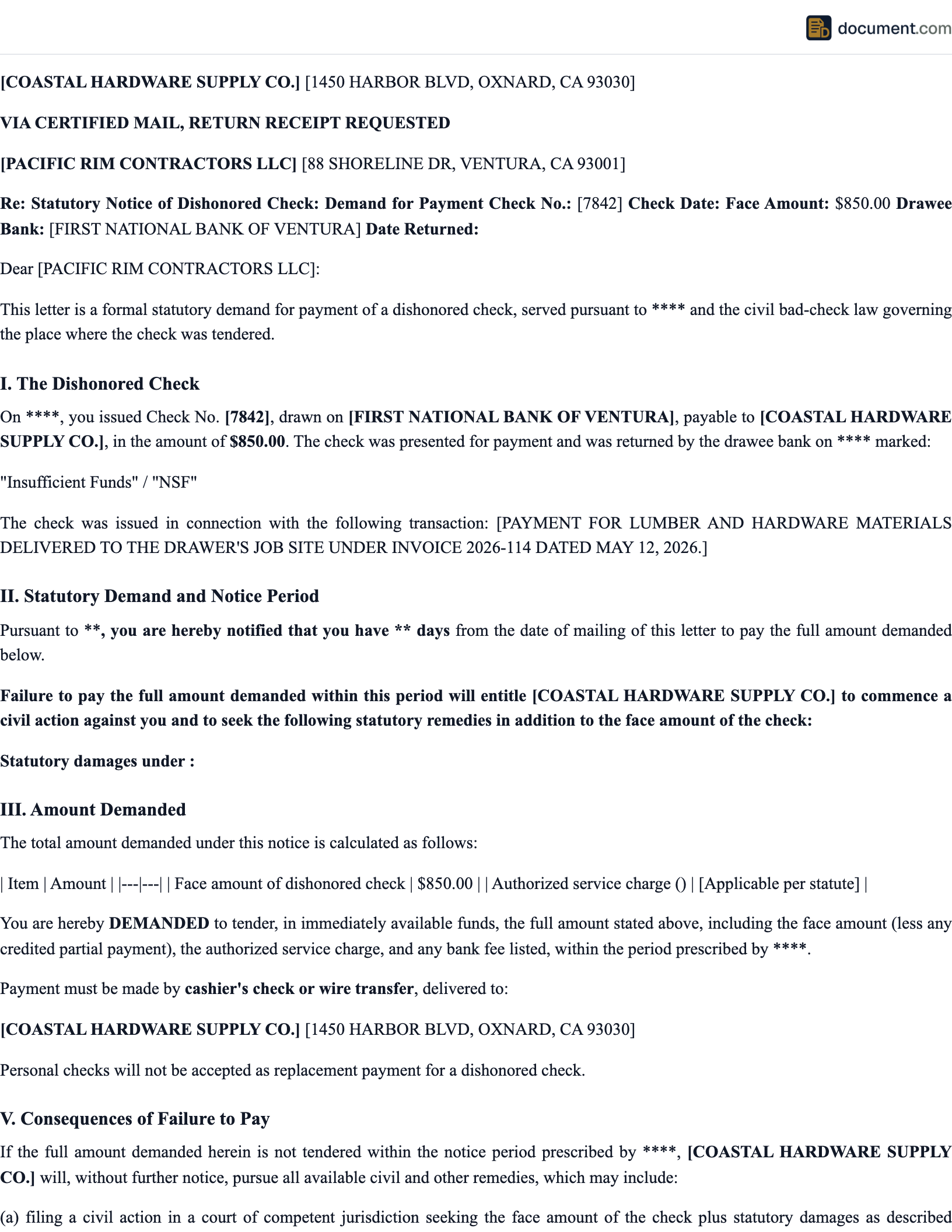



Rhode Island Notice of Dishonored Check Overview
Rhode Island gives holders of dishonored checks a civil remedy that goes well beyond the face amount of the instrument. Under R.I. Gen. Laws § 6-42-3, a payee who follows the prescribed notice procedure can recover three times the check amount -- subject to a floor of $200 and a ceiling of $1,000 -- plus the check itself and a $25 service charge. The legislature located this remedy in Title 6, Chapter 42 of the General Laws, the commercial-law title governing checks and other instruments, rather than in the general civil procedure title, which signals that the remedy is understood as a commercial collection tool rather than a punitive fine.
The practical architecture of the statute is a two-step process. First, the holder must wait until the check has been dishonored and remained unpaid for at least ten days. Second, the holder sends a written notice of dishonor by certified mail, return receipt requested, and then waits another thirty days. Only after that second window closes without payment does the civil penalty become available. A holder who skips either waiting period or uses the wrong mailing method cannot collect the treble-damage enhancement, even if the check is plainly worthless.
Rhode Island courts with jurisdiction over these claims include the District Court under its regular civil docket and, if the total amount claimed falls within the jurisdictional ceiling, the small-claims division of the District Court. The small-claims ceiling in Rhode Island is $2,500 -- one of the lowest in the country -- which means that once the treble-damage enhancement is added, many bad-check claims will exceed the small-claims limit and must proceed on the regular civil docket. That procedural detail affects how the holder should calculate filing fees and whether the complexity of producing documentation warrants retaining counsel.
3x check amount
Civil damages
30 days after written demand
Notice period
Up to $25
Service charge
R.I. Gen. Laws § 6A-3-506
Controlling statute
The Controlling Statute: R.I. Gen. Laws § 6A-3-506
R.I. Gen. Laws § 6-42-3 sits within Chapter 6-42, titled 'Checks and Other Instruments -- Dishonor,' which runs from § 6-42-1 through § 6-42-4. The chapter establishes the complete civil framework: § 6-42-1 defines the instruments covered and sets out the threshold dishonor period; § 6-42-2 specifies the form and delivery method for the notice of dishonor; § 6-42-3 creates the cause of action and sets the damages; and § 6-42-4 provides defenses available to the drawer.
The cause of action in § 6-42-3 is straightforward. Once a check, draft, or other instrument has been dishonored and has remained unpaid for ten days, the holder is permitted to send a statutory notice of dishonor. If the maker or drawer then fails to pay the full amount demanded within thirty days of that mailing, the holder may bring a civil action in District Court. The statute authorizes the holder to elect the small-claims procedure under Title 10, Chapter 16, subject to the jurisdictional ceiling for that procedure.
The damages formula has three components. The holder recovers the face amount of the check, a collection service charge of up to $25, and a civil penalty equal to three times the check amount -- with the constraint that the penalty may not be less than $200 and may not exceed $1,000. These three components are cumulative: a holder is not choosing between the face amount and the treble penalty; the holder recovers all three if the notice procedure was properly followed and the drawer failed to pay.
The statute provides an affirmative defense for the drawer in two situations: a justifiable stop-payment order or a lawful account attachment that caused the dishonor. A drawer who can show that the stop payment was legally justified -- for example, a bona fide dispute about the goods or services underlying the transaction -- can defeat the civil penalty, though the holder's right to recover the underlying debt on a contract theory remains unaffected. A drawer who pays the full amount demanded within the thirty-day notice period avoids the civil penalty entirely, regardless of how the check came to be dishonored.
Statute Reference
R.I. Gen. Laws § 6A-3-506
Damages: 3x check amount; not less than $200 nor more than $1,000
What You Can Recover in Rhode Island
Rhode Island's damages formula is capped in a way that is unusual among civil bad-check statutes. Most states set a ceiling as a multiple of the check amount or as a fixed dollar amount added on top of the check. Rhode Island instead caps the treble-damage component itself at $1,000, regardless of how large the check was. On a $50 check, the treble component would otherwise be $150, but the $200 floor lifts it to $200, so the total recovery is the $50 face amount plus up to $25 service charge plus $200 civil penalty -- $275 in total. On a $400 check, the treble component is $1,200, which the $1,000 ceiling reduces to $1,000, yielding a total of $1,425 plus the service charge.
The practical consequence is that the civil penalty structure in Rhode Island is most valuable on mid-range checks -- roughly $67 to $333 -- where the threefold multiplier produces a penalty between $200 and $1,000 without hitting either cap. Below that range, the $200 floor operates to give the holder a minimum penalty regardless of how small the check was. Above roughly $333, the $1,000 ceiling begins to compress the return: a holder whose $1,000 check was returned gets the same $1,000 civil penalty as a holder whose $500 check was returned. For checks larger than a few hundred dollars, the treble-damage component becomes a diminishing fraction of the total claim, and the holder's most important remedy is often simply recovering the face amount.
Beyond the civil penalty and face amount, the holder may also recover the $25 service charge authorized by the statute. This charge is intended to compensate the payee for the bank's returned-check fee and the cost of the collection demand itself. Unlike the civil penalty, the service charge is not subject to a minimum, and a holder who does not incur a full $25 in costs is not prohibited from claiming the statutory amount -- the statute sets the ceiling, not a reimbursement formula. The service charge should be itemized in the notice letter alongside the check amount and the amount of the pending civil penalty so the drawer understands exactly what full payment requires.
- Civil damages: 3x check amount; not less than $200 nor more than $1,000
- Service charge: Up to $25
- Notice period before suit: 30 days after written demand
Notice Procedure and Timeline in Rhode Island
The notice of dishonor under R.I. Gen. Laws § 6-42-2 must be sent by certified mail, return receipt requested. Rhode Island does not require a simultaneous first-class mailing the way California, Illinois, and several other states do, but that gap in the statute cuts both ways: if the certified mailing is returned unclaimed, the holder cannot fall back on a parallel first-class copy to establish constructive receipt. Best practice is to send a first-class copy at the same time even though the statute does not require it, both as a belt-and-suspenders measure and because some District Court judges expect it.
The thirty-day notice period runs from the date of mailing, not from the date the drawer signs the return receipt. Calculate the deadline as a specific calendar date and state it plainly in the letter: 'You have thirty (30) days from the date of this mailing, until [specific date], to pay the full amount of $[X]. If payment is not received by that date, a civil action may be commenced against you for the face amount of the check, a service charge of up to $25, and civil damages of not less than $200 and not more than $1,000 pursuant to R.I. Gen. Laws § 6-42-3.' Setting the deadline as a named calendar date removes any dispute about when the window closed.
Send the notice to the address printed on the check or to the drawer's last known address if that address has changed. Rhode Island's statute requires that the mailing be to the maker or drawer directly. If the check lists a business address and the drawer is an individual, send the notice to both addresses to avoid a later argument about whether notice was properly directed. Keep the original certified mail receipt, the tracking confirmation, and -- if the envelope is returned -- the returned envelope with the postal notation showing the delivery attempt. These documents are the exhibits that prove each procedural element of the claim if the case goes before a District Court judge.
Rhode Island-Specific Notes
Rhode Island's small-claims ceiling of $2,500 is one of the lowest jurisdictional limits in the country and has not changed since 1980 for plaintiff claims. This creates a practical constraint for bad-check cases. If the face amount of the check is, say, $800, and the holder adds the $1,000 treble penalty and the $25 service charge, the total claim is $1,825 -- still within small claims. But a $1,500 check produces a potential claim of $1,500 plus $1,000 plus $25, for a total of $2,525, which would exceed the small-claims ceiling by $25 and require filing on the regular District Court civil docket. Holders should run this arithmetic before choosing a filing track, because the regular docket carries higher filing fees and procedural requirements.
Rhode Island's statute expressly contemplates that the ten-day period before the notice can be sent is a precondition to the entire civil remedy, not merely a courtesy waiting period. A holder who sends the notice on the ninth day after dishonor has not satisfied the statutory prerequisite. The safer approach is to wait at least eleven days from the date the bank's return notice is received before mailing the demand, giving one day of buffer beyond the statutory minimum.
Rhode Island Specific Note
Rhode Island's Chapter 6-42 expressly limits the civil penalty to checks, drafts, and 'other instruments' within the scope of the chapter. The statute has not been amended to extend the civil bad-check remedy to dishonored ACH electronic fund transfers the way California, Florida, and several other states have done. A payee whose ACH debit was returned for insufficient funds is not entitled to the treble-damage civil penalty under Chapter 6-42; the available remedy is a breach of contract or account claim for the face amount of the debit only. Confirm the nature of the instrument before invoking the civil bad-check procedure.
Rhode Island's criminal bad-check statute is separate from the civil remedy in Chapter 6-42. The civil notice procedure is not a criminal referral and does not involve the district attorney. However, sending the civil demand and retaining proof that the drawer failed to pay is the kind of documentation that criminal diversion programs typically require before they will accept a check for prosecution. If the drawer's pattern of conduct suggests deliberate fraud rather than a one-time NSF event, the holder can pursue the civil remedy under Chapter 6-42 and separately contact the local district attorney's office about criminal referral -- the two proceedings are independent and can run concurrently.
Rhode Island Bad Check FAQ
Other State Bad Check Laws
Each state sets its own notice period, damage formula, and service charge. Browse sibling state pages for the specific rules that apply to your situation, or return to the full 50-state guide.
Create your Rhode Island Notice of Dishonored Check in minutes.
Answer a few questions and download a Rhode Island-compliant bad check demand letter that cites R.I. Gen. Laws § 6A-3-506 and is ready to mail certified.