
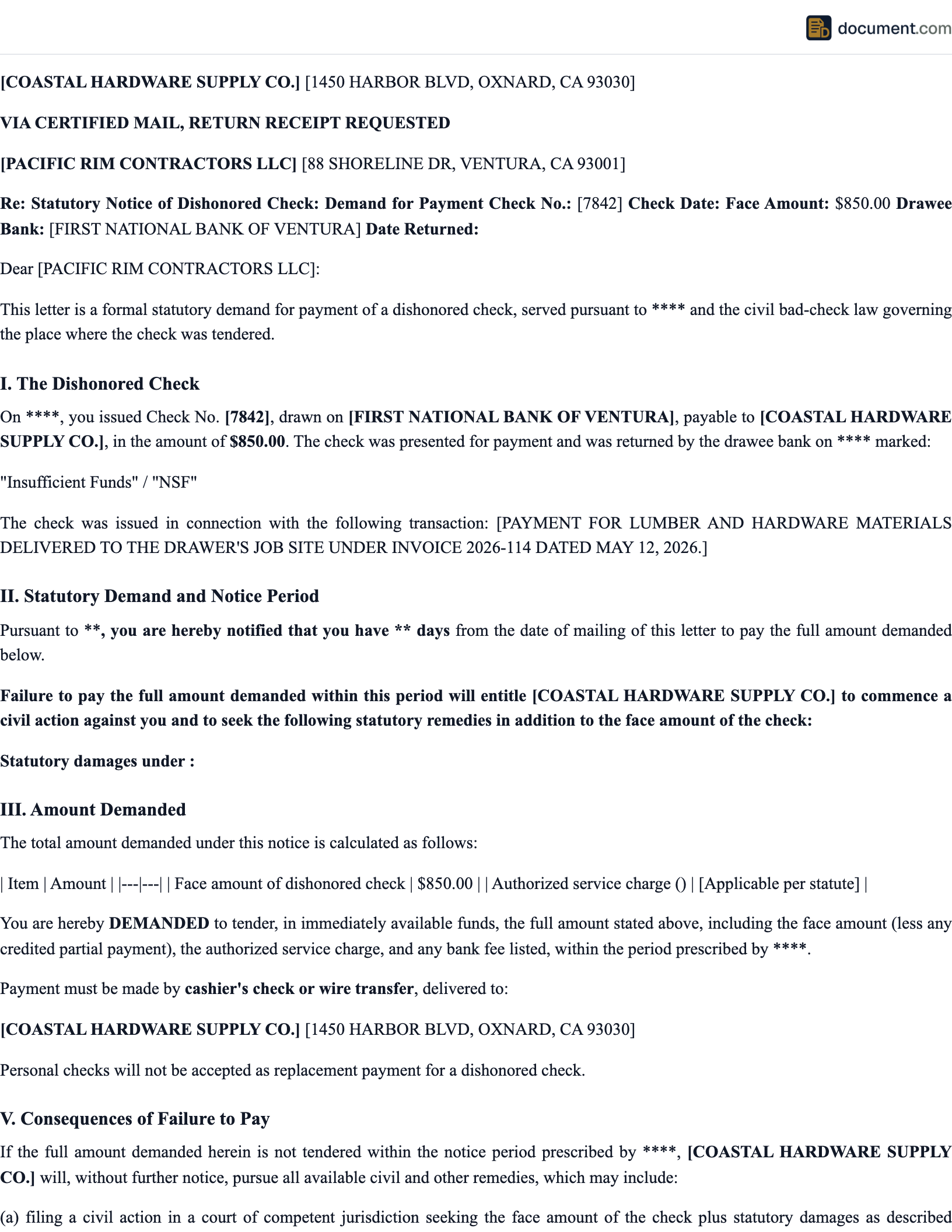



South Carolina Notice of Dishonored Check Overview
South Carolina gives check holders a civil remedy that is separate from, and often faster than, the criminal bad-check process. Under S.C. Code Ann. § 34-11-75, a payee who receives a dishonored check can pursue civil damages worth far more than the face amount of the instrument, provided the payee first sends a proper written demand and waits the prescribed period before filing suit. The statute is straightforward in structure but precise in its requirements, and a notice that omits required elements or uses the wrong mailing method leaves the enhanced-damage remedy on the table.
South Carolina's civil bad-check law sits within Title 34, Chapter 11, a chapter devoted entirely to fraudulent checks. The civil remedy under Section 34-11-75 and the criminal offense under Section 34-11-60 operate on parallel tracks. A payee can pursue the civil notice-and-sue procedure, refer the matter for criminal prosecution, or both. Most holders start with the civil route because it produces a money judgment directly enforceable against the drawer, without waiting for a criminal prosecution that may or may not result in restitution.
The statute covers checks, drafts, and other written orders drawn on a bank or depository for the payment of money. It reaches the most common dishonor scenarios: insufficient funds, closed accounts, and checks drawn with fraudulent intent. Stop-payment checks present a fact-specific question under South Carolina law, and holders in that situation should confirm whether the stop was entered with or without legitimate cause before relying on the statutory notice procedure.
Lesser of $500 or 3x amount owed
Civil damages
30 days after certified mail demand
Notice period
Up to $30
Service charge
S.C. Code Ann. § 34-11-75
Controlling statute
The Controlling Statute: S.C. Code Ann. § 34-11-75
S.C. Code Ann. § 34-11-75 creates civil liability for any person who knowingly or with fraudulent intent draws, issues, or delivers a check that is subsequently dishonored. The statute is triggered when the drawer acts with knowledge of insufficient funds or with intent to defraud -- the same mental-state element that the companion criminal statute requires, though the civil remedy does not depend on a criminal conviction or even a criminal charge. The payee enforces the civil remedy independently, through a private civil action.
The statute conditions the enhanced civil damages on a specific pre-suit demand procedure. The payee must send written demand by certified mail, the demand must describe the check and the circumstances of dishonor, and the payee must give the drawer 30 days to pay before filing suit. A demand that does not identify the check with particularity -- check number, date, amount, drawee bank -- or that is sent by ordinary first-class mail rather than certified mail will not satisfy the statutory prerequisite. Courts read compliance with the notice procedure strictly, so the form and method of the demand matter as much as the timing.
If the drawer does not pay within 30 days of the certified-mail demand, the payee may file a civil action. The court may award the face amount of the check, civil damages calculated under the statute's formula, court costs, and -- at the court's discretion -- reasonable attorney fees as part of costs. The attorney-fee provision makes Section 34-11-75 potentially viable even on small checks where the face amount alone would not justify litigation, because a fee award can shift the economics of the claim.
Section 34-11-75 also sets out three affirmative defenses available to the drawer: full satisfaction of the debt before the action is commenced; a bank error that caused the dishonor; and the payee's own knowledge of insufficient funds at the time the check was accepted. The bank-error defense requires the drawer to come forward with evidence that the dishonor was the bank's mistake, not the drawer's lack of funds. The knowledge-of-insufficiency defense targets situations where the payee agreed to hold the check or knew it could not be covered -- a common arrangement in the construction and real estate industries that can strip the payee of the statutory remedy.
Statute Reference
S.C. Code Ann. § 34-11-75
Damages: Lesser of $500 or 3x amount owed; plus court costs
What You Can Recover in South Carolina
Under S.C. Code Ann. § 34-11-75, the civil damages formula awards the lesser of $500 or three times the amount owed on the check. That cap structure means the multiplier is effectively unlimited on small checks but hard-capped on checks above roughly $167. On a $100 check, three times the amount owed is $300 -- below the $500 ceiling, so the payee collects $300 in damages plus the $100 face amount, for a total of $400 before costs. On a $200 check, three times the amount is $600 -- above the $500 ceiling, so the damages are capped at $500, bringing total recovery to $700. On any check above $167, the $500 cap applies and the multiplier becomes irrelevant to the damages calculation.
On top of the civil damages, the payee recovers court costs, which under Section 34-11-60 can include a $30 service charge that the statute authorizes on dishonored checks. The court may also award reasonable attorney fees as part of the cost award under Section 34-11-75, giving the payee a potential fee-shifting argument that is not available in a plain contract action for the face amount. Total recovery on a typical small-business dishonored check -- face amount plus $500 in damages plus service charge plus costs -- can reach several hundred dollars above the check value on instruments of modest size.
The damages are calculated on the amount still owed at the time the notice period runs, not necessarily the original face amount. If the drawer makes partial payment during the 30-day window, that payment reduces the base for the treble calculation. A drawer who pays half of a $300 check within 30 days reduces the unpaid base to $150, and three times that amount ($450) remains below the $500 cap, so the payee collects $450 in damages on the remaining balance. Partial payment does not defeat the civil claim -- it only adjusts the arithmetic.
- Civil damages: Lesser of $500 or 3x amount owed; plus court costs
- Service charge: Up to $30
- Notice period before suit: 30 days after certified mail demand
Notice Procedure and Timeline in South Carolina
The demand must be sent by certified mail. South Carolina's statute specifies that medium, not first-class mail, not email, not hand delivery. Address the certified mailing to the drawer at the address printed on the check or, if that address is no longer current, to the drawer's last known address. Unlike some other states, South Carolina does not expressly require a simultaneous first-class mailing, but sending a duplicate by regular mail the same day is a sound practice: if the certified piece is refused or returned unclaimed, the first-class copy supports the argument that the drawer had a reasonable opportunity to receive the demand.
The demand letter must describe the check and the circumstances of dishonor. At minimum, include the check number, the date written on the check, the face amount, the name of the drawee bank, and the reason the bank returned it -- insufficient funds, closed account, or stop payment. State the total amount the payee demands: the face amount of the check plus the $30 service charge if you are claiming it, and any bank-imposed returned-check fee the statute authorizes. Show the calculation in the letter itself. Cite Section 34-11-75 by name and section number, state that the payee intends to pursue civil damages under that statute if payment is not received, and give a specific calendar deadline 30 days from the date of mailing.
The 30-day period runs from the date of mailing, not the date the drawer receives the letter. Mail the demand and retain the certified-mail receipt, the tracking number, and the return receipt card when it comes back. If the certified piece is returned unclaimed, retain the envelope with the postal notation and your tracking printout -- those documents establish that you complied with the notice requirement. Do not file suit until the 30-day window has closed. Filing even a few days early is a procedural defect that can cost the payee the entire enhanced-damage award.
South Carolina-Specific Notes
South Carolina's criminal bad-check statute at Section 34-11-60 establishes a two-track system based on check amount. Checks of $1,000 or less are handled in magistrate court; checks above $1,000 go to general sessions court. The felony threshold is $5,000 -- a check or series of checks exceeding that amount triggers a felony charge rather than a misdemeanor. Criminal prosecution requires proof of intent to defraud and is handled by the solicitor's office, not the payee. Many holders use the civil notice as a first step and reserve the criminal referral for situations where the drawer has ignored the civil demand or is a repeat offender.
South Carolina magistrate court -- which is the state's equivalent of small claims court -- has civil jurisdiction over cases in which the amount in controversy does not exceed $7,500. Civil bad-check cases seeking the face amount plus the Section 34-11-75 damages are well within that ceiling for most dishonored checks, making magistrate court the practical venue for the majority of these claims. Filing in magistrate court is faster and less expensive than circuit court, and judges in that forum routinely handle civil bad-check cases. If the total damages you are seeking, including face amount, civil penalty, service charge, and attorney fees, might exceed $7,500, file in circuit court instead. Note that the South Carolina legislature has pending legislation that would raise the magistrate court civil limit to $25,000, but as of mid-2026 the current ceiling remains $7,500.
South Carolina Specific Note
South Carolina's statute includes an affirmative defense for payees who accepted the check with knowledge of insufficient funds. This defense appears more often than practitioners expect, particularly in relationships where one party has agreed to hold a check, deposit it on a specific date, or accept post-dated instruments. If the drawer can show the payee knew the check would not clear when accepted, the court may deny the enhanced civil damages even if the notice was properly sent. Payees in these situations -- landlords who accepted post-dated rent checks, contractors who accepted checks marked 'do not deposit until' -- should be prepared to address this defense in any civil filing.
South Carolina's Section 34-11-90 includes a first-offense sentence suspension provision in the criminal context: after conviction, a first-time offender who pays restitution and court costs is entitled to have the sentence suspended. This is a criminal-side mechanism, not a pre-charge diversion program, and it does not eliminate the civil remedy under Section 34-11-75. A drawer who settles the criminal case through restitution still owes the civil damages to the payee unless the civil claim was separately resolved. The two proceedings are independent, and restitution paid in the criminal case does not automatically satisfy a civil judgment.
South Carolina Bad Check FAQ
Other State Bad Check Laws
Each state sets its own notice period, damage formula, and service charge. Browse sibling state pages for the specific rules that apply to your situation, or return to the full 50-state guide.
Create your South Carolina Notice of Dishonored Check in minutes.
Answer a few questions and download a South Carolina-compliant bad check demand letter that cites S.C. Code Ann. § 34-11-75 and is ready to mail certified.