
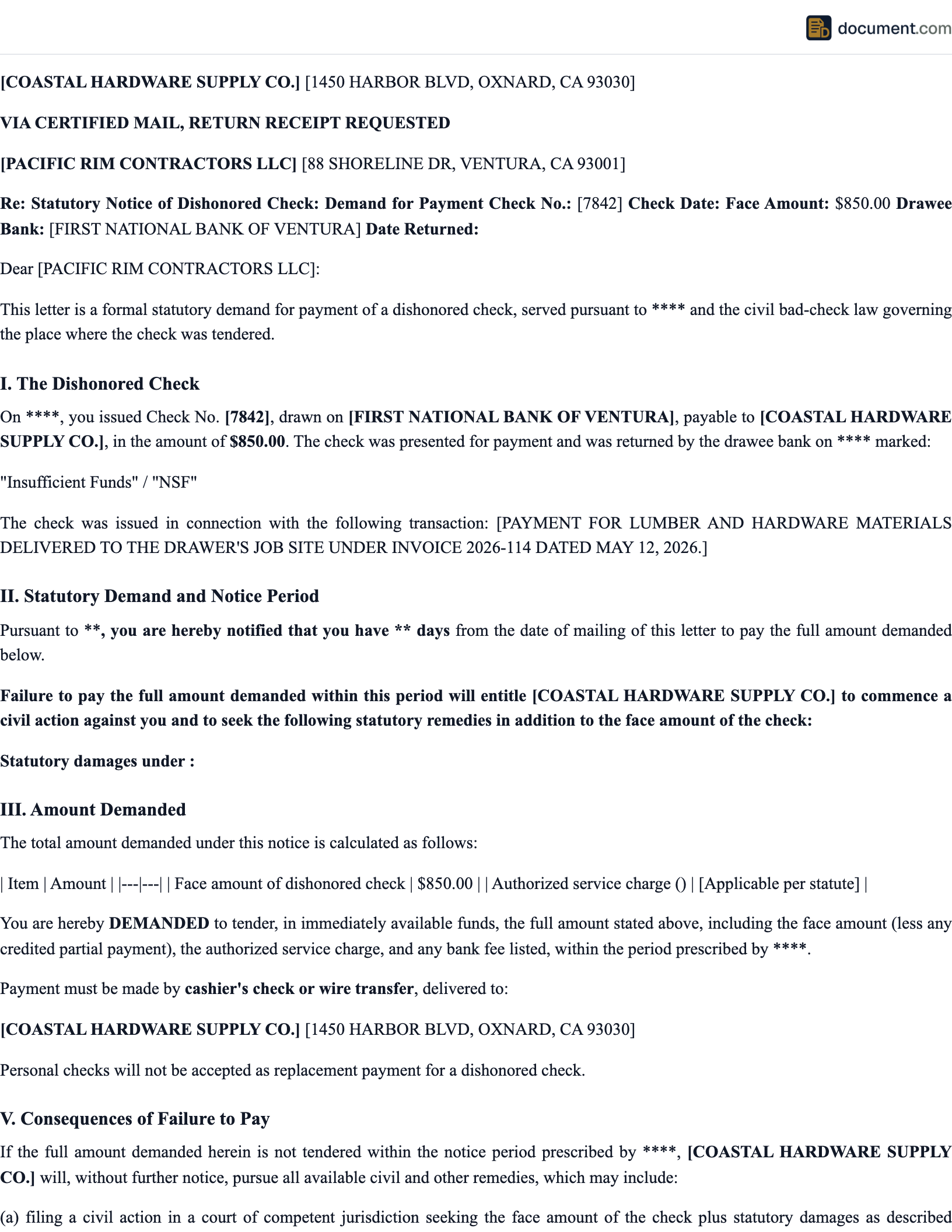



Ohio Notice of Dishonored Check Overview
Ohio gives payees a powerful civil remedy when a check is returned unpaid. Under Ohio Revised Code § 2307.61, the holder of a dishonored check may sue not just for the face amount of the instrument but for three times that amount, together with collection costs, actual bank charges, and reasonable attorney fees. That combination makes civil recovery worth pursuing even on checks that would otherwise be too small to justify the effort of litigation.
The civil remedy sits alongside Ohio's separate criminal bad-check statute, Ohio Rev. Code § 2913.11, but the two tracks are independent. You do not need to wait for a criminal prosecution, and a criminal conviction is not required to prevail in a civil action. Most payees pursue the civil route because it produces a money judgment they can enforce directly, on a timeline they control, without depending on a prosecutor's office to accept the case.
One threshold requirement gates everything that follows: Ohio law conditions the right to civil penalties on the payee sending a written demand to the check writer and waiting at least 30 days for payment before filing suit. Skip that step, or send a demand that does not satisfy the statutory requirements, and you will be limited to the face amount of the check on an ordinary contract theory, losing the treble-damage multiplier and the attorney-fee award that make § 2307.61 worth using.
3x check value
Civil damages
30 days written demand before filing suit
Notice period
Actual bank charges
Service charge
Ohio Rev. Code § 2307.61
Controlling statute
The Controlling Statute: Ohio Rev. Code § 2307.61
Ohio Rev. Code § 2307.61 is titled 'Civil action for willful damage or theft' and reaches dishonored checks because Ohio defines the offense of passing bad checks, § 2913.11, as a theft offense under the definitions in § 2913.01. That definitional hook brings bad checks squarely within § 2307.61's civil remedy framework. The statute gives the property owner -- in this context, the payee -- the right to bring a civil action against the person who committed or benefited from the theft offense.
The damages formula under § 2307.61 authorizes the payee to recover liquidated damages equal to three times the value of the check at the time it was presented and dishonored. On top of that multiplier, the statute separately authorizes recovery of reasonable administrative costs, the costs of maintaining the civil action, and reasonable attorney fees. Those add-ons are available when the check value is less than five thousand dollars and the payee serves the required written demand at least 30 days before filing. For checks at or above five thousand dollars, the statute still authorizes the treble multiplier; confirm the full fee-and-cost provisions with the current enrolled text for transactions in that range.
Crucially, § 2307.61 contains a reciprocal provision: if the person sued prevails in the civil action, that person may recover reasonable attorney fees, defense costs, and proved compensatory damages from the payee. This is not a typical one-sided fee-shifting statute. A payee who brings a civil bad-check claim without solid documentation of the dishonor and a proper demand runs a real risk of ending up on the wrong side of a fee award. The statute rewards the well-prepared holder and penalizes the careless one.
Ohio's civil bad-check remedy operates through the general civil courts rather than through a dedicated bad-check proceeding. That means venue, service of process, and pleading rules follow standard Ohio civil procedure. For claims within the $6,000 small claims ceiling, municipal and county court small claims divisions hear these matters routinely, and judges in those courts are familiar with the § 2307.61 framework. Claims above $6,000 proceed in the general civil division.
Statute Reference
Ohio Rev. Code § 2307.61
Damages: 3x check value; plus collection fees, bank fees, and reasonable attorney fees
What You Can Recover in Ohio
Under § 2307.61, the core recovery is three times the face amount of the dishonored check. On a $500 check, that yields a potential judgment of $1,500 before adding fees and costs. On a $2,000 check, the treble figure reaches $6,000. Because the multiplier applies to the full check value rather than only the unpaid portion, Ohio's formula is straightforward to calculate: take the face amount of the check, multiply by three, then add the items below.
On top of the treble damages, the statute separately authorizes: actual bank charges the payee incurred because of the dishonor (the returned-check fee your bank assessed), reasonable administrative or collection costs, the cost of maintaining the civil action (filing fees, service costs), and reasonable attorney fees if you retained counsel. Ohio does not fix a dollar cap on the bank-charge or attorney-fee components the way some states cap their service charges at a flat figure. What is 'reasonable' is determined by the court based on the work actually performed and the amount in controversy.
One practical point on the arithmetic: if the check writer makes partial payment between dishonor and the expiration of your demand period, apply that payment to the balance before calculating treble damages. The multiplier under § 2307.61 attaches to the value of the dishonored instrument, and a payment that partially satisfies the debt reduces the base. Document any partial payments in writing, note the date received, and recalculate the demand total if you amend the notice or file suit after a partial payment arrives.
- Civil damages: 3x check value; plus collection fees, bank fees, and reasonable attorney fees
- Service charge: Actual bank charges
- Notice period before suit: 30 days written demand before filing suit
Notice Procedure and Timeline in Ohio
Before filing a § 2307.61 civil action, you must serve a written demand on the check writer and allow at least 30 days to pass without full payment. This is a statutory prerequisite, not a courtesy step. Ohio courts have been clear that the demand requirement conditions the availability of enhanced damages: a payee who files before the 30-day period runs forfeits the treble-damage and fee-award components and is left with a plain contract claim for the face amount.
The demand letter should identify the check by date, amount, check number, and drawee bank; state the reason it was returned (NSF, closed account, or stop payment); recite that you are proceeding under Ohio Rev. Code § 2307.61; specify the total amount you are demanding, including the face amount, bank charges, and any collection costs you are asserting; and state that you will file a civil action for treble damages and attorney fees if the full amount is not received within 30 days. Precision in the demand amount matters: a court that finds the demand vague may limit recovery to the face value.
Send the demand by certified mail, return receipt requested, addressed to the name and address that appear on the check or to the drawer's last known address if that is different and verifiable. Retain the outbound receipt, the tracking confirmation, and, if the mailing is returned unclaimed, the envelope with the postal notation. These records are the exhibits that prove the demand element at trial. The 30-day period runs from the date of mailing, not from the date the drawer signs the return receipt card, so the clock starts as soon as you drop the envelope at the post office. Count 30 full calendar days and do not file until that window has closed.
Ohio-Specific Notes
Ohio's criminal bad-check statute, § 2913.11, grades the offense based on the total value of all checks passed. A single returned check under $1,000 to one payee is a first-degree misdemeanor. The threshold rises to a fifth-degree felony when the checks to a single payee total $1,000 or more but less than $7,500, or when checks to multiple payees total $1,500 or more but less than $7,500. The fourth-degree felony threshold starts at $7,500 across all checks, and checks totaling $150,000 or more reach the third-degree felony level. These thresholds are relevant because they signal the seriousness with which Ohio treats willful bad-check conduct, and because many county prosecutors' offices will not accept a check for criminal prosecution unless the civil demand has already been sent and ignored, making your § 2307.61 demand letter a practical prerequisite to criminal referral as well.
Ohio's small claims limit sits at $6,000 (exclusive of interest and costs), which means the treble-damages calculation itself can run up to $2,000 in face value before the treble figure bumps you out of small claims jurisdiction. A payee holding a $1,500 dishonored check seeking $4,500 in treble damages fits comfortably within that ceiling and can file without an attorney in the municipal or county small claims division. A $2,500 check yields a $7,500 treble figure, which exceeds the small claims cap and would require filing in the general civil division -- worth knowing before you choose your forum.
Ohio Specific Note
§ 2307.61's reciprocal attorney-fee provision is not standard in most states' bad-check statutes. If you bring a civil action under this section and the drawer prevails -- for example, by showing the check was returned because of a banking error you contributed to, or that the demand notice was defective -- the court may award the drawer reasonable attorney fees and defense costs against you. This risk is manageable with proper documentation and a clean demand procedure, but it is a real exposure that distinguishes Ohio from states with one-sided fee-shifting. Do not use the civil bad-check remedy as leverage on an underlying contract dispute where the drawer has a colorable defense to the transaction itself.
Ohio does not appear to operate a statewide district attorney check diversion program of the kind found in some other states; check-fraud prosecutions are handled at the county level by individual prosecutors' offices, and practices vary considerably. Some county offices maintain informal intake procedures for businesses presenting bad checks accompanied by proof of a civil demand; others route these cases through the general theft-fraud intake process. If criminal referral is part of your strategy, contact the prosecutor's office in the county where the check was presented or where the drawer resides before assuming a particular intake procedure applies.
Ohio Bad Check FAQ
Other State Bad Check Laws
Each state sets its own notice period, damage formula, and service charge. Browse sibling state pages for the specific rules that apply to your situation, or return to the full 50-state guide.
Create your Ohio Notice of Dishonored Check in minutes.
Answer a few questions and download a Ohio-compliant bad check demand letter that cites Ohio Rev. Code § 2307.61 and is ready to mail certified.