
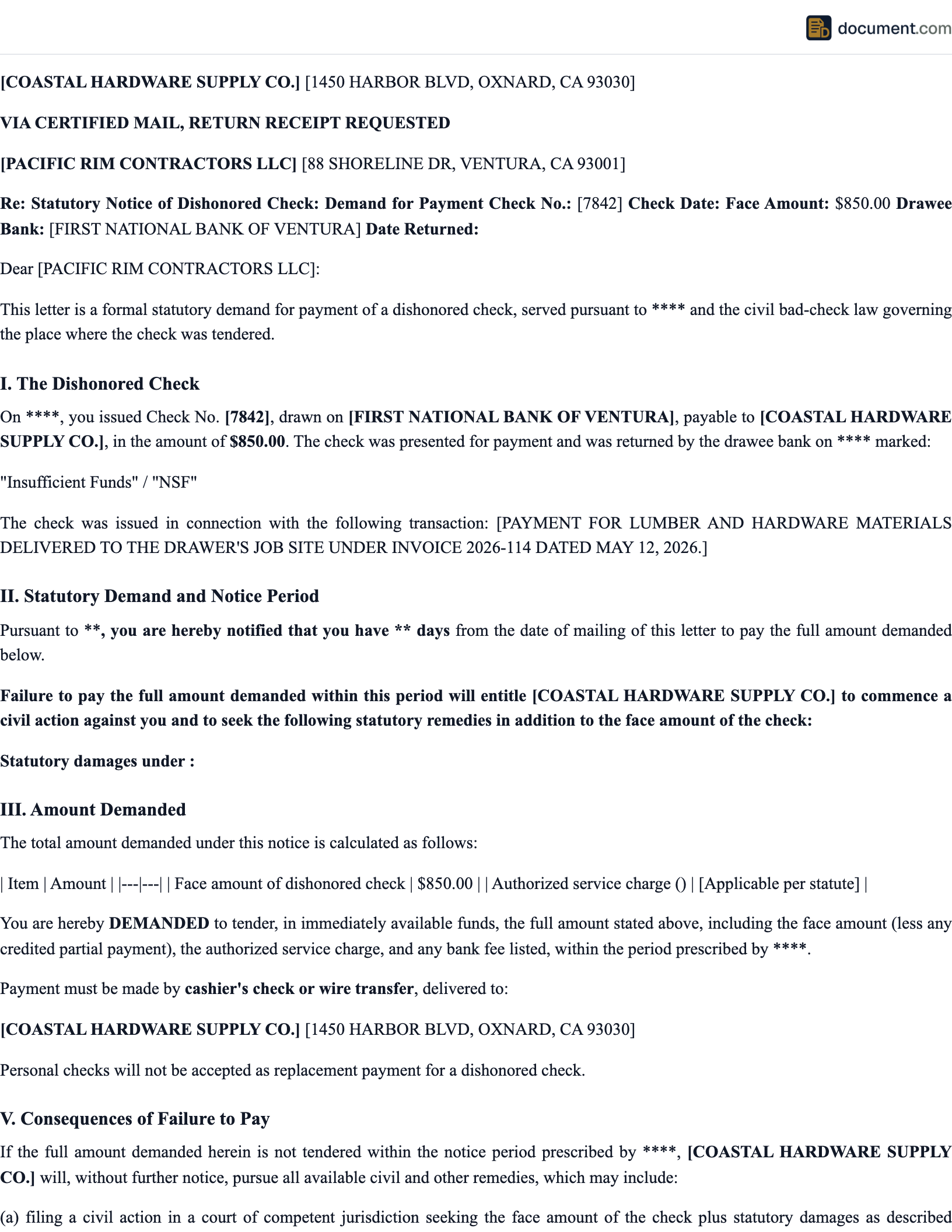



Oklahoma Notice of Dishonored Check Overview
Oklahoma takes a two-track approach to dishonored checks. The criminal framework under Okla. Stat. tit. 21, §§ 1541.3 and 1541.4 handles the punitive side, while the civil remedy framework under tit. 22, § 114 and tit. 68, § 218 gives payees a direct route to recovery without involving the district attorney. The civil track is the faster and more controllable option for most businesses and individuals holding a bad check, because the payee controls the timeline from dishonor to demand to suit.
The threshold question in any Oklahoma bad-check matter is whether the drawer received written notice and failed to cure within five days. That five-day window is not a courtesy period; it is a statutory prerequisite. A payee who moves straight from dishonor to court action, skipping the written demand, gives up the civil penalty and may also undermine any later criminal referral to a DA bogus-check program. The notice is the foundation on which every other remedy rests.
Oklahoma's civil statute is compact compared to those of states like California or Florida, but it covers the essential elements: authorization for civil damages beyond the face value of the check, an administrative service charge separate from the check amount, and a defined cure window that, once it closes without payment, converts a straightforward collection problem into an enhanced civil claim. Understanding how those three components interact is what separates a payee who recovers the full statutory amount from one who walks away with only the check face value and a bank fee.
Civil damages available
Civil damages
5 days after dishonor for cure before full liability attaches
Notice period
Administrative fee authorized under tit. 68, § 218
Service charge
Okla. Stat. tit. 22, § 114 / tit. 68, § 218
Controlling statute
The Controlling Statute: Okla. Stat. tit. 22, § 114 / tit. 68, § 218
Okla. Stat. tit. 22, § 114 is the civil counterpart to Oklahoma's criminal bogus-check provisions. It establishes that a payee who holds a dishonored check may pursue civil damages against the drawer, provided the payee has first sent a written demand giving the drawer at least five days to make the check good. The statute does not prescribe a specific form of notice, but it conditions the civil remedy on the demand having been sent and the cure period having run without satisfaction. The provision interacts directly with tit. 21, §§ 1541.3 and 1541.4, which create the criminal presumption that a maker who passes a check without sufficient funds intends to defraud, but § 114 operates entirely within the civil system.
Okla. Stat. tit. 68, § 218 provides the authorization for the administrative service charge that a payee may add to the amount demanded. This section sits in Title 68, the revenue and taxation title, because returned-check charges arise frequently in the context of payments made to government agencies, but courts and practitioners have applied it as the source of the service charge authorization in private civil bad-check actions as well. The charge compensates the holder for the administrative cost of handling the return, separate from any bank fee the holder may have incurred. The amount of the service charge is fixed by statute rather than left to the payee's discretion, which means a demand that claims a service charge higher than the authorized figure exposes the payee to an objection that could reduce the overall recovery.
The two statutes work in sequence. Title 68, § 218 determines how much the payee may demand in the notice letter. Title 22, § 114 determines whether the payee has standing to bring the civil action at all and on what timetable. A payee who sends a demand that includes the correct authorized service charge, waits the full five days, and then files suit when payment has not arrived has satisfied both provisions. A payee who omits the service charge from the demand letter may still recover the check face value and any civil damages, but loses the right to add the charge later because it was not claimed in the notice.
Oklahoma's statute does not expressly authorize treble damages in the way that California Civil Code § 1719 or Florida Statutes § 68.065 do. The civil damages available under § 114 are best understood as compensatory and penalty damages rather than a fixed multiplier. Payees seeking the maximum civil recovery should confirm the current enrolled text of § 114 with the Oklahoma State Courts Network or the legislature's official statutes site, because the precise damages formula and any cap are the details that determine what the case is worth before filing.
Statute Reference
Okla. Stat. tit. 22, § 114 / tit. 68, § 218
Damages: Civil damages available; 5-day cure period after dishonor before criminal/civil exposure
What You Can Recover in Oklahoma
Civil damages under Okla. Stat. tit. 22, § 114 include the face amount of the dishonored check plus the authorized service charge under tit. 68, § 218. The civil damages that attach after the five-day cure period expires without payment go beyond the face amount, allowing the payee to recover more than a straightforward breach-of-contract claim would yield. The exact multiplier or ceiling should be confirmed against the current enrolled statutory text, because the specific cap is the figure courts will apply and it controls how much the demand letter should claim.
The service charge authorized under tit. 68, § 218 is separate from the civil penalty and from any bank returned-check fee. It accrues at the time of dishonor and may be included in the initial demand letter without waiting for the five-day period to run. A payee who is owed $500 on the check face, incurred a $35 bank return fee, and is entitled to the statutory service charge should itemize all three components in the demand. Showing the arithmetic in the letter removes any dispute about what 'full payment' means when the drawer tries to settle during the cure window.
The five-day cure window itself affects how damages are calculated. If the drawer tenders the face amount plus the service charge within five days of receiving the written notice, that payment constitutes a complete cure and no civil penalty attaches. If the drawer sends a partial payment within five days, the civil penalty calculation runs on the unpaid balance, not the original check amount. Documenting the date and amount of any partial payment is important, because a drawer who claims to have cured within the window bears the burden of showing timely full payment, and a payee who received a partial payment and did not credit it correctly can find the damages calculation disputed at trial.
- Civil damages: Civil damages available; 5-day cure period after dishonor before criminal/civil exposure
- Service charge: Administrative fee authorized under tit. 68, § 218
- Notice period before suit: 5 days after dishonor for cure before full liability attaches
Notice Procedure and Timeline in Oklahoma
The five-day cure period under Okla. Stat. tit. 22, § 114 runs from the date the drawer receives the written demand, not from the date of mailing. This distinction matters for calculating when the payee may file suit. A notice mailed Monday by regular first-class mail to an in-state address might be received Wednesday or Thursday, which means the five-day window runs until the following Monday or Tuesday. Payees who mail by certified mail, return receipt requested, have a signed receipt showing the delivery date, which removes any ambiguity. Where the certified piece is refused or unclaimed, the return envelope with the postal notation documents that the drawer had an opportunity to accept the demand and declined it, which supports the inference that the drawer had notice.
Oklahoma's civil statute does not specify certified mail as the required delivery method the way California's or North Carolina's statutes do, but certified mail with return receipt remains the correct practice for two reasons. First, it creates a receipt that proves both delivery and the date of delivery, which sets the five-day clock with precision. Second, many district attorney bogus-check programs in Oklahoma counties will not accept a check for the diversion program unless the payee can show that a written demand was sent and the drawer failed to respond, and the certified-mail receipt is the cleanest evidence of that fact. Address the notice to the address printed on the check or, if you have independent knowledge of a different current address, to both.
Calculate the payment deadline as a specific calendar date and state it plainly in the notice. If the letter reads 'you have five days from receipt of this notice,' a drawer who disputes the receipt date can argue about when the window closed. A notice that reads 'you have five days from receipt of this letter, which we expect will be received no later than [date], meaning payment must be received no later than [specific date]' eliminates that argument. Include payment instructions in the same letter: the name of the payee, the mailing address, and a statement that replacement funds must be in the form of a cashier's check or money order. Accepting a personal check as replacement payment on a dishonored personal check is a practice courts have noted with some skepticism.
Oklahoma-Specific Notes
Oklahoma's criminal bad-check statute, Okla. Stat. tit. 21, §§ 1541.3 and 1541.4, creates a tiered penalty structure based on the number and aggregate value of bad checks. A single check below $1,000 is generally a misdemeanor, punishable by up to six months in county jail and a fine up to $500. When a person writes two or more bad checks totaling $1,000 or more, the offense rises to a felony carrying up to ten years in prison and a fine up to $5,000. The statute also establishes a legal presumption of intent to defraud from the act of passing a check that is dishonored, which shifts the evidentiary burden onto the drawer in both criminal and civil proceedings.
Oklahoma district attorneys in multiple counties operate dedicated bogus-check programs that function as pre-prosecution diversion mechanisms. Tulsa County's Bogus Check Division and the District 12 program, among others, accept check submissions from victims, contact check writers, and pursue restitution on the payee's behalf. These programs typically collect the face value of the check plus a merchant return fee (the Tulsa program has used a $25 merchant return fee). Participation is generally free to the payee. The practical implication for civil-track payees is that the DA program and the civil notice procedure are not mutually exclusive: sending the statutory demand under tit. 22, § 114 first documents the demand element, and if the drawer ignores the civil notice, the payee has the paperwork the DA program will want when the check is submitted for the diversion track.
Oklahoma's small claims court ceiling is $10,000, which covers most dishonored-check cases that individuals and small businesses encounter. A payee with a check below that amount can file the civil action in small claims court without an attorney, presenting the original check, the bank's return notice, the demand letter, and the certified-mail receipt. Small claims judges in Oklahoma are familiar with the bad-check statutory framework, and a complete paper trail typically resolves the case on the documents. For checks above $10,000, the action must be filed in the district court's general civil division, where the procedural requirements are more demanding.
Oklahoma Specific Note
Oklahoma's five-day cure period is measured from the date the drawer receives the demand, not from the date of mailing. A payee who files suit on day five after mailing, without accounting for delivery time, may have filed prematurely if delivery did not occur on the day of mailing. Filing before the cure period has fully run is the most common procedural defect in Oklahoma bad-check civil actions. Count the days from the delivery date shown on the certified-mail return receipt, add five full days, and do not file until the morning of day six or later. If the certified piece is unclaimed and returns without a delivery date, consult the tracking record for the date delivery was attempted and reason from that date.
Oklahoma Bad Check FAQ
Other State Bad Check Laws
Each state sets its own notice period, damage formula, and service charge. Browse sibling state pages for the specific rules that apply to your situation, or return to the full 50-state guide.
Create your Oklahoma Notice of Dishonored Check in minutes.
Answer a few questions and download a Oklahoma-compliant bad check demand letter that cites Okla. Stat. tit. 22, § 114 / tit. 68, § 218 and is ready to mail certified.