


North Dakota Notice of Dishonored Check Overview
North Dakota's civil bad-check remedy sits inside a statute that handles both criminal punishment and civil collection within the same section of the Century Code. N.D. Cent. Code § 6-08-16 requires the holder of a dishonored check to send a written demand and wait thirty days before pursuing civil penalties. The structure keeps the focus on voluntary repayment first: the legislature gave check writers a full month to make the instrument good before a court may award enhanced damages.
The civil damages formula North Dakota uses is deliberately conservative compared to the treble-damage schemes found in California, Florida, and most of the South. The statute limits the penalty to the lesser of $100 or three times the check amount, plus collection costs capped at $10. That ceiling means the civil remedy works best on small checks where the flat $100 penalty exceeds the 3x multiplier, and it means the holder of a large bounced check should think carefully about whether the civil bad-check track alone will make recovery worthwhile or whether combining it with a broader contract claim is the better path.
North Dakota is a sparsely populated state with a single level of district courts and a small claims division that handles claims up to $15,000. Most dishonored-check disputes fall well within that limit, which means the entire proceeding, from the thirty-day demand through a judgment, can unfold in small claims court without an attorney. The practical consequence is that following the statute's notice procedure precisely matters more than anywhere a misstep can be corrected through discovery or pre-trial motion practice.
$100 or 3x check amount, whichever is less
Civil damages
30 days written demand
Notice period
Up to $10
Service charge
N.D. Cent. Code § 6-08-16
Controlling statute
The Controlling Statute: N.D. Cent. Code § 6-08-16
N.D. Cent. Code § 6-08-16 covers any check, draft, or order drawn on a bank when the drawer knows at the time of issuance that the account lacks sufficient funds or credit to cover it. The statute applies to both NSF returns and closed-account situations. A check returned because the account never existed is treated the same as one returned because the balance ran short, though the closed-account scenario will more easily support the element of willfulness that the criminal side of the same statute requires.
The civil liability provision within § 6-08-16 conditions enhanced recovery on a two-step process. First, the holder must send written notice of dishonor to the drawer. Second, the drawer must fail to pay the face amount of the check, plus any authorized collection costs, within thirty days of that notice. Only after the window closes without full payment does the civil penalty attach. The statute does not require a specific form of notice or a particular phrase to appear in the demand letter, but the notice must be written and it must be directed to the drawer.
The criminal penalties within the same statute escalate by amount and by recidivism. A check for $100 or less is an infraction on a first offense. A check exceeding $100 but not more than $500, or any check by a drawer with one prior conviction within three years, is a Class B misdemeanor. The threshold rises to a Class A misdemeanor for checks between $500 and $1,000 or a drawer with two prior violations within three years. A check exceeding $1,000, or three or more violations within five years, constitutes a Class C felony. The statute also imposes a 120-day window from the date of dishonor within which a criminal complaint must be filed, so holders who consider a criminal referral should not let that deadline drift.
The civil and criminal tracks are independent. A holder does not need a criminal conviction to collect civil damages, and sending the civil demand letter is not a substitute for a formal criminal referral. That said, district attorney offices and law enforcement agencies in North Dakota generally want to see evidence that a civil demand was made and went unanswered before they commit prosecutorial resources to a bad-check case. The written demand required by § 6-08-16 serves both purposes at once.
Statute Reference
N.D. Cent. Code § 6-08-16
Damages: $100 or 3x check amount, whichever is less; plus collection costs up to $10
What You Can Recover in North Dakota
North Dakota's civil damages cap is structured as the lesser of $100 or three times the check amount. The practical effect is that the multiplier only controls on checks smaller than $33.34. For any check at or above $33.34, three times the face amount exceeds $100, so the statutory maximum civil penalty is $100 regardless of how large the check was. On a $50 check, for example, three times $50 is $150, which exceeds the cap, so the holder recovers $100 in civil penalties plus the $50 face value. On a $20 check, three times $20 is $60, which is below the cap, so the holder recovers $60 in civil penalties plus the $20 face value.
On top of the civil penalty, § 6-08-16 authorizes collection costs up to $10. That figure covers the cost of the certified mailing and the bank's returned-check fee, though neither expense alone typically stays under $10 in today's postal environment. Holders should include the collection cost demand explicitly in the notice letter and show the arithmetic: face amount of the check, plus up to $10 in collection costs, plus the civil penalty if the drawer does not pay within thirty days. Total potential recovery on a $200 check is therefore $200 (face) plus $10 (collection costs) plus $100 (civil penalty ceiling) for a maximum of $310.
The relatively modest ceiling has a practical implication for how holders use this statute. Holders of large dishonored checks, say a $3,000 contractor payment, should understand that the civil bad-check remedy adds only $110 to their recovery ($100 penalty plus $10 collection costs). A straightforward breach-of-contract claim for the face amount, filed in district court or small claims court, may be a more complete remedy when the face amount is the bulk of what is at stake. The § 6-08-16 notice should still be sent, because it preserves all options and satisfies the demand prerequisite for criminal referral, but the holder should not rely on the statutory penalty as the core of a large recovery strategy.
- Civil damages: $100 or 3x check amount, whichever is less; plus collection costs up to $10
- Service charge: Up to $10
- Notice period before suit: 30 days written demand
Notice Procedure and Timeline in North Dakota
The written demand required by § 6-08-16 must be sent to the drawer and the thirty-day period runs from when that notice is given. The statute does not specify certified mail by name, but best practice in North Dakota mirrors what courts in other states have consistently required: send the notice by certified mail, return receipt requested, to the address printed on the check or to the drawer's last known address. Sending a simultaneous first-class copy is not mandated by the statute but is worth doing, because an unclaimed certified mailing that the holder backs up with a first-class copy is far harder for the drawer to attack as insufficient service.
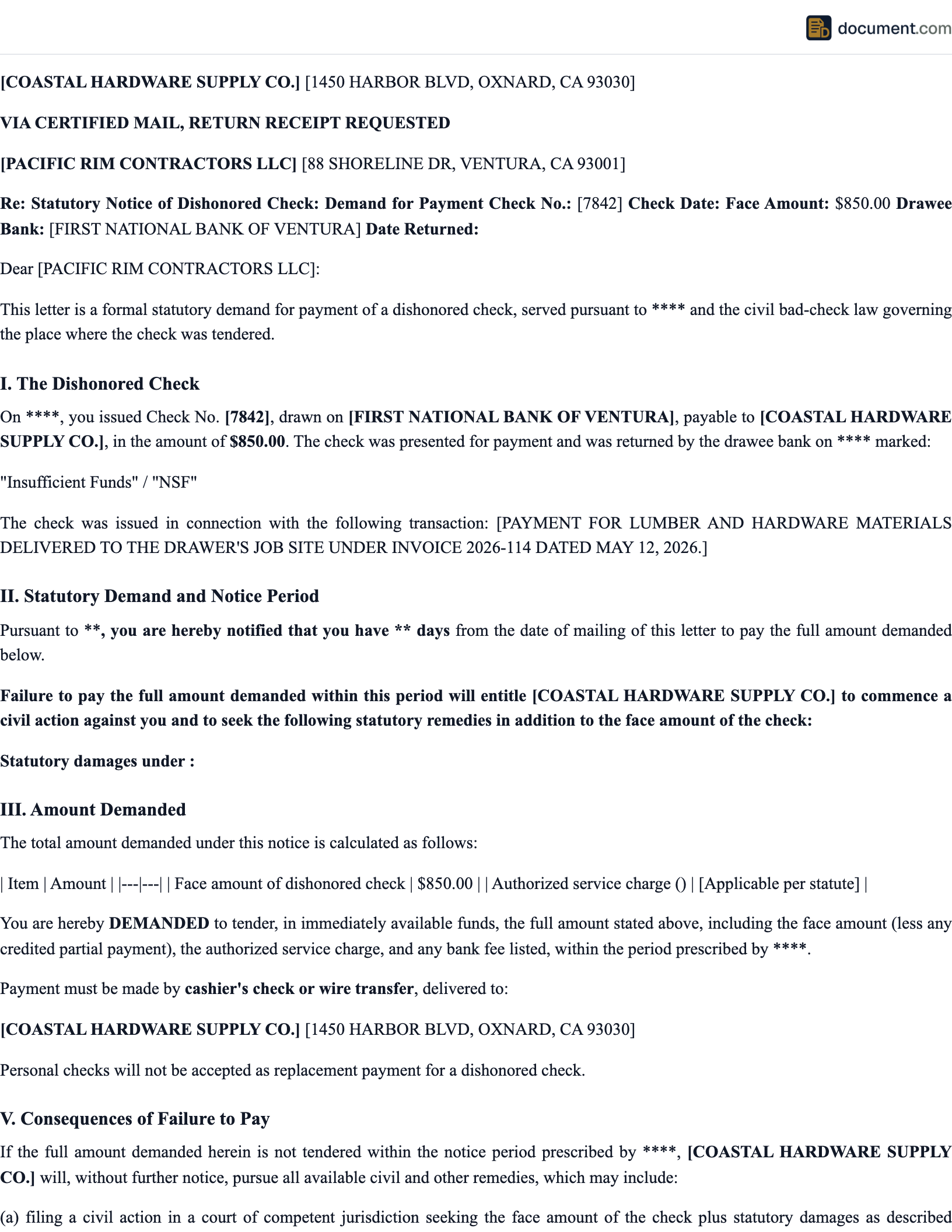
The notice should state the check number, the date of the check, the face amount, the name of the drawee bank, and the reason for dishonor as it appears on the bank's return notice. It should state the total amount the holder demands, including the authorized collection costs if the holder is claiming them. It should also state clearly that the drawer has thirty days from the date of the notice to pay in full, and that failure to do so may result in civil action for the face amount of the check plus civil penalties under N.D. Cent. Code § 6-08-16. Specifying the calendar deadline by date, not just by counting days, removes any ambiguity about when the window closes.
Count the thirty days from the date of mailing, not from the date of the bank's return. If the holder mails the notice on June 10, the period expires July 10, and suit may be filed on July 11 if nothing has been paid. Do not file before the thirty days run. A premature filing does not reset the clock; it can forfeit the civil penalty on the theory that the holder failed to comply with the statutory prerequisite. Retain the certified mail receipt, the tracking printout showing delivery (or the returned envelope if the mailing came back unclaimed), and a copy of the notice letter itself. Those three documents are the exhibits that establish compliance in small claims court.
North Dakota-Specific Notes
North Dakota small claims court handles claims up to $15,000, and the filing fee as of July 1, 2025, is $20. Nearly every dishonored-check case in North Dakota, even one combining the face amount with the civil penalty and collection costs, will fall within that ceiling. Small claims procedure in North Dakota is informal: the judge asks questions directly, formal rules of evidence are relaxed, and documentary proof, the check, the bank's dishonor notice, the demand letter, and the mailing receipt, will typically carry the case on its own. Holders should have all four documents organized and ready to present before the hearing date.
The 120-day criminal complaint deadline in § 6-08-16 is shorter than most holders expect. If a criminal referral is a realistic possibility, start counting from the date the bank returned the check, not from when the holder first noticed it in the mail or discovered the return online. The thirty-day civil demand period and the 120-day criminal filing window overlap substantially, which means a holder who waits sixty or seventy days before sending the civil notice may find the criminal track closing before the civil demand period even runs. Send the written demand promptly after receiving the bank's dishonor notice.
North Dakota does not appear to operate a statewide district attorney bad-check diversion program equivalent to the formalized programs found in urban Texas or California counties. In practice, referrals for criminal prosecution go through local county state's attorneys, and individual county offices handle bad-check complaints on a discretionary basis. A holder who wants to pursue the criminal route should contact the state's attorney's office in the county where the transaction occurred, present the written demand and proof of mailing, and ask whether the office accepts bad-check referrals directly from payees.
North Dakota Specific Note
§ 6-08-16 imposes a knowledge requirement on the criminal side: the drawer must have known at the time of issuance that the account lacked sufficient funds. On the civil side, the statute does not require the holder to prove fraudulent intent to collect the civil penalty; the dishonor and failure to pay after written demand are sufficient. However, if a drawer raises a good-faith dispute about the underlying transaction, whether goods were defective, services were not rendered, or there was an agreement to hold the check, that defense can complicate both the civil and criminal tracks. A disputed underlying transaction is a reason to consult an attorney before sending the demand letter in a form that could be read as an admission about the underlying debt.
North Dakota Bad Check FAQ
Other State Bad Check Laws
Each state sets its own notice period, damage formula, and service charge. Browse sibling state pages for the specific rules that apply to your situation, or return to the full 50-state guide.
Create your North Dakota Notice of Dishonored Check in minutes.
Answer a few questions and download a North Dakota-compliant bad check demand letter that cites N.D. Cent. Code § 6-08-16 and is ready to mail certified.